

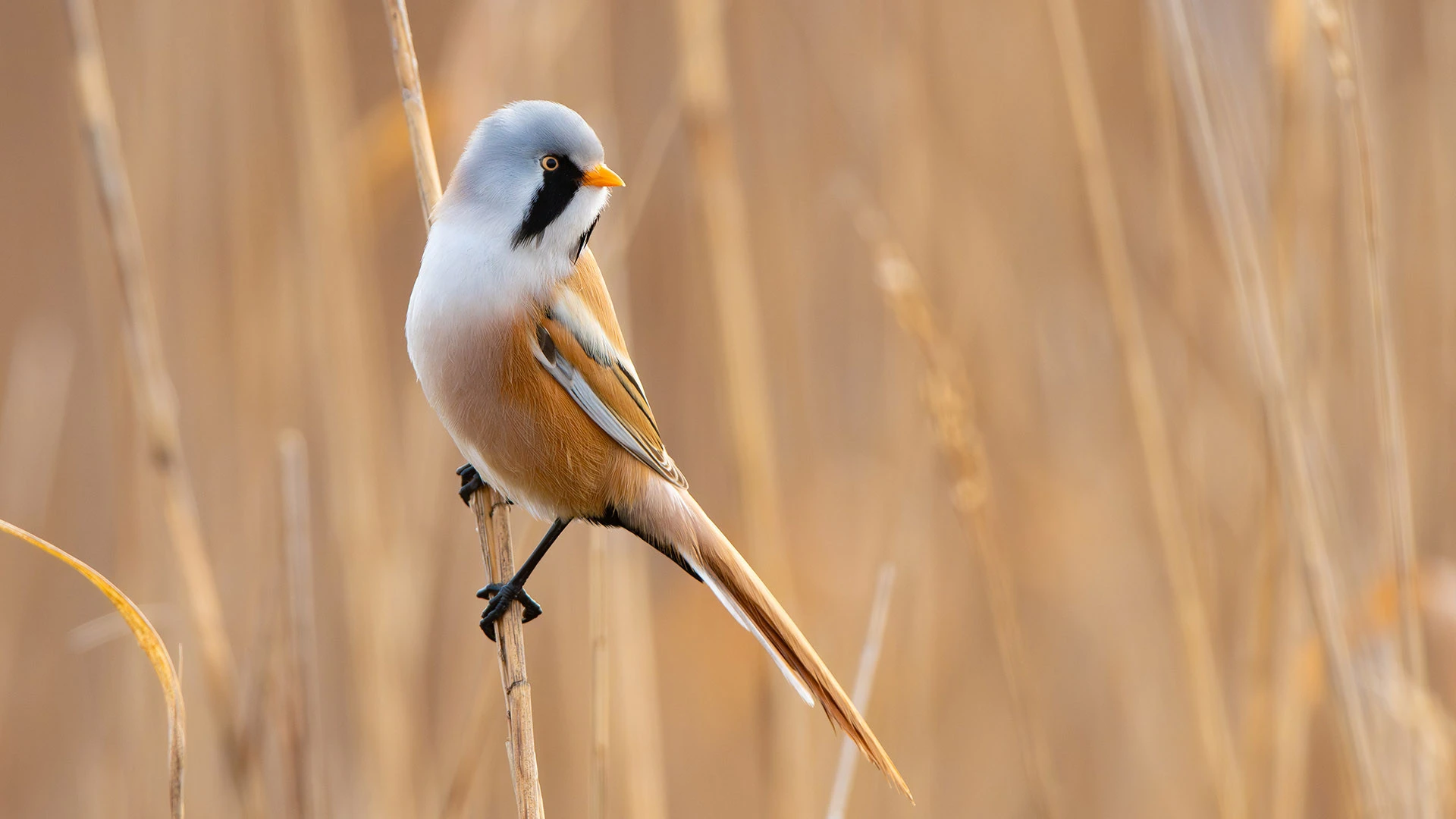
No. 249 on our checklistBearded Reedling (Panurus biarmicus)
A small long tailed bird of the reed beds, heard as a ringing “ping” long before it is seen.
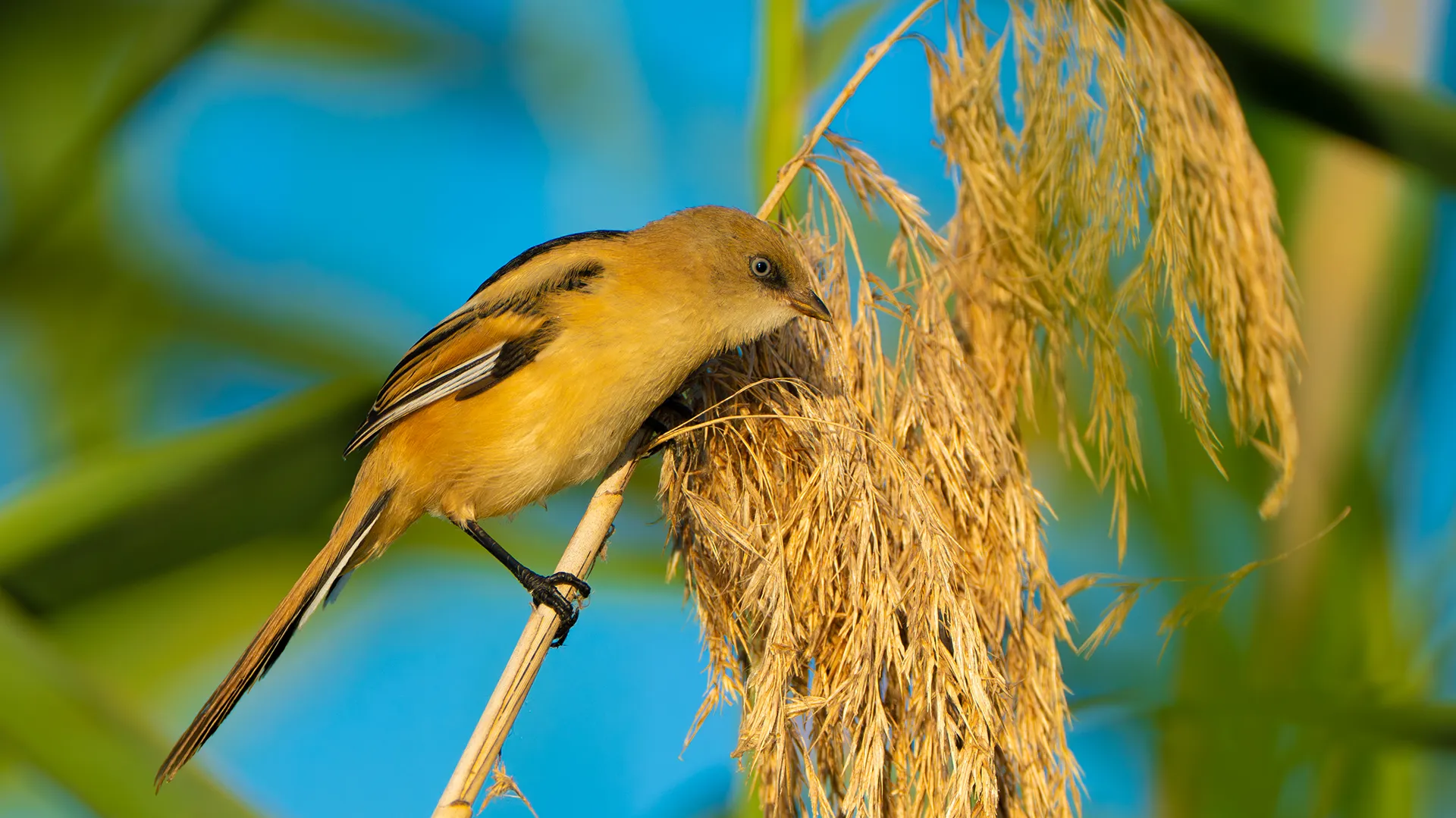
Long before you see it, you hear it: a clear, ringing “ping, ping” coming out of the reeds. Then a small flock of tawny birds with long tails whirrs low over the reed tops and drops out of sight again. If you are lucky, one climbs a stem and shows itself: the male with a blue grey head, an orange bill and a long black moustache. The Bearded Reedling lives its whole life in the reed beds of the Danube Delta, summer and winter.
Quick facts
- Scientific name Panurus biarmicus
- Family bearded reedling (Panuridae), the only species in its family
- Length 14 to 16 cm, half of it tail
- Wingspan 16 to 18 cm
- Weight about 12 to 18 g
- In the Danube Delta resident all year
When to see it in the Danube Delta and Dobrogea
- JanModerate
- FebModerate
- MarModerate
- AprModerate
- MayModerate
- JunModerate
- JulModerate
- AugModerate
- SepModerate
- OctModerate
- NovModerate
- DecModerate
- Status here
- All year.
- IUCN Red List
- Least Concern
- Our checklist
- No. 249 of 385 · see the full checklist
How to recognise it
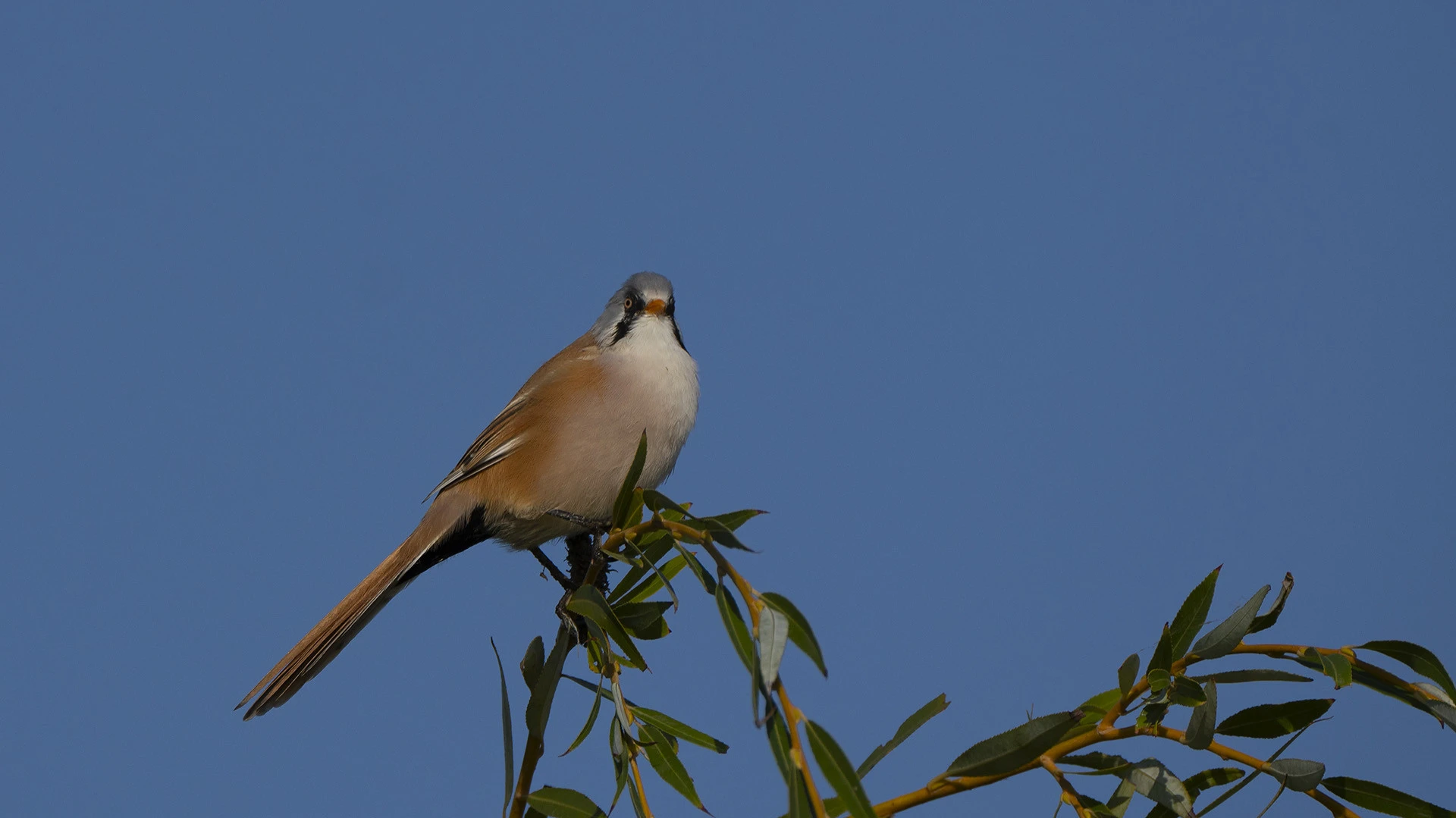
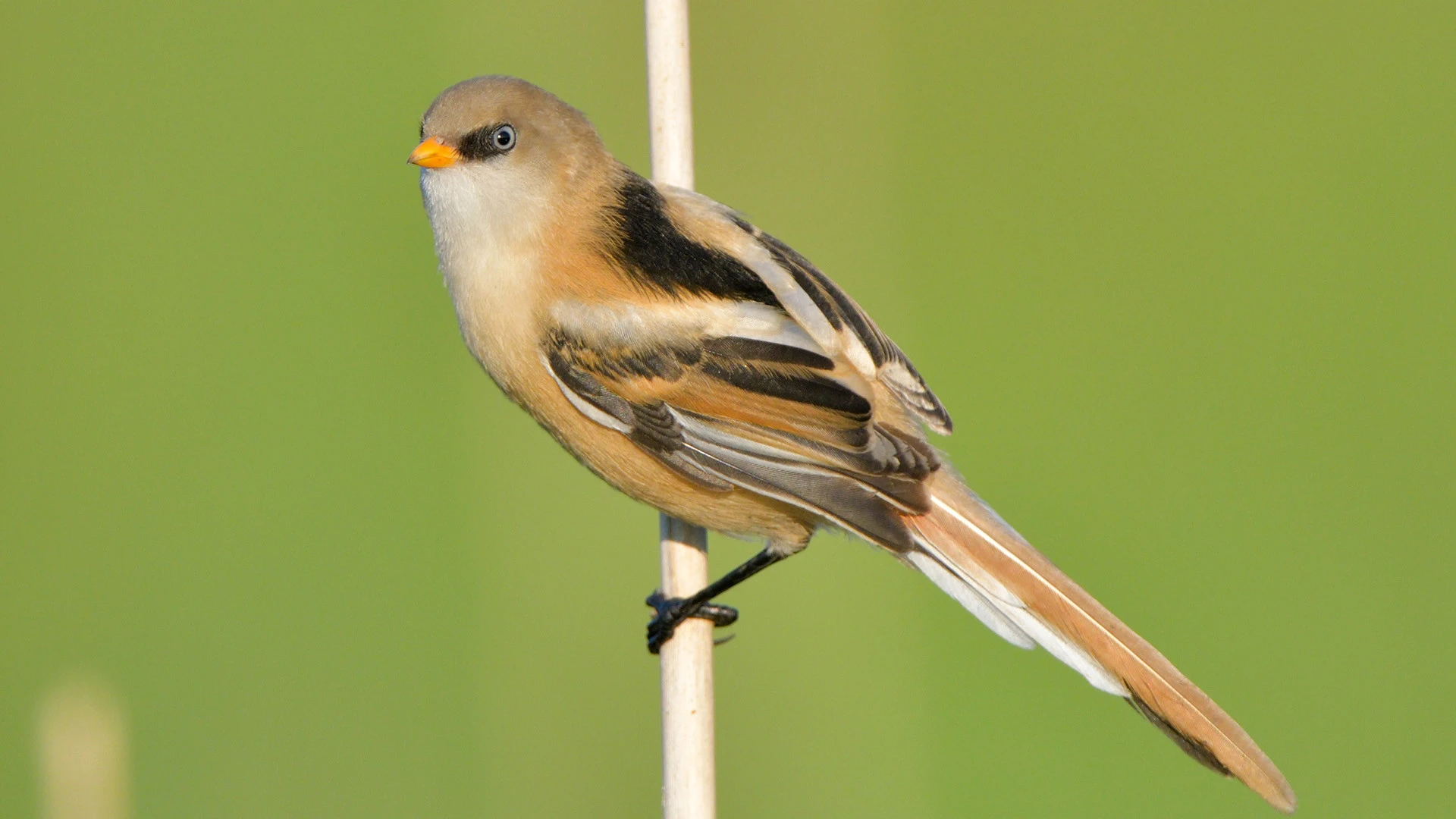
It is a small, round bodied bird with a very long, graduated tail, the colour of dry reeds: warm tawny cinnamon above and below. The male has a pale blue grey head, a yellow orange bill, a pale eye and a broad black moustache hanging down from the eye, and black under the tail. The female has a brownish head, no moustache and no black under the tail. Young birds have a dark back and, in the male, a dark area between bill and eye.
The best clue is the call, a metallic “ping” or “tching”, repeated by the whole flock. In flight it looks like a small ball with a long tail, whirring low over the reed tops.
Feeding and nesting
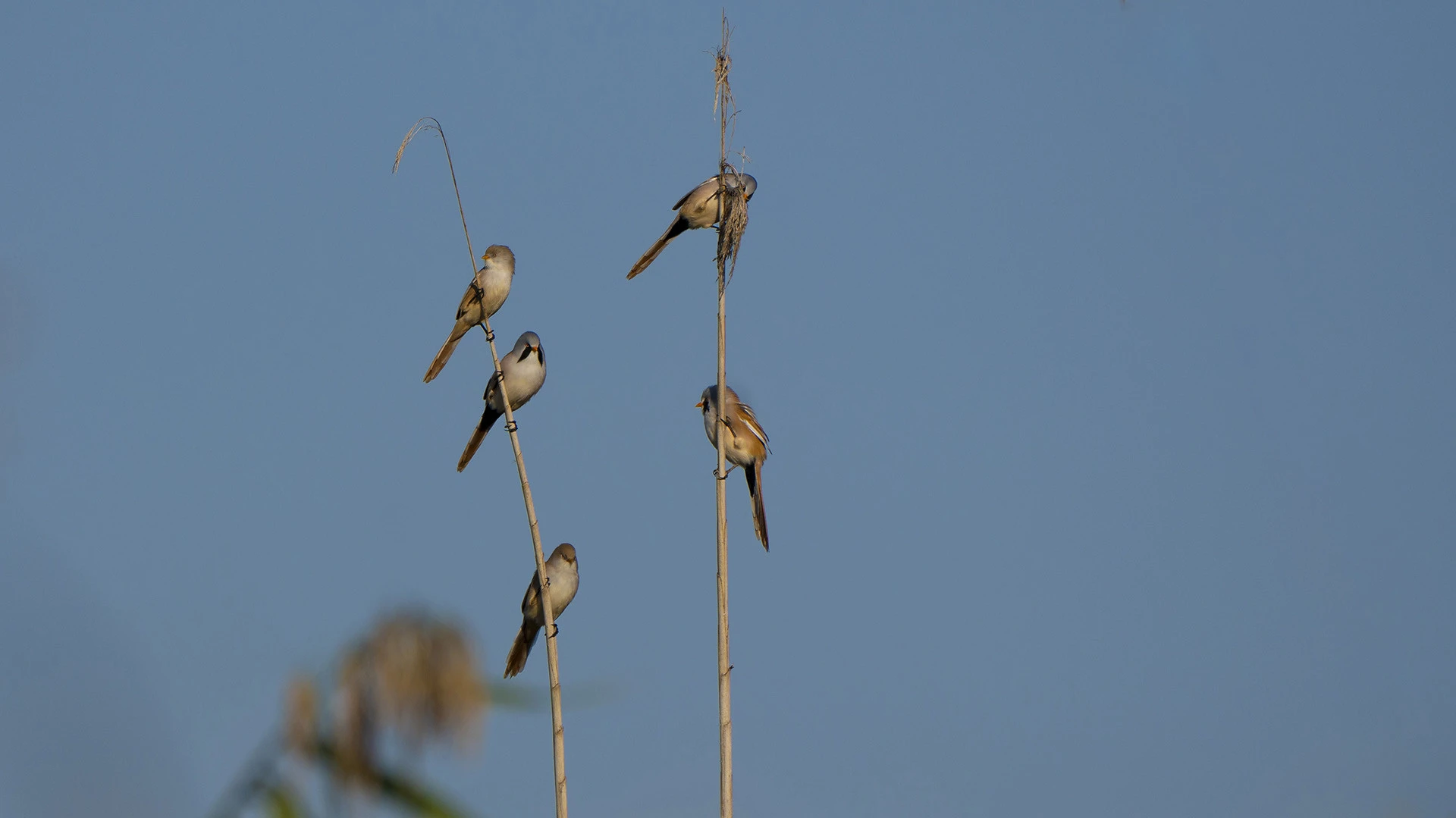
In spring and summer it eats insects, especially the caterpillars and small animals living in the reeds, and feeds them to its chicks. In autumn it changes its diet almost completely to reed seeds, which it picks from the plumes while hanging on a stem, often upside down, with one foot above the other. To grind the seeds, its stomach grows thicker and more muscular in winter, and the bird swallows small stones to help.
It nests low in the reeds, close to the water, in old broken stems or reed litter. The nest is a cup of reed leaves lined with the soft feathery tops of the reeds. The female lays usually five to seven eggs; both parents incubate them for about twelve days and feed the chicks, which leave the nest after about ten days. A pair can raise two or even three broods in a year.
Where to see it in the Danube Delta
Bearded Reedlings live in large reed beds all over the Danube Delta, along the channels and around the lakes, and they are here all year. Our checklist marks it moderate in every month. They are easiest to see on calm mornings in autumn and winter, when the reeds are dry and the family flocks move about noisily, and in early spring, when they climb to the top of the stems in the sun. On a windy day they stay hidden.
You can see and hear it on our 5 day birdwatching tour in the Danube Delta and photograph it on our 5 day wildlife photo tour, from a slow boat at the edge of the reeds.
Interesting facts
- Alone in its family. Once called the Bearded Tit, it is not a tit at all. It is the only species in its own family, Panuridae, with no close relatives.
- A summer stomach and a winter stomach. In winter, when it lives on reed seeds, its stomach becomes much more muscular, and in spring it changes back for a diet of insects.
- Engaged young. Young birds form pairs already in their first autumn, in the flocks, and stay together through the winter.
- Feet made for reeds. Its feet are ordinary songbird feet, three toes forward and one back, but strong enough to straddle two reed stems at once, one foot on each.
Status and threats
The Bearded Reedling lives in reed beds from western Europe across Asia to China and is listed as Least Concern by the IUCN. It needs large, old reed beds, with standing dry stems in winter. Hard winters with snow and ice on the reed seeds can kill many birds, but the species recovers quickly thanks to its large broods. Burning and cutting the reeds in winter take away its food and its nesting places.
For the Bearded Reedling the greatest danger is insecticides. In summer it raises its chicks only on insects, and in many villages of the Danube Delta mosquito sprays are used intensively, often without discernment and without any authorisation, killing far more than mosquitoes.
See it with us
Our birding guides are biologists and ornithologists who are on the water every day of the year. Small groups, open boats, the best hours of the day.
Keep reading
Keep reading
More from the blog

4 min read
Little Bittern (Botaurus minutus)
The smallest heron of the Danube Delta, so well hidden in the reeds that most visitors only see it flying low over the channel.

4 min read
Black-necked Grebe (Podiceps nigricollis)
Golden fans behind the eyes and red eyes: in spring, one of the most elegant water birds of the Danube Delta lakes.

5 min read
Pallas’s Gull (Ichthyaetus ichthyaetus)
The largest black headed gull in the world, nesting on the islands of the Danube Delta coast since 2009.