

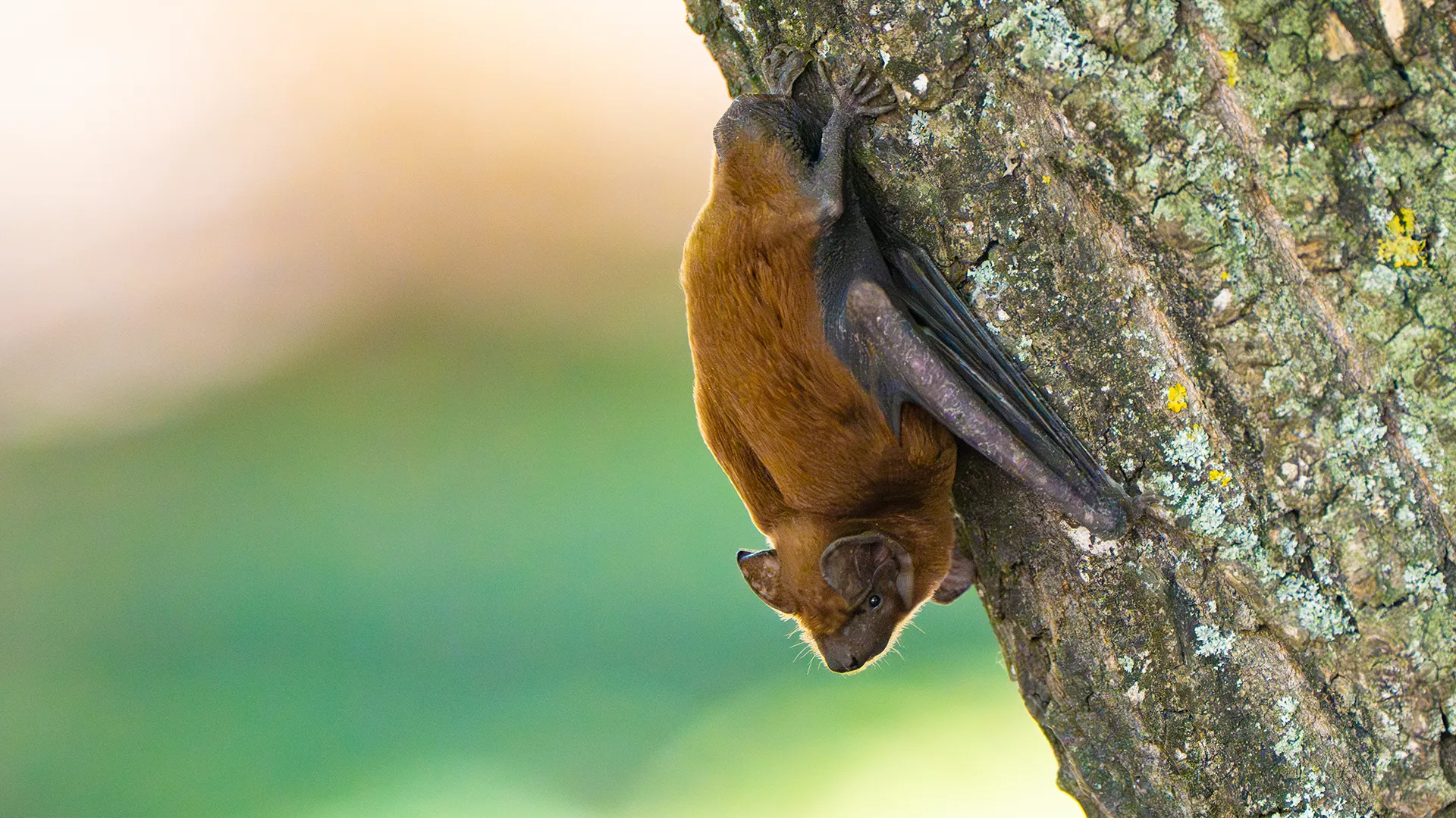
No. 13 on our checklistCommon Noctule (Nyctalus noctula)
Just after sunset, a large, fast-flying bat hunts high above the treetops and over the water of the Danube Delta: the common noctule, one of Europe's most powerful flying bats. Discover how to recognise it in flight, where it spends the day, and when you have the best chance of seeing it.
Just after sunset, when the sky above the Danube Delta is still holding the last light of the day, a large bat may appear high above the tree line. It flies fast and straight, with long, narrow wings, making sudden steep turns as it catches insects in the air. This is the common noctule, one of Europe’s largest and most powerful flying bats. Unlike the small bats that often flutter close to buildings and vegetation, the noctule is a hunter of open skies, often feeding well above the treetops and over water.
Quick facts
- Scientific name Nyctalus noctula (Schreber, 1774)
- Family evening bats (Vespertilionidae)
- Order bats (Chiroptera)
- Head and body length about 60 to 82 mm
- Wingspan approximately 320 to 450 mm
- Weight usually 18 to 40 g
- Activity mainly around sunset and before dawn
- Diet flying insects, especially beetles and moths
- Roosts mainly tree cavities, including old woodpecker holes
- In the Danube Delta recorded in Letea Forest, Maliuc–Gorgova and Crișan
- IUCN Red List Least Concern
Description
The common noctule is a relatively large bat, with a robust body, long narrow wings and a short, rounded head. Its fur is usually reddish-brown to chestnut, with a glossy appearance, while the underside is somewhat paler. The ears, muzzle and wing membranes are dark brown. Its wings are long and pointed, an adaptation for fast flight in open spaces.
With a wingspan that can reach around 45 cm, the noctule is considerably larger than many of the bats commonly seen around houses and gardens. Its flight is also distinctive: fast, direct and often high above the ground, interrupted by sudden steep dives as it pursues flying insects.
Unlike bats that hunt close to vegetation, the noctule often feeds in open air, above woodland edges, clearings, fields and water. Its powerful flight allows it to cover large areas while searching for prey, sometimes travelling more than 10 km between its roost and feeding grounds.
Habitat: a bat of trees and open skies
The common noctule is primarily associated with woodland, especially mature forests containing old trees with natural cavities. It uses tree holes as daytime shelters and maternity roosts, often selecting cavities originally excavated by woodpeckers. These hollows provide protection from weather and predators, as well as relatively stable conditions for resting and raising young.
Its feeding habitat is much more varied than its roosting habitat. Noctules hunt above forests, along woodland edges, over meadows and agricultural land, and around lakes and rivers. They may also forage in towns and cities, particularly where insects gather around street lights and suitable roosting places are available.
The Danube Delta offers a combination of these habitats. Mature trees in the Delta’s forests provide potential roosting sites, while the open spaces above lakes, channels, clearings and reed beds offer extensive feeding areas. The old trees of Letea Forest are particularly relevant because they provide the cavities that tree-dwelling bats need.
The common noctule in the Danube Delta
Although bats are an important part of the Delta’s mammal fauna, they have received less research attention than many of the larger and more visible species. Records from the region are relatively scattered, but they confirm that the common noctule has been present in several parts of the Delta for decades.
Following fieldwork carried out between 1990 and 1993, specimens of Nyctalus noctula were reported from Maliuc–Gorgova, where one individual was collected on 21 August 1992, and from Crișan, where another was collected on 24 August 1992. The observations were published in research on the biology of the genus Nyctalus.
A more detailed study of bats in Letea Forest was published in the Scientific Annals of the Danube Delta Institute in 2007. Fieldwork carried out between June and September 2006 identified 11 bat species in the forest. The common noctule and Leisler’s bat (Nyctalus leisleri) were reported among the most abundant species recorded during the study.
The researchers used mist nets and ultrasound detectors to identify bats in different habitats, including forest edges, clearings and open areas. Their work highlighted the importance of the forest and its surrounding landscape for bats, while also showing how much remains to be investigated about the Delta’s bat populations.
These records confirm the common noctule’s presence in the Danube Delta, but they should not be interpreted as a current population estimate. More recent, systematic monitoring would be needed to understand its numbers, seasonal movements and roosting sites in the region.
Flight and echolocation: hunting in the dark
Bats do not rely on eyesight alone to navigate and catch prey at night. The common noctule uses echolocation, producing high-frequency sounds and interpreting the echoes that return from objects around it. This allows it to detect insects, avoid obstacles and navigate in darkness.
Its echolocation calls are relatively loud and low in frequency compared with those of many smaller European bats. They can sometimes be detected by specialised bat detectors, which convert ultrasound into sounds that people can hear. The noctule’s characteristic calls may be heard as a series of regular, sharp pulses, although the exact sound depends on the detector and recording method.
The noctule is a fast aerial hunter. It usually catches insects while flying, often high above the ground or water. When it detects prey, it can make a sudden dive or turn, intercepting the insect with its mouth or wing membranes. It then consumes the prey in flight.
Its hunting activity is often concentrated around sunset and the first hours of darkness, with another period of activity before dawn. On warm evenings, several noctules may be seen flying over the same open area, following concentrations of insects.
Diet: a predator of flying insects
The common noctule is an insectivore. Its diet includes moths, beetles, flies, mayflies and other flying insects. The composition changes with the season and with the insects available in its feeding areas.
In spring, smaller insects such as midges and mayflies can be important prey. Later in the season, noctules also take larger insects, including cockchafers, dung beetles and moths. These insects are often abundant around woodland edges, wetlands and open water, making such habitats valuable feeding grounds.
By feeding on large numbers of insects, noctules are part of the natural system that helps regulate insect populations. Their activity is especially useful in landscapes where wetlands, forests and agricultural land meet, because these habitats support a wide variety of flying insects.
Reproduction: colonies in tree cavities
During spring, female noctules gather in maternity colonies, usually in tree cavities. These colonies provide a warm and protected environment in which the females give birth and raise their young. The number of bats in a roost can vary considerably, and the colony may move between several tree holes during the breeding season.
The young are usually born in June or July. A female generally gives birth to one pup, although twins are also recorded. Newborn bats are small and dependent on their mothers for warmth and milk. They remain in the roost while the females leave to forage, returning to nurse them.
The pups develop quickly. After a few weeks they begin to fly, and by around six weeks of age they can usually forage independently. During this period, the maternity colony is particularly sensitive to disturbance. If a tree cavity is damaged or the roost is disturbed, the consequences can be serious for the young bats.
Male noctules often spend the summer separately or in small groups. In late summer, males establish mating roosts, usually in tree cavities, and use calls and scent to attract females. Mating takes place in late summer and autumn, while fertilisation is delayed until after hibernation in many individuals.
Migration and winter survival
The common noctule is one of Europe’s migratory bat species. Some populations move between summer breeding areas in northeastern Europe and wintering areas farther south and southwest. Individual bats can travel hundreds of kilometres, and movements exceeding 1,000 km have been documented.
However, not all noctules migrate. Research across Central Europe has shown that the species has a partial and flexible migration pattern: some individuals travel long distances, while others remain close to their summer territories or move only relatively short distances. Females tend to migrate more frequently and over greater distances than males in some populations.
During winter, noctules use sheltered cavities where temperatures are more stable. These may include hollow trees, rock crevices, cracks in buildings and bridges, and other protected spaces. They enter periods of torpor or hibernation when conditions are cold and insect prey is scarce, reducing their energy requirements until warmer weather returns.
In the Danube Delta, the records from August and the research on the genus Nyctalus indicate that the area is relevant during the migration period. One study noted the use of abandoned woodpecker holes as preferred shelters by noctules between August and October. However, the precise migration routes and the proportion of local bats that migrate remain insufficiently documented.
Conservation and threats
The common noctule is listed as Least Concern on the IUCN Red List and remains widespread across much of Europe. Nevertheless, like all European bat species, it is protected under European wildlife legislation. Its conservation depends on maintaining suitable roosts, feeding habitats and safe movement routes.
The loss of old trees with cavities is one of the main concerns for tree-dwelling bats. Removing dead or hollow trees, intensive forestry and the loss of mature woodland can eliminate roosting places that may have been used for many years. Because noctules often return to traditional roosting areas, the loss of a single important tree can affect an entire colony.
Other pressures include the loss of insect-rich habitats, pesticide use, disturbance of roosts and collisions with wind turbines. Wind energy development can be a particular concern for migratory bats because turbines may be located along movement routes and in areas where bats gather to feed.
In the Danube Delta, protecting mature trees and woodland edges is especially important. The old forests and tree lines are not only part of the landscape’s character; they also provide shelter for bats and other wildlife. Maintaining these habitats helps preserve the ecological connections between forests, wetlands and open water.
Interesting facts
- One of Europe’s larger bats. With a wingspan that can reach around 45 cm, the common noctule is much larger than many of the small bats often seen around buildings.
- It flies high and fast. Unlike bats that hunt close to vegetation, noctules often feed in open air above treetops, fields and water.
- It uses old woodpecker holes. Tree cavities created by woodpeckers are among its preferred summer roosts.
- It is a long-distance traveller. Some individuals migrate more than 1,000 km between summer and winter areas, although many remain much closer to their breeding grounds.
- It can be heard with the right equipment. Its echolocation calls are ultrasonic, but a bat detector can make them audible to human ears.
- It catches insects in flight. The noctule usually captures and eats its prey while flying, without needing to land.
When and where to see the common noctule in the Danube Delta
The common noctule is most likely to be observed around sunset and during the first hours of darkness, when it leaves its roosts to hunt. Look above the tree canopy, along forest edges and over open water, where its fast, direct flight may be easier to distinguish from that of smaller bat species.
Letea Forest is a particularly interesting area because research has confirmed the presence of the species there. The combination of mature trees, woodland edges and open feeding areas provides suitable conditions for noctules. The wider landscapes around lakes and channels may also offer good feeding opportunities, especially where flying insects are abundant.
Identifying a bat in flight is not always easy. The noctule’s relatively large size, fast flight and tendency to fly high above the ground are useful clues, but several other species can look similar in poor light. A bat detector and experience with bat calls are often needed for a reliable identification.
Any observation should be made without disturbing roosts. Bats are protected wild mammals, and tree cavities or buildings used as shelters should never be opened, blocked or damaged. Watching them emerge and hunt at dusk is a much better way to appreciate these remarkable animals.
The common noctule is rarely the main attraction for visitors to the Delta, but it is an important part of the region’s nocturnal wildlife. Its presence reminds us that the forests and open skies above the wetlands are just as alive as the water and reed beds below. Browse more species in our guide to the mammals of the Danube Delta and Dobrogea.
See it with us
Slow open boats, small groups and a guide who knows the places and the wildlife. From a few hours on the water to a week in the Danube Delta and Dobrogea.
Keep reading
Keep reading
More from the blog
10 min read
Coypu (Myocastor coypus) – A Newcomer to the Danube Delta?
The coypu (Myocastor coypus), also known as nutria, is a large semi-aquatic rodent native to South America. Introduced to Europe for its valuable fur...

7 min read
Eurasian Otter (Lutra lutra): the Fisherman of the Danube Delta Channels
The Eurasian otter, the fisherman of the Danube Delta: how it lives in the channels, its long history beside people on the Lower Danube,...

3 min read
The Free Horses of the Danube Delta: the True Story of the Letea Horses
They look wild and live free among the dunes and oaks of Letea, but their story is different: the true story of the horses...