


No. 202 on our checklistWhite-tailed Eagle (Haliaeetus albicilla)
The White-tailed Eagle is the largest bird of prey in Romania. How to identify it, its American cousin the Bald Eagle, the unique DNA of the Danube Delta eagles and where to see it.
A White-tailed Eagle lifting off a dead willow on a lake shore, wings as broad as a door and its white tail shining in the sun, is one of those moments you never forget from a trip to the Danube Delta. It is the largest bird of prey in Romania and one of the largest eagles in the world.
Quick facts
Quick facts
- Scientific name Haliaeetus albicilla (Linnaeus, 1758)
- Family Accipitridae (eagles, hawks and buzzards)
- Length 80-90 cm
- Wingspan 220 cm
- Weight 4.3-5.5 kg, females larger than males
- Average lifespan 20-25 years
- In the Danube Delta present all year; it breeds here, and many more arrive from the north in winter
When to see it in the Danube Delta and Dobrogea
- JanAbundant
- FebAbundant
- MarAbundant
- AprAbundant
- MayAbundant
- JunAbundant
- JulAbundant
- AugAbundant
- SepAbundant
- OctAbundant
- NovAbundant
- DecAbundant
- Status here
- All year, winter visitor. Local population in the Danube Delta + wintering from north.
- IUCN Red List
- Least Concern
- Our checklist
- No. 202 of 385 · see the full checklist
Identification
The adult is brown, with a paler, buff head and neck, a massive yellow bill and a short, wedge-shaped, pure white tail. In flight it shows very broad, rectangular wings with well spread “fingers” and a prominent head, which earned it the nickname “the flying barn door”. Juveniles are dark brown and mottled, with a dark bill and a dark tail with paler centres. The adult plumage, with the white tail, only appears after the age of five.
Diet
The White-tailed Eagle feeds on large fish, which it snatches from the surface in a shallow glide, and on waterbirds, especially coots and ducks, which it tires out by attacking again and again until they can no longer dive. It also eats carrion and often steals prey from other birds, from cormorants to other raptors. In winter it gathers around unfrozen water, where fish and weakened birds are easier to find.
Nest and young
Pairs stay together for life and use the same nest for years, adding branches every season, so an old nest can reach two metres across and weigh hundreds of kilograms. In the Danube Delta it nests in old trees, willows and poplars, in quiet places. The female lays one to three eggs at the end of winter, incubated by both parents for about 38 days. The young fly at 70-90 days and stay near their parents for several more weeks.
Its American cousin
The closest relative of the White-tailed Eagle is the Bald Eagle, the national bird of the United States. The two are sister species, descended from a common ancestor that lived around the North Pole. Genetic studies estimate that their lineages split more than a million years ago, when the populations of Eurasia and North America became isolated from each other.
The link between the continents was Beringia, a land bridge between Siberia and Alaska that appeared and disappeared with the ice ages, as sea levels fell and rose. Since then the two species have evolved separately: the adult White-tailed Eagle has only a white tail, while the Bald Eagle has both a white head and a white tail. In size, shape and way of life, however, they are remarkably similar. White-tailed Eagles still breed in Greenland, close to North America, yet the two have remained distinct species.
The Danube Delta eagles have their own DNA
A genetic study published in August 2026 by a team of Romanian researchers (Ciorpac and colleagues, in the journal Genes) analysed mitochondrial DNA from the feathers of White-tailed Eagles breeding in the Danube Delta Biosphere Reserve. The data were compared with samples from across Europe and Asia, 480 in total. The result: 47 genetic variants (haplotypes), 11 of which were found only in the Danube Delta eagles.
For the researchers, these unique variants show that the lower Danube population has survived here for a very long time and diversified locally. Today’s Danube Delta eagles most likely come from the recovery of the local population after the declines of the last century, not from birds that recently moved in from elsewhere in Europe. The study supports the idea that the Danube Delta acted as a refuge and a centre of diversification for the species in southeastern Europe, a reservoir of genetic diversity for the White-tailed Eagle as a whole.
Where and when to see it in the Danube Delta
You can see it all year, perched on dead willows along the lake shores or soaring high above the reeds. In winter, when eagles from northern Europe arrive, your chances rise a lot: on unfrozen water you often see several at once, adults and juveniles, around flocks of ducks and geese. You can see it on our day trips and birdwatching tours, and in winter on our private winter birding day trip.
Interesting facts
- The comeback. In the 1970s and 1980s, Romania’s White-tailed Eagles were decimated by poisons used against so-called “pests” and by hunting. Thanks to protection they have returned, and the Danube Delta is one of their most important strongholds in the country.
- Giant nests. A nest used by the same pair for decades can become so heavy that it breaks the branch it sits on.
- A pirate of the air. It often steals fish caught by other birds, chasing them until they drop it.
- A white tail after five years. The age of a White-tailed Eagle can be estimated quite well from how much white is in its tail and from the colour of its bill.
Status and threats
The White-tailed Eagle ranges from Greenland and northern Europe to Japan and is listed as Least Concern (LC) by the IUCN, after a strong recovery in recent decades. It is strictly protected in the European Union. Threats include poisoning, lead swallowed with shot birds and carcasses, power lines, wind turbines and disturbance near the nest.
See all the species in our bird list of the Danube Delta and Dobrogea.
See it with us
Our birding guides are biologists and ornithologists who are on the water every day of the year. Small groups, open boats, the best hours of the day.
Keep reading
Keep reading
More from the blog
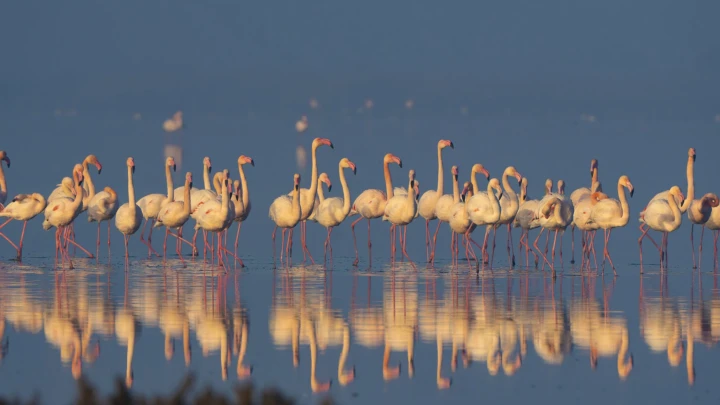
5 min read
Greater Flamingo (Phoenicopterus roseus)
Once only a rare visitor, the flamingo now appears more and more often in the salty lagoons of the Danube Delta and Dobrogea.
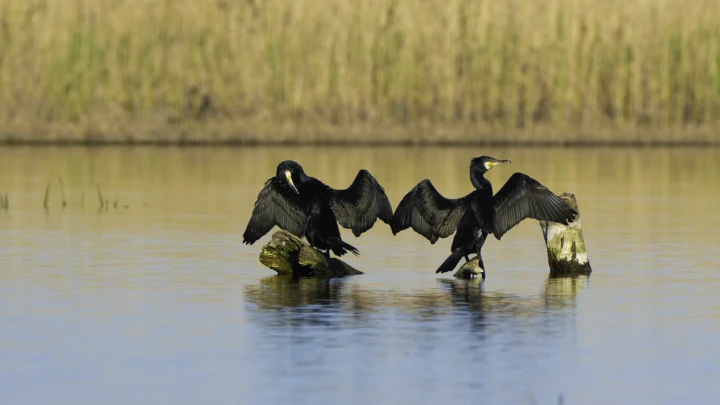
4 min read
Great Cormorant (Phalacrocorax carbo)
The Great Cormorant, the underwater fisherman of the Danube Delta: identification, how it hunts and dries its wings, colonies and where to see it.
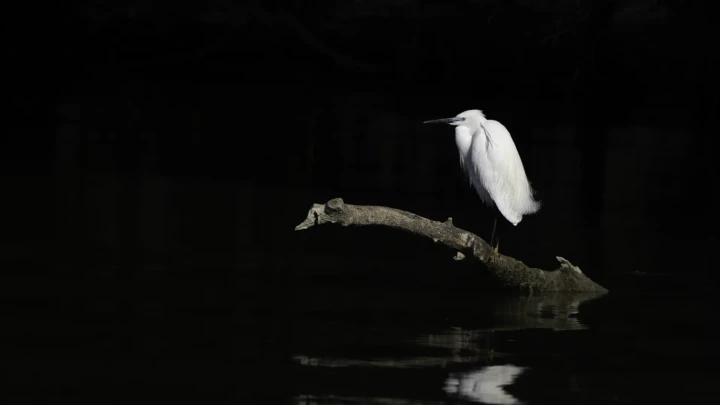
3 min read
Little Egret (Egretta garzetta)
The Little Egret, the snow white heron with yellow feet: identification, its active hunting, the plume trade that nearly wiped it out and where...