

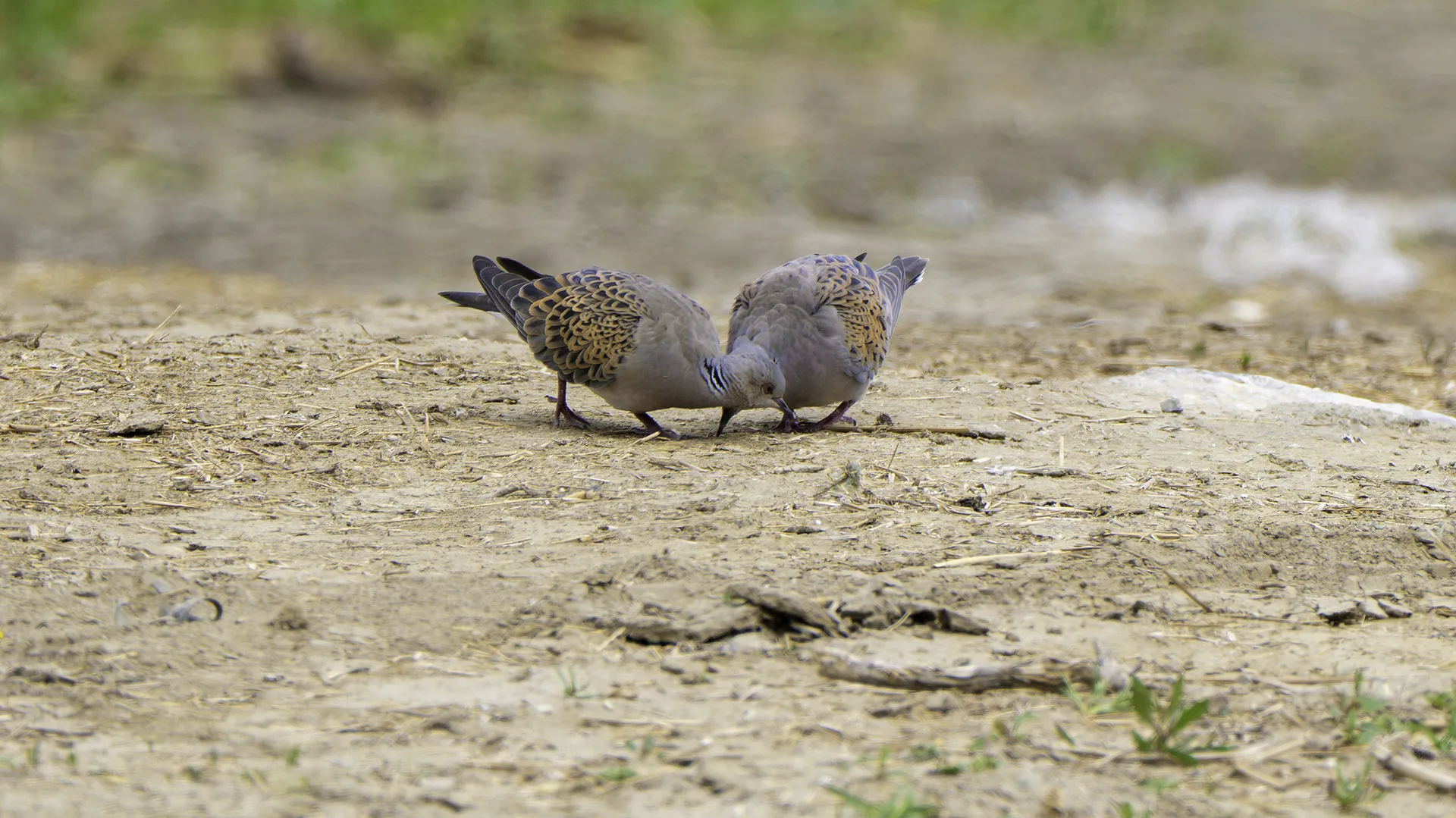
No. 54 on our checklistEuropean Turtle Dove (Streptopelia turtur)
Scaled chestnut wings and a soft purring song distinguish this summer migrant. The European Turtle Dove breeds in the region and is globally Vulnerable.
The European Turtle Dove (Streptopelia turtur) is a migratory dove with warm, patterned wings and a soft purring song. In the Danube Delta and Dobrogea, the checklist records it from April to September and lists it as a summer breeder.
Linnaeus originally described it as Columba turtur in 1758.
Quick facts
Quick facts
- Scientific name Streptopelia turtur (Linnaeus, 1758)
- Common name European Turtle Dove
- Family Columbidae
- Order Columbiformes
- Weight about 157 g
- Diet mainly seeds taken on the ground, including those of wild plants and cereals
- Habitat hedgerows, thickets and open woodland with nearby seed-rich ground
- Breeding usually 2 eggs; both adults incubate for 14–16 days; young typically fledge at 18–19 days
- Conservation status Vulnerable globally; Least Concern as a breeding bird in Romania (2022)
When to see it in the Danube Delta and Dobrogea
- JanNot normally recorded
- FebNot normally recorded
- MarNot normally recorded
- AprPresent
- MayPresent
- JunScarce
- JulScarce
- AugScarce
- SepPresent
- OctNot normally recorded
- NovNot normally recorded
- DecNot normally recorded
- Status here
- Summer breeder, recorded from April to September; less frequent from June to August in the local checklist.
- IUCN Red List
- Vulnerable
- Our checklist
- No. 54 of 385 · see the full checklist
How to recognize it
In adults, the black-and-white patch on the side of the neck contrasts with the chestnut-toned, scaled wing coverts. The song is a low repeated purr, quite different from the familiar call of the Eurasian Collared Dove. Listening along woodland edges or hedgerows can reveal a bird hidden by foliage.
Dense cover and open feeding ground
Turtle doves need both places to nest and places to feed. Dense hedges and thickets provide nesting cover, while accessible wild seeds on open ground provide food. A site with plenty of shrubs is not necessarily good feeding habitat if the ground nearby offers few seeds.
A migrant with different trends across its range
The species winters in Africa south of the Sahara. BirdLife identifies the loss of feeding and nesting habitat, disease and hunting along migration routes among the factors behind declines. An increase reported for one country over a given period does not cancel a decline assessed across the wider range.
Interesting facts
- The song is a purr. Its low repeated notes carry from cover even when the singer is hidden.
- It feeds mainly on the ground. Seeds are an important part of the diet.
- Two eggs make a typical clutch. Both adults take turns incubating.
- The name dates to 1758. Linnaeus described it as Columba turtur before it was placed in Streptopelia.
Status and conservation
BirdLife assesses the European Turtle Dove as Vulnerable globally. Romania’s 2022 Red List assessed the national breeding population as Least Concern; it reports 120,000–300,000 pairs and an increasing short-term trend based on monitoring from 2010 to 2021. These assessments cover different geographic scales.
See it on our tours
On our multi-day Danube Delta discovery tours, listen near hedgerows and woodland edges during the April–September season. The purring song can be a better clue than a brief view through foliage.
See it with us
Our birding guides are biologists and ornithologists who are on the water every day of the year. Small groups, open boats, the best hours of the day.
Keep reading
Keep reading
More from the blog
4 min read
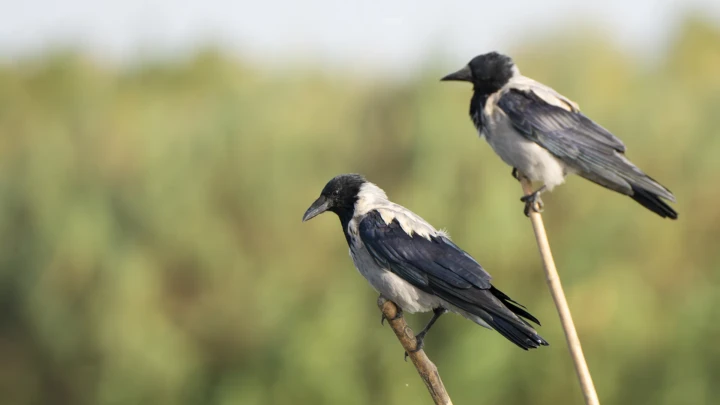
Hooded Crow (Corvus cornix)
Grey body, black hood and wings: the Hooded Crow is the common crow of the Danube Delta, a clever omnivore whose old nests have...

5 min read
Common Cuckoo (Cuculus canorus)
The Common Cuckoo in the Danube Delta: how to recognize it, how females trick reed warblers into raising their young, migration to Africa and...

6 min read
Red-breasted Goose (Branta ruficollis)
Most of the world population spends the winter on the western shore of the Black Sea, and about a third of it in Dobrogea....