

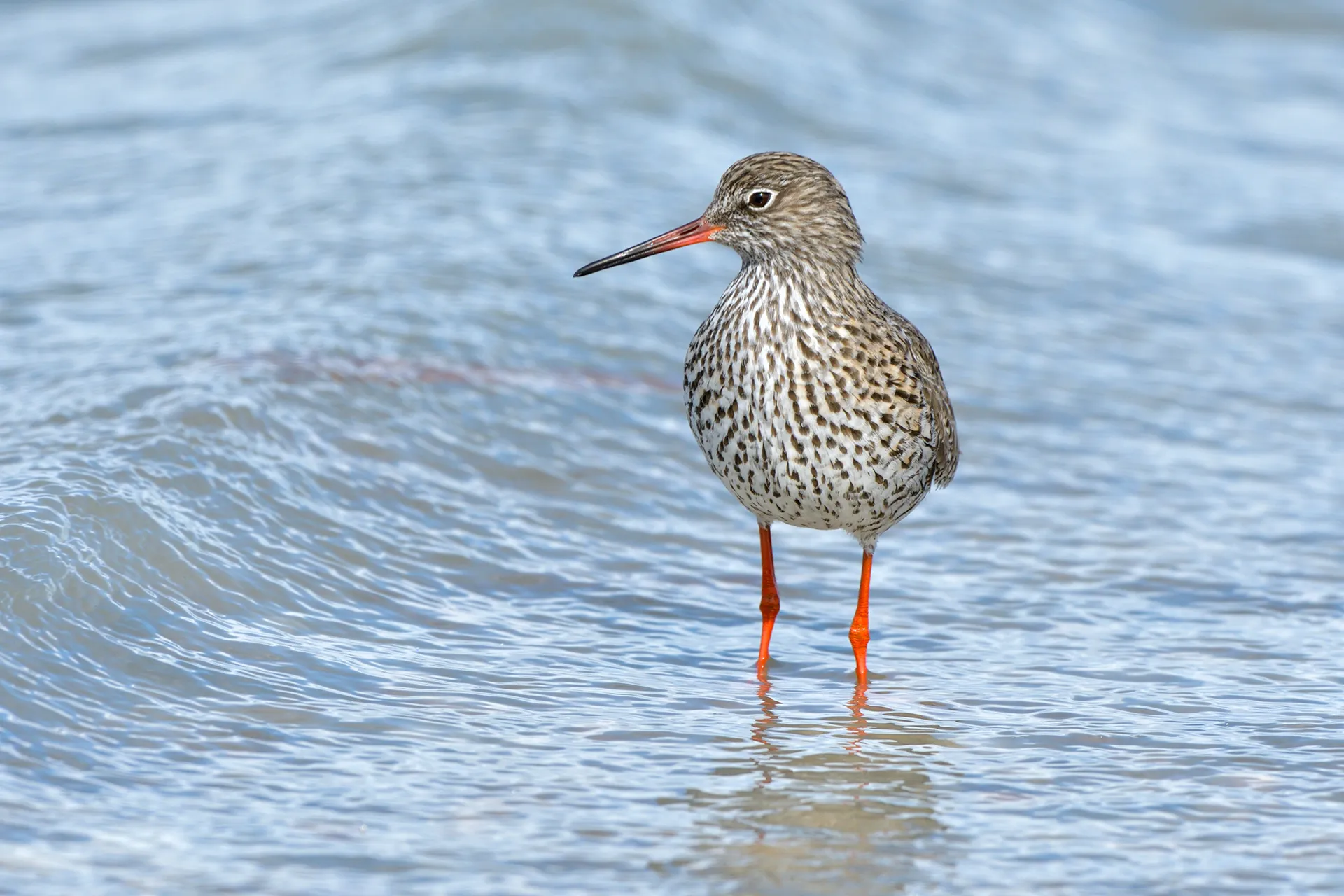
No. 102 on our checklistCommon Redshank (Tringa totanus)
Orange-red legs and a broad white wing edge identify Common Redshank, a rare breeder in the Danube Delta and Dobrogea.
The Common Redshank (Tringa totanus) is a wader with orange-red legs and a broad white trailing edge to the wing. The Danube Delta and Dobrogea checklist records it from February to October and describes it as a rare breeder.
Linnaeus originally described it as Scolopax totanus in 1758.
Quick facts
Quick facts
- Scientific name Tringa totanus (Linnaeus, 1758)
- Common name Common Redshank
- Family Scolopacidae
- Order Charadriiformes
- Weight about 153 g
- Diet invertebrates
- Habitat wet grassland, coastal marshes and other shallow wetland margins
- Breeding usually 4 eggs; both parents incubate for about 24 days; young typically fledge at 25–35 days
- Conservation status Least Concern globally; Romania (2022): Near Threatened as a breeding bird; passage population not evaluated
When to see it in the Danube Delta and Dobrogea
- JanNot normally recorded
- FebScarce
- MarPresent
- AprPresent
- MayScarce
- JunScarce
- JulPresent
- AugPresent
- SepPresent
- OctPresent
- NovNot normally recorded
- DecNot normally recorded
- Status here
- Rare breeder; recorded February–October, with more regular records in March–April and July–October.
- IUCN Red List
- Least Concern
- Our checklist
- No. 102 of 385 · see the full checklist
How to recognize it
The orange-red legs are conspicuous, but they are not enough to separate it from Spotted Redshank. In flight, look for the broad white trailing edge to the wing. Common Redshank also looks stockier than Spotted Redshank, which has a finer, longer bill.
Wet grassland, marshes and passage sites
Common Redshanks breed in habitats that include wet grassland and coastal marshes. Chicks find invertebrates in damper patches. The local checklist describes breeding as rare, although the species is more regularly recorded in spring and again from July to October. Those records should not be read as evidence of frequent local nesting.
Interesting facts
- Red legs are only the first clue. Spotted Redshank can also show red legs.
- The white wing edge is conspicuous in flight. Look across the trailing part of the wing rather than only at the rump.
- Both parents incubate. The typical clutch contains four eggs.
- The downy young can walk soon after leaving the nest. They find invertebrate prey in damp feeding patches.
Status and conservation
The Common Redshank is Least Concern globally. Romania’s 2022 Red List classifies its breeding population as Near Threatened and reports 200–2,000 breeding pairs with an unknown short-term trend. The passage population was not evaluated.
See it on our tours
On our multi-day photo tours in the Danube Delta and Dobrogea, scan shallow wetland margins from a distance. If a red-legged wader takes flight, check for the broad white trailing edge of the wings.
See it with us
Our birding guides are biologists and ornithologists who are on the water every day of the year. Small groups, open boats, the best hours of the day.
Keep reading
Keep reading
More from the blog

4 min read
Whiskered Tern (Chlidonias hybrida)
The tern of the water lilies: it nests on floating leaves and hunts low over the lakes of the Danube Delta all summer.
4 min read
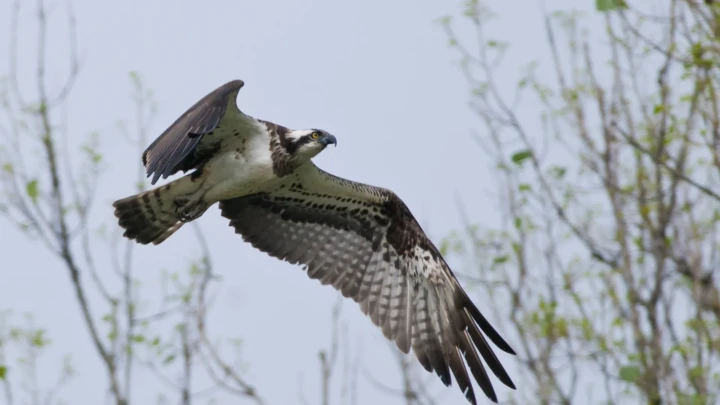
Osprey (Pandion haliaetus)
A fish-hunting raptor that dives feet-first into the water: when to see the Osprey on migration in the Danube Delta and Dobrogea, and why...
5 min read
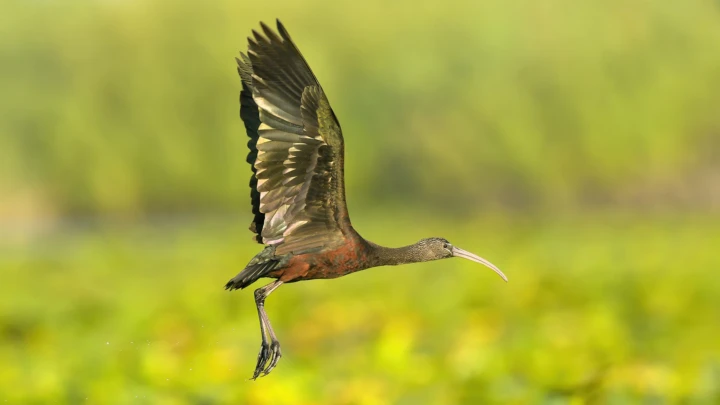
Glossy Ibis (Plegadis falcinellus)
Dark brown in the shade, green and bronze in the sun: the only ibis that breeds widely in Europe, and the Danube Delta is...