

Birdwatching: Discover the World of Birds
How to start birdwatching: binoculars, a field guide, a notebook and a camera, then the first trips to discover the birds of the Danube Delta and Dobrogea.
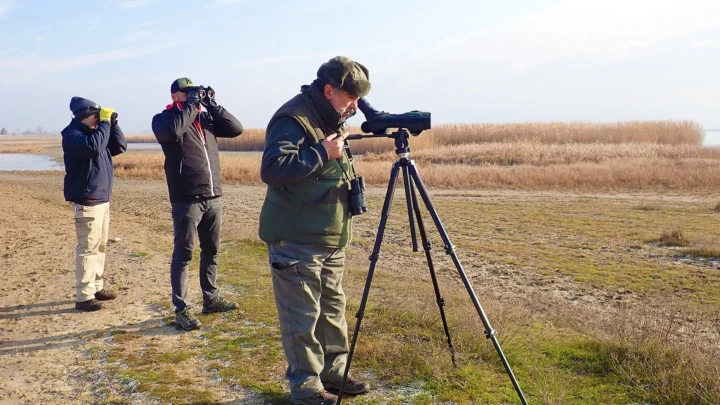
Birdwatching, or birding, is the pleasure of discovering the fascinating world of birds. Few things are better than spending your free time outdoors, noticing what happens around you and understanding what you see. There are thousands of bird species out there, just waiting to be discovered.
Birding means more than seeing birds. It means learning to identify the species, and in time their age and sex, and keeping notes of what you see. Soon those notes become your own database, a great help on your next outings, and you can share your records with birders at home and around the world through public databases such as eBird.
People once paid attention to everything around them: which birds and animals lived nearby and how they behaved. That is how they learned that rain is coming when swallows fly low over the water or the ground. Since the industrial revolution we have grown more attached to our machines and screens than to nature, and the planet carries the marks. It is time to look around again, to see that we are not the only ones living on Earth, and to understand the role and place of every creature in nature.
You do not have to be a scientist to watch birds. You need no special training: you do it for passion and pleasure, and you learn as you go.
Were you drawn to nature as a child? Did you watch birds and animals back then? Why not now?
Did you know that Romania has more than 400 bird species? Can you name 10 birds, leaving out the farmyard ones? How many species did you see the last time you walked in a park? Not sure? That is where birding begins.
Have you seen the film?
A famous film on the subject is The Big Year, based on the book by Mark Obmascik, The Big Year: A Tale of Man, Nature and Fowl Obsession. Watch it, and you will want to try.
How to start
First you need some basic optics: a pair of binoculars. The most popular models are 8×40 or 8×42. Ideally they are light, so you barely feel them after a full day around your neck. Decent binoculars now cost around 60-80 euros. Later you will want a spotting scope too, but that is a story for another article.
A field guide helps you identify the species you see correctly. Choose a printed guide to the birds of Europe, or a bird app on your phone; there are free and paid ones.
A notebook for your sightings is useful too, although today there are many apps for phones and tablets where you can keep lists, some of them with the GPS location of every sighting.
A camera is very helpful for checking the birds later. Rare species and subspecies can be very hard to identify without a photo, not to mention proving what you saw. How much you invest is up to you: high quality images, or simple record shots for identification.
Then you need information about the place you visit, so you know what to expect. The best birding spot is often the one closest to you, and you can have lovely surprises on your way home or to work. I know people who go birding every morning on their walk to work, through parks and green areas, with small binoculars and a camera. It is amazing how many species they see in a year.
Travelling to discover birds
The next step is travelling for birds. In Romania, the number one destination is clearly Dobrogea, including the Danube Delta. We have prepared a bird list of the Danube Delta and Dobrogea for you: study it and find out which birds you can see each month.
Any trip into nature can become a birding trip, as long as your attention goes to the birds. At first, until you have seen all the common species, any trip or stay in the Danube Delta can bring you 30 to 100 species that are new to you. Ask our guides for help: they all know the common species and are trained to spot them in the vegetation of the Danube Delta. Later, for the trickier species that are harder to identify, and to go deeper into the subject, you will want our specialist birdwatching guides. Until then, let us know if you find rarer species, and share your sightings, common ones included, on our Facebook page.
See our birdwatching tours.
You have started and seen your first 100 species. What comes next? Read How to Become a Better Birder, the second part of this article.
See it with us
Our birding guides are biologists and ornithologists who are on the water every day of the year. Small groups, open boats, the best hours of the day.
Keep reading
Keep reading
More from the blog

2 min read
Birds of Transylvania: Birding Around Brasov and Sibiu
Old forests, alpine ridges and hay meadows: the birds of Transylvania around Brasov and Sibiu, with a checklist of more than 275 species.

2 min read
Bird List of the Danube Delta and Dobrogea
The 385 birds of the Danube Delta and Dobrogea, month by month: what you can see on your dates, with names in five languages.
3 min read
How to Become a Better Birder
How to train your eye and ear for birds, keep a notebook, share your sightings and plan what comes after your first 100 species.