

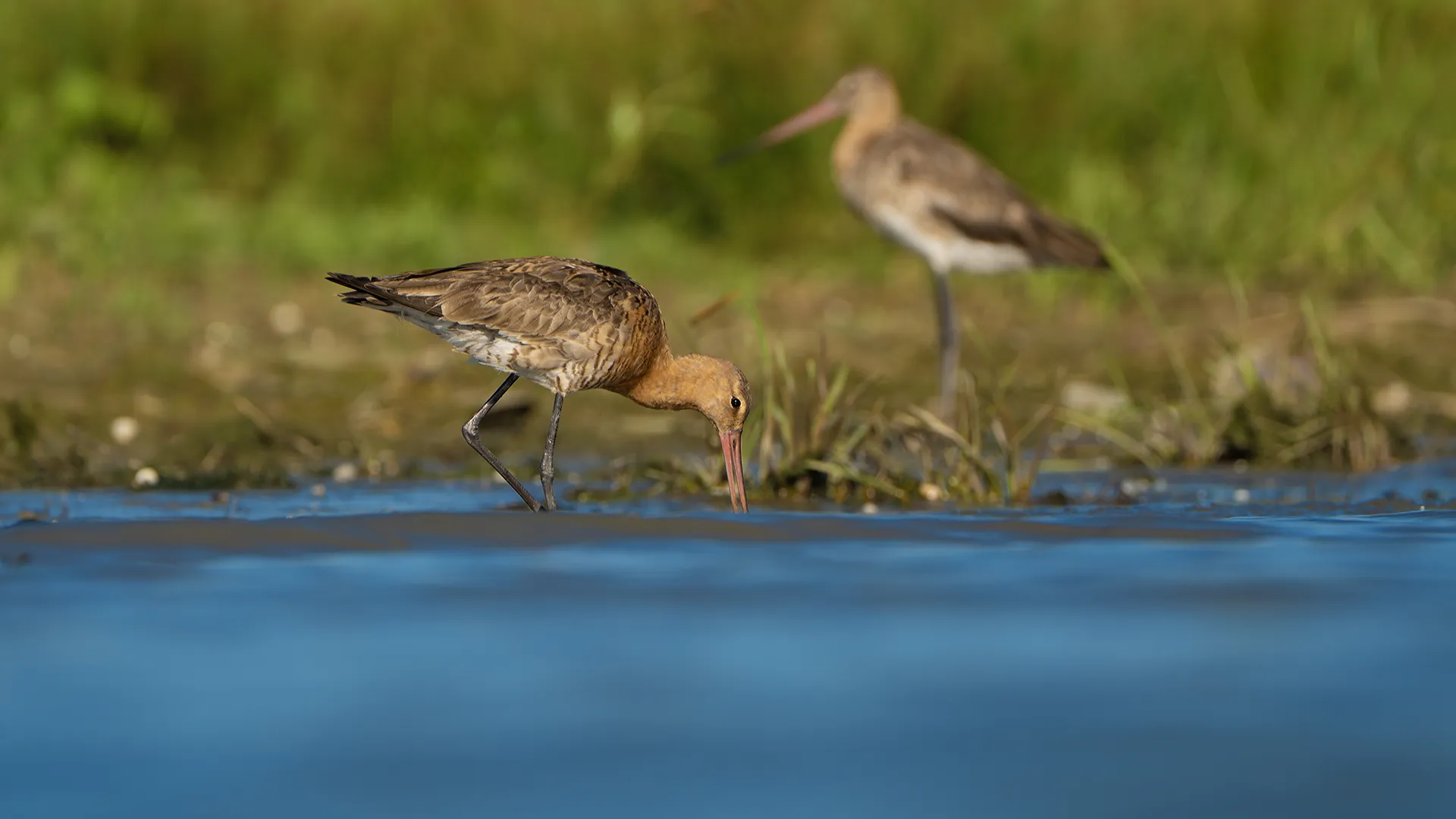
No. 90 on our checklistBlack-tailed Godwit (Limosa limosa)
A long-billed wader with a bold wing stripe. Black-tailed Godwit occurs on passage and is a very rare breeder in the Danube Delta region.
The Black-tailed Godwit (Limosa limosa) is a long-legged wader with a very long bill and a bold black-and-white wing pattern in flight. The Danube Delta and Dobrogea checklist records it from March to October and describes it as a very rare breeder.
Linnaeus originally described it as Scolopax limosa in 1758.
Quick facts
Quick facts
- Scientific name Limosa limosa (Linnaeus, 1758)
- Common name Black-tailed Godwit
- Family Scolopacidae
- Order Charadriiformes
- Weight about 299 g
- Diet worms, insects and other invertebrates; also some plant material, especially outside the breeding season
- Habitat wet grassland for breeding; shallow wetlands, muddy margins and lagoons outside the breeding season
- Breeding usually 4 eggs; both parents incubate for 22–24 days; young typically fledge at 25–30 days
- Conservation status Near Threatened globally; Romania (2022): Vulnerable as a breeding bird; passage population not evaluated
When to see it in the Danube Delta and Dobrogea
- JanNot normally recorded
- FebNot normally recorded
- MarScarce
- AprPresent
- MayPresent
- JunVery rare
- JulPresent
- AugPresent
- SepPresent
- OctScarce
- NovNot normally recorded
- DecNot normally recorded
- Status here
- Very rare breeder; recorded March–October, very rare in June.
- IUCN Red List
- Near Threatened
- Our checklist
- No. 90 of 385 · see the full checklist
How to recognize it
Look for long legs and a very long bill. Breeding birds can show orange-brown on the chest, while birds in non-breeding plumage are greyer. In flight, the broad white wing stripe and the contrast between the white base and black end of the tail help distinguish it from Bar-tailed Godwit.
Passage is not the same as breeding
Black-tailed Godwits use wet grassland and marshy sites for nesting and can gather on muddy shores and at shallow wetlands outside the breeding season. The local checklist shows more regular records in spring and late summer than in June. Sightings of feeding or resting birds do not by themselves indicate local nesting.
Interesting facts
- The tail is not entirely black. The dark end contrasts with the white base in flight.
- The white wing stripe is a useful clue. It can be easier to see than plumage colours when a flock takes off.
- Both parents incubate. A typical clutch contains four eggs.
- It does not eat only animals. Seeds and other plant material can form part of the diet outside the breeding season.
Status and conservation
The Black-tailed Godwit is Near Threatened globally. Romania’s 2022 Red List lists the breeding population as Vulnerable, with an estimated 10–100 breeding pairs and an unknown short-term trend. The passage population was not evaluated.
See it on our tours
On our multi-day photo tours in the Danube Delta and Dobrogea, scan shallow water and muddy margins in the passage season. If a flock takes flight, check for the bold white wing stripe and black tail band.
See it with us
Our birding guides are biologists and ornithologists who are on the water every day of the year. Small groups, open boats, the best hours of the day.
Keep reading
Keep reading
More from the blog
4 min read
Eurasian Sparrowhawk (Accipiter nisus)
A fast hunter of small birds that turns up in villages, reedbeds and woods: the Eurasian Sparrowhawk is common in the Danube Delta and...
3 min read
Little Bustard (Tetrax tetrax)
The Little Bustard, a rare steppe bird that once bred in Dobrogea: identification, its leaping courtship display, diet and where it still appears in...

4 min read
Isabelline Wheatear (Oenanthe isabellina)
A pale sandy wheatear that sings from the top of a mound and often nests in an old ground squirrel burrow.