

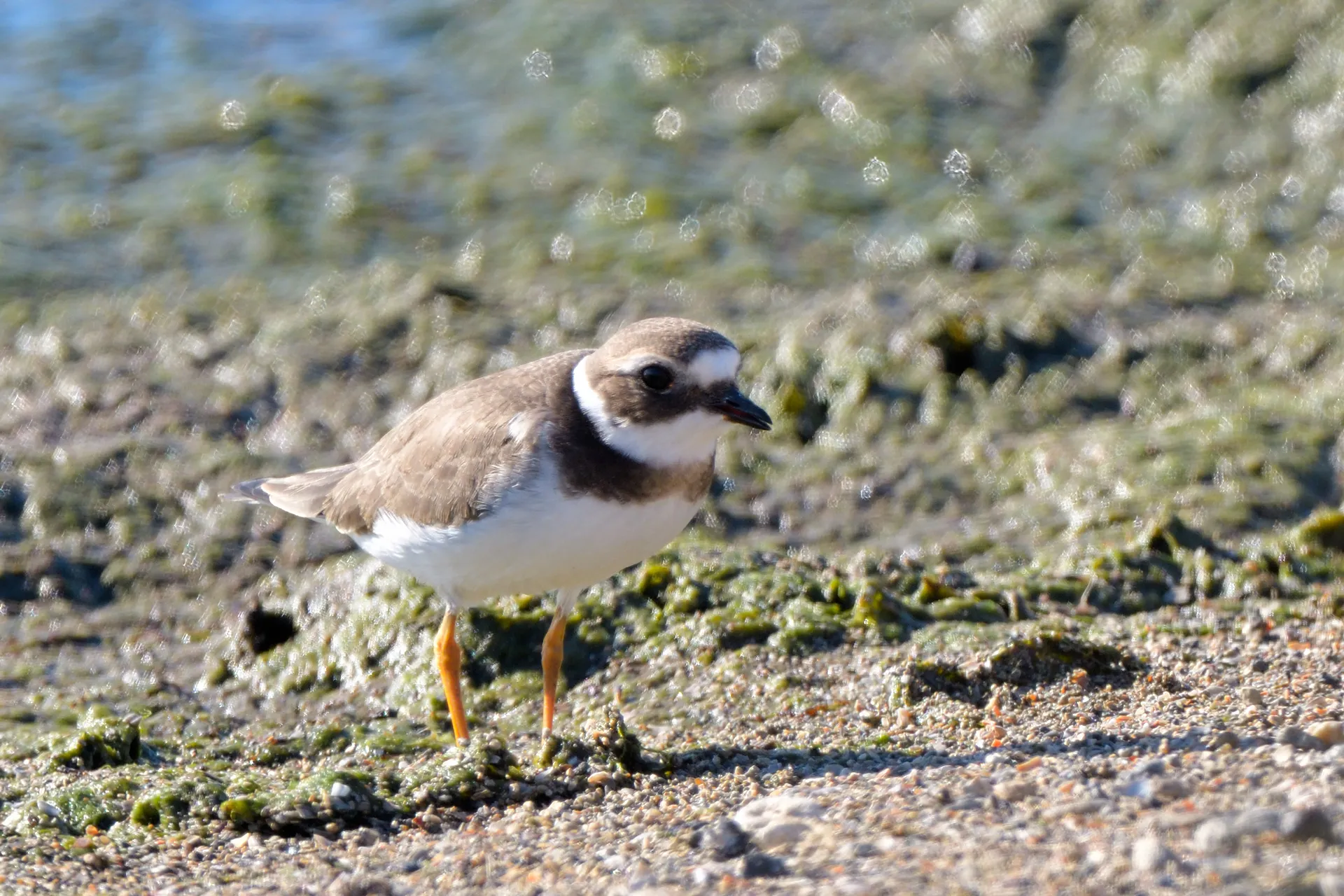
No. 78 on our checklistCommon Ringed Plover (Charadrius hiaticula)
Check the wing stripe and leg colour to identify this stocky shorebird, a spring and autumn passage migrant in the Danube Delta.
The Common Ringed Plover (Charadrius hiaticula) is a small, stocky shorebird with a dark breast band and orange legs in adult plumage. In the Danube Delta and Dobrogea the checklist records it on spring and autumn passage.
Quick facts
Quick facts
- Scientific name Charadrius hiaticula Linnaeus, 1758
- Common name Common Ringed Plover
- Family Charadriidae
- Order Charadriiformes
- Weight about 68 g
- Diet small invertebrates, including crustaceans, insects, molluscs and worms
- Habitat sandy, muddy or pebbly shores, lagoon margins and exposed banks on passage
- Breeding usually 4 eggs; both parents incubate for 23–25 days; young typically fledge at 23–25 days
- Conservation status Least Concern globally; Romania (2022): not listed in the 2022 Romanian national assessment under this scientific name
When to see it in the Danube Delta and Dobrogea
- JanNot normally recorded
- FebNot normally recorded
- MarScarce
- AprPresent
- MayPresent
- JunNot normally recorded
- JulNot normally recorded
- AugNot normally recorded
- SepPresent
- OctPresent
- NovScarce
- DecNot normally recorded
- Status here
- Passage migrant: March–May and September–November.
- IUCN Red List
- Least Concern
- Our checklist
- No. 78 of 385 · see the full checklist
How to recognize it
Look for a broad dark breast band, a black-and-white head pattern and orange legs on an adult. The breeding adult has an orange bill tipped with black; the colours can be duller outside the breeding season. In flight a conspicuous white wing stripe is a useful clue. The smaller Little Ringed Plover lacks that distinct stripe and shows a yellow eye-ring in a good view.
A shorebird on passage
The local checklist records Common Ringed Plovers in March to May and again in September to November, with April, May, September and October the more regular months. Look for birds on exposed shores and shallow wetland margins. The species breeds elsewhere on beaches and at some inland sites, but the local checklist treats it as a passage migrant, not a breeder.
Interesting facts
- The white wing stripe shows best in flight. It helps separate this species from Little Ringed Plover.
- The nest can be a simple scrape. On a shingle beach the speckled eggs blend with the pebbles.
- A parent can feign injury. A broken-wing display can draw attention away from the chicks.
- The original scientific name is unchanged. Linnaeus described it as Charadrius hiaticula in 1758.
Status and conservation
The Common Ringed Plover is Least Concern globally. It is not listed under Charadrius hiaticula in Romania’s 2022 national bird Red List; no Romanian category is assigned here. The regional checklist records it on passage.
See it on our tours
On our multi-day photo tours in the Danube Delta and Dobrogea, scan exposed shores during spring or autumn passage. Keep enough distance for feeding birds to stay on the shore.
See it with us
Our birding guides are biologists and ornithologists who are on the water every day of the year. Small groups, open boats, the best hours of the day.
Keep reading
Keep reading
More from the blog

4 min read
White-winged Tern (Chlidonias leucopterus)
Jet black body and white wings in spring: the most striking of the marsh terns over the lakes of the Danube Delta.
4 min read
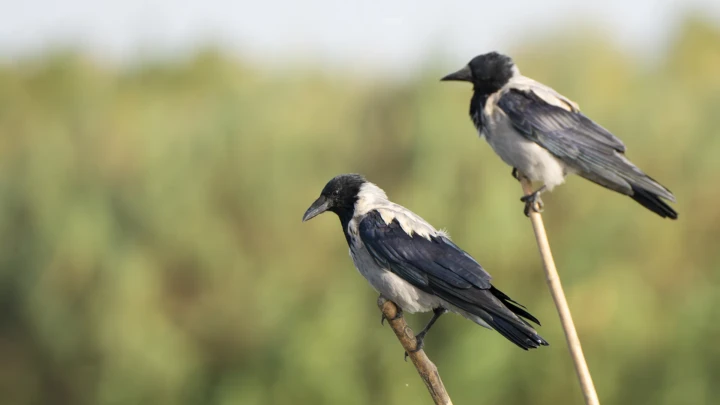
Hooded Crow (Corvus cornix)
Grey body, black hood and wings: the Hooded Crow is the common crow of the Danube Delta, a clever omnivore whose old nests have...
5 min read
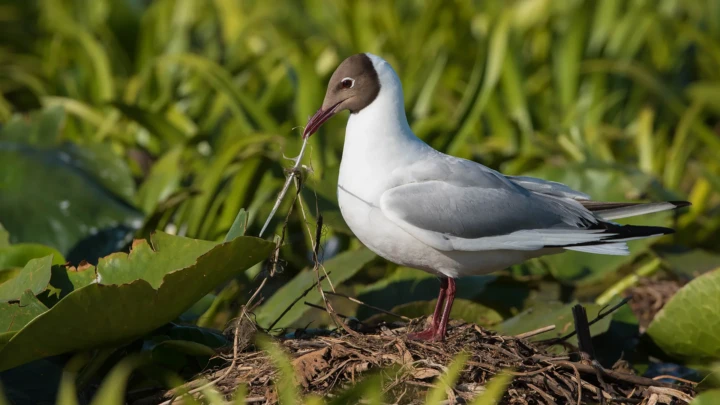
Black-headed Gull (Chroicocephalus ridibundus)
Brown hood in summer, white head in winter: the Black-headed Gull in the Danube Delta and Dobrogea, its colonies, behaviour and old name Larus...