

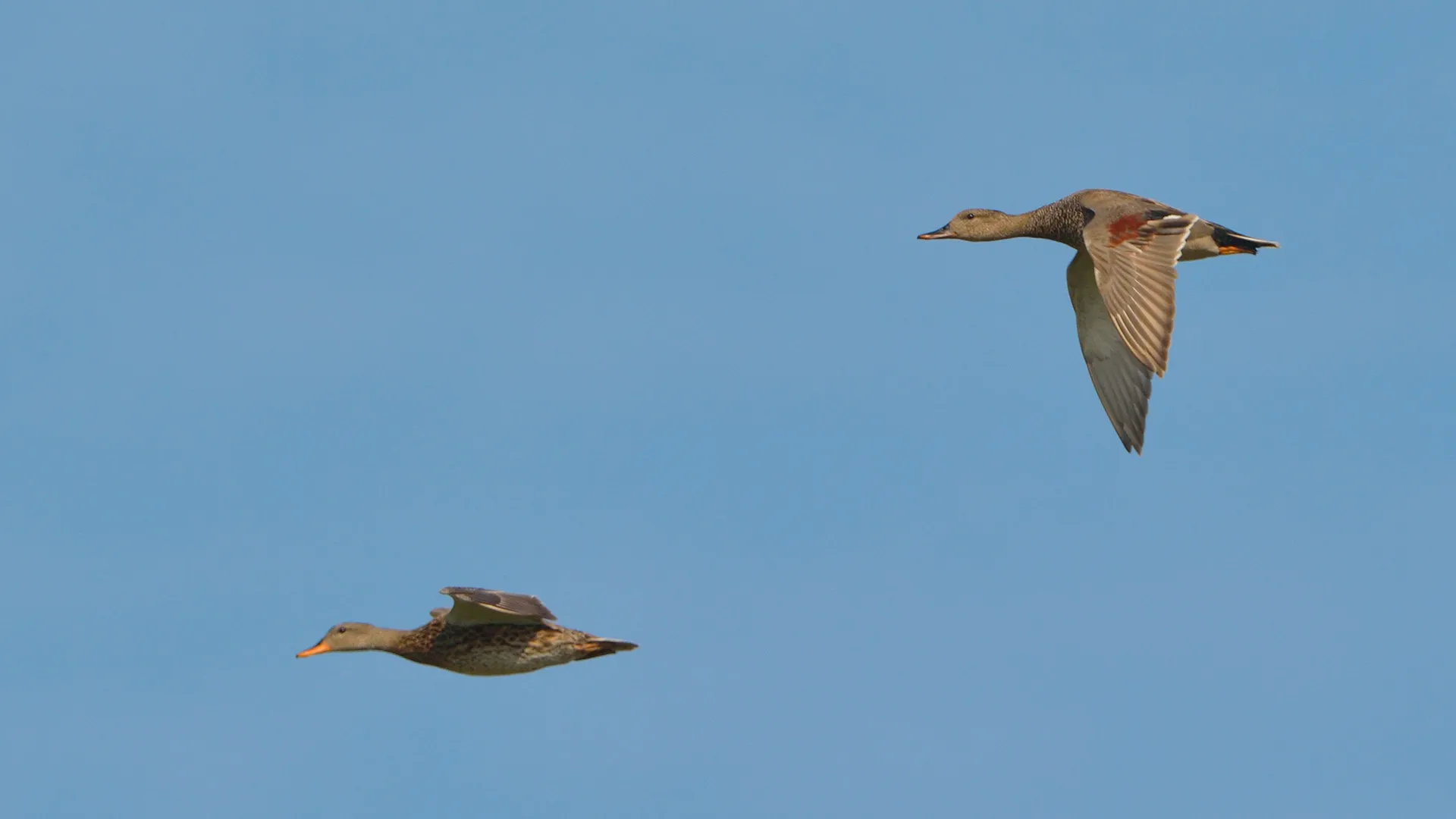
No. 35 on our checklistGadwall (Mareca strepera)
Meet the Gadwall, a plant-eating dabbling duck that steals food from coots: identification, breeding in the Danube Delta, autumn migration and status.
The Gadwall (Mareca strepera) is a quietly elegant dabbling duck. From a distance the drake looks plain gray, but up close it is covered in fine black and gray vermiculations, with a black rear end and a small white patch in the wing.
In the Danube Delta it breeds in moderate numbers and becomes abundant during the autumn migration, when flocks from the north pass through the lakes and lagoons.
Quick facts
Quick facts
- Scientific name Mareca strepera (Linnaeus, 1758); formerly Anas strepera, a name still used in many books and databases
- Common name Gadwall
- Family Anatidae (ducks, geese and swans)
- Order Anseriformes (waterfowl)
- Length 48–54 cm
- Wingspan 90 cm
- Weight 700–830 g
- Diet mainly plants: leaves, stems and seeds of aquatic plants, taken at the surface or by upending
- Habitat shallow, productive lakes, marshes and fishponds with plenty of underwater vegetation and reedy margins
- Breeding one brood a year; usually 9–11 eggs, incubated by the female for 24–26 days; the young fly at 45–50 days
- Conservation status Least Concern (global IUCN Red List); a game species in Romania
When to see it in the Danube Delta and Dobrogea
- JanA few wintering birds
- FebA few wintering birds
- MarSpring passage
- AprPairs on the lakes
- MayNesting
- JunFemales with ducklings
- JulMoult
- AugAutumn passage begins
- SepPeak autumn passage
- OctLast migrants
- NovA few wintering birds
- DecA few wintering birds
- Status here
- Present all year: moderate breeder, abundant on autumn migration, scarce in winter.
- IUCN Red List
- Least Concern
- Our checklist
- No. 35 of 385 · see the full checklist
How to recognize it
The Gadwall is slightly smaller and slimmer than the Mallard. The drake is gray with a finely patterned breast, a black rear end and a dark bill. The female looks like a female Mallard, but she has a neater, steeper forehead, an orange bill with a dark center and a white belly.
The best mark in both sexes is the small square white patch on the inner wing, the speculum. It is often visible even when the bird is swimming and flashes clearly in flight. In flight the whitish belly is also a useful mark.
A surface feeder with a taste for plants
The Gadwall is one of the most herbivorous dabbling ducks. It feeds on the leaves, stems and seeds of aquatic plants, picking them from the surface or upending in shallow water. It favors the productive margins and shallower parts of lakes, and in the Danube Delta it is found on the reed-fringed lakes and channels with rich underwater vegetation.
Because it depends on underwater plants, the Gadwall does well where water quality is good and aquatic vegetation is abundant.
Breeding in the Danube Delta
Pairs form during the winter and arrive together on the breeding lakes. The nest is hidden in dense vegetation on dry ground, often near water and sometimes on small islands. The female incubates alone and raises the ducklings, while the drake leaves to moult. Romania reported 500–9,000 breeding pairs for 2013–2015, a wide range that shows how difficult it is to count ducks nesting inside the reed beds.
Migration and winter
In late summer and autumn, Gadwalls from farther north pass through the Danube Delta, and September is the month with the largest numbers. Most of them continue farther south and west. Only a few winter in Romania: the country reported 600–4,800 wintering birds for 2013–2018, with an increasing trend.
Interesting facts
- A duck that steals from coots. Gadwalls regularly wait beside Eurasian Coots and snatch the plants the coots bring up from the bottom. In a study in the United States, about 30% of the Gadwalls observed were stealing food, and food stealing was most common among subordinate, often unpaired birds without access to the best feeding spots. Similar behavior has been described in southern Spain when low water made food harder to reach.
- “Noisy” in Latin. The scientific name strepera means “noisy”. The drake gives a short, deep, croaking call, and the female a quacking voice similar to a Mallard’s.
- A new genus. For a long time the Gadwall was placed in the genus Anas, with Mallard and teals. Genetic studies showed that it is closest to the wigeons and the Falcated Duck, and it is now placed with them in the genus Mareca.
- A duck on the rise. Wintering numbers in the European Union have increased by about 4.7% a year in the long term. The oldest known ringed Gadwall in Britain lived more than 21 years.
Status and conservation
The Gadwall is widespread and listed as Least Concern on the global IUCN Red List. In Romania it is a game species, hunted from 15 August to 15 February under the hunting law. Its future in the Danube Delta depends on clean water and healthy underwater vegetation, the same conditions that support many other waterbirds.
See it on our tours
On our multi-day birdwatching tours in the Danube Delta and Dobrogea, we check the reed-fringed lakes and lagoons for dabbling ducks. In late summer and early autumn, the Gadwall flocks are one of the many signs that migration is in full swing.
See it with us
Our birding guides are biologists and ornithologists who are on the water every day of the year. Small groups, open boats, the best hours of the day.
Keep reading
Keep reading
More from the blog

5 min read
Little Grebe (Tachybaptus ruficollis)
The smallest grebe in Europe: a round little diver that comes to the Danube Delta in numbers for the winter.
5 min read
Glossy Ibis (Plegadis falcinellus)
Dark brown in the shade, green and bronze in the sun: the only ibis that breeds widely in Europe, and the Danube Delta is...

4 min read
Squacco Heron (Ardeola ralloides)
A sandy heron that turns white the moment it takes off. Easy to see from the boat in summer, along the channels.