

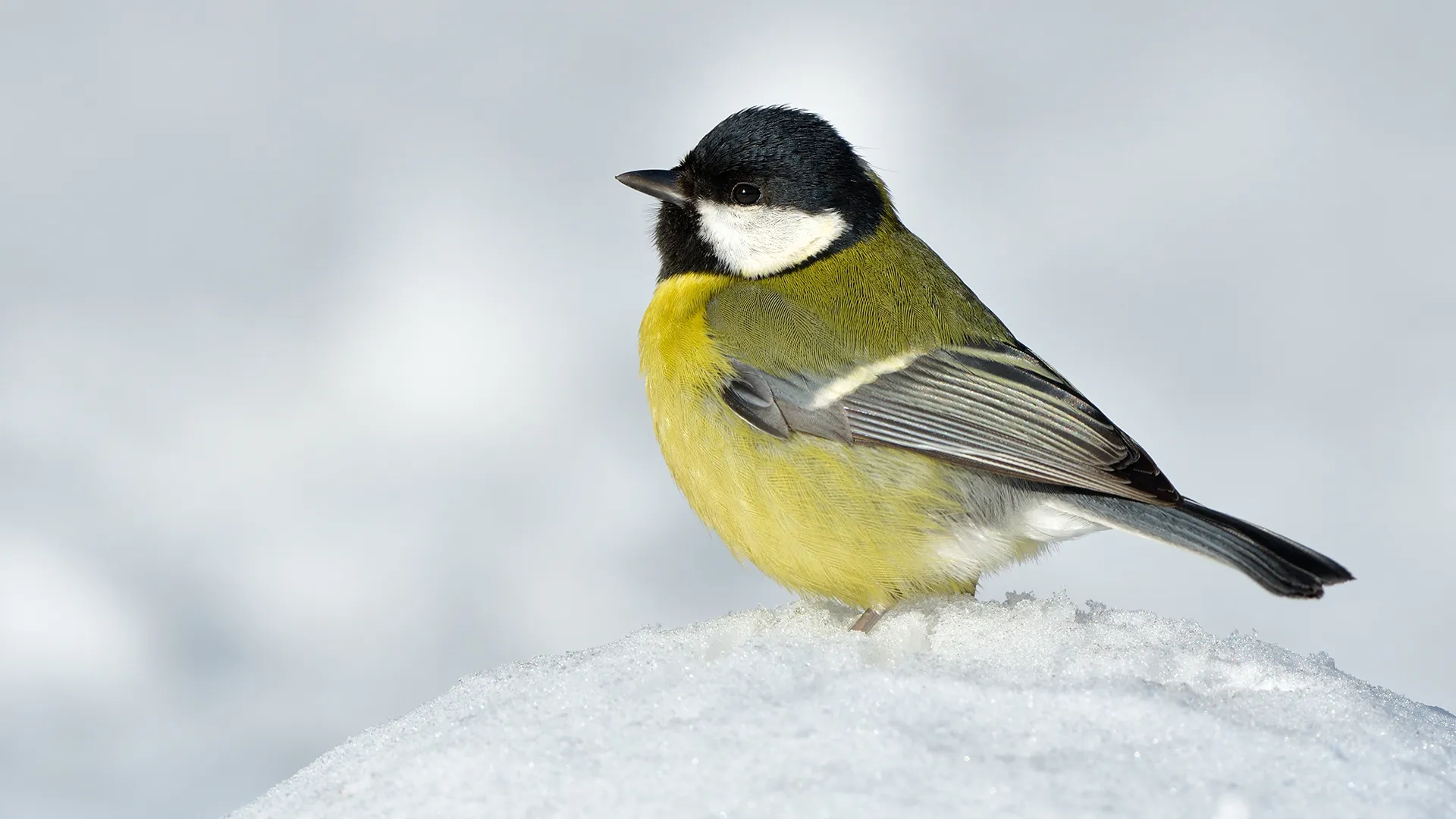
No. 245 on our checklistGreat Tit (Parus major)
Black cap, white cheeks and a yellow breast with a black stripe: the Great Tit, the most common tit of the Danube Delta and Dobrogea, and one of the best studied wild birds in the world.
The Great Tit (Parus major) is the largest and most common tit of the Danube Delta and Dobrogea. It lives all year in forests, orchards, parks, gardens and villages, and its loud song is one of the first signs of spring.
It is one of the best studied wild birds, and studies have shown it to be an inventive and flexible animal.
Quick facts
Quick facts
- Scientific name Parus major Linnaeus, 1758
- Common name Great Tit
- Family Paridae (tits and chickadees)
- Order Passeriformes
- Wing length about 7.5 cm (adults, British ringing data)
- Weight about 18–19 g
- Diet insects, especially caterpillars, and spiders in summer; seeds and nuts in winter
- Habitat deciduous and riverine forests, scrub, orchards, parks, gardens and villages
- Breeding in tree holes and nest boxes; usually 7–9 eggs, incubated by the female for 13–14 days; young leave the nest at 18–21 days; sometimes two broods
- Conservation status Least Concern (global IUCN Red List); Least Concern on the Romanian Red List (2022)
When to see it in the Danube Delta and Dobrogea
- JanMixed flocks
- FebSong begins
- MarPairs, song
- AprNest building, egg-laying
- MayChicks in the nest
- JunYoung fledge, second broods
- JulFamily groups
- AugMixed flocks
- SepPresent all year
- OctMixed flocks
- NovMixed flocks
- DecMixed flocks
- Status here
- Resident, present all year in forests, orchards and villages.
- IUCN Red List
- Least Concern
- Our checklist
- No. 245 of 385 · see the full checklist
How to recognize it
The Great Tit is clearly larger than the Blue Tit. It has a glossy black head with large white cheeks, a greenish back and a yellow breast divided by a black stripe. The stripe is more pronounced in males. Its best known song is a loud, repeated teacher-teacher, but it has a very large range of songs and calls.
One species, not three
For a long time, great tits from Europe to Japan and Indonesia were treated as one species. A 2005 study of mitochondrial DNA, songs and plumage concluded that they form three species: the Great Tit of Europe and western and central Asia, the Japanese Tit of eastern Asia and the Cinereous Tit of southern Asia. The European and the eastern groups separated about 1.5 million years ago.
A clever, adaptable bird
Great Tits nest in tree holes and nest boxes and, like Blue Tits, time their breeding to the spring peak of caterpillars. Outside the breeding season they eat many seeds and visit bird feeders, often in mixed flocks with Blue Tits and other small birds.
They can learn from each other. In a large experiment at Wytham Woods, near Oxford, researchers taught two males in each of five groups one of two ways to open a puzzle box. Each method spread through its group, and three quarters of the birds learned to solve the box. The local method was still dominant the next winter, even though many birds had been replaced. Earlier, from 1921, Great Tits and Blue Tits in Britain learned to peck open milk bottles left on doorsteps.
Interesting facts
- Hunters of bats. In a cave in the Bükk Mountains of north-eastern Hungary, Great Tits were seen searching for, killing and eating hibernating pipistrelle bats in winter, mainly when other food was scarce. Many responded to recordings of the calls of waking bats.
- Local traditions. In the Wytham Woods experiment, birds that moved to a new group usually changed to the method used by the local majority.
- A tie to show off. Males use their black breast stripe as a badge when displaying to rival males.
- Up to ten years. The oldest ringed Great Tit in Britain lived 10 years and 5 months.
Status and conservation
The Great Tit is listed as Least Concern on the global IUCN Red List. In Romania it is Least Concern on the Romanian Red List (2022), with 4,812,726–5,698,871 breeding pairs and an increasing trend.
See it on our tours
On our multi-day birdwatching tours in the Danube Delta and Dobrogea, Great Tits are a constant presence in the forests and villages of the Danube Delta and Dobrogea. In spring, their loud songs are a good way to start learning the bird voices of the region.
See it with us
Our birding guides are biologists and ornithologists who are on the water every day of the year. Small groups, open boats, the best hours of the day.
Keep reading
Keep reading
More from the blog

6 min read
Red-breasted Goose (Branta ruficollis)
Most of the world population spends the winter on the western shore of the Black Sea, and about a third of it in Dobrogea....

3 min read
Common Shelduck (Tadorna tadorna)
The Common Shelduck, a big black and white duck of the coastal lagoons that nests in fox burrows: identification, diet, crèches and where to...
4 min read
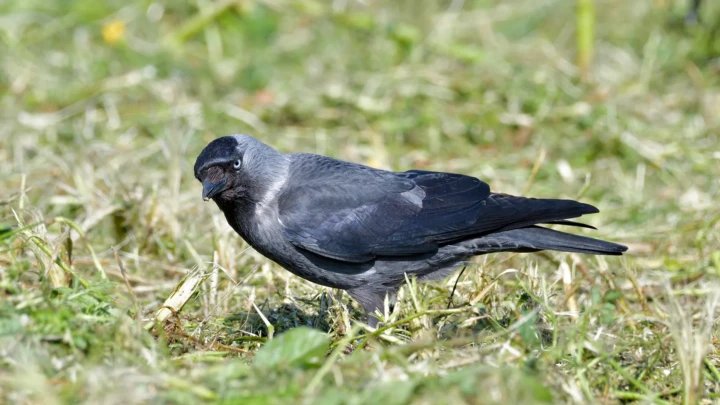
Western Jackdaw (Coloeus monedula)
The smallest crow of the Danube Delta, with a grey nape and pale silver eyes: the Western Jackdaw, a sociable bird of villages, old...