

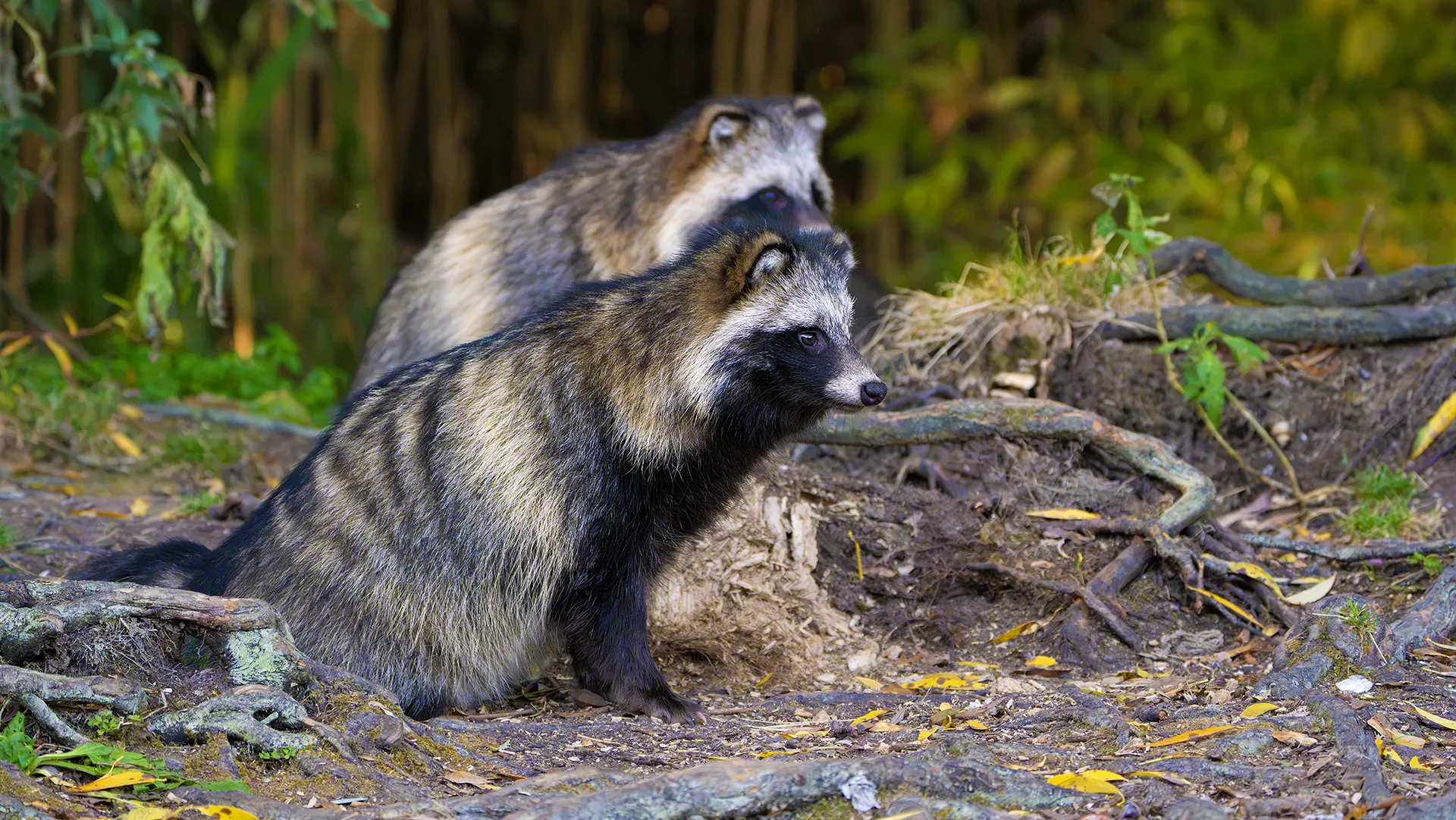
Raccoon Dog (Nyctereutes procyonoides): the Night Wanderer of the Danube Delta
A canid from the far east of Asia that walked all the way to the Danube Delta: how the raccoon dog arrived, how it lives, and the best season to see it.
At dusk, on a willow ridge at the edge of the reeds, a round, shaggy animal steps out of the vegetation, sniffs the ground and trots along the bank on short legs. A dark mask around the eyes, a thick coat, a bushy tail: it looks like a raccoon, walks like a small fox, and belongs to the dog family. The raccoon dog came to the Danube Delta from the far east of Asia, on its own feet, and today it is one of the most secretive and most interesting mammals you can meet here.
Quick facts
- Scientific name Nyctereutes procyonoides
- Subspecies in Europe N. p. ussuriensis, the Ussuri raccoon dog
- Family dogs (Canidae)
- Size head and body about 50 to 70 cm, tail 15 to 25 cm
- Weight about 4 to 10 kg, heaviest in late autumn
- Activity at dusk and at night
- In the Danube Delta resident all year, present since the 1950s
- IUCN Red List Least Concern


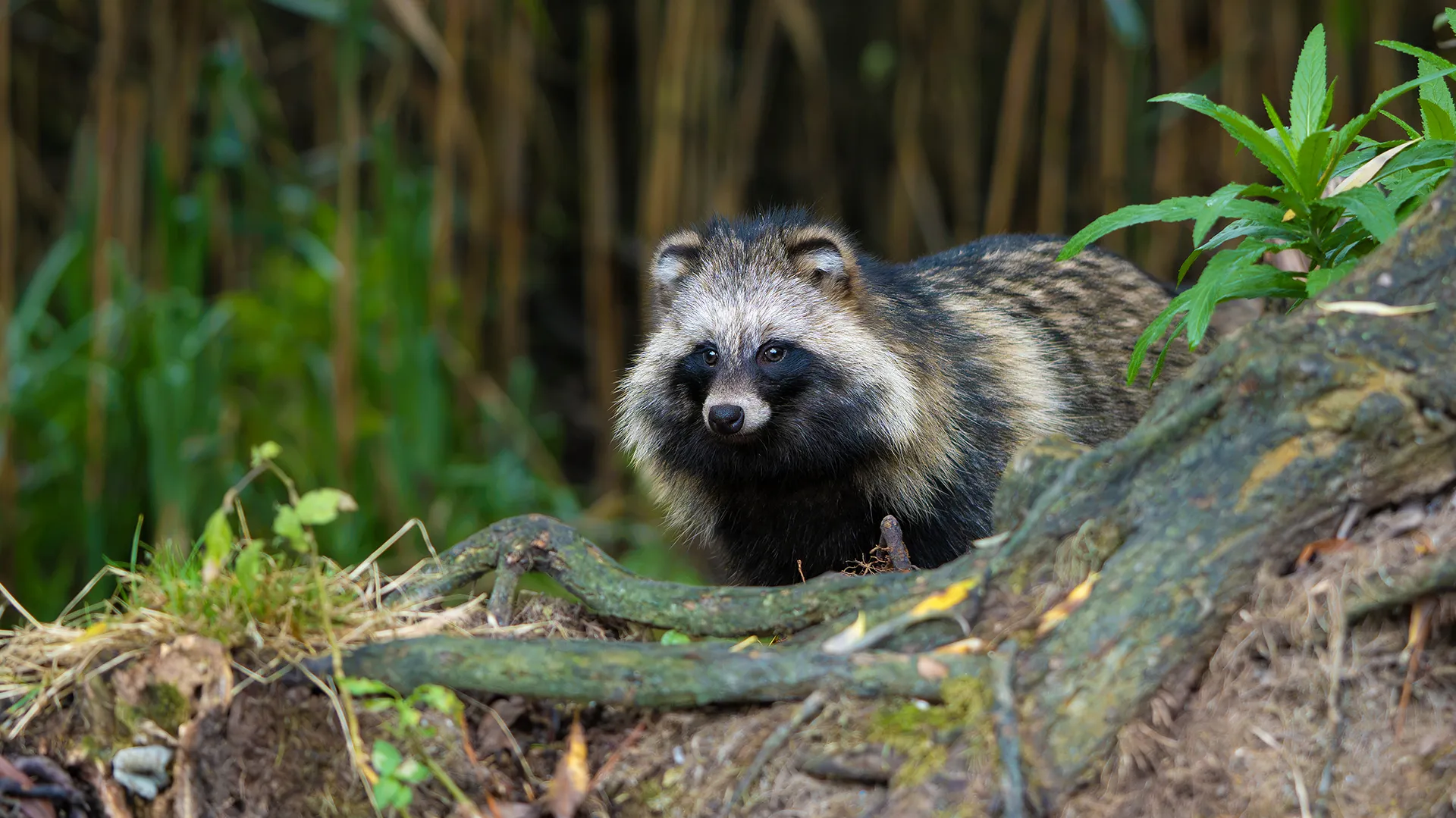

Description
The raccoon dog is a medium sized, stocky canid with short legs, a short muzzle and small rounded ears. Its long, dense fur is a mix of grey, brown and yellowish tones, darker on the legs, the chest and along the back. The face has a pale muzzle and a dark band around and below the eyes, the mask that gives the animal its name, and long hair on the cheeks makes the head look wide and round. In autumn, with its winter coat and its fat reserves, it looks almost twice as big as in summer.
It is not a raccoon. The raccoon is an American animal from another family; the raccoon dog is a true canid, a relative of the fox, the golden jackal and the wolf, and the closest of them in build and way of life is the fox.
Subspecies, and why Europe got the Ussuri raccoon dog
The raccoon dog of mainland Asia, Nyctereutes procyonoides, is usually divided into four subspecies: N. p. procyonoides in southern and eastern China and northern Vietnam, N. p. orestes in the mountains of southwestern China, N. p. koreensis in Korea, and N. p. ussuriensis, the Ussuri raccoon dog, in the basins of the Amur and Ussuri rivers, northeastern China and the Russian Far East. The raccoon dogs of Japan were long treated as a fifth subspecies, N. p. viverrinus, but many zoologists now consider them a separate species, Nyctereutes viverrinus. They have only 38 chromosomes, against 54 in the mainland raccoon dog, a smaller body and shorter, less insulating fur, and genetic studies place the split between the two lines at roughly 600,000 years ago.
All the raccoon dogs of Europe, including those of the Danube Delta, are Ussuri raccoon dogs, Nyctereutes procyonoides ussuriensis. The choice was deliberate. The Ussuri raccoon dog is the northernmost form of the species and one of the largest, and it lives with winters of deep snow and hard frost. It has the longest and densest coat, it builds large fat reserves in autumn and it can sleep through the coldest weeks in its den. For Soviet fur farmers this meant the most valuable pelt; for the game biologists who released it, an animal able to survive the winters of Russia, the Baltic countries and Ukraine. The same toughness explains why it spread so fast once it was free.
The genus is not new to Europe. Millions of years before people brought the raccoon dog here, its fossil relatives lived on this continent: Nyctereutes donnezani is known from Spain to Eastern Europe, from about 9 to 3.4 million years ago, and Nyctereutes megamastoides from later deposits. In a way, the Ussuri raccoon dog came back to a continent where its genus had lived long before.
From the far east of Asia to the Danube Delta
The home of the raccoon dog is eastern Asia: China, Korea, Japan and the valleys of the Amur and Ussuri rivers in the Russian Far East. Its journey to Europe began on Soviet fur farms, and from 1928 to 1929 the authorities started to release it in the wild, so that hunters would have a new valuable game species. The first releases were in the Caucasus. Between 1929 and 1955 about 9,100 animals were set free, most of them in the European part of the Soviet Union, from Leningrad to Ukraine.
The releases closest to us were made between 1949 and 1954 in Soviet Moldavia, just across the Prut. From there the raccoon dog spread on its own, at an average of about 40 km a year, and up to 120 km a year near the release sites. It was first recorded in Romania in 1951, and soon after it settled in the Danube Delta, where wetlands, ridges with willows and endless reed beds gave it everything it needed. By the 1980s the species had colonised more than 1.4 million square kilometres of Europe, and the Danube remains its main road towards the Balkans.
In Romania the raccoon dog lives today mainly in the Danube Delta, in the floodplain of the Lower Danube and along the Prut.
Life in the reeds and on the ridges
The raccoon dog loves water and cover: reed beds with firm banks, willow ridges, wet meadows, the edges of channels and lakes, and the outskirts of villages. It rarely crosses open land. It does not like to dig, so it often moves into old burrows of foxes and badgers, or makes its den under roots, in dense reed or under piles of cut reed.
It is a true omnivore and eats almost anything it finds on its slow walks along the banks: frogs and toads, small rodents, insects, snails, fish, eggs, carrion, and in late summer and autumn a lot of fruit, berries and seeds. Few European mammals have such a wide menu, and this is one of the secrets of its success.
Raccoon dogs live in pairs, and the pair often stays together for life. They mate at the end of winter, and after about two months the female gives birth in the den to a large litter, often six to ten pups. The father is a real family animal: he warms and guards the pups while the mother is out feeding, and later both parents bring them food. The young stay in the den for the first weeks, start to follow their parents in early summer and become independent in autumn.
Interesting facts
- The only dog that sleeps through winter. The raccoon dog is the only member of the dog family that hibernates. In the cold north of its range it sleeps in its den when frosts are hard and snow is deep. In the mild winters of the Danube Delta it stays active most of the season and rests only during the coldest spells.
- Twice the weight in autumn. To get through winter, a raccoon dog can almost double its weight between early summer and late autumn, feeding heavily on fruit and berries. Autumn raccoon dogs are round, fluffy and very photogenic.
- It never barks. Unlike most of its relatives, the raccoon dog does not bark. It growls when threatened and makes a soft, high whimper that sounds a little like a crying child.
- A master of playing dead. When a dog or another predator catches it, a raccoon dog may go limp and lie motionless, as if dead, then run off as soon as it is left alone. Zoologists call this behaviour thanatosis, and few canids use it as readily.
- Blamed for more than it does. In its new home, the raccoon dog was often accused of destroying bird nests. Studies across Europe tell a calmer story: birds and eggs appear in only a small part of its diet, and in one Latvian wetland raccoon dogs took just 0.3% of the duck nests. Early studies in the Danube Delta suggested that many of the birds it eats are found already dead, or wounded and left behind by hunters.
Tanuki, the cousin from Japan
In Japan the raccoon dog is the tanuki, one of the best known animals of Japanese folklore. Its oldest written mention is in the Nihon Shoki, a chronicle of the 8th century, which records that tanuki in the province of Mutsu turned into people and sang songs. In the old tales the bake danuki, the shape shifting tanuki, is a cheerful trickster and a master of disguise, but also gullible and absent minded, and many stories end with the tanuki outwitted. Today ceramic tanuki, with a round belly, a straw hat and a bottle of sake, stand at the entrance of countless restaurants and shops across Japan, as a sign of good luck and good business.
Biologically, the tanuki is the Japanese raccoon dog, Nyctereutes viverrinus, the form with 38 chromosomes. It is a close cousin of the raccoon dog of the Danube Delta, not the same animal. When a guest from Japan sees a raccoon dog on a bank near Mila 23, the face is familiar, but the animal is a relative from the mainland, from the cold side of the family.
Status and threats
The raccoon dog is listed as Least Concern by the IUCN. Because it was brought to Europe by people, the European Union lists it among the invasive alien species of Union concern, since 2019. In Romania it is a game species, hunted under yearly quotas.
In the Danube Delta its greatest danger is free roaming dogs, especially the dogs of the sheep flocks. With its short legs, the raccoon dog is slow and cannot outrun a dog. Dogs also carry canine parvovirus: our guides saw far fewer raccoon dogs between 2004 and 2017, the years when the disease spread among them. Like foxes, raccoon dogs can carry rabies and parasites, so they should never be fed or touched.
When and where to see it in the Danube Delta
The raccoon dog lives in the Danube Delta all year round, but it is shy and active mostly at dusk and at night, so most visitors only see its tracks in the soft mud of the banks. The best season is autumn, from September to November, when it spends long hours feeding before winter and often comes out before dark. In spring and early summer you may see whole families near the den. Look for it at first light and in the evening, along willow ridges, the edges of the reeds and quiet channels, where it walks slowly along the bank.
Our guides know the spots around Mila 23 where raccoon dogs come out at dusk, and on a calm autumn evening, with patience and a slow boat, the chances are good. You can look for it on our 5 day wildlife photo tour or on the 5 day birdwatching tour in the Danube Delta, and photographers who want to focus on it can ask for a private photo tour in autumn. Browse all the mammals of the Danube Delta and Dobrogea.
See it with us
Slow open boats, small groups and a guide who knows the places and the wildlife. From a few hours on the water to a week in the Danube Delta and Dobrogea.
Keep reading
Keep reading
More from the blog

9 min read
European Hare (Lepus europaeus) in the Danube Delta
The European hare is a familiar but often overlooked mammal of the Danube Delta and Dobrogea. Discover how it survives in open landscapes, why...

9 min read
Muskrat (Ondatra zibethicus)
The muskrat is a semi-aquatic rodent from North America that has lived in the Danube Delta since the 1950s. Discover how it swims, feeds,...
3 min read
European Souslik (Spermophilus citellus): the Little Sentinel of the Steppe
Standing upright at the entrance of its burrow, the European souslik watches over the steppe of Dobrogea: its life, hibernation and why it is...