

No. 28 on our checklistRed-crested Pochard (Netta rufina)
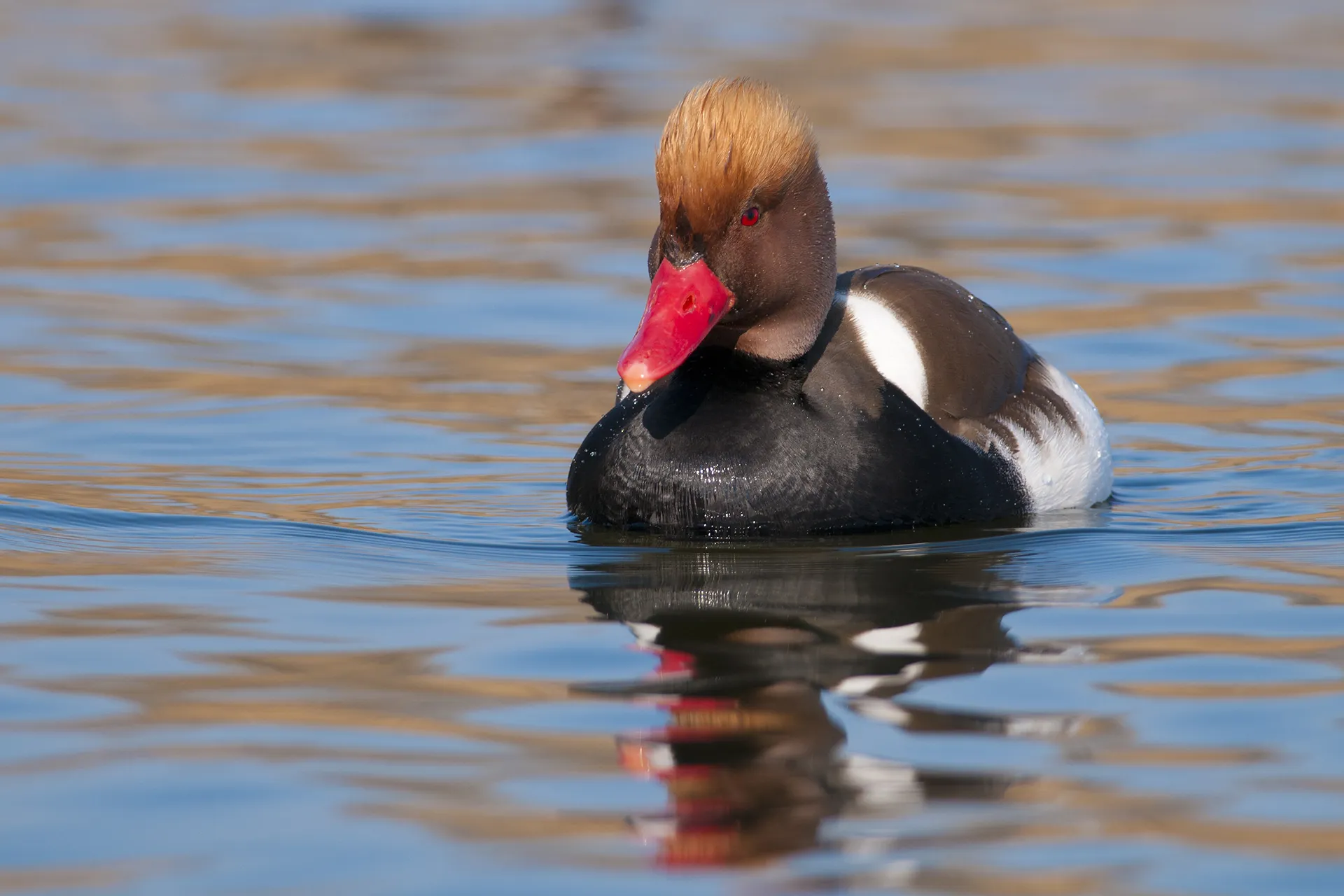
An orange-headed duck with a bright red bill, feeding on stoneworts and pondweeds: the Red-crested Pochard, a breeding bird of the Danube Delta whose numbers grow in winter.
The Red-crested Pochard (Netta rufina), described by Pallas in 1773 as Anas rufina, is a large diving duck; the drake has a rounded orange head and a bright red bill. In the Danube Delta it is present all year: it breeds rarely and irregularly, and is more numerous in winter, from October to March.
\nIt is a food specialist, tied to clear waters rich in submerged plants, especially stoneworts and pondweeds.
Quick facts
Quick facts
- Scientific name Netta rufina (Pallas, 1773); originally Anas rufina
- Common name Red-crested Pochard
- Family Anatidae (ducks, geese and swans)
- Order Anseriformes
- Weight about 1.1 kg
- Diet mainly submerged water plants, especially stoneworts (Characeae) and pondweeds
- Habitat shallow lakes and ponds with rich submerged and fringing vegetation, large open waters, brackish lagoons
- Breeding breeds from mid-April to early June, as single pairs or in loose groups; females often lay eggs in the nests of other females or other ducks
- Conservation status Least Concern (global IUCN Red List); Least Concern on the Romanian Red List (2022) for the breeding population; the wintering population was not evaluated
When to see it in the Danube Delta and Dobrogea
- JanWintering flocks
- FebWintering flocks
- MarPairs forming
- AprBreeding pairs
- MayNesting
- JunDucklings
- JulDucklings
- AugMoult
- SepMoult
- OctWinter arrivals
- NovWintering flocks
- DecWintering flocks
- Status here
- Present all year: rare, irregular breeder; moderate in winter.
- IUCN Red List
- Least Concern
- Our checklist
- No. 28 of 385 · see the full checklist
How to recognize it
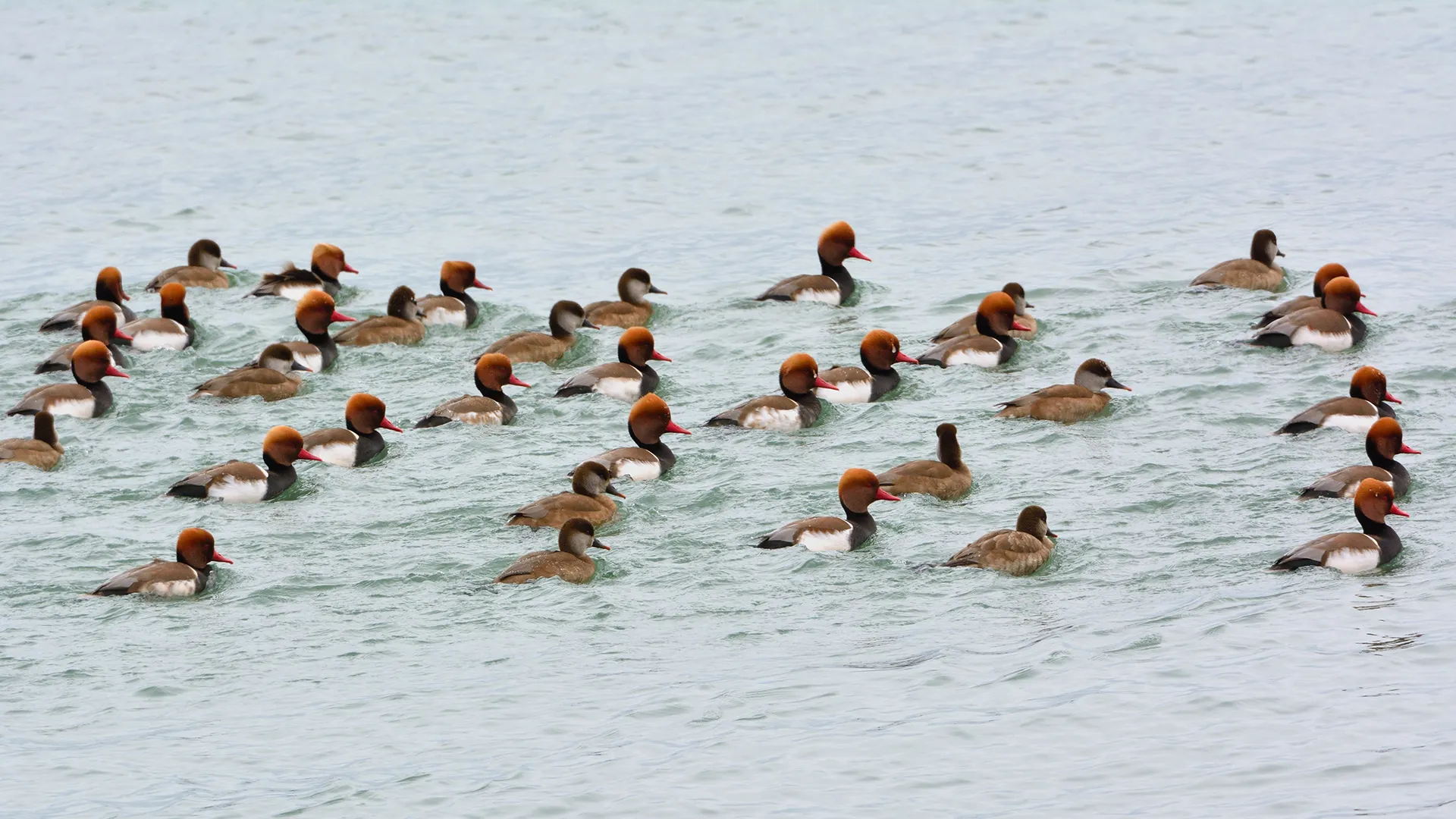
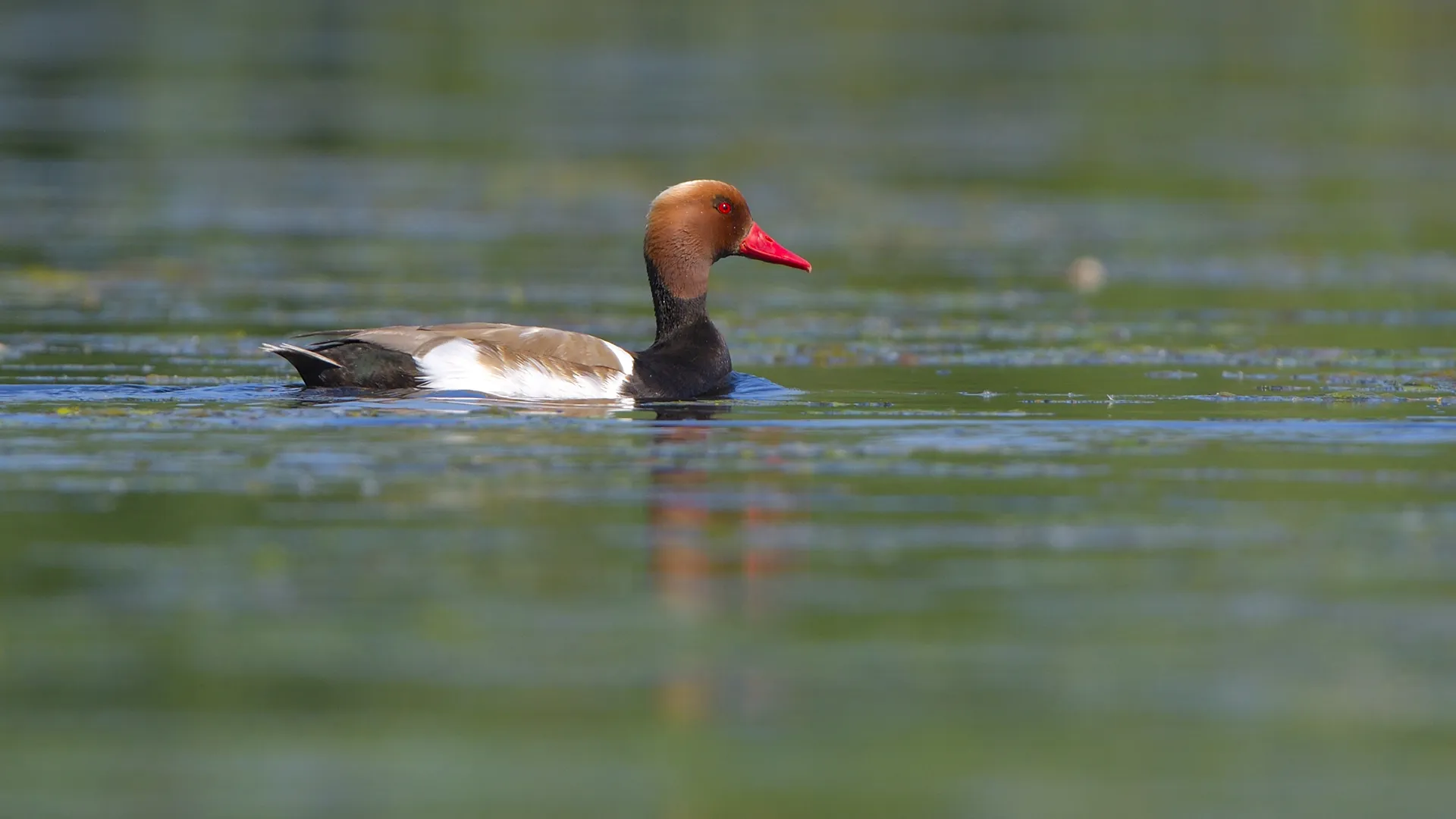
The drake Red-crested Pochard has a large, rounded, orange-chestnut head, a bright coral-red bill, a black breast and tail, a brown back and white flanks. It is unmistakable. The female is plain grey-brown, with a dark brown cap and pale grey-white cheeks. Out of the breeding season, males moult into a plumage similar to the female’s, but keep the red bill.
A duck that needs clean water
The Red-crested Pochard breeds in wetlands rich in submerged vegetation, including stoneworts and pondweeds. In neighbouring Bulgaria, the national breeding bird atlas notes that the species depends heavily on stonewort beds, and only 0 to 1 pairs breed there, with pairs recorded in the breeding season at Poda and Lake Srebarna.
In Romania and the Danube Delta
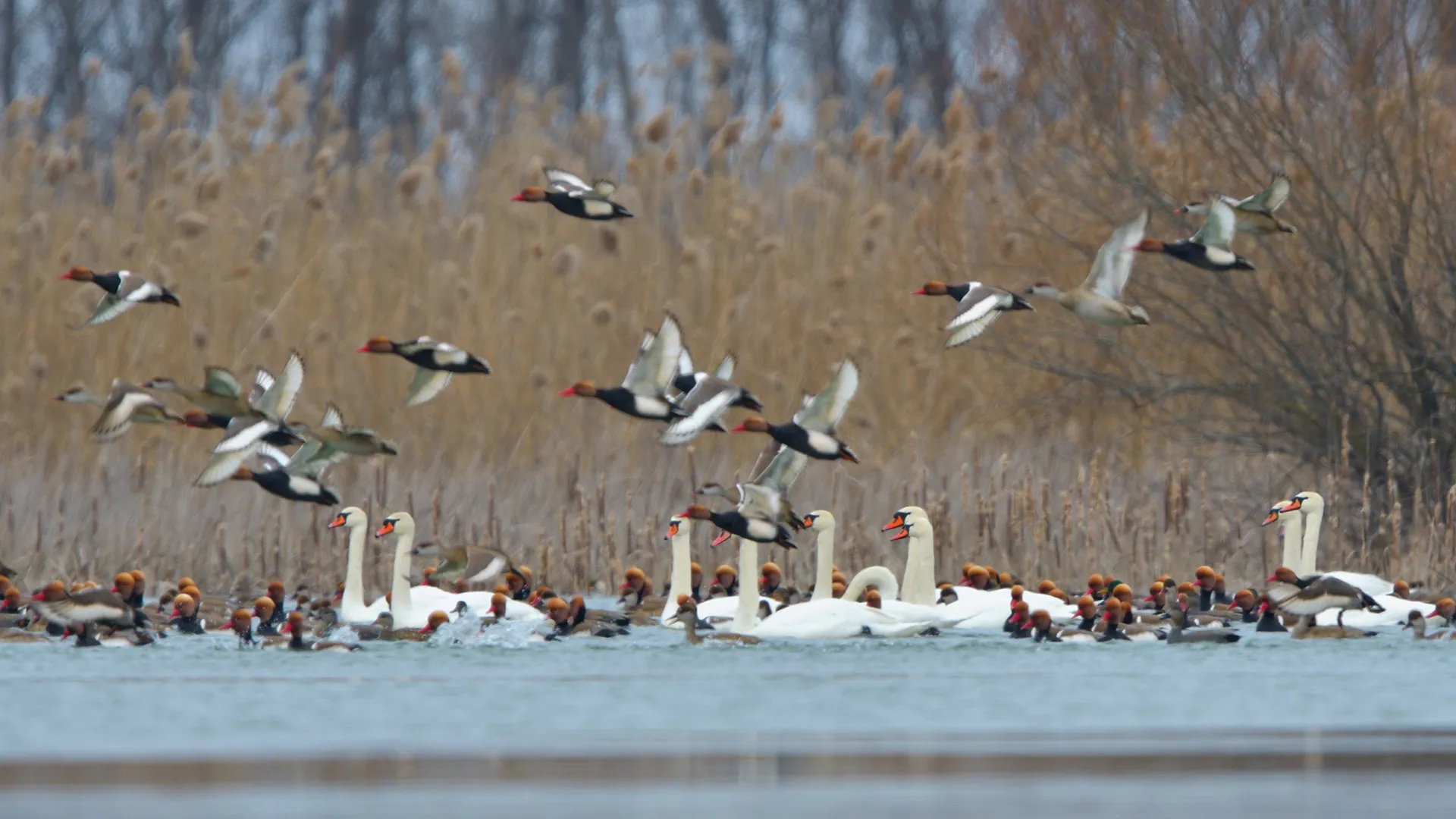
The Romanian Red List (2022) estimates the breeding population at 230 to 2,300 pairs, a wide range that reflects how poorly it is known; its trend is unknown. In the Danube Delta, breeding is rare and irregular: in our own field experience, at most four or five pairs, and not every year. There may be more, but it does not form a stable breeding population here. The species was first assessed as Near Threatened, but was then moved to Least Concern, because birds may arrive from populations further east. In winter numbers are higher: in the January 2025 midwinter waterbird count in Romania, 25,109 Red-crested Pochards were counted, with large numbers in key wetlands such as the reservoirs of the Olt Valley and the Danube Delta.
Courtship and shared nests
In spring, groups of 2 to 20 males court 1 to 4 females, with intense swimming chases that may end in pursuit flights. Laying eggs in the nests of other birds is common, both in nests of other Red-crested Pochards and of other duck species. The ducklings are covered in down and leave the nest soon after hatching. The world population is estimated at 420,000 to 600,000 birds and is increasing in Europe.
Interesting facts
- A plant-eating diver. Unlike most diving ducks, the Red-crested Pochard feeds mainly on water plants, especially stoneworts.
- Eggs in other nests. Females often lay eggs in the nests of other Red-crested Pochards or other ducks.
- A British population from captivity. In Britain, most Red-crested Pochards come from captive birds; a naturalised population is centred on the Cotswold Water Park.
- Increasing in Europe. The world population, estimated at 420,000–600,000 birds, is increasing in Europe.
Status and conservation
The Red-crested Pochard is listed as Least Concern on the global IUCN Red List. On the Romanian Red List (2022), the breeding population (230–2,300 pairs, unknown trend) is Least Concern, after an initial assessment as Near Threatened. The wintering population (trend uncertain) was not evaluated. The species depends on wetlands with rich submerged vegetation.
See it on our tours
On our multi-day birdwatching tours in the Danube Delta and Dobrogea, look for Red-crested Pochards on the open lakes of the Danube Delta with rich underwater vegetation. In spring the bright orange heads of the drakes stand out among other diving ducks, and in winter they gather in larger flocks.
See it with us
Our birding guides are biologists and ornithologists who are on the water every day of the year. Small groups, open boats, the best hours of the day.
Keep reading
Keep reading
More from the blog
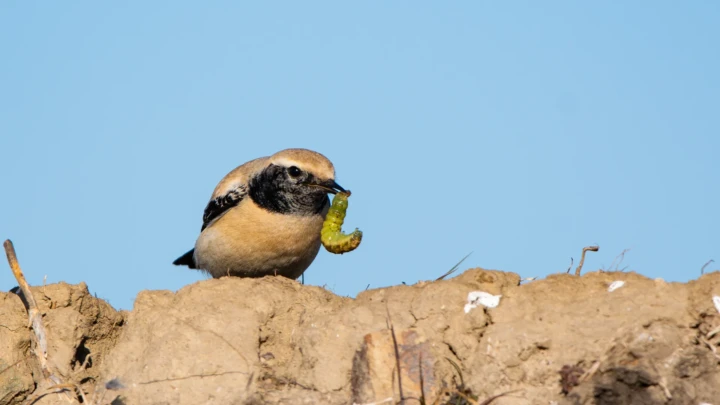
2 min read
Desert Wheatear (Oenanthe deserti)
The Desert Wheatear, a rare vagrant from the deserts and steppes of Asia to the dunes of Dobrogea: how to identify it by its...
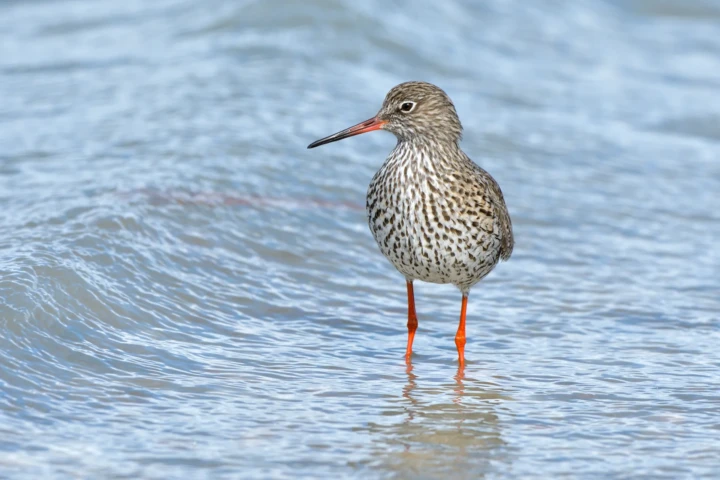
2 min read
Common Redshank (Tringa totanus)
Orange-red legs and a broad white wing edge identify Common Redshank, a rare breeder in the Danube Delta and Dobrogea.
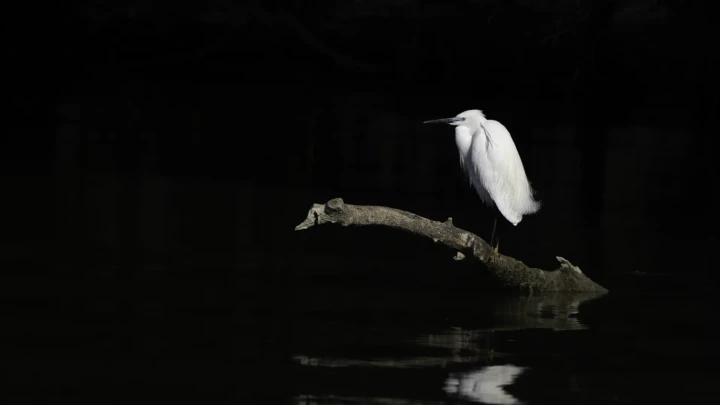
3 min read
Little Egret (Egretta garzetta)
The Little Egret, the snow white heron with yellow feet: identification, its active hunting, the plume trade that nearly wiped it out and where...