

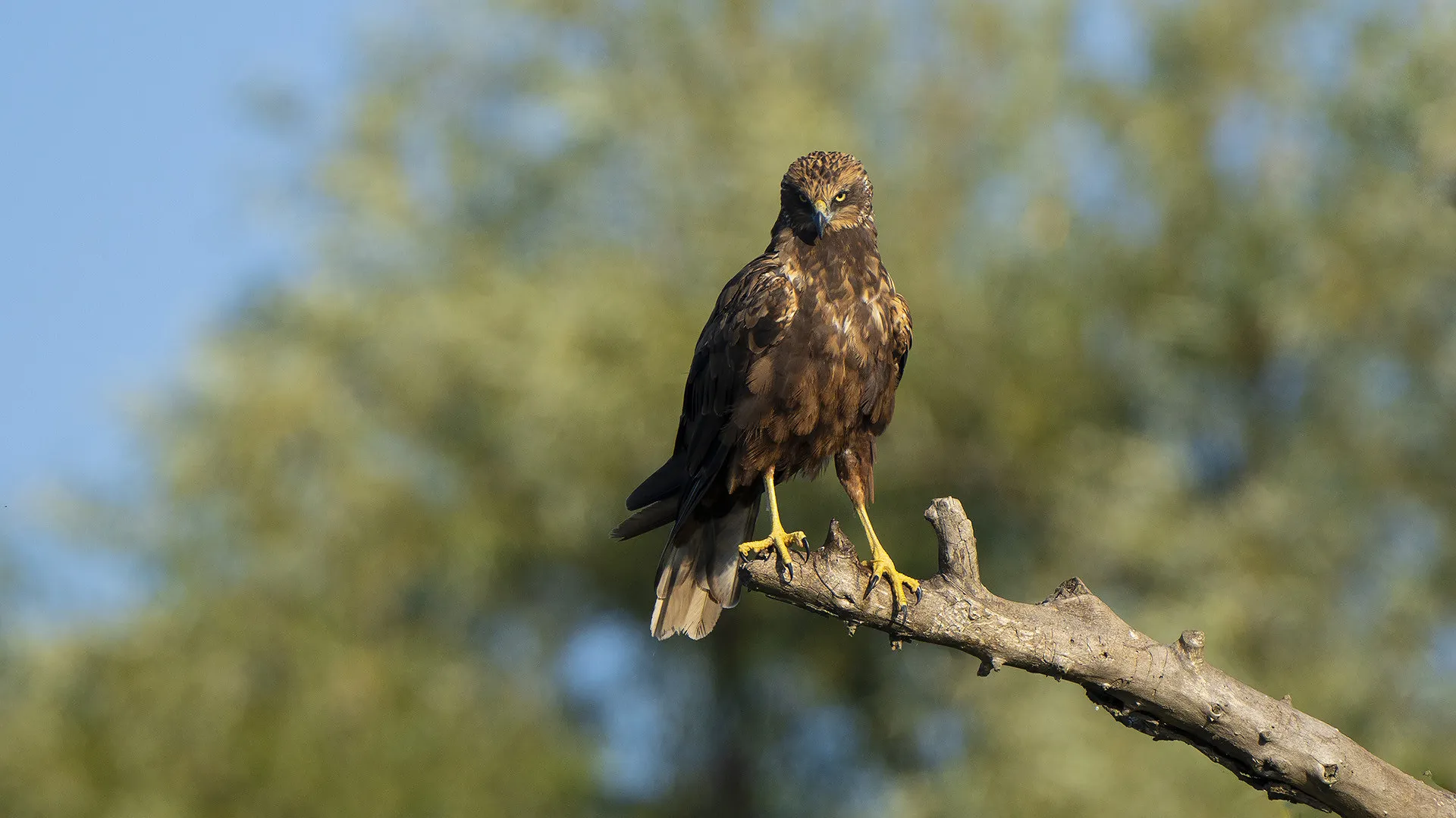
No. 199 on our checklistWestern Marsh Harrier (Circus aeruginosus)
Gliding low over the reeds with wings raised in a shallow V: the Western Marsh Harrier is the most typical bird of prey of the Danube Delta, present all year.
The Western Marsh Harrier (Circus aeruginosus) is one of the birds of prey you will see most often over the reedbeds of the Danube Delta. It hunts in slow, low flight just above the reeds, with its wings held in a shallow V, and nests on the ground, deep in the reedbed.
It is present all year: breeding birds arrive in spring, migrants pass in large numbers in autumn, and the Danube Delta is the most important wintering area of the species in Romania.
Quick facts
Quick facts
- Scientific name Circus aeruginosus (Linnaeus, 1758)
- Common name Western Marsh Harrier, also called Marsh Harrier
- Family Accipitridae (hawks, eagles and harriers)
- Order Accipitriformes
- Weight about 600 g on average; females are clearly heavier than males
- Diet small waterbirds and small mammals
- Habitat reedbeds, marshes and lake edges; also farmland and dry grassland, especially in winter
- Breeding nests on the ground in reeds; usually 4–5 eggs, incubated for 31–38 days by the female; young fly at 35–40 days
- Conservation status Least Concern (global IUCN Red List and Europe); Least Concern on the Romanian Red List (2022)
When to see it in the Danube Delta and Dobrogea
- JanWintering birds
- FebWintering birds
- MarDisplay flights
- AprNest building in reeds
- MayIncubation
- JunChicks, food passes
- JulYoung fledge
- AugAutumn passage
- SepAutumn passage
- OctLast migrants
- NovWintering birds
- DecWintering birds
- Status here
- Present all year: breeds in reedbeds, is a common migrant in autumn and winters on marshland and dry land.
- IUCN Red List
- Least Concern
- Our checklist
- No. 199 of 385 · see the full checklist
How to recognize it
The Marsh Harrier is the largest and broadest-winged of the European harriers. Males are three-coloured: brown body and inner wings, pale gray outer wings and tail, and black wingtips. Females and young birds are dark chocolate-brown with a cream crown and throat, often with cream patches on the front of the wings.
The hunting flight is the best identification feature: slow wingbeats and long glides low over the reeds, with the wings raised in a shallow V. The Black Kite is similar in colour but has a forked tail and flies with flatter wings, while the Hen, Pallid and Montagu’s Harriers are slimmer, and males are pale gray.
Life in the reedbed
Marsh Harriers nest mainly in reedbeds, on the ground, and in recent years some pairs have also been found nesting in crops. The female incubates the eggs, while the male brings most of the food for the female and the chicks. They hunt small waterbirds and small mammals, quartering low over the reeds and dropping suddenly onto prey. In winter, the birds that stay hunt over marshes and also over fields and dry land.
Migration and winter
Most European Marsh Harriers leave Europe in winter: the latest European Red List data give only 7,700–11,500 birds wintering in Europe, compared with 151,000–243,000 breeding pairs. In north Dobrogea, autumn counts in the Măcin Mountains recorded an average of about 470 Marsh Harriers a year, with the median passage date on 8 September, earlier than most other raptors. The Milvus Group, which coordinates the monitoring of wintering raptors in Romania, describes the Danube Delta as the only important wintering site for the species in the country.
Interesting facts
- Dinner delivered in mid-air. When the female comes up from the nest, the male often drops his prey and she catches it in the air below him. In a study in Spain, about 60% of the prey brought by males was passed this way, and aerial passes rose from 26% during incubation to 77% when the chicks were large.
- The male feeds the family. In the same study males supplied almost 80% of all prey delivered to the nest.
- Back from extinction in Britain. The species was wiped out as a breeding bird in Britain in 1899 by persecution. After a slow recovery, the British population fell to a single pair in 1971; it now numbers several hundred pairs.
- A large share of Europe’s harriers. Romania holds about 9,300–22,400 breeding pairs, around 8% of the European population, according to the latest European Red List data.
Status and conservation
The Western Marsh Harrier is listed as Least Concern on the global IUCN Red List and in Europe. In Romania it is Least Concern on the Romanian Red List (2022), with 9,334–22,314 breeding pairs and an uncertain trend. The species depends on large reedbeds. In western Europe, its recovery has been linked to the protection and restoration of reedbeds, the ban on organochlorine pesticides and reduced persecution.
See it on our tours
On our multi-day photo tours in the Danube Delta and Dobrogea, Marsh Harriers give some of the best chances to photograph a raptor in flight: they often hunt low over the reedbeds along the channels, close to the boat, and food passes in June are a highlight.
See it with us
Our birding guides are biologists and ornithologists who are on the water every day of the year. Small groups, open boats, the best hours of the day.
Keep reading
Keep reading
More from the blog

5 min read
Common Cuckoo (Cuculus canorus)
The Common Cuckoo in the Danube Delta: how to recognize it, how females trick reed warblers into raising their young, migration to Africa and...

5 min read
White-tailed Eagle (Haliaeetus albicilla)
The White-tailed Eagle is the largest bird of prey in Romania. How to identify it, its American cousin the Bald Eagle, the unique DNA...
3 min read
Little Egret (Egretta garzetta)
The Little Egret, the snow white heron with yellow feet: identification, its active hunting, the plume trade that nearly wiped it out and where...