

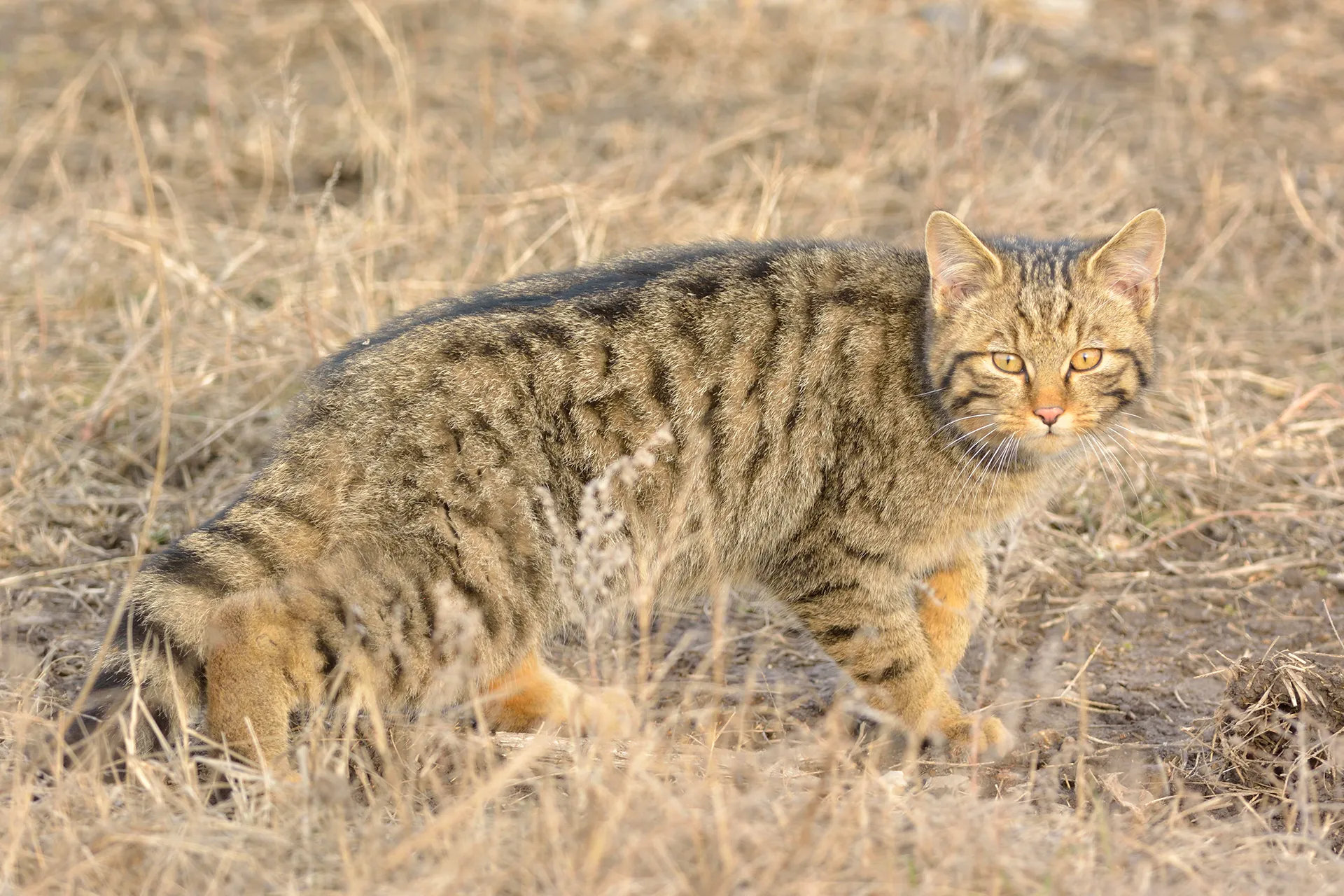
No. 39 on our checklistEuropean Wildcat (Felis silvestris)
The European Wildcat (Felis silvestris) inhabits the Danube Delta and Dobrogea, but its secretive behaviour makes encounters uncommon. Discover how this elusive predator lives, hunts, and survives in the region's varied habitats.
The European wildcat (Felis silvestris) is one of the most elusive mammals of the Danube Delta and Dobrogea. It is present throughout the region, but occurs in relatively small numbers and is rarely seen by casual visitors. Extremely cautious and secretive, it can live close to places regularly visited by people while remaining almost completely unnoticed.
For those exploring the Delta with experienced local guides, however, an encounter with a wildcat is not impossible. It takes silence, patience and a trained eye to recognise this elusive predator as it moves through the landscape. Sometimes, the difference between seeing one and missing it altogether is just a brief movement in the vegetation.
Quick facts
Quick facts
- Scientific name Felis silvestris
- Common name European wildcat
- Family Felidae
- Order Carnivora
- Body length 45–80 cm
- Tail length approximately 30 cm
- Weight 3–8 kg
- Diet mainly rodents, but also birds, rabbits and other small animals
- Activity mainly nocturnal and crepuscular
- Habitat forests, scrubland, river corridors and other areas with sufficient cover
- Conservation status Least Concern globally (IUCN)
Description: more than a wild-looking domestic cat
The European wildcat is similar in size to a large domestic cat, but it has a noticeably more robust build. Its head is broad, its ears are relatively small and widely spaced, and its legs are strong. The coat is thick and usually grey-brown, with dark markings on the head, neck, back and limbs.
One of its most distinctive features is its tail. Thick and bushy, it has several clearly defined dark rings and a blunt black tip. A dark line usually runs along the back, while the overall coat pattern is relatively consistent compared with the wide variety of markings found in domestic cats.
Adults typically measure 45–80 cm from head to body, with a tail of around 30 cm. Their weight generally ranges from 3 to 8 kg, with males usually larger than females. The dense winter coat makes the animal look particularly compact and powerful.
Wildcat or domestic cat?
Distinguishing a European wildcat from a domestic cat is not always easy, especially when the animal is seen briefly or at a distance. Some domestic cats have coat patterns that closely resemble those of wildcats, and hybrids can display a combination of characteristics from both.
There are several features worth looking for. A typical European wildcat has a thick tail with distinct black rings and a blunt black tip. Its head is broad, its body is strongly built and its coat is generally less variable than that of domestic tabby cats. The markings on its flanks are often less pronounced, while the dark dorsal line is usually clearly visible.
However, no single external feature guarantees a reliable identification. Domestic cats and wildcats can look remarkably similar, and genetic testing is sometimes necessary to establish whether an individual is a genetically pure wildcat or a hybrid.
Habitat: a cat of forests and natural landscapes
The European wildcat is traditionally associated with broad-leaved and mixed forests, especially those offering dense undergrowth, old trees and sheltered resting places. It needs areas where it can remain hidden while hunting and moving through its territory.
Its habitat requirements are not limited to continuous woodland. Wildcats can also use forest edges, scrubland, grasslands, river corridors and other landscapes where vegetation provides sufficient cover. Areas combining sheltered resting places with open ground can be particularly suitable, as they offer both protection and access to prey.
In the Danube Delta and Dobrogea, the landscape is remarkably varied. Willow forests, wooded riverbanks, islands, patches of dry ground and areas of dense vegetation create a mosaic of terrestrial habitats within a predominantly wetland environment. The wildcat is part of this less visible side of the region’s wildlife.
The European wildcat in the Danube Delta and Dobrogea
The European wildcat is present throughout the Danube Delta and Dobrogea, although it occurs in relatively small numbers. It is not restricted to a few isolated locations. Rather, its discreet behaviour and strong tendency to avoid people make it difficult to observe across the region.
Our guides encounter wildcats in different parts of the Delta during wildlife trips. These observations, sometimes accompanied by photographs taken in their natural habitat, show just how much can remain hidden in a landscape that many visitors assume they know well.
Spotting one requires more than simply looking for movement. Wildcats are extremely cautious and can disappear quickly into vegetation or remain motionless when they sense something approaching. Silence, familiarity with the landscape and an experienced eye are essential. A visitor may pass through suitable habitat without ever realising that a wildcat was nearby.
Scientific research has also documented the species in the inner Danube Delta. A camera-trap survey conducted in March 2011 recorded wildcats in two study areas, around Dovnica and the Julia field station, including the Șontea and Fortuna canal systems and Lake Rotund. Four of the 67 videos obtained during the survey recorded a wildcat, and tracks were also found in the study area.
These records provide independent scientific confirmation of the species in the inner Delta. They should not, however, be interpreted as an estimate of its current population or as a complete picture of its distribution. Field observations by local guides add another valuable perspective on a mammal that is present across a much wider area than occasional sightings might suggest.
Behaviour: solitary, cautious and difficult to observe
European wildcats are generally solitary animals. They maintain individual territories and usually avoid direct contact with other wildcats, except during the breeding season and when females are raising their young.
They are mainly nocturnal, although they may also be active around dawn and dusk. Their activity patterns can vary according to habitat, disturbance and the availability of prey. During daylight, they usually rest in sheltered places such as dense vegetation, tree hollows or abandoned burrows.
Wildcats are capable climbers, but most of their hunting takes place on the ground. They rely on excellent hearing, patience and the ability to move quietly through vegetation. Their cautious nature is one of the main reasons why they are so rarely encountered, even in areas where they are present.
Scent marking plays an important role in communication and territorial behaviour. Urine, scent glands and other olfactory signals help individuals communicate with neighbouring wildcats. Vocalisations are also used, particularly during the breeding season.
Diet: a predator of small animals
Small mammals form the main part of the European wildcat’s diet. Mice, rats and voles are particularly important prey, making the wildcat an effective predator of rodents in the habitats it occupies.
Where rabbits are available, they can become an important food source. Wildcats also take birds, reptiles, amphibians and insects, depending on local conditions and opportunities. Occasionally, they may feed on carrion or cache food for later consumption.
Hunting usually involves stalking rather than prolonged pursuit. The wildcat approaches its prey quietly, using natural cover to get close before making a short, rapid attack. It generally hunts alone and relies on patience, good hearing and precise movements.
Reproduction and raising young
The breeding season usually takes place in late winter, mainly between January and March. During this period, males become more active and may travel greater distances in search of females.
After a gestation period of approximately 64–71 days, most kittens are born in April or May. Litter size varies, but several kittens are common. Females give birth in sheltered places, such as tree hollows, dense vegetation or abandoned burrows, where the young remain protected during their first weeks.
Kittens begin eating solid food at around one month of age. They gradually learn to hunt and develop the skills needed to become independent. They may remain with their mother for several months while developing the skills needed for independent life.
Conservation and threats
The European wildcat is classified as Least Concern at the global level by the IUCN. However, this broad classification does not mean that every population is secure. In several parts of Europe, wildcat populations remain threatened, fragmented or poorly documented.
One of the most important conservation concerns is hybridisation with domestic cats. Where wildcats and free-ranging domestic cats come into contact, they may interbreed. Over time, this can lead to the introduction of domestic-cat genes into wildcat populations and make it increasingly difficult to identify genetically pure individuals.
Other threats include habitat loss and fragmentation, road mortality, direct persecution and diseases transmitted by domestic cats. Changes in prey availability and human disturbance can also affect local populations.
In the Danube Delta and Dobrogea, maintaining suitable natural habitats and limiting unnecessary disturbance are important for the long-term conservation of this elusive predator. Responsible ownership of domestic cats and monitoring of wildcat populations can also help reduce some of the pressures associated with hybridisation and disease transmission.
Interesting facts about the European wildcat
- It is not the ancestor of the domestic cat. The domestic cat descends from the African wildcat, Felis lybica, rather than the European wildcat.
- Its tail is one of its best identification features. The thick tail, distinct dark rings and blunt black tip are characteristic of the species.
- It is an excellent climber. Although it hunts mainly on the ground, it can climb trees when necessary.
- It is difficult to distinguish from domestic cats. Some domestic cats and hybrids closely resemble wildcats, making genetic analysis important for conservation.
- It can remain unnoticed even where it is present. Its cautious behaviour, quiet movements and ability to use dense vegetation make direct encounters uncommon.
Where to see the European wildcat in the Danube Delta
The European wildcat is present throughout the Danube Delta and Dobrogea, but seeing one is never guaranteed. Although it lives in relatively small numbers, its low visibility is largely a consequence of its extremely cautious behaviour and its ability to avoid human contact.
Wildcats use a variety of natural habitats, including wooded areas, scrubland, riverbanks and patches of dense vegetation. They can be encountered in different parts of the Delta, but are easily missed by visitors who are unfamiliar with the landscape and the subtle signs of wildlife activity.
During our wildlife trips, spotting a wildcat is one of those special moments that rewards silence, patience and experience. Our guides know how to read the landscape and recognise the brief movements that might otherwise go unnoticed. Even then, an encounter remains unpredictable.
For wildlife photographers, a wildcat sighting can be particularly memorable. These animals rarely stay in view for long, and there is often very little time to react. The photographs made during our trips offer a glimpse of a mammal that is part of the Delta’s wildlife but remains hidden from most visitors.
The European wildcat reminds us that the Danube Delta is much more than its famous waterways and birdlife. Beyond the open lakes and reed beds, a rich terrestrial world exists, inhabited by secretive mammals that require patience and experience to discover.
See it with us
Slow open boats, small groups and a guide who knows the places and the wildlife. From a few hours on the water to a week in the Danube Delta and Dobrogea.
Keep reading
Keep reading
More from the blog
10 min read
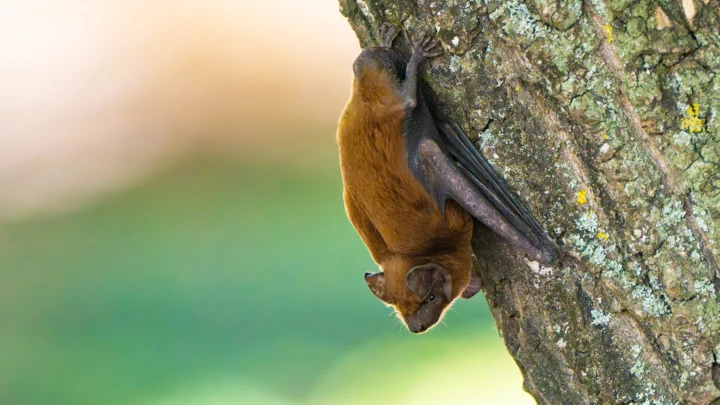
Common Noctule (Nyctalus noctula)
Just after sunset, a large, fast-flying bat hunts high above the treetops and over the water of the Danube Delta: the common noctule, one...

7 min read
Eurasian Otter (Lutra lutra): the Fisherman of the Danube Delta Channels
The Eurasian otter, the fisherman of the Danube Delta: how it lives in the channels, its long history beside people on the Lower Danube,...
9 min read
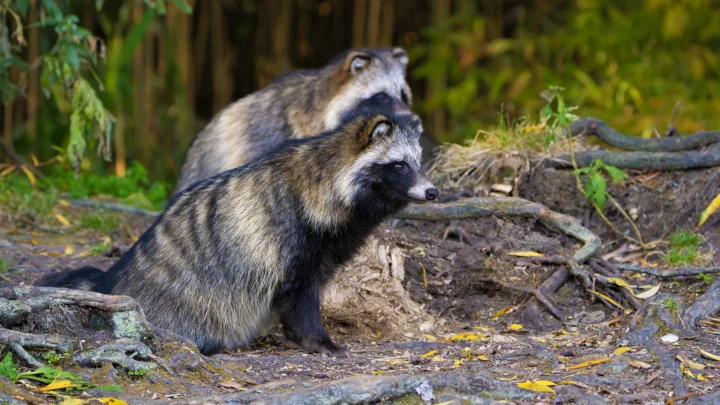
Raccoon Dog (Nyctereutes procyonoides): the Night Wanderer of the Danube Delta
A canid from the far east of Asia that walked all the way to the Danube Delta: how the raccoon dog arrived, how it...