

No. 38 on our checklistCoypu (Myocastor coypus) – A Newcomer to the Danube Delta?
The coypu (Myocastor coypus), also known as nutria, is a large semi-aquatic rodent native to South America. Introduced to Europe for its valuable fur and, to a lesser extent, its meat, it has established wild populations across much of the continent. In southeastern Europe, its expanding distribution has brought it increasingly close to the Danube Delta, where recent observations suggest that a new chapter in the region’s mammal fauna may be beginning.
Unlike many mammals traditionally associated with the Danube Delta, the coypu is not native to Europe. Its arrival is the result of human introductions followed by escapes, releases and natural dispersal. Today, the species is well established in parts of Greece and Bulgaria, while observations from the Danube Delta are becoming particularly interesting to local naturalists.
Quick facts
Quick facts
- Scientific name Myocastor coypus (Molina, 1782)
- Common names Coypu, nutria
- Order Rodentia
- Family Echimyidae (traditionally Myocastoridae)
- Native range South America
- Body length approximately 40–65 cm
- Tail length approximately 30–45 cm
- Weight usually 5–10 kg
- Diet mainly aquatic and waterside vegetation
- Habitat marshes, lakes, rivers, canals and vegetated wetlands
- Activity mainly crepuscular, but also active during daylight
- Status in Europe non-native invasive species
- Status in the Danube Delta recently observed; establishment of a local breeding population has not yet been confirmed
Description: a large rodent adapted to water
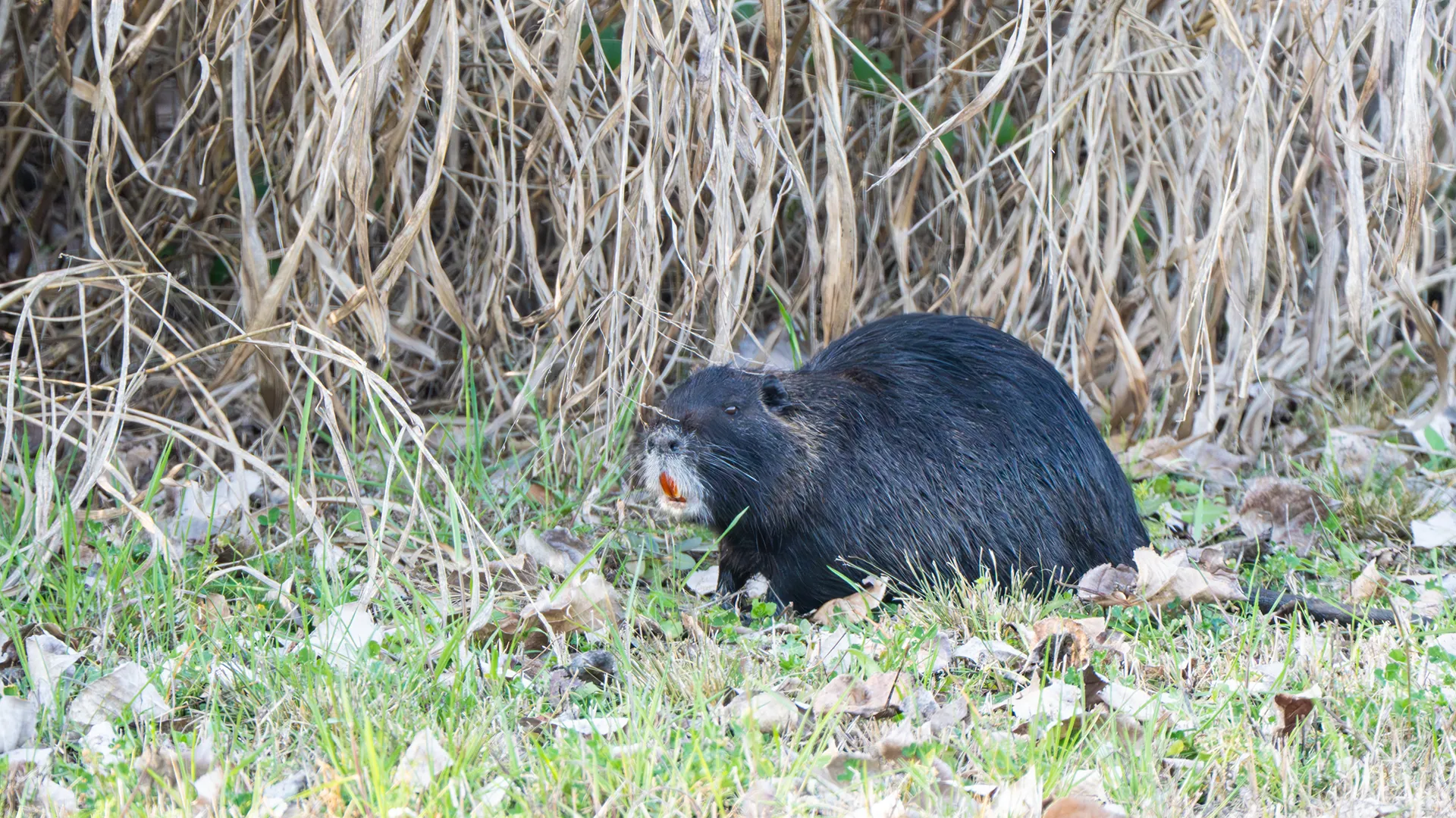
The coypu is a robust, heavily built rodent with dense brown fur, a rounded body, a broad head and a long, almost cylindrical tail. Its appearance may initially suggest a small beaver or an unusually large muskrat, but several features make it relatively easy to recognise.
One of the most distinctive characteristics is its large, bright orange incisors. Like other rodents, coypus have continuously growing front teeth, which are maintained through gnawing and feeding. The orange colour results from iron-containing pigments in the tooth enamel.
The hind feet are partially webbed, providing propulsion while swimming, while the front feet remain relatively free and dexterous. The eyes, ears and nostrils are positioned high on the head, allowing the animal to remain alert while much of its body is submerged.
Adults commonly weigh between 5 and 10 kg, although larger individuals occur. Their thick fur consists of a dense undercoat protected by longer guard hairs, an adaptation that once made the species economically attractive to fur farmers.
From South America to Europe
The coypu originates from South America, where it inhabits wetlands, rivers and marshes across countries including Argentina, Uruguay, Paraguay, Brazil, Bolivia and Chile. In its native range, it is a natural component of aquatic ecosystems and an important herbivore in wetland vegetation communities.
Its history in Europe is closely connected to the fur industry. During the nineteenth and twentieth centuries, coypus were transported to numerous countries and bred in captivity for their dense, soft underfur. In some regions, the animals were also raised for meat.
Romania, the Republic of Moldova and Ukraine were among the countries where coypus were kept in captivity. As elsewhere in Europe, escaped or deliberately released animals provided opportunities for the species to survive outside farms and adapt to natural habitats.
The decline of fur farming did not necessarily end the species’ presence. Once coypus reached suitable wetlands, their ability to reproduce and exploit abundant aquatic vegetation allowed some populations to become established without further human assistance.
Today, wild coypu populations occur in many European countries. Their success has been particularly noticeable in regions with extensive wetlands, relatively mild winters and abundant vegetation.
Expanding through southeastern Europe
Southeastern Europe provides an interesting example of the coypu’s continuing expansion. The species is established in Greece, including the wetlands of northern Greece, where it can be locally abundant. Lake Kerkini is one of the places where coypus are regularly encountered.
In Bulgaria, the species has a longer history than many visitors might expect. Coypus were introduced near Burgas in the middle of the twentieth century, and subsequent populations developed in river basins and wetland systems. Further records from northern and northeastern Bulgaria show that its distribution is not limited to the original introduction areas.
Field observations along the Bulgarian Black Sea coast indicate an increasingly noticeable presence in suitable wetland habitats. From these coastal systems, natural dispersal northwards towards the Danube Delta is a plausible route of expansion.
However, the history of the species in the region is not explained by a single migration route. Captive escapes, local releases and dispersal from already established populations may all have contributed. Without genetic or detailed movement studies, the precise origin of individual animals found near the Danube Delta cannot be established with certainty.
The coypu in the Danube Delta: a newcomer to watch
The recent appearance of coypus in the Danube Delta is particularly interesting because the region offers extensive areas of apparently suitable habitat. Its lakes, channels, reed beds and vegetated banks resemble the environments occupied by the species elsewhere in Europe.
During recent years, several coypus have been reported from the southern part of the Delta. More recently, in 2026, two observations were made farther north. One animal was recorded near Mila 23 and filmed by a member of our guiding team, while another was observed farther north, in the Lake Matița area.
These observations are valuable because they suggest that coypus are reaching different parts of the Delta, rather than appearing only at its southern margins. They also provide an opportunity to follow the possible development of a new mammal population through direct field observations.
At present, however, sightings alone do not demonstrate that a self-sustaining breeding population has become established in the Danube Delta. The animals could represent dispersing individuals, descendants of escaped captive animals or members of an expanding population whose origins are not yet known.
Whether the coypu will become a regular member of the Delta’s mammal fauna remains an open question. Given its adaptability and its presence in neighbouring regions, continued observations will be particularly important.
Habitat and aquatic adaptations
Coypus are strongly associated with water and rarely venture far from suitable aquatic habitats. They prefer lakes, marshes, slow-flowing rivers, canals and ponds with abundant vegetation along the banks.
They are powerful swimmers and can dive when disturbed. Their webbed hind feet provide propulsion, while the long tail helps with balance and movement. On land, their heavy body and relatively short legs make them appear less agile than they are in water.
Coypus often rest in dense vegetation or use burrows excavated into suitable banks. Where conditions allow, their burrowing activity may create extensive systems of passages and resting chambers.
They are particularly well adapted to wetlands with emergent vegetation, including reed beds and areas rich in aquatic plants. Such habitats provide both food and shelter, reducing the need to travel long distances away from water.
Diet: an efficient wetland herbivore
The coypu is primarily herbivorous. Its diet consists mainly of aquatic and semi-aquatic plants, including stems, leaves, roots, rhizomes and other soft plant tissues.
It often feeds on emergent vegetation growing along the margins of lakes and canals. Using its front feet and powerful incisors, it can manipulate plant material and reach parts of plants that are less accessible to some other herbivores.
Although coypus consume many types of vegetation, their feeding behaviour can have important ecological consequences when populations become numerous. By removing above-ground plant material and excavating underground structures, they may reduce plant cover and disturb wetland soils.
Occasional consumption of animal material has been reported, but vegetation remains overwhelmingly the main component of the diet.
Reproduction and population growth
One reason for the coypu’s success outside its native range is its considerable reproductive capacity. Unlike many mammals with a strongly defined breeding season, coypus can reproduce throughout the year when environmental conditions are favourable.
Gestation lasts approximately 127–138 days, and a female commonly gives birth to four to six young, although litter size varies. Under favourable conditions, females may produce more than one litter annually.
The young are born relatively well developed, with fur and open eyes, and can enter the water shortly after birth. They begin feeding on vegetation at an early age while continuing to nurse.
Sexual maturity can be reached within the first year of life. Combined with plentiful food and relatively mild winters, this reproductive potential allows populations to increase rapidly after establishment.
Cold winters remain an important limiting factor. Severe freezing conditions can reduce survival and reproductive success, particularly when access to food becomes difficult.
Coypu, muskrat or beaver?
In the Danube Delta, a coypu may initially be confused with two other semi-aquatic rodents: the muskrat (Ondatra zibethicus) and the Eurasian beaver (Castor fiber). However, their size, tail shape and general appearance provide useful identification clues.
- Coypu: a large, heavy-bodied rodent with a long cylindrical tail, prominent orange incisors and partially webbed hind feet.
- Muskrat: considerably smaller, with a laterally flattened tail and a more compact body. It often swims with much of its body submerged.
- Eurasian beaver: generally much larger, with a broad, flattened, paddle-shaped tail that is unmistakable when clearly visible.
The coypu’s conspicuous orange teeth and long round tail are particularly useful for identification. Its white whiskers and pale muzzle can also help distinguish it from a muskrat during a close observation.
An invasive species and its ecological impact
Although the coypu is an interesting animal to observe, its expansion into new ecosystems raises important conservation concerns. In the European Union, Myocastor coypus is listed as an invasive alien species of Union concern.
Where populations become numerous, intensive feeding can reduce aquatic vegetation, alter the structure of reed beds and affect habitats used by other wildlife. Burrowing may also destabilise riverbanks, embankments and irrigation structures.
The ecological impact varies considerably between regions and depends on population density, habitat characteristics and the availability of food. The presence of a few individuals does not automatically imply substantial damage to an ecosystem.
For the Danube Delta, it is therefore important to distinguish between occasional records and the establishment of a large, reproducing population. At present, the observations reported by our guides are evidence of occurrence, not evidence of a measurable ecological impact.
Monitoring future sightings, recording locations and documenting any signs of reproduction would help clarify the species’ status and allow conservation authorities to assess potential risks at an early stage.
Interesting facts about the coypu
- It comes from South America. The coypu reached Europe through human introductions, particularly the fur industry.
- Its teeth are naturally orange. Iron-rich enamel gives the incisors their distinctive colour and contributes to their durability.
- It is an excellent swimmer. Partially webbed hind feet and a body adapted to aquatic life allow it to move efficiently through wetlands.
- Its young are unusually well developed at birth. Newborn coypus have fur, open eyes and can enter water very early in life.
- It can reproduce throughout the year. Favourable conditions may allow females to produce multiple litters annually.
- It has more than one route of introduction. Escapes from captivity and natural dispersal from established populations have both contributed to its spread in Europe.
Where to see the coypu in the Danube Delta
The coypu is not yet a mammal that visitors should expect to encounter regularly during a Danube Delta wildlife trip. Recent observations indicate its presence in the region, but the extent and stability of any local population remain uncertain.
Several individuals have been reported from the southern Delta in recent years. In 2026, further observations were made near Mila 23 and Lake Matița, including a filmed encounter by one of our guides. These records suggest that the species deserves closer attention as its distribution in southeastern Europe continues to change.
Coypus are most likely to be noticed along vegetated banks, in shallow wetland margins or swimming through quiet channels. Their relatively large size makes them easier to identify than smaller rodents, although dense vegetation can conceal them remarkably well.
For naturalists and wildlife enthusiasts, the coypu offers an opportunity to observe ecological change as it happens. Its appearance in the Danube Delta raises questions about dispersal, adaptation and the future composition of the region’s mammal communities.
Will the coypu establish a permanent breeding population in the Delta, or will these remain scattered observations of dispersing individuals? For now, the answer is uncertain. What is clear is that the species is approaching, and possibly entering, a new stage in its relationship with one of Europe’s most remarkable wetland ecosystems.
See it with us
Slow open boats, small groups and a guide who knows the places and the wildlife. From a few hours on the water to a week in the Danube Delta and Dobrogea.
Keep reading
Keep reading
More from the blog
3 min read
European Souslik (Spermophilus citellus): the Little Sentinel of the Steppe
Standing upright at the entrance of its burrow, the European souslik watches over the steppe of Dobrogea: its life, hibernation and why it is...
10 min read
Common Noctule (Nyctalus noctula)
Just after sunset, a large, fast-flying bat hunts high above the treetops and over the water of the Danube Delta: the common noctule, one...

9 min read
European Hare (Lepus europaeus) in the Danube Delta
The European hare is a familiar but often overlooked mammal of the Danube Delta and Dobrogea. Discover how it survives in open landscapes, why...