

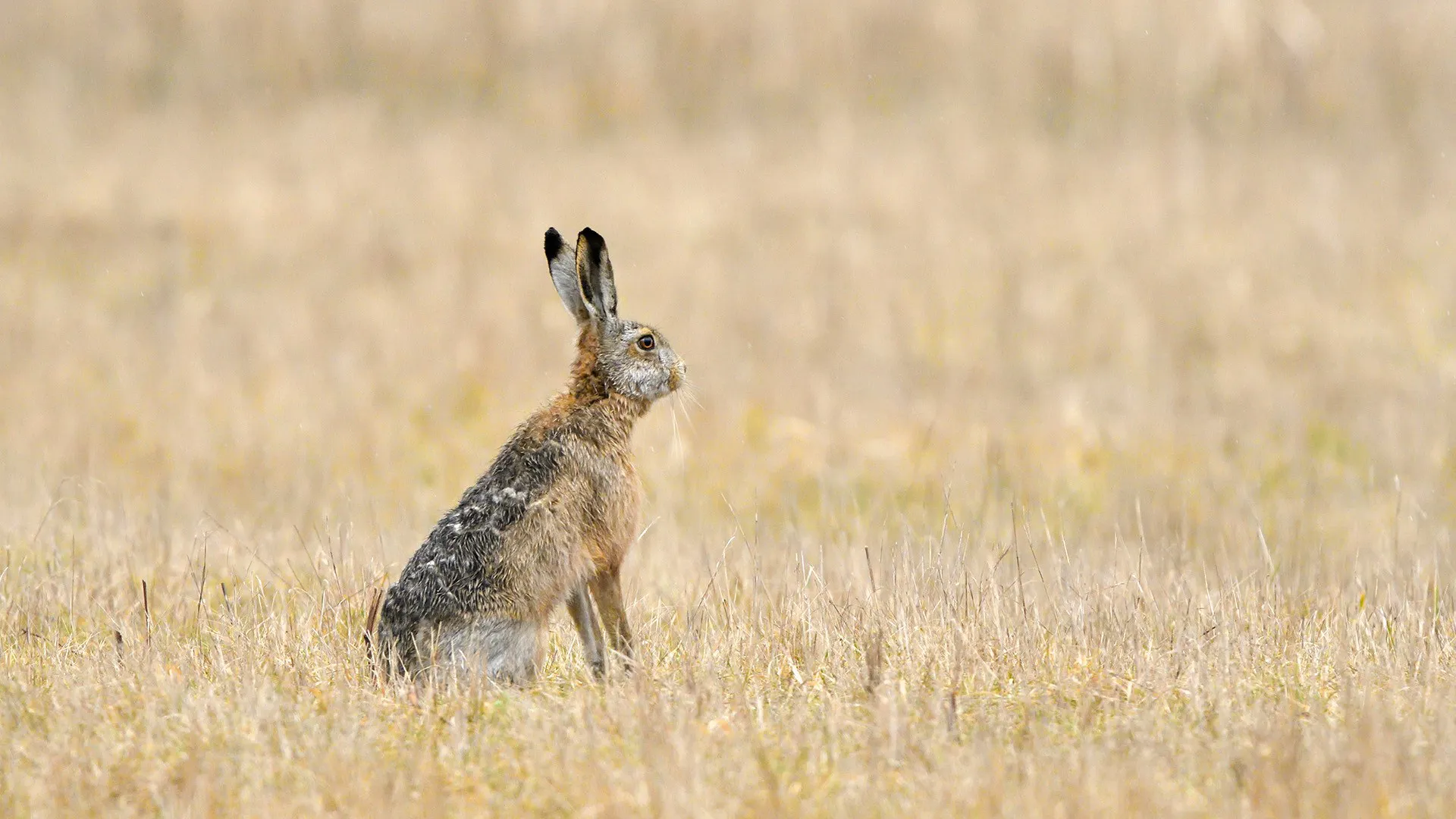
European Hare (Lepus europaeus) in the Danube Delta
The European hare is a familiar but often overlooked mammal of the Danube Delta and Dobrogea. Discover how it survives in open landscapes, why it never digs a burrow, and what makes this remarkable runner so well adapted to life in the wild.
At the edge of a field, where short grass meets a strip of reeds or a line of shrubs, a pair of long ears may be the only thing visible above the vegetation. The European hare rarely needs a burrow or a hiding place underground. It rests in a shallow depression in the ground, relying on stillness, camouflage and an extraordinary ability to run. In the Danube Delta, it belongs to a landscape that is easy to overlook: the dry ridges, open meadows and cultivated fields between the wetlands.
Quick facts
- Scientific name Lepus europaeus Pallas, 1778
- Family hares and rabbits (Leporidae)
- Order Lagomorphs (Lagomorpha)
- Head and body length about 55 to 65 cm
- Weight usually 3.5 to 5 kg, varying with season and food availability
- Activity mainly at dusk and during the night, but also active by day
- Diet herbivorous
- In the Danube Delta found on dry ridges, meadows and open ground, as well as around agricultural land
- IUCN Red List Least Concern
Description
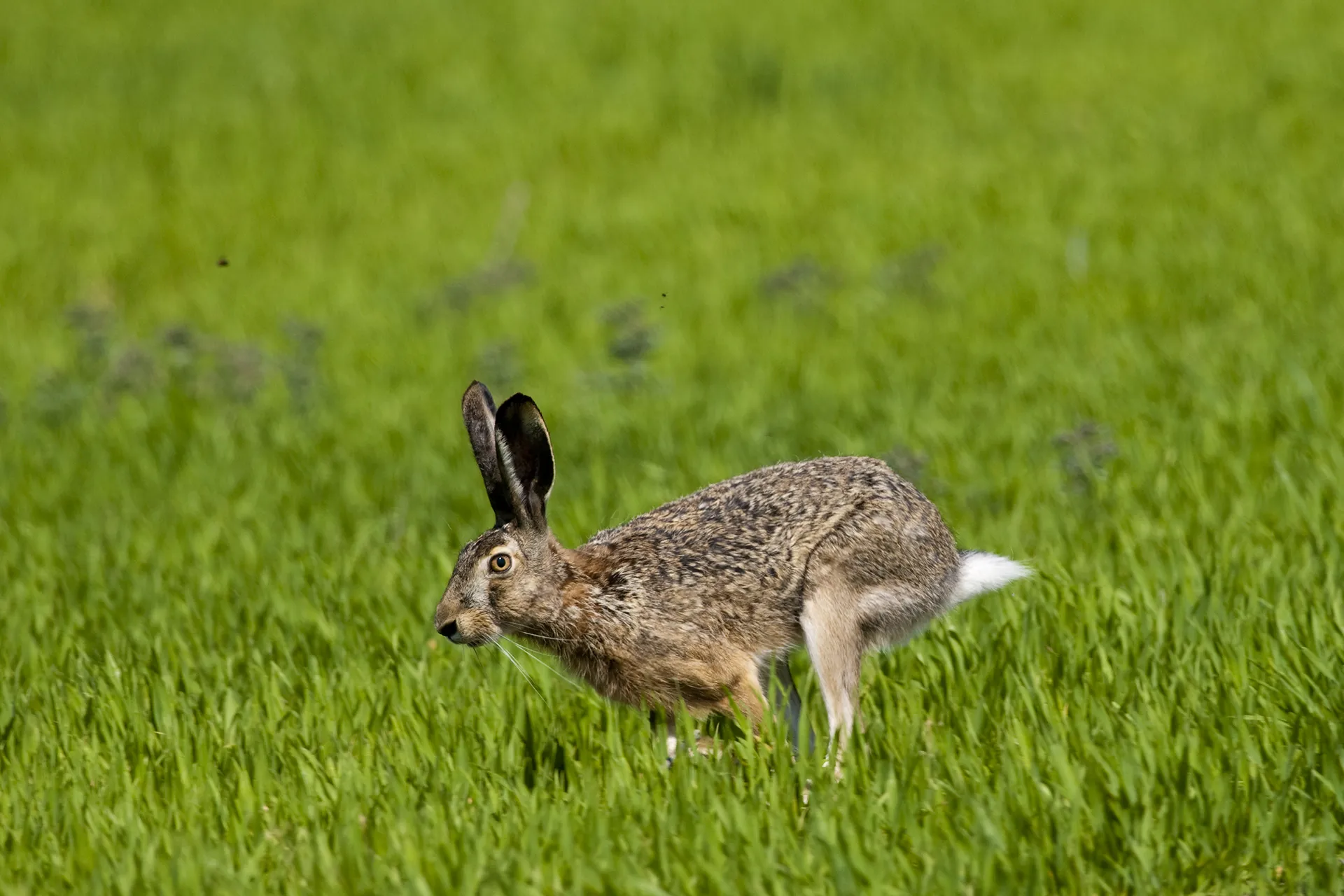
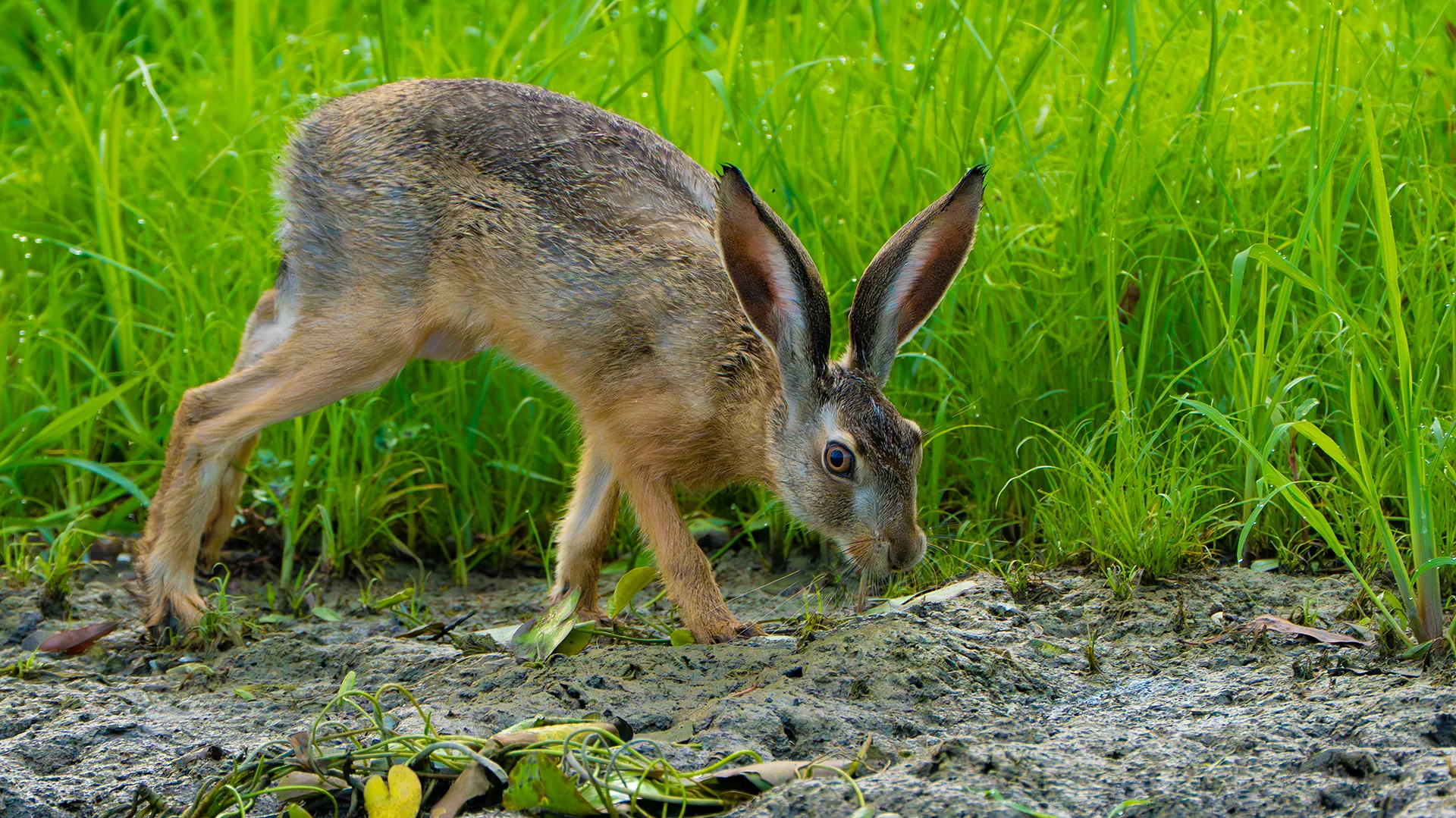
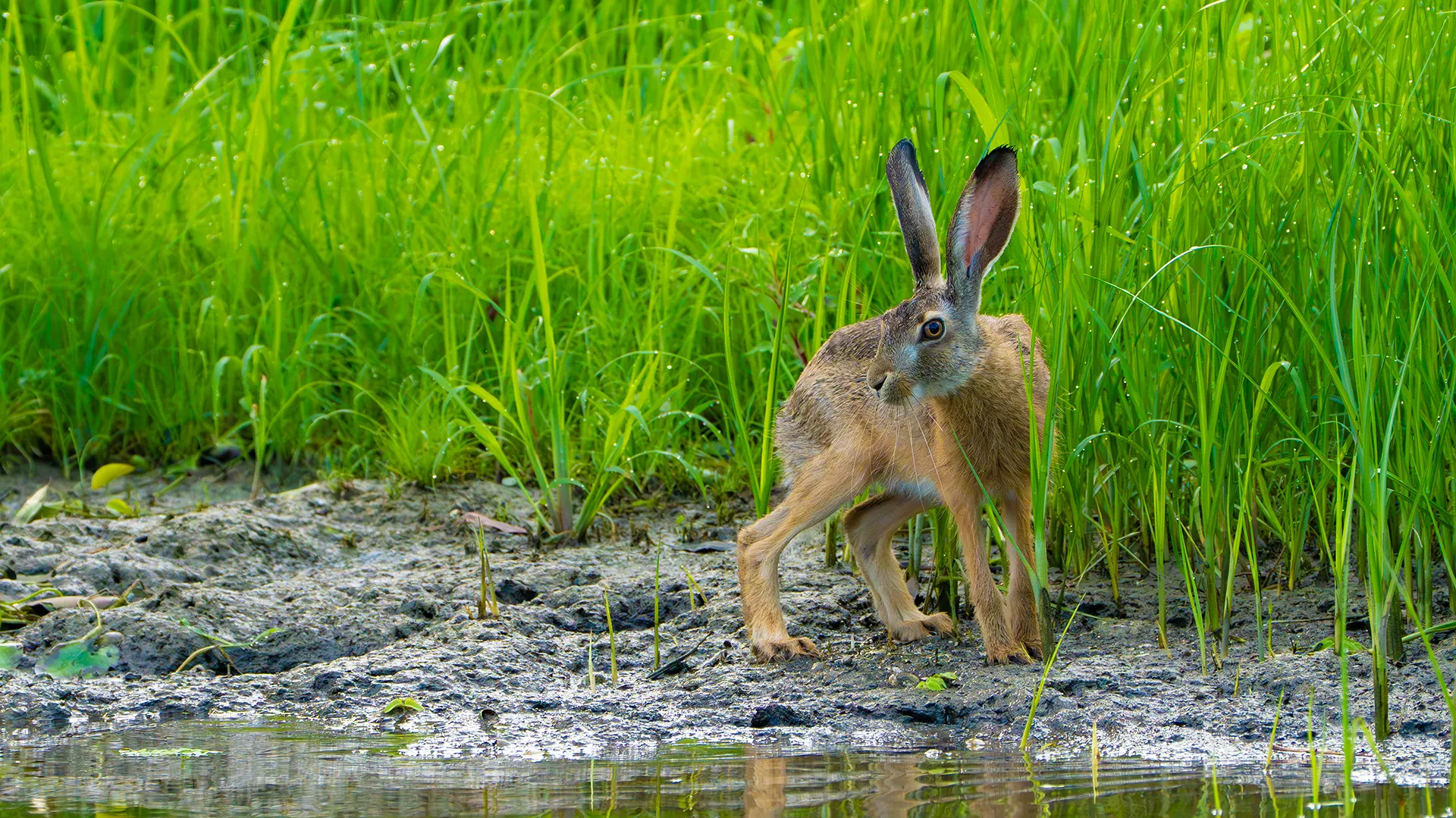
The European hare is one of the largest hares in the world and the largest hare species found in Europe. Its body is slender and muscular, with long, powerful hind legs built for fast running and sudden changes of direction. The ears are long, with distinctive black tips, while the tail is dark on top and white underneath. Its coat varies from yellowish-brown to greyish-brown, with a paler underside. This colouring blends remarkably well with dry grass, bare soil and the muted colours of open fields.
Unlike the mountain hare, the European hare does not turn white in winter. Its coat may become a little greyer and denser, but it remains broadly the same colour throughout the year. Seasonal changes in weight are often more noticeable: hares can be heavier in autumn, when food is abundant, than they are after winter.
The long ears are not simply a characteristic feature of its appearance. They help the hare detect sounds from a considerable distance, while its large eyes provide a wide field of vision. Together with a highly developed sense of smell, these senses make it difficult to approach a hare without being noticed.
Subspecies: what kind of European hare lives in Romania?
The taxonomy of the European hare is not entirely settled. Several subspecies have been described across its extensive range, based largely on geographical distribution and differences in external appearance. Among the names historically associated with this part of Europe are Lepus europaeus karpathorum and Lepus europaeus transsylvanicus.
The name L. e. karpathorum has been used in some recent field records for European hares observed in Romania, including Dobrogea. However, this does not establish that every hare in the Danube Delta belongs to that subspecies. A mitochondrial DNA study published in 2018 found several genetic lineages of European hare in Central and Eastern Europe. It also showed that hares from eastern Romania can carry haplotypes belonging to the Anatolian/Middle Eastern lineage, alongside the wider European genetic diversity.
These genetic lineages do not correspond automatically to the traditional named subspecies. In the absence of a genetic study specifically covering the Danube Delta population, the most scientifically cautious identification is Lepus europaeus, the European hare, without assigning a confirmed local subspecies.
For further reading: Large-scale mitochondrial DNA analysis reveals new light on the phylogeography of Central and Eastern-European Brown hare, published in PLOS ONE in 2018.
Habitat: the dry ground of a wetland landscape
The European hare is primarily an animal of open country. It favours grasslands, meadows, agricultural fields, steppe-like habitats and open areas with patches of vegetation that provide food and shelter. It generally avoids dense forest, although it may use woodland edges, hedgerows and scrub for cover.
At first glance, the Danube Delta might seem an unlikely place for a species associated with open farmland and grassland. Much of the Delta is covered by water, reed beds and wet habitats, but it also contains a network of higher, drier ground. River and lake banks, natural levees, sandy ridges and the open areas around villages provide suitable places for hares.
In the wider Dobrogea region, the species also occupies agricultural land, dry grasslands and steppe-like habitats. Here, the open landscape offers good visibility and plenty of feeding opportunities, while small patches of shrubs and taller vegetation provide places to rest and hide.
Behaviour: a life spent above ground
One of the most interesting differences between hares and rabbits is the way they use the ground. European hares do not dig burrows. Instead, they rest in shallow depressions known as forms, which they make by pressing their bodies into the vegetation or soil. A form is little more than a sheltered hollow, often difficult to recognise unless the animal is still sitting in it.
During the day, a hare may remain motionless in its form, with its ears laid back and its body pressed close to the ground. Its brown coat makes it surprisingly difficult to see, even in relatively short vegetation. It usually waits until danger is very close before escaping. This behaviour is sometimes mistaken for fear or sluggishness, but it is an effective strategy: moving too early would make the animal easier to detect.
When it finally runs, the change is remarkable. The hare can accelerate quickly, reach speeds of around 60 km/h and make sharp turns that make it difficult for a predator to follow. Its long hind legs are responsible for much of this performance, but endurance and the ability to change direction are just as important as straight-line speed.
European hares are mostly solitary outside the breeding season. They are generally more active around dusk and at night, when they leave their resting places to feed. However, they can also be seen during daylight, especially in quiet areas or during the breeding season.
Diet: grasses, herbs and winter food
The European hare is a strict herbivore. Its diet includes grasses, leaves, wild herbs and cultivated plants, with the exact choice depending on what is available in each season. It often selects young, nutritious vegetation, including clover and other plants growing among grasses and crops.
In winter, when fresh vegetation is scarce, hares turn to tougher food such as twigs, buds and the bark of young trees and shrubs. This seasonal flexibility helps them survive in landscapes where food availability changes considerably throughout the year.
Like rabbits and several other herbivorous mammals, hares practise caecotrophy: they re-ingest special soft droppings produced during digestion. This allows them to extract additional nutrients from plant material that has already passed through the digestive system. It may not be the most appealing detail of hare biology, but it is an efficient way to make the most of a plant-based diet.
Reproduction: leverets born ready for the world
The breeding season can begin as early as January or February and may continue into summer. During this period, hares become more visible, and their behaviour can be quite different from the quiet, solitary routine of the rest of the year. Males may chase females across open ground, and two hares sometimes rise on their hind legs and strike each other with their forepaws. This familiar behaviour is often called boxing.
After a pregnancy of approximately 41 to 42 days, the female gives birth in a sheltered place among vegetation. Unlike rabbits, hares do not give birth in underground nests. The young, known as leverets, are born fully furred, with their eyes open and the ability to move shortly after birth. They are therefore much more developed than newborn rabbits.
A female can produce several litters during a favourable breeding season. The young are usually born separately in small, sheltered places rather than gathered in a deep nest. Their mother visits them for short periods to nurse them, often only once or twice a day. The rest of the time, the leverets remain apart and motionless, reducing the chance that a predator will find the entire litter.
This is why a young hare found alone in grass should not be picked up or moved. Its mother is probably nearby and will return when it is time to feed. Human intervention, even when well intentioned, can do more harm than good.
Predators and survival
Despite its speed, the European hare has many natural enemies. Foxes, golden jackals and wolves may hunt adult hares, while birds of prey can take young animals. Leverets are particularly vulnerable during their first weeks of life, when remaining hidden is their main defence.
In the Danube Delta and Dobrogea, the combination of open ground and patches of vegetation creates both opportunities and risks. Hares can detect approaching predators across open areas, but they also need enough cover to remain unnoticed while resting. Their survival depends on this balance between visibility, shelter and the ability to escape quickly.
Interesting facts
- It never digs a burrow. A hare rests above ground in a shallow hollow called a form. Even when giving birth, the female does not build an underground nest.
- Its eyes are open from birth. Leverets are born covered in fur, with their eyes open and their bodies ready for movement. This is one of the main differences between hares and rabbits.
- It can swim. Although it is not an aquatic mammal, the European hare can swim when it needs to cross water or escape danger.
- It does not turn white in winter. Its coat may become greyer, but the European hare keeps its brown colouring throughout the year.
- It can box. During the breeding season, hares sometimes stand on their hind legs and strike with their forepaws. These encounters are often between a female and a persistent male, rather than simply fights between two males.
- It is not a rabbit. Hares and rabbits belong to the same family, but they differ in body shape, behaviour, reproduction and the way they raise their young.
When and where to see the European Hare in the Danube Delta
The European hare can be found in the Danube Delta throughout the year, although seeing one is never guaranteed. It is most likely to be encountered in open areas on dry ground: along natural levees, on grassy banks, near the edges of reed beds and around the agricultural land surrounding Delta villages.
Early morning and late afternoon are good times to look for hares, when they may be feeding or moving between resting places. In the middle of the day, they often remain hidden in their forms, where their camouflage makes them very difficult to spot. Spring can be particularly interesting, as breeding activity sometimes brings hares into the open.
When travelling through the Delta, look beyond the water and the reed beds. The higher banks and open patches of land are part of the same ecosystem, and they support mammals that are easy to miss if all our attention is focused on the wetlands. A quiet approach and a little patience are often more useful than trying to get closer.
You can explore these habitats on our Danube Delta wildlife tours, together with a local naturalist guide. Browse more species in our guide to the mammals of the Danube Delta and Dobrogea.
See it with us
Slow open boats, small groups and a guide who knows the places and the wildlife. From a few hours on the water to a week in the Danube Delta and Dobrogea.
Keep reading
Keep reading
More from the blog

9 min read
Muskrat (Ondatra zibethicus)
The muskrat is a semi-aquatic rodent from North America that has lived in the Danube Delta since the 1950s. Discover how it swims, feeds,...
9 min read
Red Fox (Vulpes vulpes)
The red fox is one of the most adaptable mammals in the Danube Delta, living among reed beds, dry ridges and village edges. Discover...

7 min read
Eurasian Otter (Lutra lutra): the Fisherman of the Danube Delta Channels
The Eurasian otter, the fisherman of the Danube Delta: how it lives in the channels, its long history beside people on the Lower Danube,...