

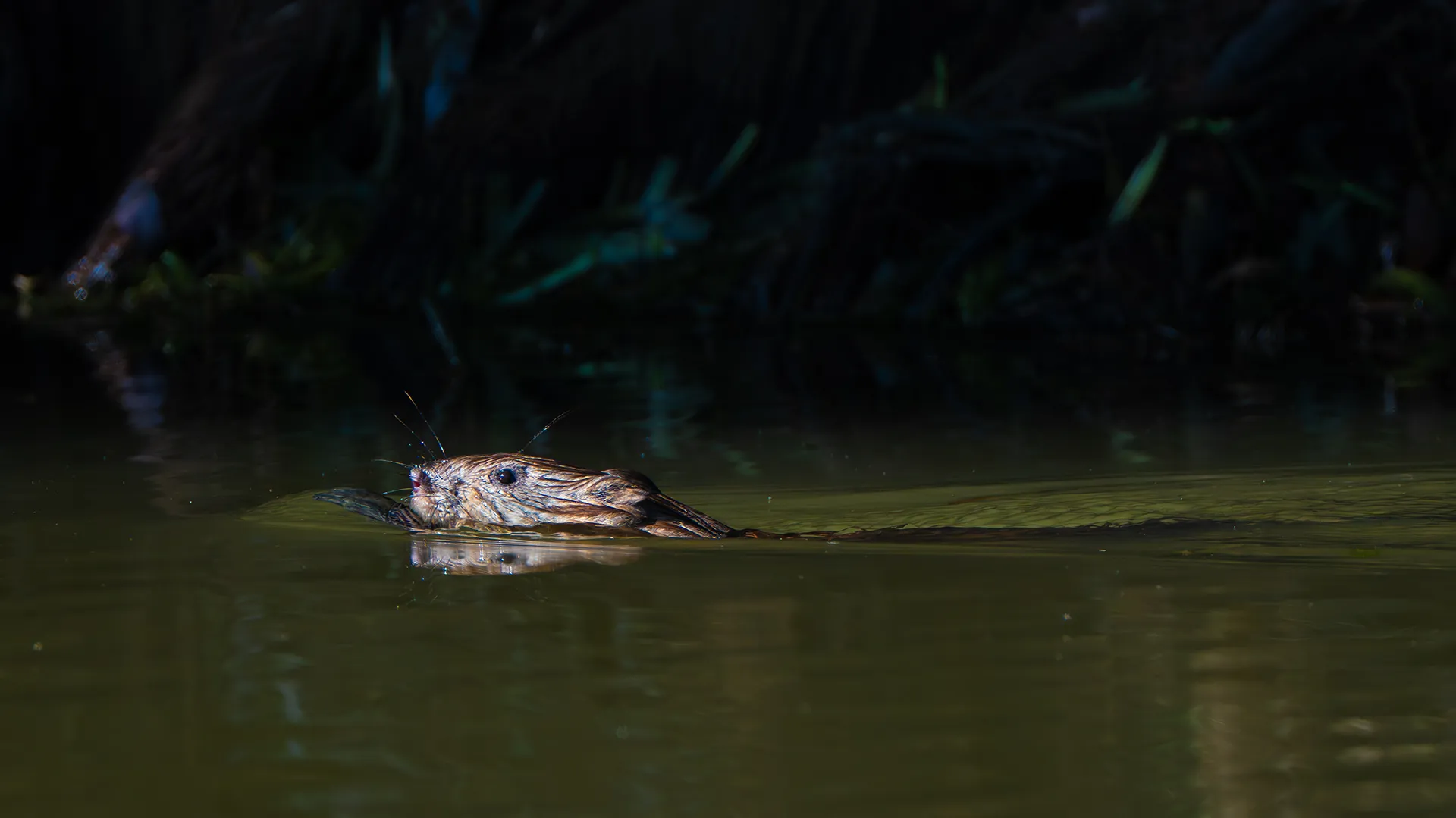
Muskrat (Ondatra zibethicus)
The muskrat is a semi-aquatic rodent from North America that has lived in the Danube Delta since the 1950s. Discover how it swims, feeds, builds its lodges and became a familiar, yet non-native, inhabitant of Europe's wetlands.
A small brown head breaks the surface of a quiet channel, followed by a rounded back and a long, thin tail trailing behind. The animal swims steadily towards the reeds, disappears for a moment and emerges a little further along the bank. This is the muskrat, a semi-aquatic rodent from North America that has become a familiar part of the Danube Delta. It is not native to Europe, but it has lived in these wetlands for more than seventy years, quietly shaping the banks and vegetation along the water.
Quick facts
- Scientific name Ondatra zibethicus (Linnaeus, 1766)
- Family Cricetidae
- Order rodents (Rodentia)
- Origin North America
- Total length about 40 to 67 cm, including the tail
- Weight usually 0.6 to 2 kg
- Activity mainly at dusk and during the night, but also active by day
- Diet primarily aquatic plants
- In the Danube Delta recorded since 1951
- Conservation status Least Concern globally; an invasive alien species of Union concern in the European Union


Description
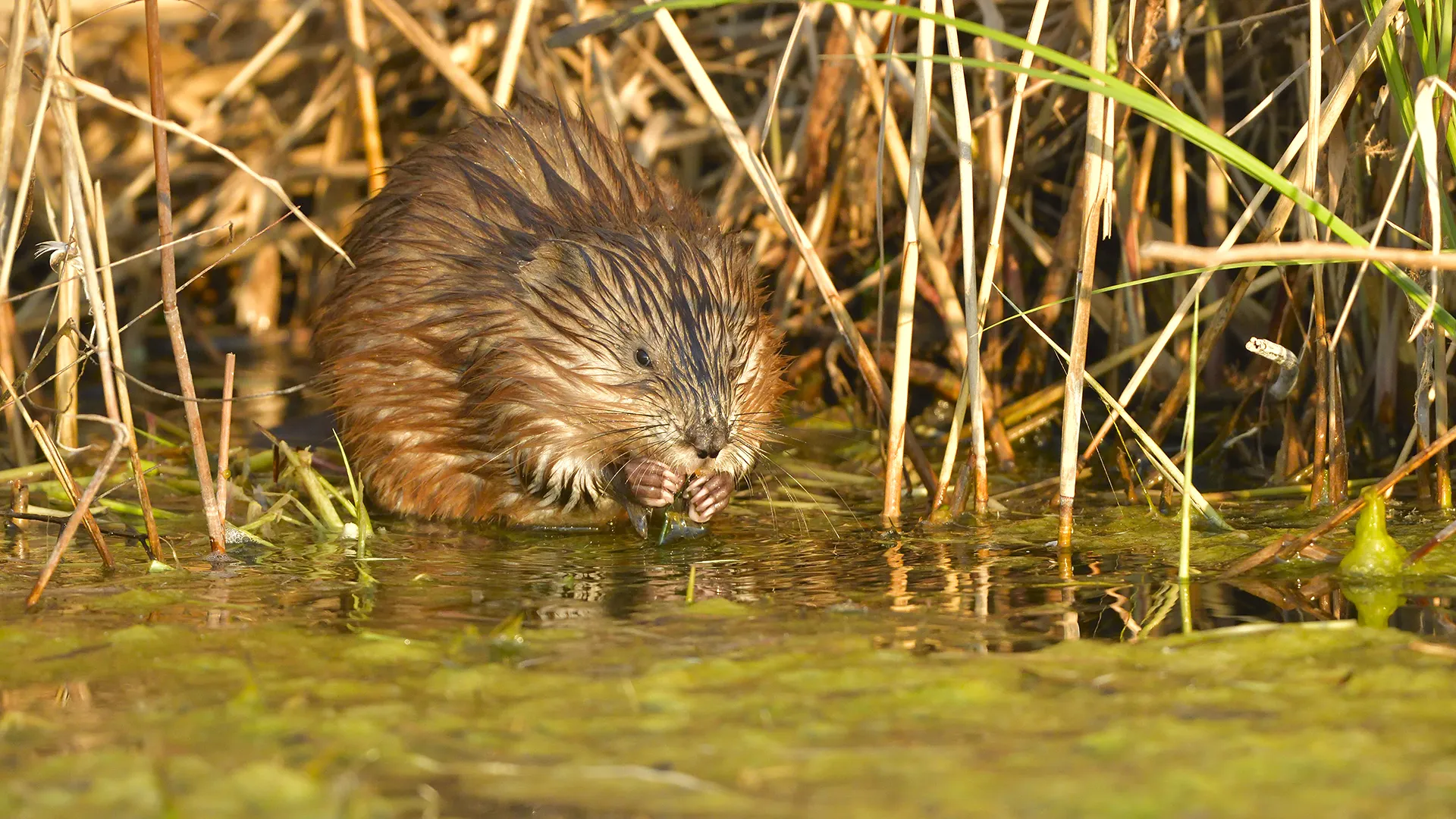
The muskrat is a medium-sized, stocky rodent with dense, waterproof fur, usually dark brown on the back and lighter on the underside. Its head is broad, with small eyes and short, rounded ears that are almost hidden in the fur. Long whiskers help it navigate among vegetation and along the muddy banks where it spends much of its time.
Its most distinctive feature is the tail: long, thin, almost hairless and flattened from side to side. It works like a rudder when the animal swims, helping it steer through narrow channels and dense aquatic vegetation. The hind feet are adapted for swimming, with a fringe of stiff hairs along their edges, while the strong front feet and claws are used for digging.
The muskrat has another useful adaptation for feeding underwater. Its lips can close behind the incisors, allowing it to gnaw on plant material while submerged without taking in water. It can remain underwater for several minutes, and some sources report dives lasting up to around 20 minutes.
From North America to the Danube Delta
The muskrat is native to North America, where its natural range extends across much of Canada and the United States. It was introduced to Europe in the early twentieth century, mainly for fur farming. Animals escaped from farms or were deliberately released, and the species spread rapidly through suitable wetlands and river systems.
In Romania, the muskrat arrived by more than one route. It was recorded in the western part of the country in the late 1930s, following escapes from fur farms in Central Europe. A second introduction brought it to the Danube Delta in 1951, from where it became established in the wetlands of the Lower Danube.
Its presence in the Delta has been documented for decades. Records include observations near Sulina and Maliuc, as well as around Fortuna Lake and Ciobănița Lake. A review of the Delta’s mammal fauna published in 2020 describes the muskrat as a constant presence on the canals, although its population is now much smaller than it was during the 1970s, when intensive hunting for its fur was still practised.
Today, the muskrat is part of the everyday wildlife of the Delta’s channels and lakes. Its North American origin is a reminder that not every familiar animal in a European wetland is native to the continent.
Life along the water
Muskrats are closely associated with freshwater habitats that offer abundant vegetation and relatively sheltered banks. They live along canals, lakes, ponds, marshes and slow-moving rivers, where reeds, sedges and other aquatic plants provide both food and building material.
They usually make their homes in one of two ways. Where the banks are suitable, they dig burrows into the shoreline, with entrances often located below the waterline. In areas with softer or flatter banks, they build dome-shaped lodges from reeds, sedges, roots and mud. These structures rise above the water and provide a dry, protected place to rest and raise their young.
A muskrat lodge is smaller and less substantial than a beaver lodge. It is made mainly from soft marsh vegetation rather than branches and logs. From a boat, it may look like a rough mound of reeds and mud, sometimes difficult to distinguish from other accumulations of vegetation along the water’s edge.
Muskrats also create narrow paths through the vegetation as they move between feeding areas and their shelters. These trails, together with feeding remains and small droppings deposited in groups, can reveal the presence of an animal even when it is not visible.
Diet: a life built around aquatic plants
The muskrat is primarily herbivorous. Its diet consists mainly of aquatic and waterside vegetation, including the roots, stems and leaves of reeds, cattails, sedges, bulrushes and water lilies. Roots and underground plant parts are particularly important because they remain available even when much of the vegetation above the water has dried or disappeared.
It often feeds close to its shelter, carrying plant material to a favourite feeding spot or eating directly in the water. The remains of cut stems and partially eaten roots along a bank are among the signs that a muskrat has been active in the area.
Although plants make up most of its diet, the muskrat may occasionally eat animal matter, including mussels, crayfish, snails, frogs or fish, particularly when plant food is scarce. This is not its usual feeding strategy, however: it remains a rodent adapted mainly to a diet of aquatic vegetation.
Reproduction: several litters in a year
Muskrats have a high reproductive potential, which has helped the species establish itself across a large part of Europe. In favourable conditions, breeding can take place over much of the warmer part of the year. The gestation period lasts approximately 25 to 30 days, and a typical litter contains four to eight young, although litter size can vary.
Depending on the climate and the availability of food, a female may produce several litters in a single year. The young are born blind and almost hairless, inside a sheltered nest in a burrow or lodge. They develop quickly, begin moving around within their first two weeks and are usually weaned after about a month.
The female provides most of the early care, keeping the young warm and feeding them until they can leave the nest. As they grow, the young begin to explore the water and nearby vegetation. In a productive wetland, this rapid cycle of reproduction can allow muskrat numbers to increase considerably when conditions are favourable.
An invasive species and its impact on wetlands
The muskrat is classified as an invasive alien species in Europe because it was introduced outside its natural range and can affect the habitats it occupies. It is included on the European Union’s list of invasive alien species of Union concern.
Its impact comes mainly from the way it feeds and builds its shelters. Intensive feeding can reduce stands of aquatic vegetation, while burrowing may weaken riverbanks, canal embankments and dykes. In some places, this can contribute to erosion, damage to water-management structures and changes in the vegetation of wetlands.
At the same time, the muskrat is not simply an animal that destroys its habitat. Like other species that modify their surroundings, its activities can change the structure of wetland vegetation and create openings in dense stands of plants. The scale of these effects depends on local population density, water conditions and the availability of food.
Its global conservation status is listed as Least Concern by the IUCN, reflecting its extensive range and large populations in its native and introduced territories. This does not mean that its introduction into European ecosystems is harmless. A species can be common and secure globally while still having significant ecological or economic impacts in the places where it has been introduced.
How to distinguish a muskrat from a coypu or a beaver
In the Danube Delta, three semi-aquatic rodents can cause confusion: the muskrat, the coypu and the Eurasian beaver. Their size, tail and swimming behaviour are the easiest clues to look for.
- Muskrat: the smallest of the three, usually weighing less than 2 kg. It has a long, thin tail flattened from side to side and small, rounded ears. When swimming, much of its back remains above the water.
- Coypu: considerably larger, often several times heavier than a muskrat. It has a long, rounded, sparsely haired tail, prominent white whiskers and large orange-yellow incisors that are often visible.
- Eurasian beaver: much larger and heavier, with a broad, flattened, paddle-shaped tail and large webbed hind feet. Its presence is also revealed by gnawed trees and, in some places, dams or substantial lodges.
When seen briefly from a boat, size can be difficult to judge. The tail is often the most useful feature: a muskrat has a narrow, laterally flattened tail, a coypu has a rounded one, and a beaver has a broad, flat paddle.
Interesting facts
- It is not a true rat. Despite its common name and superficial resemblance to a large rat, the muskrat belongs to the family Cricetidae, the same family that includes voles and hamsters.
- Its tail is a rudder. The laterally flattened tail helps it steer while swimming, making it particularly useful in narrow channels and among dense reeds.
- It can close its lips behind its teeth. This unusual adaptation allows it to gnaw on vegetation underwater without filling its mouth with water.
- It builds its own island-like shelter. In suitable habitats, a muskrat lodge is made from vegetation and mud and rises above the water, with its entrance hidden below the surface.
- It has scent glands. The animal has musk-producing glands near the base of its tail, which it uses in scent marking. This is the origin of the name muskrat.
- It can stay underwater for several minutes. Its aquatic adaptations allow it to dive and move beneath the surface while feeding or escaping danger.
When and where to see the muskrat in the Danube Delta
The muskrat lives in the Danube Delta throughout the year. It can be found along canals, lakes and marshes where banks are suitable for burrowing and aquatic vegetation provides food. It has been recorded in several parts of the Delta, including the areas around Sulina, Maliuc and the lakes near Fortuna.
It can be seen at different times of the day, although early morning and late afternoon are often good moments to watch for movement along the water’s edge. Look for a small brown animal swimming close to the reeds, a narrow wake moving through floating vegetation, or a muskrat sitting on the bank while feeding.
Muskrats are usually cautious and will dive when approached too closely. A quiet boat and a little patience may allow you to watch one swimming, feeding or returning to its burrow. Their lodges and feeding signs are also worth looking for, especially in areas with dense aquatic vegetation.
The muskrat is not one of the Delta’s largest or most spectacular mammals, but it is an interesting part of the wetland ecosystem. Its story also reminds us that the wildlife we encounter today is shaped not only by natural processes, but sometimes by human decisions made many decades ago. Browse more species in our guide to the mammals of the Danube Delta and Dobrogea.
See it with us
Slow open boats, small groups and a guide who knows the places and the wildlife. From a few hours on the water to a week in the Danube Delta and Dobrogea.
Keep reading
Keep reading
More from the blog

7 min read
The Golden Jackal (Canis aureus moreoticus)
History, Myth, and Modern Life in the Wild East of Romania Let’s get one thing straight from the start — this isn’t a safari...
9 min read
Red Fox (Vulpes vulpes)
The red fox is one of the most adaptable mammals in the Danube Delta, living among reed beds, dry ridges and village edges. Discover...
9 min read
Raccoon Dog (Nyctereutes procyonoides): the Night Wanderer of the Danube Delta
A canid from the far east of Asia that walked all the way to the Danube Delta: how the raccoon dog arrived, how it...