

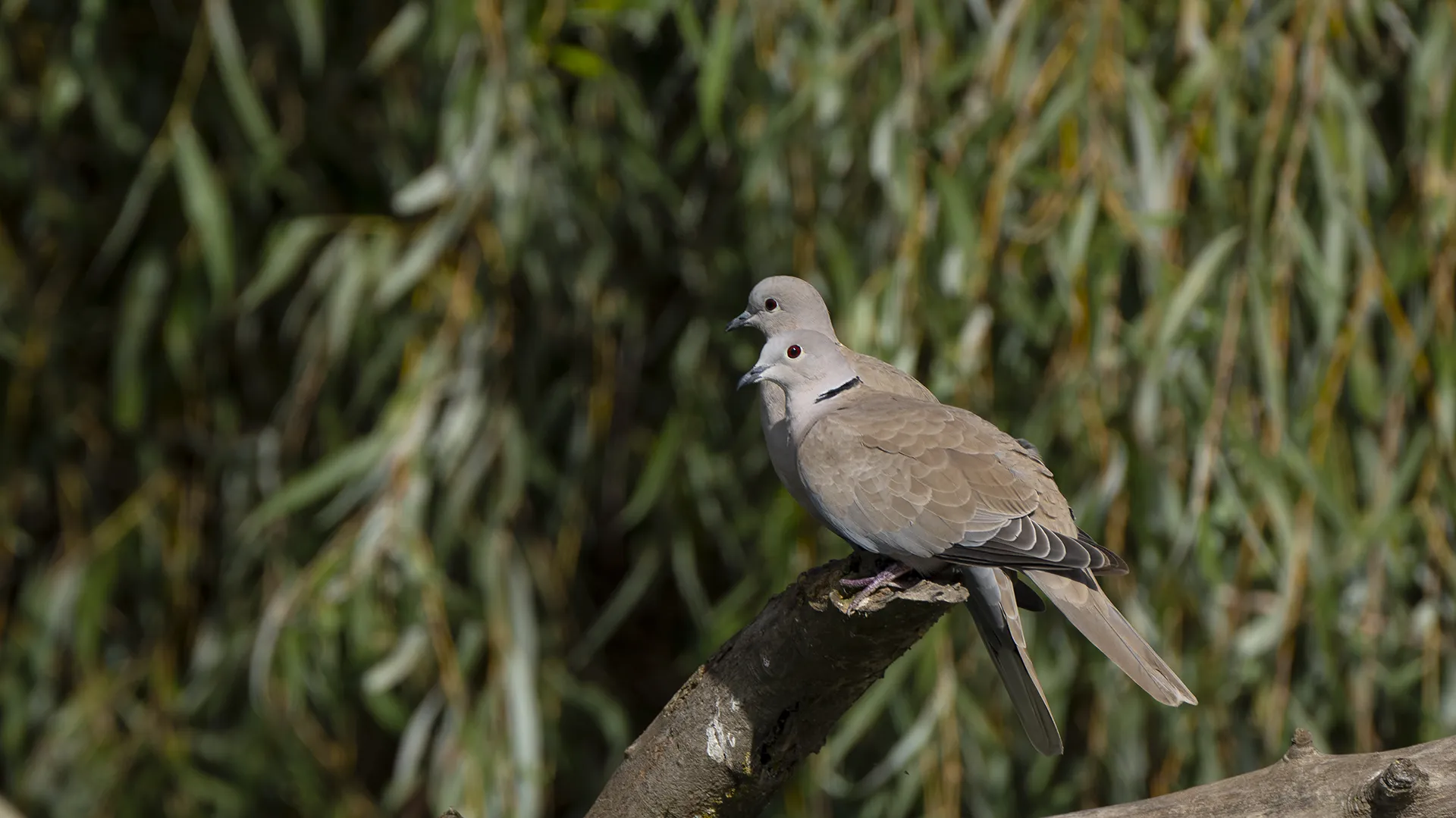
No. 55 on our checklistEurasian Collared Dove (Streptopelia decaocto)
Unknown in most of Europe 200 years ago, the Eurasian Collared Dove now lives in every Danube Delta village: identification, spread, breeding and legend.
The Eurasian Collared Dove (Streptopelia decaocto) is the pale, sandy-gray dove with a black half-collar that coos from TV aerials, poplars and garden fences in every village of the Danube Delta and Dobrogea.
It seems as if it has always been here, but it is a newcomer. Two hundred years ago it was unknown in most of Europe, and its spread across the continent in the 20th century is one of the most spectacular colonizations by any bird.
Quick facts
Quick facts
- Scientific name Streptopelia decaocto (Frivaldszky, 1838); originally described as Columba risoria var. decaocto
- Common name Eurasian Collared Dove; also Collared Dove
- Family Columbidae (pigeons and doves)
- Order Columbiformes (pigeons and doves)
- Length 31–33 cm
- Wingspan 51 cm
- Weight 200 g
- Diet mainly seeds and grain, also buds, shoots and berries; often feeds around farms, grain stores and gardens
- Habitat villages, towns, farms, parks and gardens with trees; rarely far from human settlements
- Breeding several nesting attempts in a long breeding season; almost always 2 eggs, incubated by both parents for 16–17 days; the young leave the nest at 17–19 days
- Conservation status Least Concern (global IUCN Red List); Least Concern on the Romanian Red List (2022); a game species in Romania
When to see it in the Danube Delta and Dobrogea
- JanPairs together
- FebCooing, first nests
- MarNesting
- AprNesting
- MayNesting
- JunNesting, young
- JulNesting, young
- AugLate broods
- SepLate broods, flocks
- OctFlocks
- NovFlocks at grain
- DecFlocks at grain
- Status here
- Resident all year in villages and towns; breeds over a very long season.
- IUCN Red List
- Least Concern
- Our checklist
- No. 55 of 385 · see the full checklist
How to recognize it
The Eurasian Collared Dove is a slim, long-tailed dove, pale gray-buff with a pinkish tinge to the head and breast. The narrow black half-collar on the back of the neck, edged with white, is the best field mark. The wing tips are darker gray, and from below the tail shows a broad white end and a black base. Juveniles lack the collar at first.
The call is a soft, three-note “coo-COO-coo”, repeated many times, with the stress on the middle note. In flight, especially when landing, the bird also gives a nasal, mewing “kwurr”.
The European Turtle Dove, a summer visitor to the Danube Delta, is smaller and darker, with rich orange-brown, black-centered feathers on the wings and a black-and-white striped patch on the side of the neck.
A dove that conquered Europe
The species is native to South Asia. By 1800 it was already common in parts of Central Asia, Turkey and the Balkans, but it was unknown in central and western Europe. Its numbers in the Balkans dropped in the 19th century and recovered by about 1930. After that, the dove spread north-west across Europe at remarkable speed.
It first appeared in Britain in 1955, with just four birds. By 1970 there were at least 15,000–25,000 pairs. Around 1986 it crossed from Spain to North Africa, and with human help it has also become common in North America.
In Romania the first reliable records in the ornithological literature date from the early 1930s, in the south of the country. Today the Collared Dove breeds in practically every settlement. National estimates based on the Common Bird Monitoring programme give 1–3 million pairs.
Life in the villages of the Danube Delta
In the Danube Delta and Dobrogea, the Collared Dove lives wherever people live: in Tulcea, in the fishing villages along the branches of the Danube, around farms and grain stores, and in the gardens of holiday houses. Pairs stay together all year and defend the area around their nest.
The nest is a flimsy platform of twigs placed in a tree, on a building or even on a pylon. Both parents incubate the two eggs and feed the young. Like other pigeons, they produce “crop milk”, a rich secretion from the lining of the crop, for their newly hatched chicks. Because they can raise several broods over a long season, the young may be seen almost all year round.
Interesting facts
- The dove that says “eighteen”. The name decaocto means “eighteen” in Greek. According to a legend, a poor servant girl was paid only eighteen coins a year, and Zeus created the dove to proclaim her low wage to the world. In many Balkan languages, including Romanian (“opt-spre-zece”), the word for eighteen has three syllables, just like the dove’s call.
- Described from the Balkans. The species was named in 1838 by the Hungarian naturalist Imre Frivaldszky, from specimens collected in 1835 in Plovdiv, Bulgaria. Because its European range was then under Ottoman rule, its name in many languages means “Turkish dove”, for example Türkentaube in German and Tourterelle turque in French.
- From four birds to hundreds of thousands. The four birds that reached Britain in 1955 started a population that now numbers about 800,000 pairs.
- An anachronism in films. Because the dove reached western Europe only in the second half of the 20th century, its cooing in the background of films set in western Europe before the Second World War is a historical mistake.
- Milk from a bird. Both parents feed the young chicks with crop milk, a nutritious secretion produced in the crop. Among birds, only pigeons and doves, flamingos and some penguins feed their young in a similar way.
Status and conservation
The Eurasian Collared Dove is listed as Least Concern on the global IUCN Red List and on the Romanian Red List (2022). In Romania it increased for a long time and now appears stable, according to the national Common Bird Monitoring programme. It is a game species in Romania.
See it on our tours
On our multi-day photo tours in the Danube Delta, Collared Doves are part of daily village life, perched on fences and roofs near our accommodation. They are easy, patient subjects for practising portraits of birds in soft morning light, before we set off by boat into the reed beds.
See it with us
Our birding guides are biologists and ornithologists who are on the water every day of the year. Small groups, open boats, the best hours of the day.
Keep reading
Keep reading
More from the blog
3 min read
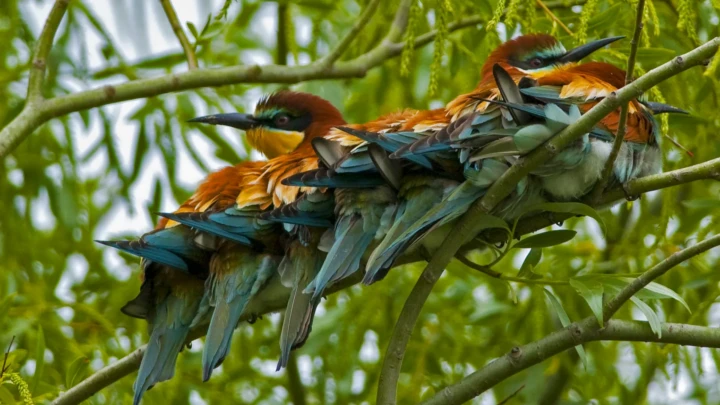
European Bee-eater (Merops apiaster)
The European Bee-eater, one of the most colourful birds in Europe: identification, how it disarms bees, colonies in sand banks and where to see...
4 min read
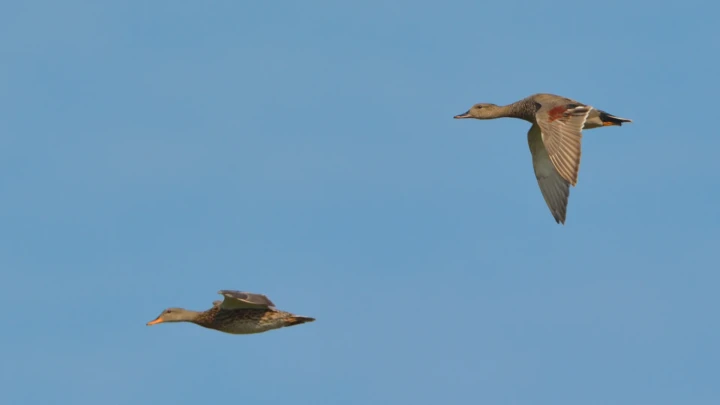
Gadwall (Mareca strepera)
Meet the Gadwall, a plant-eating dabbling duck that steals food from coots: identification, breeding in the Danube Delta, autumn migration and status.
5 min read
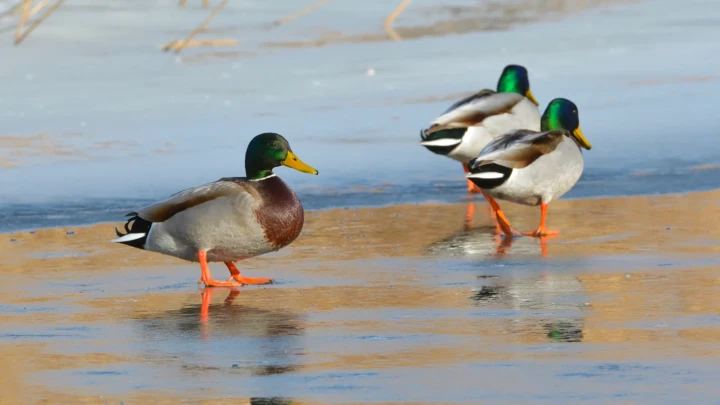
Mallard (Anas platyrhynchos)
The Mallard, the most common duck in the Danube Delta and the ancestor of farmyard ducks: identification, breeding, numbers, one-eyed sleep and changing bills.