

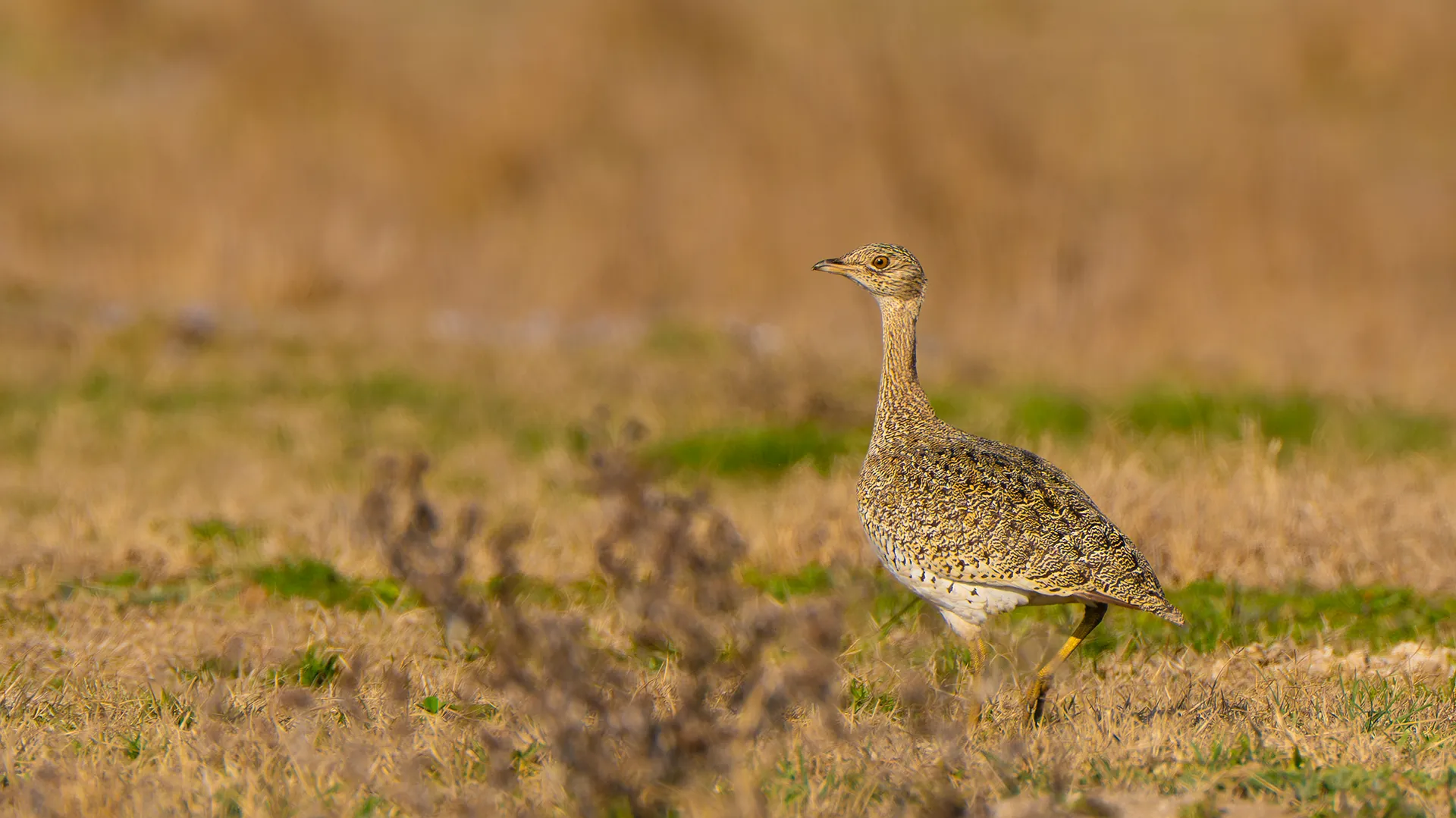
No. 50 on our checklistLittle Bustard (Tetrax tetrax)
The Little Bustard, a rare steppe bird that once bred in Dobrogea: identification, its leaping courtship display, diet and where it still appears in winter.
The Little Bustard is a bird of open steppe, about the size of a hen, whose male displays in spring by leaping into the air with his black and white neck puffed out and his wings flashing. In Romania it once bred in Dobrogea and the Bărăgan plain; today it appears only rarely, in winter or on passage, and every record is an event.
Quick facts
- Scientific name Tetrax tetrax
- Family Otididae (bustards)
- Length 40-45 cm
- Wingspan 83-91 cm
- Weight about 0.7-0.95 kg
- In Romania rare in winter and on passage, mainly in Dobrogea; no longer breeds
When to see it in the Danube Delta and Dobrogea
- JanExtremely rare
- FebExtremely rare
- MarExtremely rare
- AprAbsent
- MayAbsent
- JunAbsent
- JulAbsent
- AugAbsent
- SepAbsent
- OctAbsent
- NovExtremely rare
- DecExtremely rare
- Status here
- Passage migrant. Rare in migration, almost every year in the last 5 years. Rombird.ro: 36 reports in 10 different years since 2014, last in 2025.
- IUCN Red List
- Near Threatened
- Our checklist
- No. 50 of 385 · see the full checklist
Identification
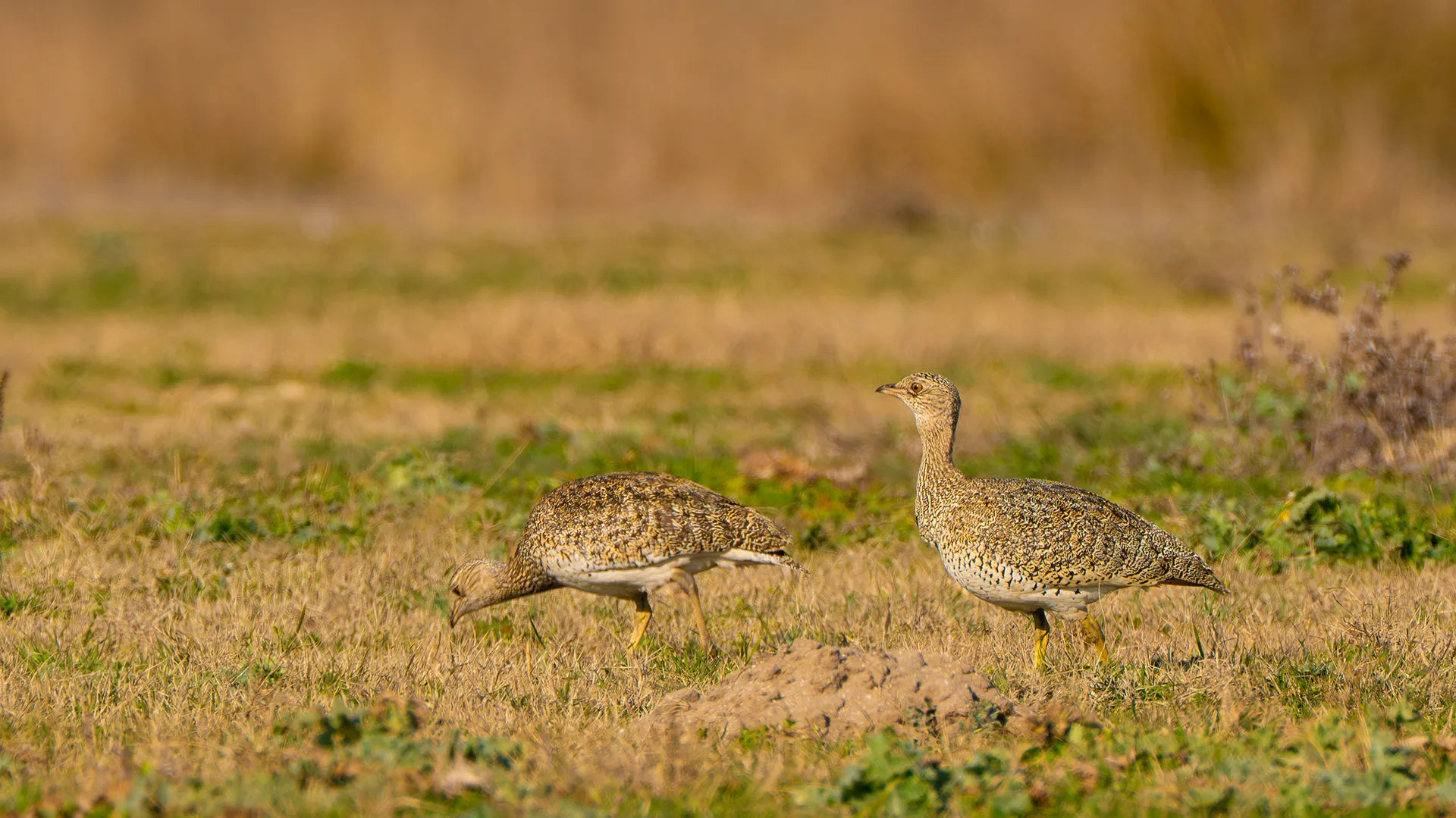
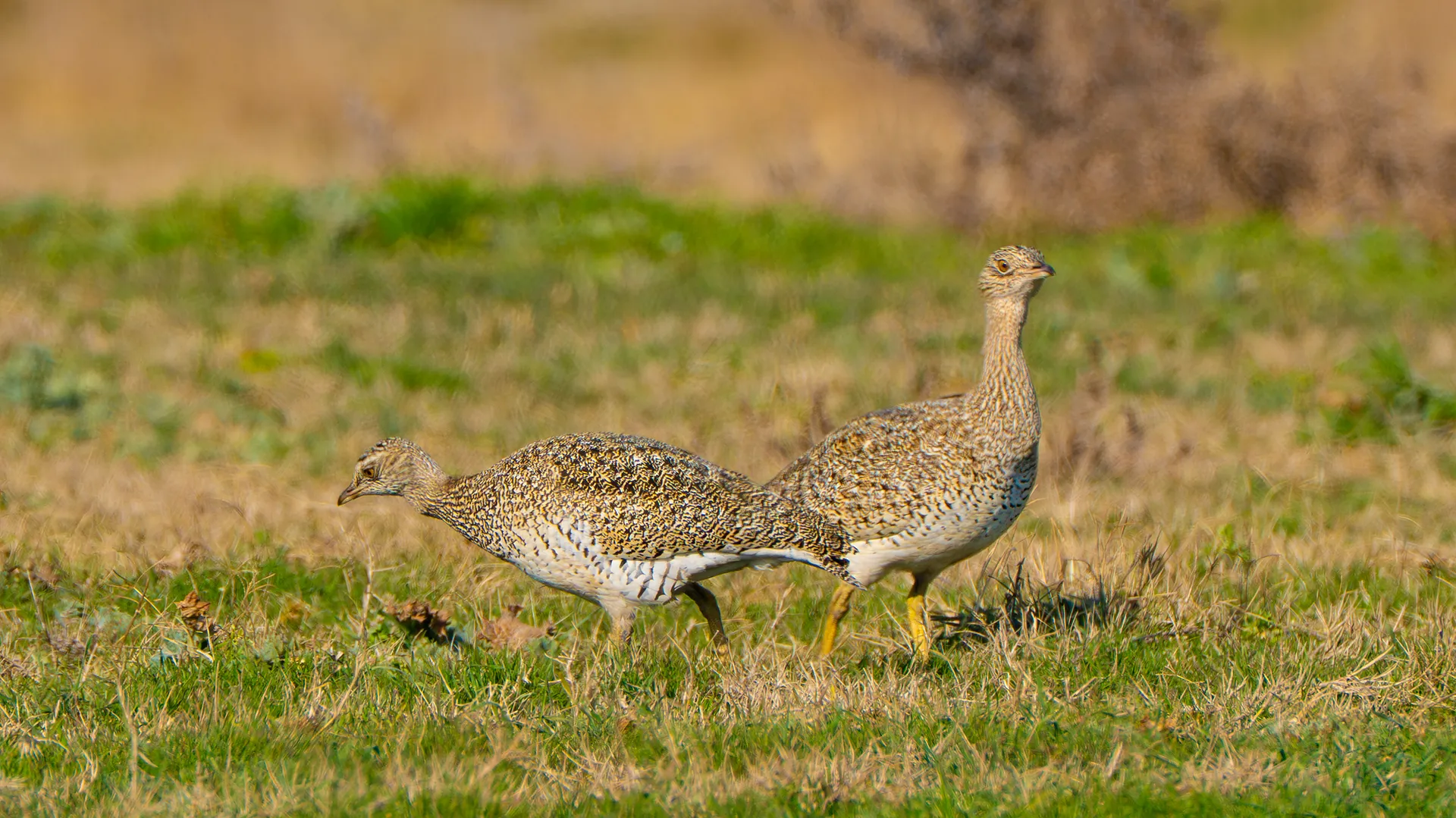
It is a stocky bird with strong legs, a medium length neck and a small head. The upperparts are sandy brown, finely vermiculated with black, a colour that makes it almost invisible in dry grass. The breeding male has a black neck with two white bands forming a V, and a bluish grey face. Females and winter males are sandy and mottled, with no black on the neck.
In flight it changes completely: the wings are largely white with black tips, and from a distance the bird looks white. The male has a shortened flight feather that makes the wings whistle in flight, a sound that gives it away. In winter Little Bustards fly in tight, fast flocks that look like flocks of ducks.
Courtship display
In spring each male chooses a display site, at a distance from the others, and puffs out the black and white feathers of his neck. He gives a short, dry “prrrt” every few seconds and from time to time leaps into the air, stamping his feet and flashing his white wings. Females visit these sites and choose their mate. The nest is a simple scrape in tall grass, where the female lays three or four eggs and incubates them alone for about three weeks.
Diet
The Little Bustard is omnivorous: it eats leaves, shoots, flowers and seeds of steppe plants and lucerne, and in summer, especially the chicks, large insects such as grasshoppers, beetles and ants.
Where and when to see it
In Romania the Little Bustard is now a rarity. It appears in winter or on passage, usually in small flocks, on the fields and grasslands of Dobrogea, often after cold spells that push birds from the steppes north of the Black Sea. You need luck and patience to see one.
Interesting facts
- Whistling wings. The male’s seventh flight feather is much shorter than the others, and his wings produce a distinctive whistle, probably used in display.
- A bird of open country. The Little Bustard needs wide, treeless grasslands where it can see predators from far away.
- The last large populations. The largest European populations are now in Spain and Portugal, and in the east in the steppes of Russia and Kazakhstan.
Status and threats
The Little Bustard is listed as Near Threatened (NT) on the IUCN Red List and is strictly protected in the European Union. In Romania it disappeared as a breeding bird with the ploughing of the steppes and the intensification of agriculture. Ploughing, pesticides, mechanised mowing during the nesting season, power lines and illegal hunting are the main threats.
See it with us
Our birding guides are biologists and ornithologists who are on the water every day of the year. Small groups, open boats, the best hours of the day.
Keep reading
Keep reading
More from the blog
5 min read
Caspian Gull (Larus cachinnans)
Long legs, a small pear-shaped head and a laughing call: how to recognize the Caspian Gull in the Danube Delta, its range expansion and...

4 min read
Eurasian Penduline Tit (Remiz pendulinus)
A tiny masked bird that weaves a hanging nest like a felt bottle at the tip of a willow branch over the water.
6 min read
Red-breasted Goose (Branta ruficollis)
Most of the world population spends the winter on the western shore of the Black Sea, and about a third of it in Dobrogea....