

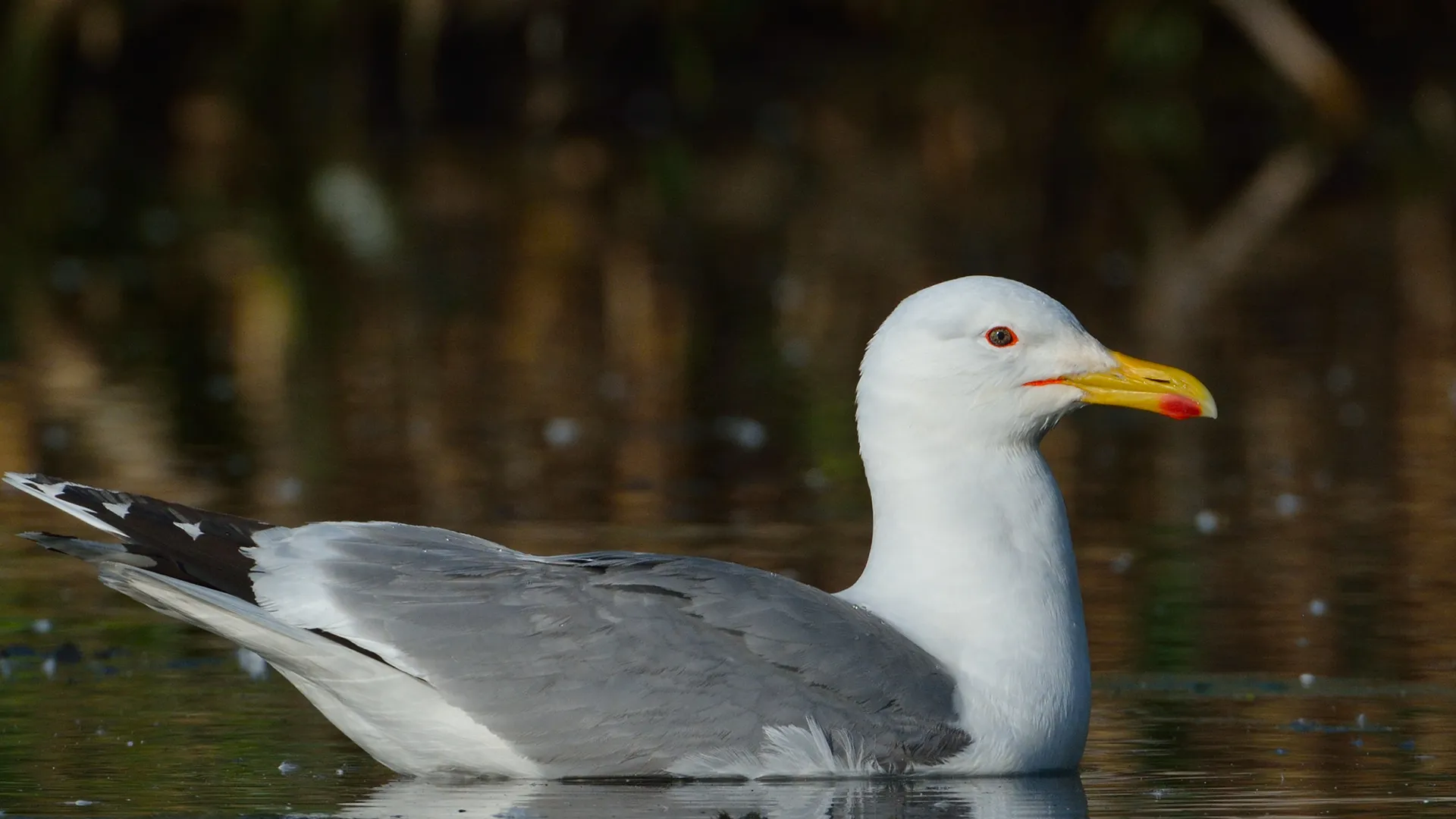
No. 140 on our checklistCaspian Gull (Larus cachinnans)
Long legs, a small pear-shaped head and a laughing call: how to recognize the Caspian Gull in the Danube Delta, its range expansion and status.
The Caspian Gull (Larus cachinnans) is a large, long-legged, white-headed gull of the Black Sea, Caspian and steppe regions, and one of the most familiar large gulls of the Danube Delta. It is present all year on the lakes, branches of the Danube, lagoons, beaches and fishing ports.
For a long time it was treated as a subspecies of the Herring Gull or grouped together with the Yellow-legged Gull, so older books often list it as Larus argentatus cachinnans.
Quick facts
Quick facts
- Scientific name Larus cachinnans Pallas, 1811
- Old scientific names Larus argentatus cachinnans; earlier, the name Larus cachinnans also covered the Yellow-legged Gull (Larus cachinnans michahellis)
- Common name Caspian Gull
- Family Laridae (gulls, terns and skimmers)
- Order Charadriiformes (waders, gulls and auks)
- Length about 56–68 cm
- Wingspan about 137–155 cm
- Diet omnivorous: fish, including discards from fishing boats, small mammals, insects, carrion and waste from rubbish dumps
- Habitat large lakes, rivers, lagoons and coasts; nests on islands, sandbanks and beaches; feeds also on fields and rubbish dumps
- Breeding one brood a year; usually 2–3 eggs, incubated by both parents; nests in colonies, sometimes mixed with other gulls
- Conservation status Least Concern (global IUCN Red List); Least Concern on the Romanian Red List (2022) as a breeding bird
When to see it in the Danube Delta and Dobrogea
- JanWintering birds
- FebWintering birds, early pairs
- MarPairs at colonies
- AprEgg-laying
- MayIncubation, chicks
- JunChicks in the colonies
- JulYoung fledge
- AugPost-breeding dispersal
- SepAutumn flocks
- OctAutumn flocks
- NovWintering birds
- DecWintering birds
- Status here
- Present all year: breeds in colonies from April to July; birds on passage and in winter from autumn to early spring.
- IUCN Red List
- Least Concern
- Our checklist
- No. 140 of 385 · see the full checklist
How to recognize it
Large gulls are not easy to identify, and the Caspian Gull is one of the trickiest. Adults have a white head, a medium-gray back and black wing tips with white spots. Compared with the Herring Gull and the Yellow-legged Gull, the Caspian Gull looks slim and elegant, with long legs, a long neck and long wings that project well beyond the tail.
The head is small and pear-shaped, with a sloping forehead, and the long, thin bill is fairly parallel-sided. The eye is small and often dark, which gives the bird a gentle expression. The legs are pale, from grayish-pink to pale yellowish. In the wing tip, the outermost feather has a long pale “tongue” on the underside, an important feature for experienced gull watchers.
Young birds take four years to reach adult plumage. First-year birds have a whitish head and underparts, a dark bill and a pale underwing, and are often cleaner and paler than young Herring Gulls.
The Caspian Gull in the Danube Delta
The Caspian Gull breeds from the Black Sea and the Caspian Sea east to Kazakhstan. In Romania, the Romanian Red List (2022), based on the national report under Article 12 of the EU Birds Directive, gives about 2,000–4,000 breeding pairs. In addition, an estimated 10,000–50,000 birds pass through on migration, and the wintering population is estimated at about 700–14,600 birds. It nests in colonies on islands, sandbanks and beaches, often together with other gulls and terns.
The Yellow-legged Gull also breeds on the Romanian coast, mainly on rooftops in Constanța, where DNA analysis has confirmed its identity. The large gulls nesting on islets in the coastal lagoons farther north have been identified as Caspian Gulls. In the field, telling the two apart takes time and good views.
Caspian Gulls are opportunists. They follow fishing boats, take fish and food waste in ports, hunt small mammals and insects on fields and feed at rubbish dumps. In autumn and winter they gather in large mixed flocks on lakes, beaches and in fishing ports.
A gull on the move
In the last 100 years the Caspian Gull has expanded its range considerably. Starting from the northern Black Sea coast and the River Dnipro in Ukraine, it spread to Poland, Belarus, Germany and the Czech Republic, and between 1990 and 2020 it reached Lithuania in the north and the Netherlands in the west. In total, it has moved about 2,500 km westward in a few decades, and the central and western European population is now estimated at at least 7,600 pairs.
Interesting facts
- The albatross posture. When giving the long call, Caspian Gulls hold their wings wide open, the so-called “albatross posture”. Herring and Yellow-legged Gulls keep their wings closed, so this behaviour is a useful identification clue.
- A laughing gull. The name cachinnans comes from the Latin for “laughing loudly”. The long call is a rapid, nasal, laughing “haaa-haaa-haa-ha-ha-ha-ha”, very different from the call of the Herring Gull.
- A family puzzle. Mitochondrial DNA studies showed that the Caspian Gull belongs to a different branch of the large gull family than the Yellow-legged Gull, with which it had long been grouped. It was recognized as a full species in Britain in 2007.
- Mixed couples. In central Poland, Caspian and Herring Gulls breed together and produce fertile hybrids. Mixed pairs, however, are less frequent than expected by chance, so the two species still prefer partners of their own kind. In one colony on the Vistula, the share of Caspian Gulls among breeders rose from 14% to 42% between 2002 and 2009.
- Half-way migrants. Ringing shows that hybrid Herring × Caspian Gulls migrate in an intermediate way, between the routes and distances typical of each parent species, as predicted by the genetic basis of migration.
Status and conservation
The Caspian Gull is listed as Least Concern on the global IUCN Red List and on the Romanian Red List (2022) as a breeding bird. Populations on passage and in winter in Romania remain Not Evaluated, because there are no trend data. Its colonies can be affected by disturbance, flooding and predators, but overall the species benefits from human food sources, such as fisheries and rubbish dumps.
See it on our tours
On our multi-day photo tours in the Danube Delta and Dobrogea, Caspian Gulls are easy subjects in flight over the boat, on the beaches near the Black Sea and in the fishing harbors. With a good lens, the long-call display with open wings is one of the best gull images of the season.
See it with us
Our birding guides are biologists and ornithologists who are on the water every day of the year. Small groups, open boats, the best hours of the day.
Keep reading
Keep reading
More from the blog
2 min read
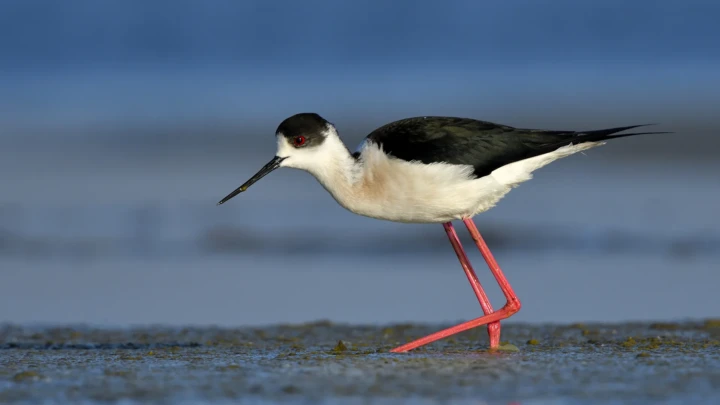
Black-winged Stilt (Himantopus himantopus)
Long pink legs and a fine black bill make the Black-winged Stilt easy to recognize as it wades across shallow wetlands of the Danube...
4 min read
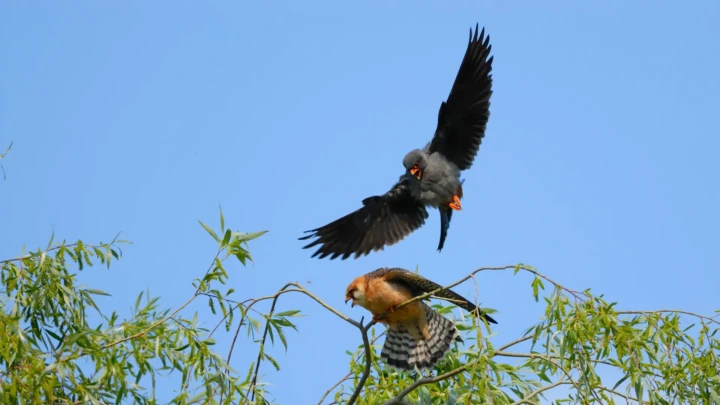
Red-footed Falcon (Falco vespertinus)
A small, sociable falcon that nests in old rook nests and gathers in big roosts before migrating to southern Africa: the Red-footed Falcon in...
2 min read
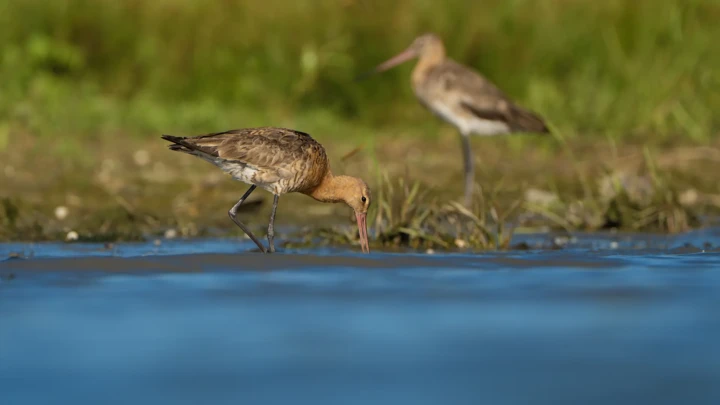
Black-tailed Godwit (Limosa limosa)
A long-billed wader with a bold wing stripe. Black-tailed Godwit occurs on passage and is a very rare breeder in the Danube Delta region.