

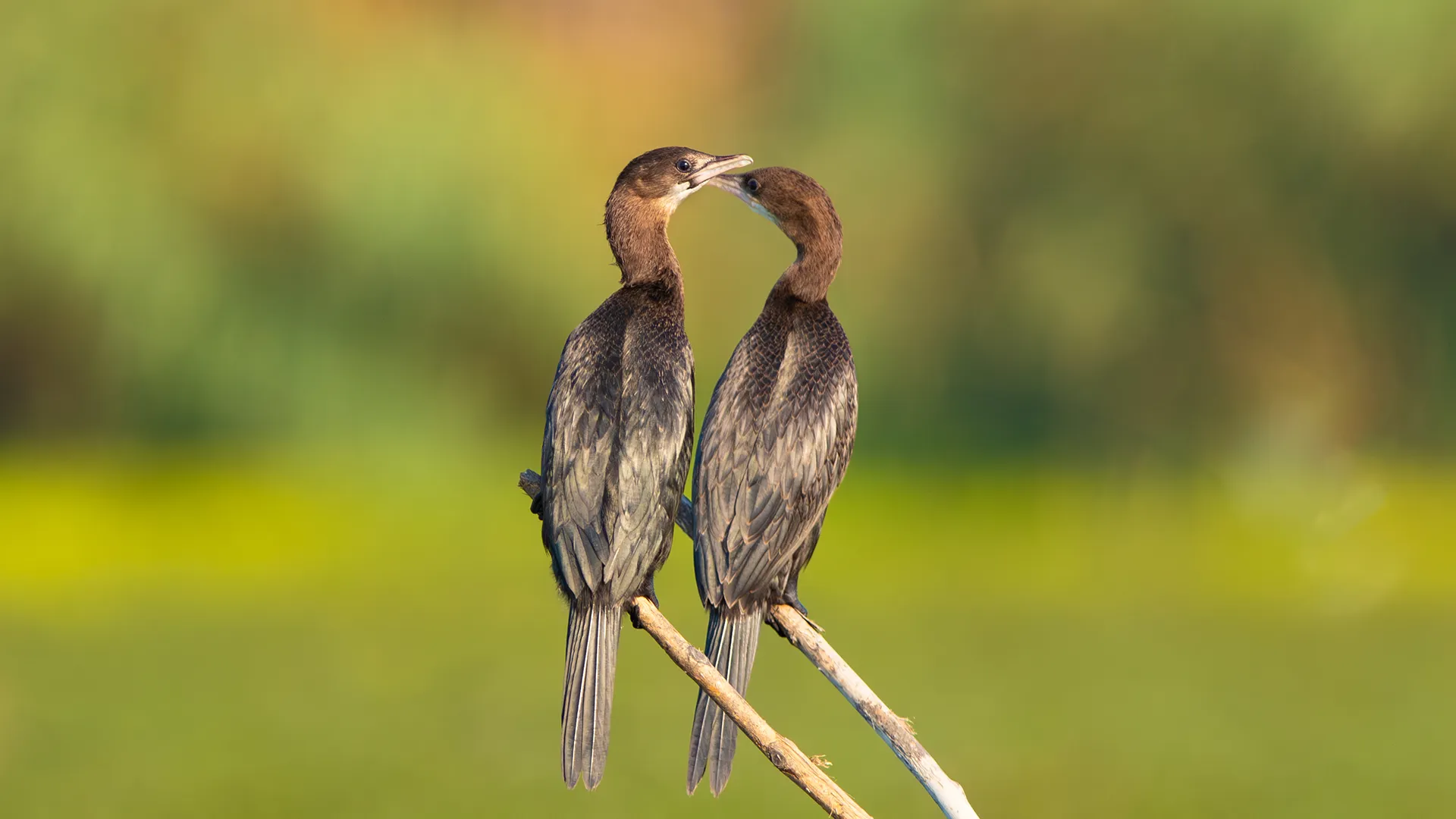
No. 153 on our checklistPygmy Cormorant (Microcarbo pygmaeus)
The Pygmy Cormorant, one of the signature birds of the Danube Delta: how to tell it from the Great Cormorant, what it eats, nesting and where to see it.
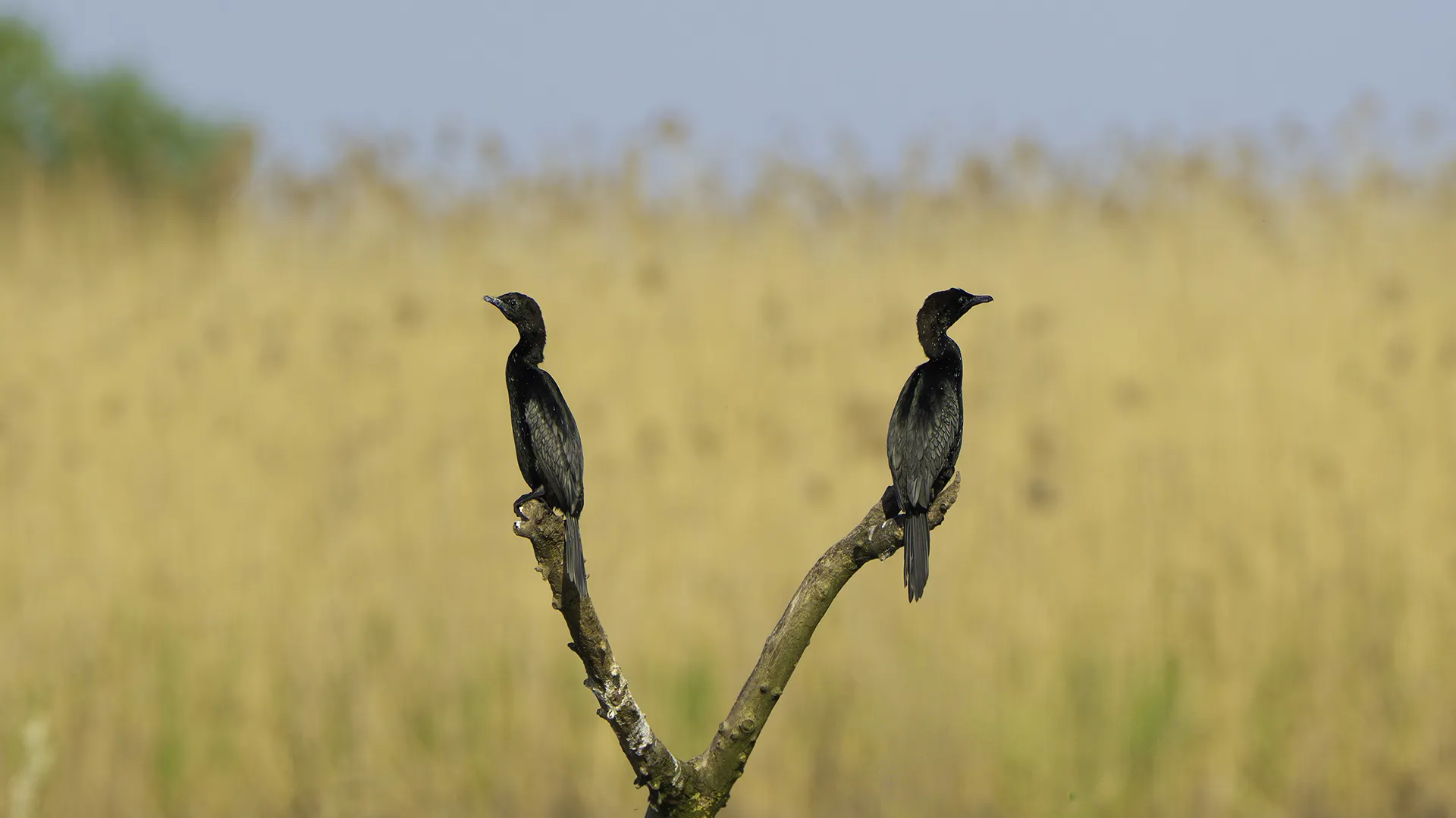
The Pygmy Cormorant looks like a Great Cormorant shrunk to half size, with a long tail and a short bill. It is one of the most characteristic birds of the Danube Delta, which holds an important part of the species’ European population. You see it perched on willow branches along the channels with its wings spread, or flying fast and low over the water.
Quick facts
- Scientific name Microcarbo pygmaeus (formerly Phalacrocorax pygmeus)
- Family Phalacrocoracidae (cormorants)
- Length 45-55 cm
- Wingspan 75-90 cm
- Weight about 550-900 g
- In the Danube Delta present all year; breeds in large numbers, some winter
When to see it in the Danube Delta and Dobrogea
- JanModerate
- FebModerate
- MarModerate
- AprModerate
- MayModerate
- JunModerate
- JulModerate
- AugModerate
- SepModerate
- OctModerate
- NovModerate
- DecModerate
- Status here
- All year. Breeding, moderate population.
- IUCN Red List
- Least Concern
- Our checklist
- No. 153 of 385 · see the full checklist
Identification
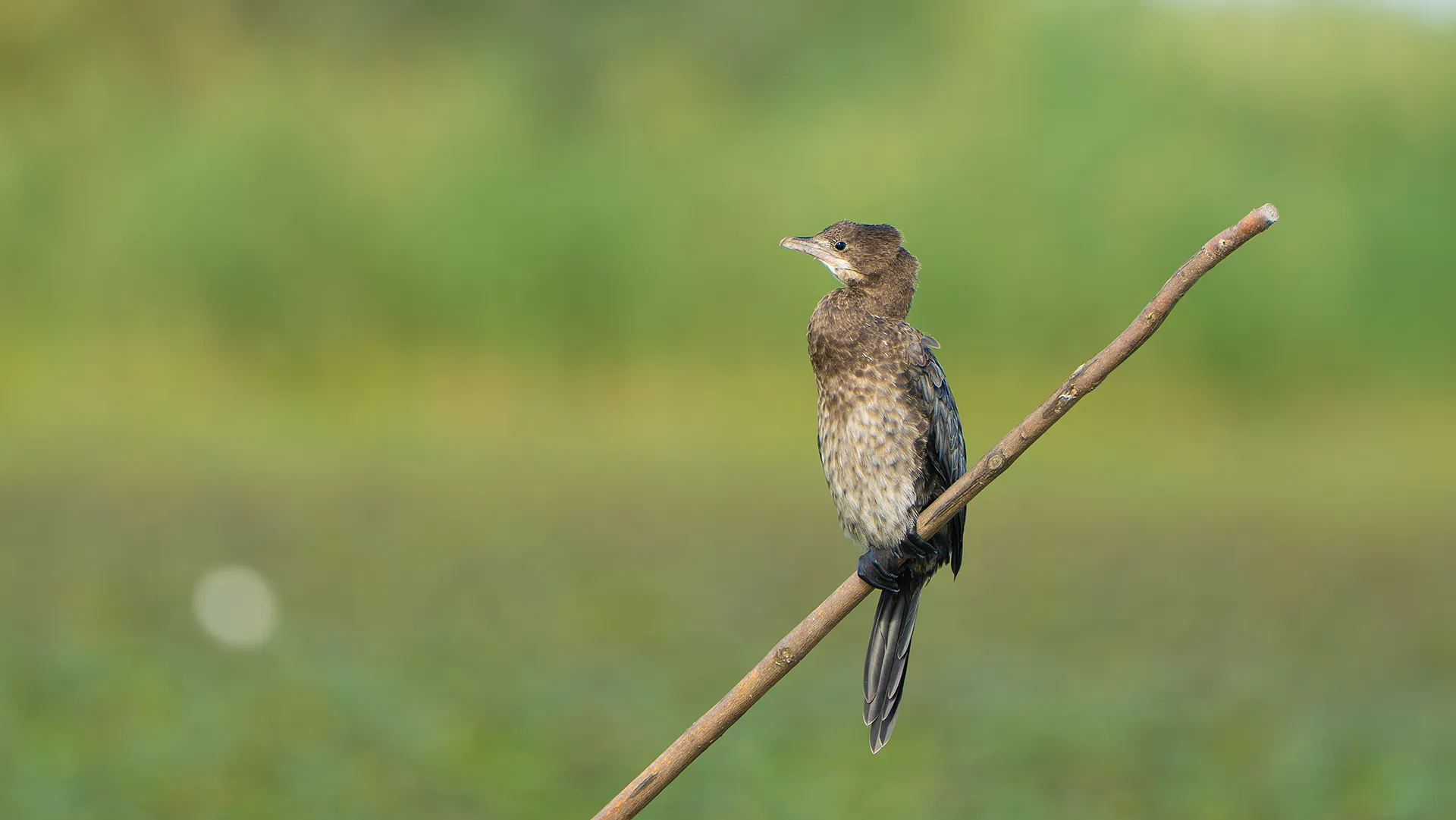
It is small for a cormorant, about the size of a Mallard, with a round head, a short neck, a short, thick bill and a long tail, which gives it a silhouette quite different from the Great Cormorant. In spring, in breeding plumage, the adult has a dark chestnut brown head and neck and a black body with a greenish gloss, sprinkled with fine white feathers like snowflakes. In autumn and winter the head becomes brown and the throat and breast pale. Juveniles are brown, with a paler belly.
In flight it beats its wings fast and looks more like a long tailed duck than a Great Cormorant. Compared with the Great Cormorant, the difference in size is obvious even from far away.
Diet
The Pygmy Cormorant fishes in shallow water, often among plants, where it dives and chases small fish, usually under 15 cm: Prussian carp, rudd, small perch, ruffe. It also eats tadpoles, frogs and large aquatic insects. Unlike the Great Cormorant, which prefers open water, it looks for narrow channels and vegetated edges.
Nest and young
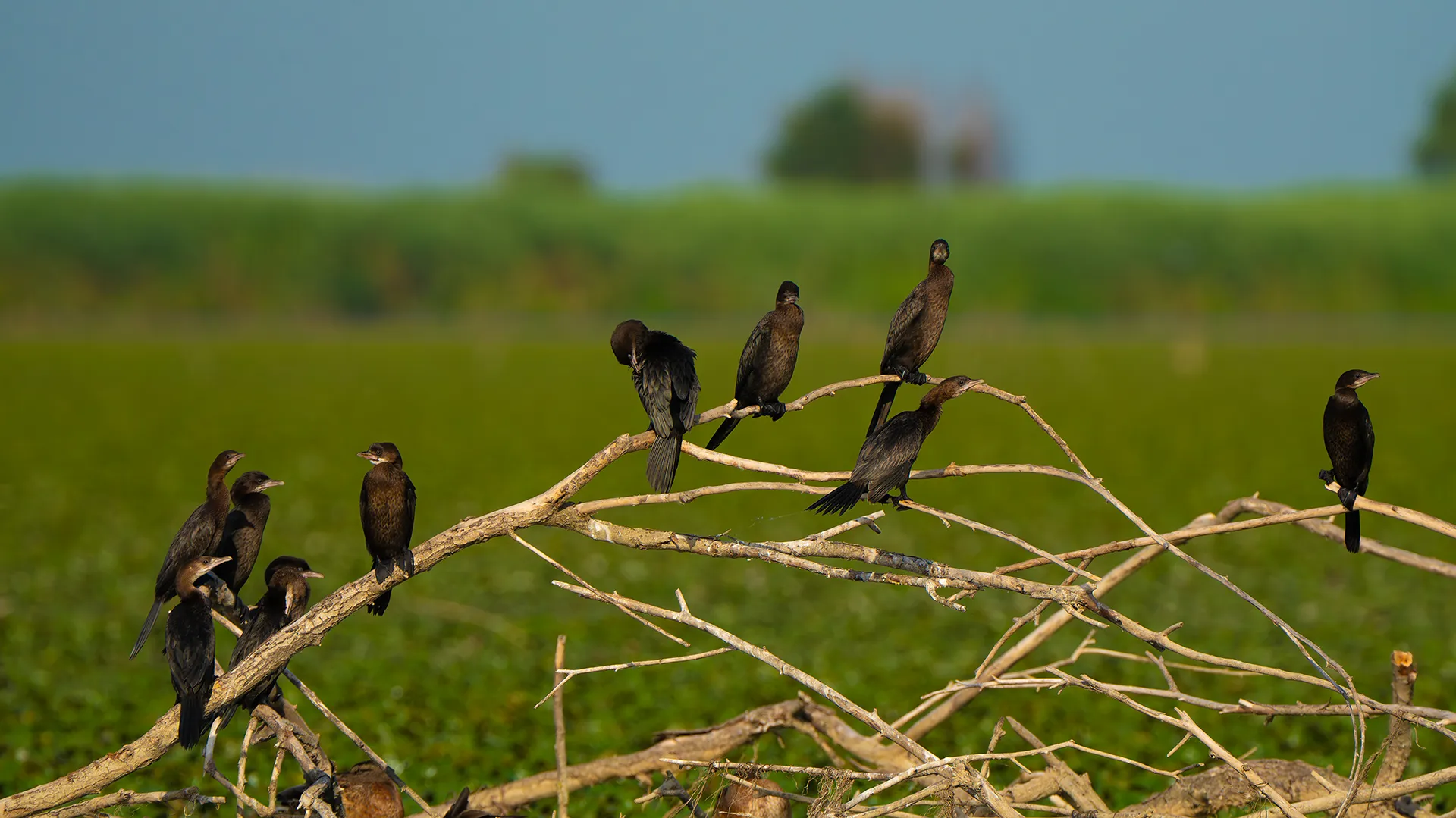
It nests in colonies, together with herons, egrets and Glossy Ibises, in flooded willows and bushes or in dense reeds. The nest is a small platform of twigs and reeds. The female lays four to six eggs, incubated by both parents for about 27-30 days. The chicks stay in the nest for a few weeks and are fed on regurgitated fish.
Where and when to see it in the Danube Delta
You see it all year. From April to September it is numerous on the channels and lakes with willows, and in winter the birds that stay gather on unfrozen water and roost in large groups in trees. It is one of the birds you see on almost every trip with us, especially on the narrow channels between the lakes.
Interesting facts
- A new genus. The world bird list now places it in the genus Microcarbo, with other small cormorants from Africa and Asia, not in Phalacrocorax like the Great Cormorant.
- A bird with a small range. The Pygmy Cormorant lives only in southeastern Europe and southwestern Asia, and the Danube Delta is one of its most important sites in Europe.
- A recovery. It was considered globally Near Threatened until 2008. Since then, thanks to wetland protection, its numbers have increased, and today it is listed as Least Concern.
- Snowflakes. The fine white feathers of the breeding plumage last only a few weeks in spring and fall out as nesting begins.
Status and threats
The Pygmy Cormorant is listed as Least Concern (LC) by the IUCN and is strictly protected in the European Union. It depends on wetlands with willows and reeds and on shallow water rich in small fish, so it suffers where these are drained, and in winter from poaching and confusion with the Great Cormorant.
In the Danube Delta today, the greatest threat to nature is fast boats. The Pygmy Cormorant nests in the willows and reeds along the channels and fishes right there, where their waves and noise reach first. That is why our boats go slowly on the channels.
See it with us
Our birding guides are biologists and ornithologists who are on the water every day of the year. Small groups, open boats, the best hours of the day.
Keep reading
Keep reading
More from the blog
5 min read
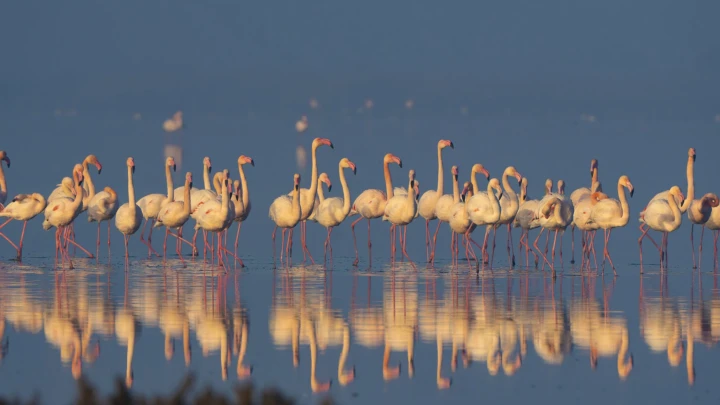
Greater Flamingo (Phoenicopterus roseus)
Once only a rare visitor, the flamingo now appears more and more often in the salty lagoons of the Danube Delta and Dobrogea.
4 min read
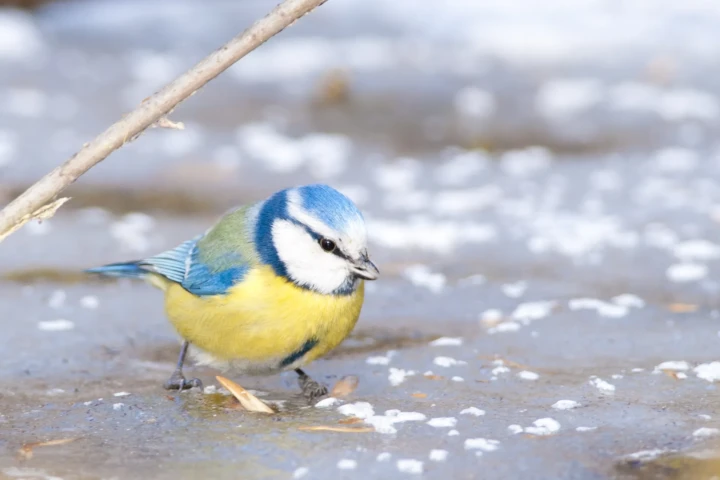
Eurasian Blue Tit (Cyanistes caeruleus)
A tiny blue and yellow acrobat of willow forests, gardens and orchards: the Eurasian Blue Tit in the Danube Delta and Dobrogea, a bird...
3 min read
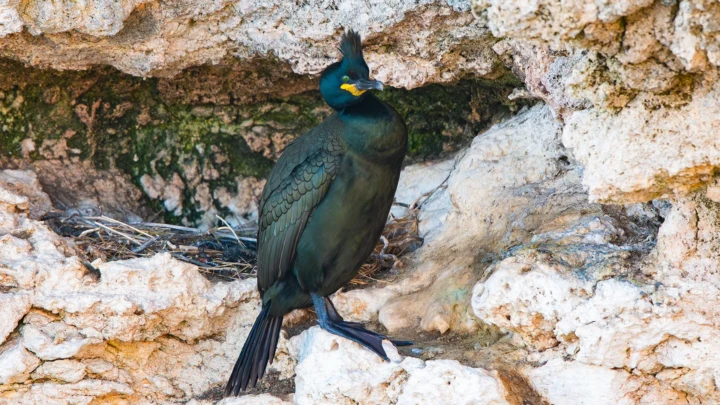
European Shag (Gulosus aristotelis)
The European Shag, the cormorant of the sea: how to tell it from the Great Cormorant, its deep dives, and where to see it...