

No. 154 on our checklistEuropean Shag (Gulosus aristotelis)
The European Shag, the cormorant of the sea: how to tell it from the Great Cormorant, its deep dives, and where to see it on the Black Sea coast of Dobrogea.
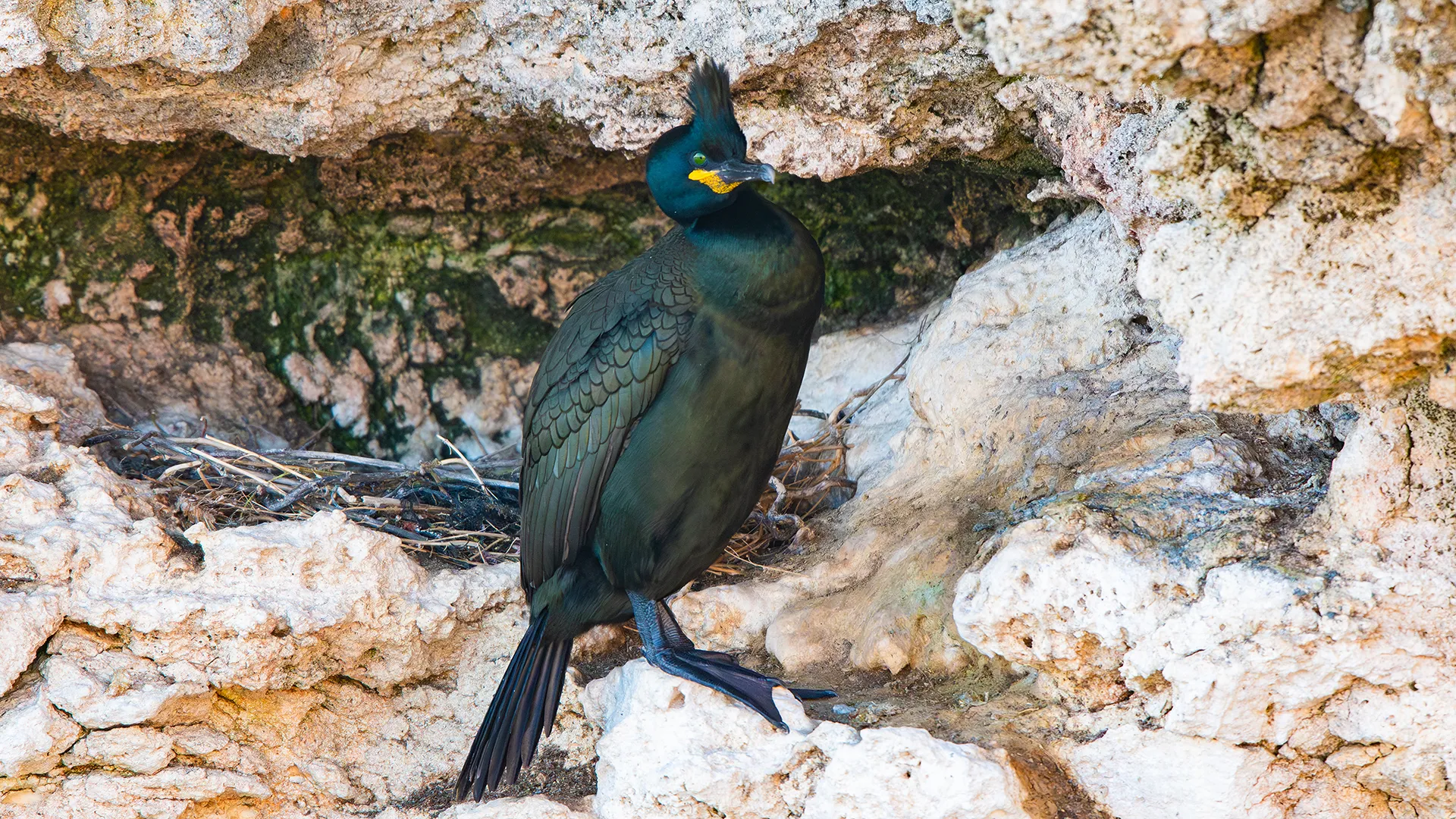
The European Shag is the cormorant of the sea, not of the marshes. It lives on rocky shores and breakwaters along the Black Sea and almost never enters the fresh waters of the Danube Delta. In spring it has a short crest curling up from its forehead and a green gloss all over the body.
Quick facts
- Scientific name Gulosus aristotelis (formerly Phalacrocorax aristotelis)
- Family Phalacrocoracidae (cormorants)
- Length 72-80 cm
- Wingspan 90-105 cm
- Weight 1.75-2.25 kg
- In Dobrogea on the coast, mostly in autumn and winter
When to see it in the Danube Delta and Dobrogea
- JanVery rare
- FebVery rare
- MarVery rare
- AprVery rare
- MayVery rare
- JunVery rare
- JulVery rare
- AugVery rare
- SepVery rare
- OctVery rare
- NovVery rare
- DecVery rare
- Status here
- All year. In 2019 first nesting in Romania. Usually nesting in South Dobruja (Bulgaria).
- IUCN Red List
- Least Concern
- Our checklist
- No. 154 of 385 · see the full checklist
Identification
The adult is black with an intense green gloss, not blue as in the Great Cormorant. The bill is slender, with a yellow patch at the gape, and in spring it has a short crest on the forehead, curved upwards. The eye is emerald green. Juveniles are brown, with a paler neck and breast.
Compared with the Great Cormorant, it is smaller and slimmer, with a much thinner bill, a steep forehead and no white cheek patch. At sea it dives with a little leap, coming almost completely out of the water.
Diet
The shag is a deep diver: it regularly goes down to 20-40 metres and chases bottom fish among the rocks, mainly gobies and other small inshore fish. It feeds alone or in small groups, close to the shore.
Nest and young
It nests on rocky coasts, on cliff ledges and in rock crevices above the sea. The nest is built of seaweed, twigs and flotsam. The female lays three eggs, incubated by both parents for about 30 days. The Black Sea and Mediterranean subspecies breeds very early, from the end of winter.
Where and when to see it
In Romania you see it on the Black Sea coast, mainly on the breakwaters and rocky shores of southern Dobrogea, in autumn and winter, when birds arrive from the rocky coasts of Bulgaria, Türkiye and Crimea. In the Danube Delta itself it is very rare, only on the Sulina breakwaters and on the seashore.
Interesting facts
- Aristotle’s name. The name aristotelis honours Aristotle, one of the first naturalists to describe the birds of the Mediterranean.
- A genus of its own. The world bird list has moved it into the genus Gulosus, of which it is the only species.
- Record dives. The shag can dive below 40 metres and stay underwater for more than a minute, longer than the Great Cormorant.
Status and threats
The European Shag lives on the coasts of Europe, North Africa and the Black Sea and is listed as Least Concern (LC) by the IUCN. The Mediterranean and Black Sea subspecies is protected in the European Union. Fishing nets in which it drowns, oil pollution and disturbance at the nest are the main threats.
See it with us
Our birding guides are biologists and ornithologists who are on the water every day of the year. Small groups, open boats, the best hours of the day.
Keep reading
Keep reading
More from the blog

4 min read
Grey Heron (Ardea cinerea)
The largest heron in Europe and the most common in the Danube Delta today, a bird the dredged canals and their willows helped to...
2 min read
Desert Wheatear (Oenanthe deserti)
The Desert Wheatear, a rare vagrant from the deserts and steppes of Asia to the dunes of Dobrogea: how to identify it by its...
4 min read
Hooded Crow (Corvus cornix)
Grey body, black hood and wings: the Hooded Crow is the common crow of the Danube Delta, a clever omnivore whose old nests have...