

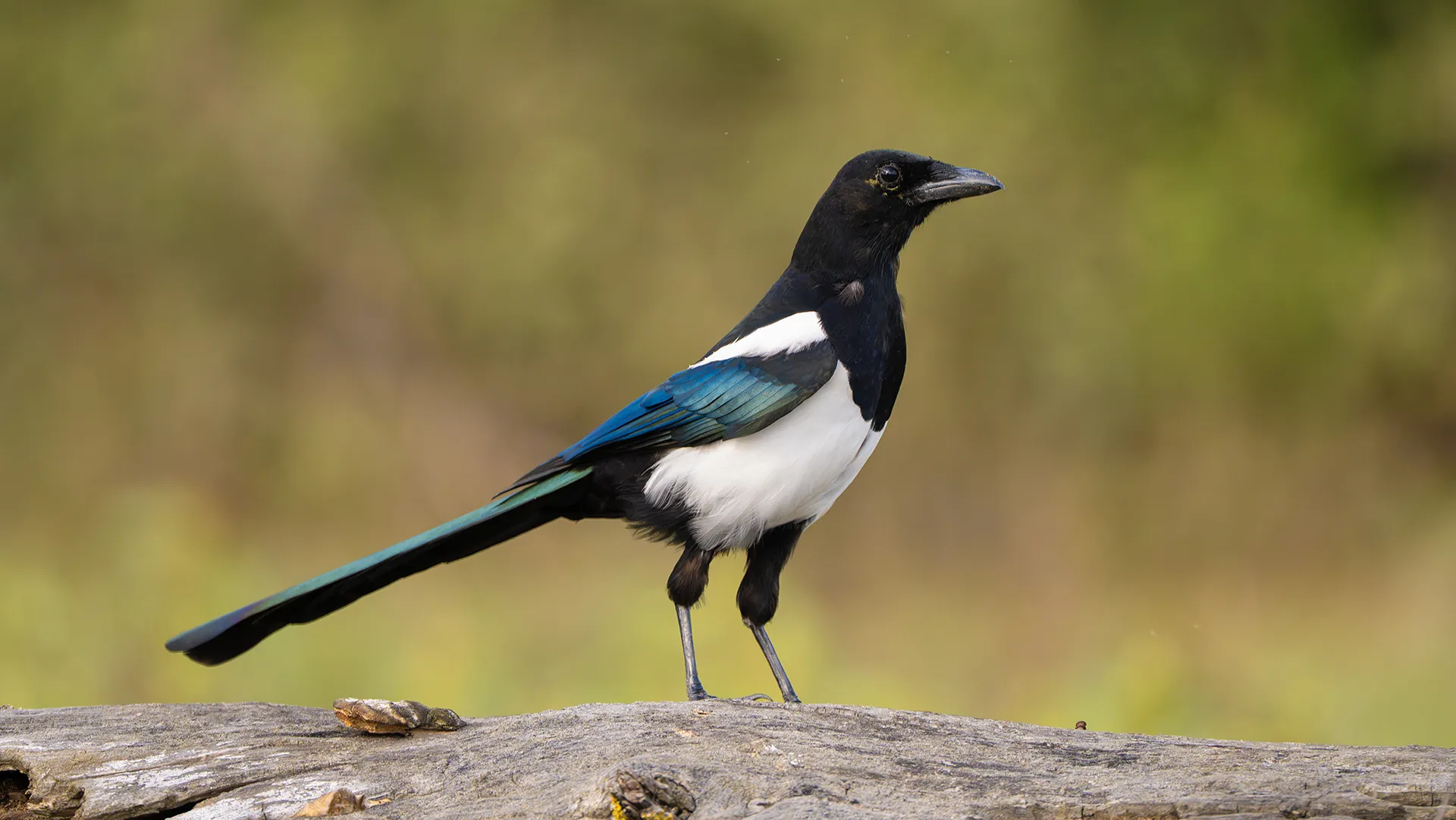
No. 237 on our checklistEurasian Magpie (Pica pica)
Black and white with a long, glossy tail and one of the brightest minds among birds: the Eurasian Magpie, a familiar resident of the villages and farmland of the Danube Delta and Dobrogea.
The Eurasian Magpie (Pica pica) is one of the most familiar birds of the Danube Delta and Dobrogea, living all year in villages, gardens, farmland and tree belts. It is easy to recognize, with black-and-white plumage and a long tail that shines green and purple in the sun.
It is also one of the most intelligent birds, the first non-mammal shown to recognize itself in a mirror.
Quick facts
Quick facts
- Scientific name Pica pica (Linnaeus, 1758)
- Common name Eurasian Magpie
- Family Corvidae (crows, jays and magpies)
- Order Passeriformes
- Length about 45 cm, of which at least a third is tail
- Wing length about 18–19 cm
- Weight about 175–215 g
- Diet omnivorous: seeds, insects and other invertebrates, small vertebrates, and eggs and chicks of other birds
- Habitat villages, gardens, farmland with hedges and tree belts, woodland edges and city parks
- Breeding one brood a year; usually 5–6 eggs, incubated by the female for about 20 days; young leave the nest at about 26–31 days
- Conservation status Least Concern (global IUCN Red List); Least Concern on the Romanian Red List (2022)
When to see it in the Danube Delta and Dobrogea
- JanPairs on territory
- FebPairs on territory
- MarNest building
- AprEgg-laying, incubation
- MayChicks in the nest
- JunYoung fledge
- JulFamily groups
- AugFamily groups
- SepPresent all year
- OctPresent all year
- NovPresent all year
- DecPresent all year
- Status here
- Resident, present all year in villages, farmland and wooded areas.
- IUCN Red List
- Least Concern
- Our checklist
- No. 237 of 385 · see the full checklist
How to recognize it
No other bird in the region looks like a magpie. The head, breast and back are black, the belly and shoulders white, and the long, graduated tail and the wings shine with metallic green, blue and purple. In flight the rounded wings show large white patches. Its call is a loud, dry, rattling chatter.
A clever neighbor
The magpie nest is a large structure of sticks, built in a tree or bush, and sometimes reused. In Sofia, Bulgaria, a study found that city pairs reused old nests more often than rural ones, and that pairs reusing a nest laid their eggs on average 7.5 days earlier. The same study recorded up to 56.8 pairs per square kilometre in the city.
The diet changes with the season. A study of magpies in Hungary in winter found seeds in almost half of the stomachs examined, invertebrates in 30% and vertebrates in 20%. Like other crows, magpies also store food.
One species or several
The Eurasian Magpie was formerly treated as one species together with the Oriental, Black-billed, Yellow-billed and Asir Magpies, from eastern Asia, North America and Arabia. These are now usually recognized as separate species, although some authorities still group most magpies as one.
Interesting facts
- The bird that knows itself. In 2008, German researchers showed that magpies can recognize their own reflection: with a mirror, two of the five birds tested tried repeatedly to remove a coloured mark that they could see only in the mirror. It was the first such evidence outside mammals; until then, mirror self-recognition had been shown in great apes and, more recently, in dolphins and elephants.
- Not guilty of emptying gardens. Magpies take eggs and chicks of songbirds, but studies in Britain found no evidence that this causes declines of songbird populations.
- Seeds for winter. In the Hungarian winter study, seeds were the most frequent food, found in 47% of stomachs.
- Up to almost 22 years. The oldest ringed magpie in Britain lived 21 years and 8 months.
Status and conservation
The Eurasian Magpie is listed as Least Concern on the global IUCN Red List. In Romania it is Least Concern on the Romanian Red List (2022), with 668,969–822,706 breeding pairs and a stable trend.
See it on our tours
On our multi-day photo tours in the Danube Delta and Dobrogea, magpies are easy and rewarding subjects in the villages of the Danube Delta: try to catch the colours of the tail in low morning light, when the black feathers turn green, blue and purple.
See it with us
Our birding guides are biologists and ornithologists who are on the water every day of the year. Small groups, open boats, the best hours of the day.
Keep reading
Keep reading
More from the blog
5 min read
Mallard (Anas platyrhynchos)
The Mallard, the most common duck in the Danube Delta and the ancestor of farmyard ducks: identification, breeding, numbers, one-eyed sleep and changing bills.
3 min read
European Bee-eater (Merops apiaster)
The European Bee-eater, one of the most colourful birds in Europe: identification, how it disarms bees, colonies in sand banks and where to see...

3 min read
Rosy Starling (Pastor roseus)
The Rosy Starling, a pink and black nomad of the Asian steppes that invades Dobrogea in some years: identification, diet, colonies and where to...