


No. 311 on our checklistRosy Starling (Pastor roseus)
The Rosy Starling, a pink and black nomad of the Asian steppes that invades Dobrogea in some years: identification, diet, colonies and where to see it.
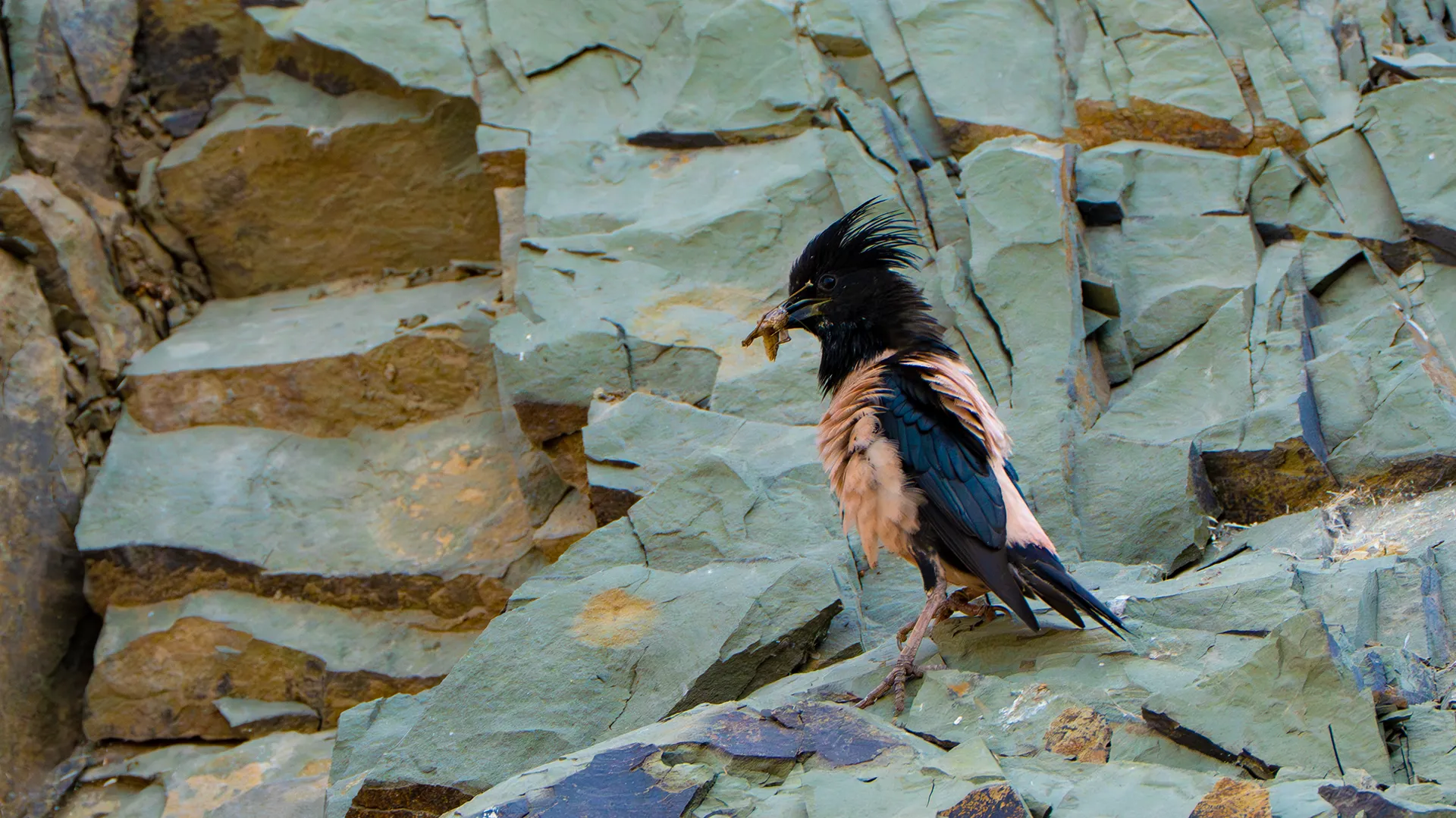
Pink and black, with a glossy crest on its head, the Rosy Starling looks like a starling dressed for a party. It is a bird of the Central Asian steppes which, in some years, pours west in flocks of thousands, following locust outbreaks. In those years Dobrogea fills with Rosy Starlings, and sometimes they breed here.

Quick facts
- Scientific name Pastor roseus
- Family Sturnidae (starlings)
- Length 19-22 cm
- Wingspan 37-40 cm
- Weight about 60-90 g
- In Dobrogea irregular summer visitor, May to August; numerous in some years
When to see it in the Danube Delta and Dobrogea
- JanAbsent
- FebAbsent
- MarAbsent
- AprAbsent
- MayRare
- JunRare
- JulRare
- AugRare
- SepAbsent
- OctAbsent
- NovAbsent
- DecAbsent
- Status here
- Summer breeder. Occasionally breeding, in some years.
- IUCN Red List
- Least Concern
- Our checklist
- No. 311 of 385 · see the full checklist
Identification
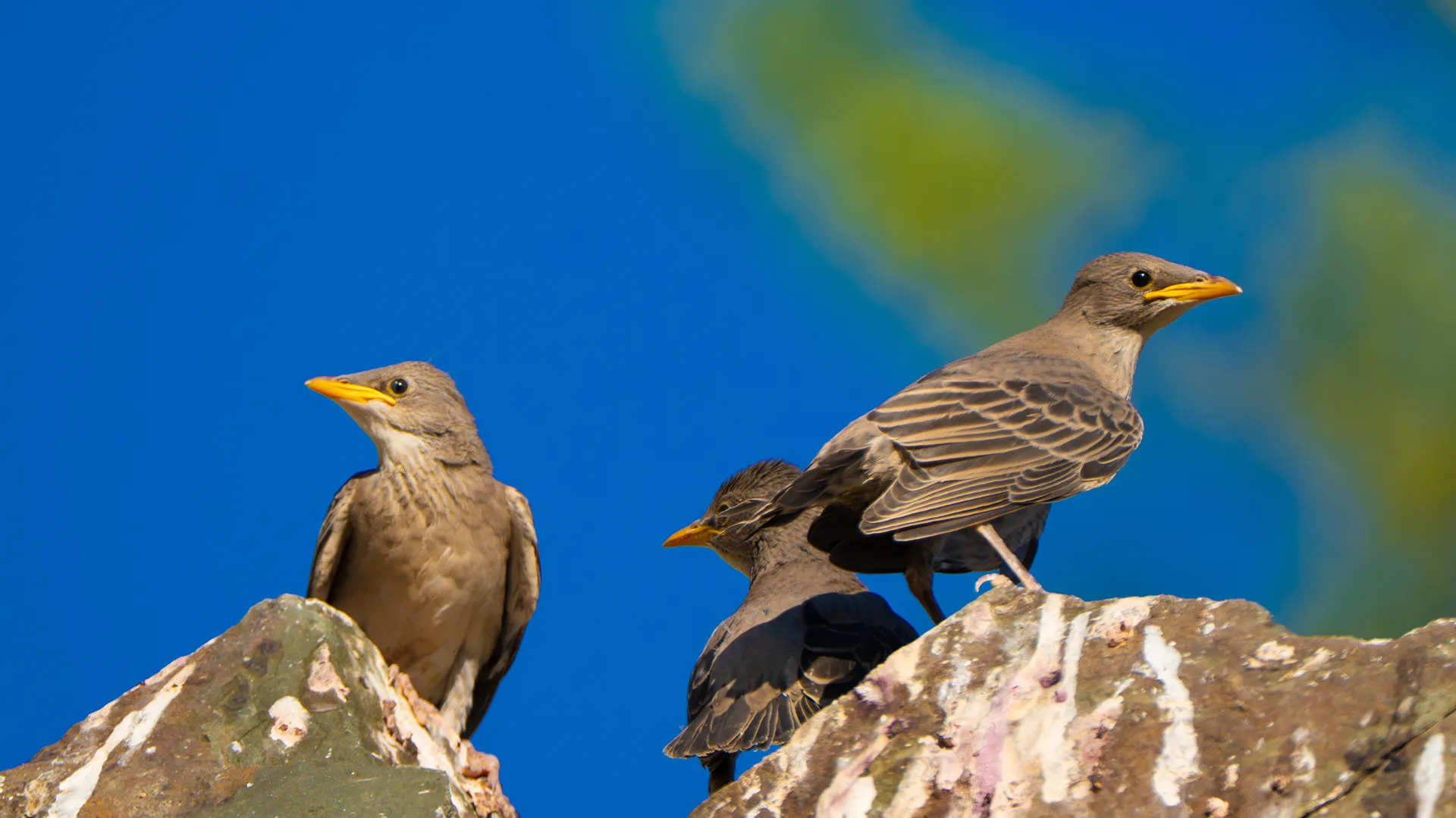
The adult has a black head, neck, wings and tail with a purple and green gloss, and a pale pink back, breast and belly. The male has a long crest, which he raises in display. The bill is yellowish pink. The female is similar but duller, with a shorter crest. Juveniles are sandy brown with no pink and resemble young Common Starlings, but have a shorter bill, yellow at the base, and are paler overall.
In flight, Rosy Starling flocks move tightly and fast, like starling flocks, and the pink shows well in good light.
Diet
The Rosy Starling specialises in locusts and grasshoppers, which it catches on the ground, walking quickly through the grass in flocks that advance like a wave. In locust years, Rosy Starlings follow the swarms over huge distances. They also eat other insects and, after breeding, fruit and berries, including cherries and grapes.
Nest and young
It nests in very dense groups, sometimes of thousands of pairs, in piles of stones, rock crevices, quarries, old walls and under roofs. Colonies form quickly and breeding is short and synchronised: within a few weeks the birds raise their young and leave. The female lays three to six pale blue eggs, incubated for about two weeks. Breeding sites change from year to year, depending on where food is plentiful.
Where and when to see it
In Dobrogea it appears irregularly: some years you see none, in others large flocks arrive from May, feeding on grasslands and fields and gathering in quarries and on rocky banks. May and June are the best months. In the Danube Delta it is seen less often, on the sandy levees with grasslands, at Letea and Caraorman.
Interesting facts
- The farmers’ friend. Because it eats huge numbers of locusts, the Rosy Starling has been protected in many Asian countries, and in China artificial nest sites have even been built for it.
- A nomadic starling. The Rosy Starling has no fixed breeding sites; it goes wherever it finds food that year, which makes it unpredictable.
- Plumage that changes by wear. In autumn the feather tips are brownish and hide the pink; through wear over the winter the tips break off, and in spring the plumage appears pink and black without any moult.
Status and threats
The Rosy Starling breeds from southeastern Europe to Central Asia, winters in India and is listed as Least Concern (LC) by the IUCN. Pesticides used against locusts take away its food, and the destruction of nest sites in quarries and old walls affects it in the years when it comes to us.
See it with us
Our birding guides are biologists and ornithologists who are on the water every day of the year. Small groups, open boats, the best hours of the day.
Keep reading
Keep reading
More from the blog
2 min read
Desert Wheatear (Oenanthe deserti)
The Desert Wheatear, a rare vagrant from the deserts and steppes of Asia to the dunes of Dobrogea: how to identify it by its...
6 min read
White Stork (Ciconia ciconia)
Nests on village poles, bill-clattering pairs and long journeys to Africa: the White Stork in the Danube Delta and Dobrogea, from March to September.
4 min read
Red-footed Falcon (Falco vespertinus)
A small, sociable falcon that nests in old rook nests and gathers in big roosts before migrating to southern Africa: the Red-footed Falcon in...