

No. 152 on our checklistWhite Stork (Ciconia ciconia)
Nests on village poles, bill-clattering pairs and long journeys to Africa: the White Stork in the Danube Delta and Dobrogea, from March to September.
The White Stork (Ciconia ciconia) is one of the best-loved birds of Romania and a familiar summer neighbor in the villages of the Danube Delta and Dobrogea. From March to September it nests on poles, roofs and trees, and hunts for frogs, insects and small animals in wet meadows, reed edges and fields.
Each autumn, the storks of the Danube Delta and Dobrogea leave for Africa along the eastern flyway, over the Bosphorus and the Middle East, and come back in spring.
Quick facts
Quick facts
- Scientific name Ciconia ciconia (Linnaeus, 1758)
- Common name White Stork
- Family Ciconiidae (storks)
- Order Ciconiiformes (storks)
- Length about 100–115 cm
- Wingspan about 155–165 cm
- Weight about 3.3 kg on average
- Diet carnivorous: insects, earthworms, frogs and tadpoles, fish, lizards, snakes, small rodents and the chicks or eggs of ground-nesting birds
- Habitat villages, farmland, wet meadows, river floodplains and marsh edges; nests close to people
- Breeding one brood a year; usually 3–5 eggs, incubated for about 33–34 days by both parents; young fly at about 8–9 weeks
- Conservation status Least Concern (global IUCN Red List and Europe); Least Concern on the Romanian Red List (2022)
When to see it in the Danube Delta and Dobrogea
- JanIn Africa
- FebIn Africa
- MarFirst birds back on the nests
- AprNest repair, egg-laying
- MayIncubation, first chicks
- JunChicks in the nest
- JulYoung fledge
- AugFlocks gather, autumn migration
- SepLast migrants
- OctIn Africa
- NovIn Africa
- DecIn Africa
- Status here
- Summer breeder: present from March to September; nests in villages and spends the winter in eastern and southern Africa.
- IUCN Red List
- Least Concern
- Our checklist
- No. 152 of 385 · see the full checklist
How to recognize it
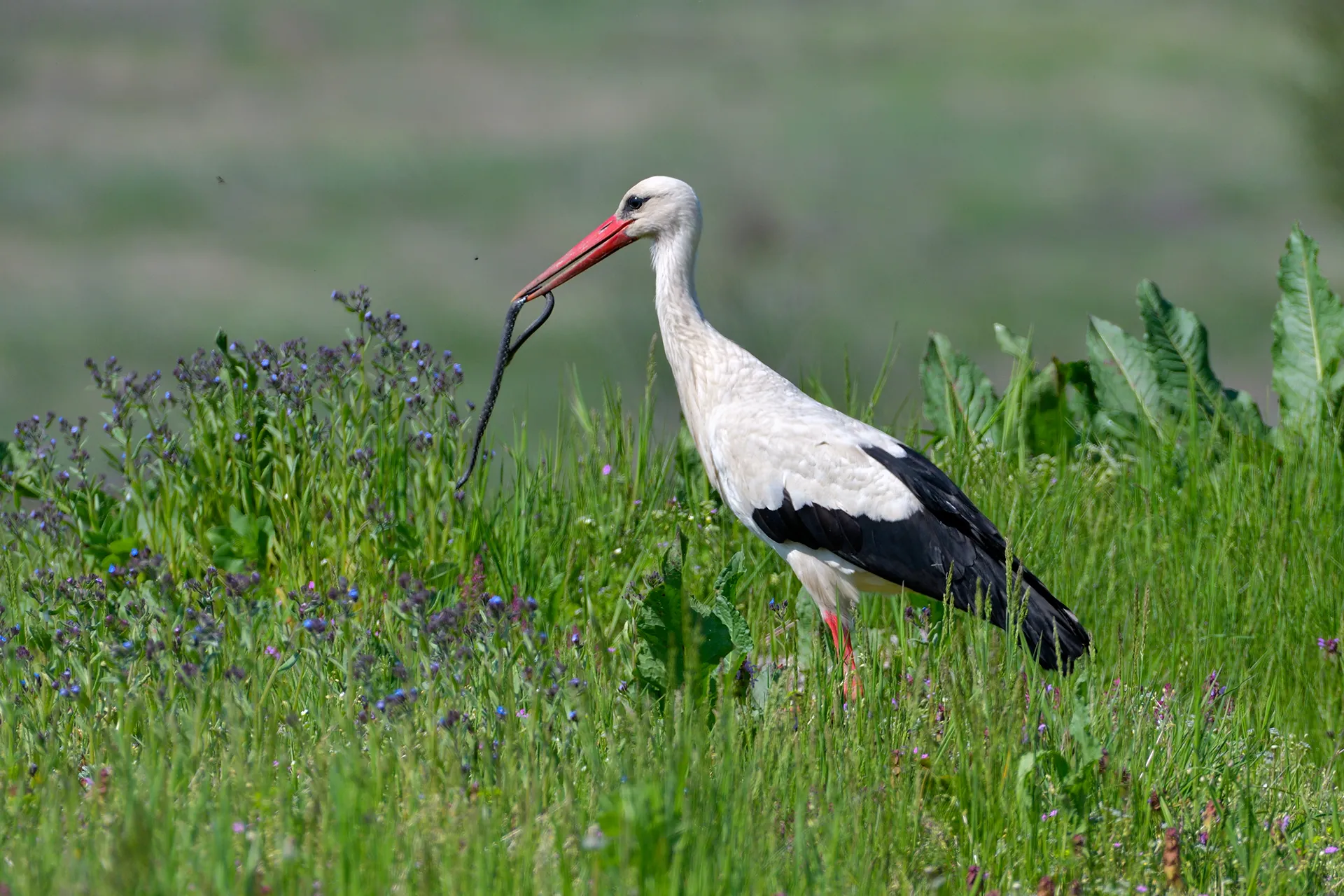
Few birds are easier to recognize. The White Stork is a tall, long-legged bird with white plumage, black flight feathers, a long, straight red bill and red legs. In flight it holds its neck straight out in front and its legs trailing behind, and the black rear half of the wing contrasts sharply with the white body.
The only similar bird here is the Black Stork, which is dark above with a white belly and nests in quiet forests, far from people. Herons and egrets fly with the neck folded back, while cranes are gray.
Storks have almost no voice. At the nest, partners greet each other with loud bill-clattering, rattling the two halves of the bill against each other. It is one of the typical sounds of a village in the Danube Delta in spring.
A neighbor of people
In Romania the White Stork has nested close to people for a very long time. In the past, nests were built on stables, haylofts and trees. Today, according to the Milvus Group, about 93% of Romanian storks nest on low-voltage electricity poles, and the first nest on a pole was recorded in 1971. In the Danube Delta and Dobrogea you will also see nests on chimneys, roofs, trees and platforms installed to keep the nest safe above the wires.
Nests are often reused for many years, and each season new sticks, reed, grass and earth are added, so old nests become heavy structures. Clutch size averages a little over four eggs in long-term European studies. Incubation lasts about a month, and the chicks stay in the nest for about two months before they can fly. Long, cold rainy spells in June can kill many chicks: in one Polish study, two days of continuous rain left the population with only 0.59 fledglings per pair, because the parents could not find enough food.
Storks hunt on foot, walking slowly through wet meadows, shallow marshes, canal edges and freshly mown or ploughed fields. They take whatever is abundant: insects and earthworms, frogs, fish, lizards, snakes and small rodents.
Migration on the eastern flyway
European White Storks are divided into two groups by a migration divide that runs through Germany. Storks breeding east of it, including those of Romania, avoid crossing the sea. They fly around the Black Sea and cross into Asia at the Bosphorus, then continue through Turkey, the Middle East and the Nile valley to eastern and southern Africa, where they spend the winter from Sudan and Chad to South Africa. Satellite-tracked storks from Poland followed the western coast of the Black Sea through eastern Romania and Bulgaria, so Dobrogea also lies on the route of storks from farther north.
The bottlenecks along the way are spectacular. In Israel, counts in the Bet She’an Valley recorded more than 538,000 White Storks in the autumn of 1997, including 162,856 birds on a single day.
Interesting facts
- The stork that proved migration. In 1822 a White Stork was shot in Mecklenburg, Germany, with an African spear about 75 cm long through its neck. The bird had flown all the way back from Africa with it, and it became one of the first hard proofs that birds migrate to distant lands instead of hibernating. It is still on display at the University of Rostock.
- Cooling down with its own droppings. On hot days storks defecate on their legs, and the evaporation helps them lose heat. This behaviour, called urohidrosis, is the reason why their red legs often look white in summer. A study published in 2021 found that half of the observed White Storks were using it at an air temperature of about 28 °C.
- Short cuts at the rubbish dump. Tracking of young storks from eight populations showed that some birds now winter at rubbish dumps in North Africa instead of crossing the Sahara, and spend less energy than those flying on to the African savanna. Migration remains risky: only 30% of the tagged young storks were still alive after one year.
- More storks than we thought. The International White Stork Census of 2024–2025 recorded 7,821 nests in Romania, 6,509 of them occupied, and 12,588 chicks. The Romanian breeding population is now estimated at 9,752–12,638 pairs, much more than the 4,374 nests found in the previous census.
Status and conservation
The White Stork is listed as Least Concern on the global IUCN Red List and in Europe, where the population has increased since the 1980s. In Romania it is Least Concern on the Romanian Red List (2022), which gives 7,500–9,000 breeding pairs based on the Article 12 report, with an uncertain trend. The newer census figures above come from a more complete survey and are not directly comparable. The main threats are electrocution and collision with medium-voltage power lines, especially during migration, the loss of wet meadows and floodplains, pesticides and hunting along the flyway. In Romania, nesting platforms on poles and insulated or bird-safe power lines are key conservation measures.
See it on our tours
On our multi-day birdwatching tours in the Danube Delta and Dobrogea, White Storks are part of almost every day in spring and summer, from nests in the villages to birds feeding in the meadows and fields. In late summer, keep an eye on the sky: migrating flocks circling in thermals are one of the great sights of the season.
See it with us
Our birding guides are biologists and ornithologists who are on the water every day of the year. Small groups, open boats, the best hours of the day.
Keep reading
Keep reading
More from the blog
5 min read
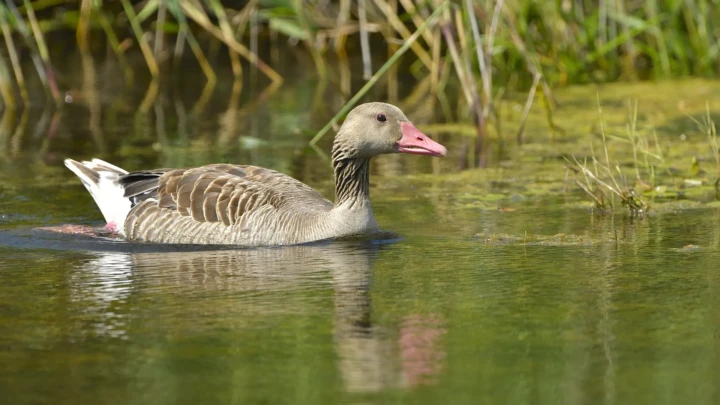
Greylag Goose (Anser anser)
Meet the Greylag Goose, the only goose that nests in the Danube Delta and the wild ancestor of the farmyard goose: identification, breeding, when...

5 min read
Purple Heron (Ardea purpurea)
The heron of the reed beds: once the most common heron of the Danube Delta, now second to the Grey Heron, and the reason...
5 min read
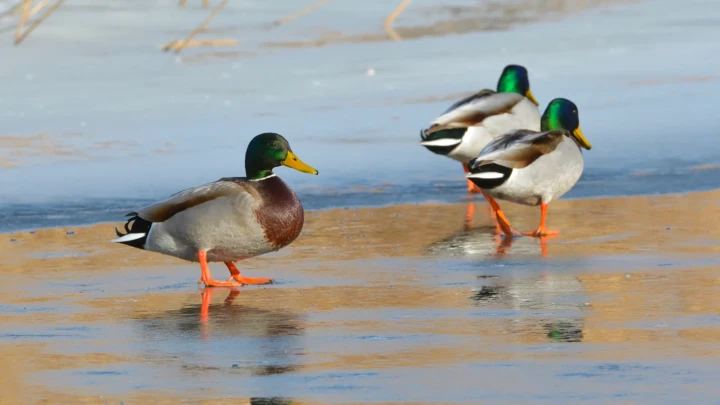
Mallard (Anas platyrhynchos)
The Mallard, the most common duck in the Danube Delta and the ancestor of farmyard ducks: identification, breeding, numbers, one-eyed sleep and changing bills.