

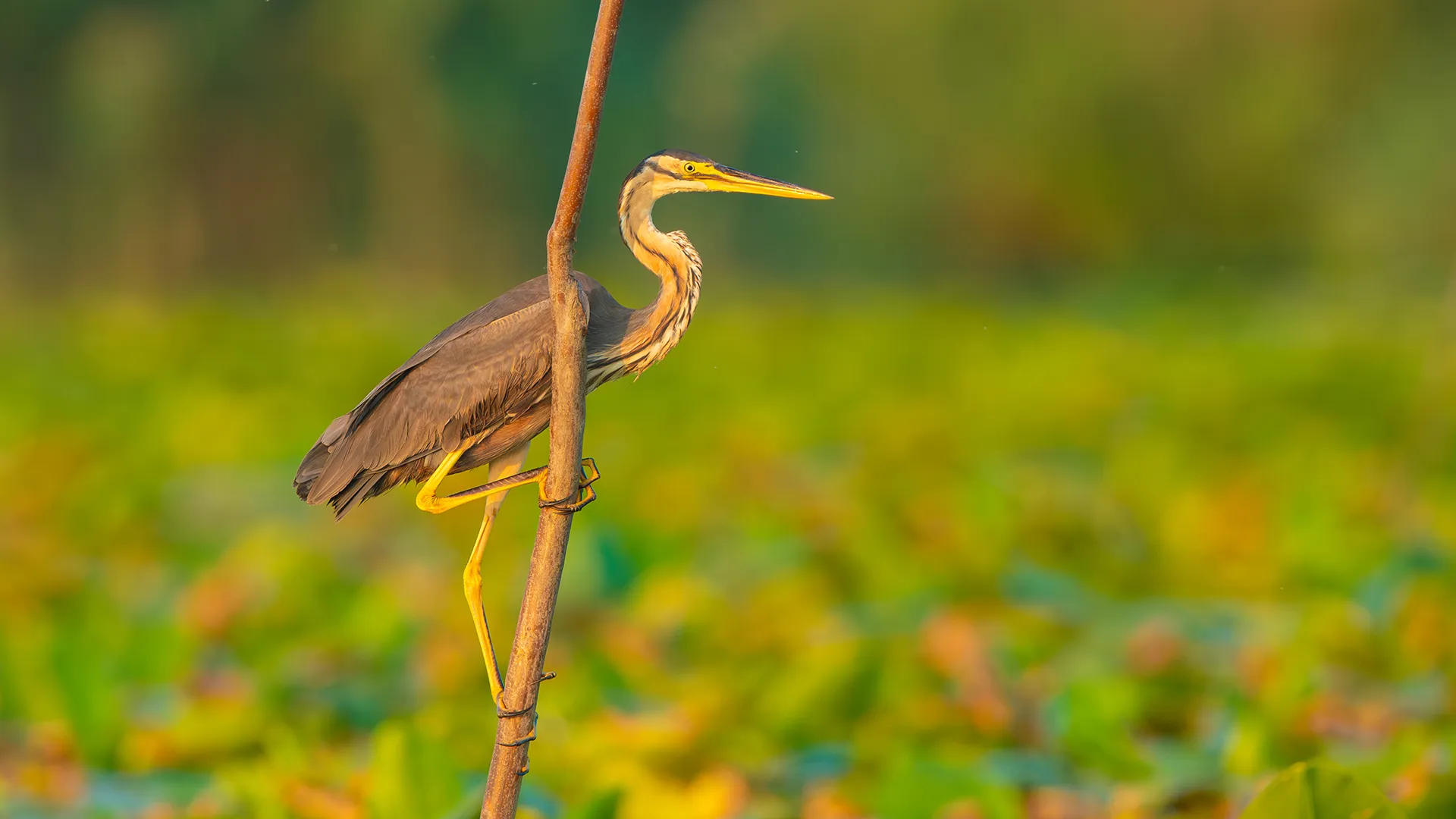
No. 167 on our checklistPurple Heron (Ardea purpurea)
The heron of the reed beds: once the most common heron of the Danube Delta, now second to the Grey Heron, and the reason why is written in the landscape.
The Purple Heron is the heron of the reed beds. Slimmer and darker than the Grey Heron, with a long, snake like neck striped in rust and black, it spends the summer hidden in the flooded reeds of the Danube Delta and is usually seen only when it rises slowly out of them, or stands motionless at the edge of a channel. It was once the most common heron of a landscape that was itself mostly reed, and its story in the Danube Delta is the story of how that landscape has changed.


Quick facts
- Scientific name Ardea purpurea
- Family herons (Ardeidae)
- Length 78 to 90 cm
- Weight about 0.5 to 1.35 kg
- Clutch usually 3 to 5 eggs
- In the Danube Delta summer visitor, April to October
When to see it in the Danube Delta and Dobrogea
- JanAbsent
- FebAbsent
- MarAbsent
- AprRare
- MayModerate
- JunModerate
- JulModerate
- AugModerate
- SepModerate
- OctRare
- NovAbsent
- DecAbsent
- Status here
- Summer breeder. Common in summer.
- IUCN Red List
- Least Concern
- Our checklist
- No. 167 of 385 · see the full checklist
How to recognise it
Adults have a black cap, a rusty orange head and neck with black stripes running down its length, a dark grey back and deep chestnut on the shoulders and belly. The bill is long, thin and yellowish. Young birds are plainer, sandy brown and with fewer stripes. In flight the Purple Heron looks darker and more angular than the Grey Heron, with a deep bulge in the folded neck and long toes that stick out well behind the tail.
The Grey Heron is larger, heavier and grey and white, with a thicker bill and a white neck. At a distance, the colour of the neck is the quickest clue: grey and white on the Grey Heron, rust and black on the Purple Heron.
Life in the reeds
The Purple Heron hunts by standing still, often half hidden in the reeds or on a mat of floating plants, and striking at fish, frogs, water insects and small mammals. Its very long toes let it stand on bent reed stems above the water, where a Grey Heron could not.
It nests in flooded reed beds, alone or in loose colonies, on a platform of reed stems built just above the water. The female lays usually three to five eggs, both parents incubate them for 25 to 30 days, and the young fly at about 45 to 50 days old. In Europe it prefers old, uncut reed: studies in the Camargue in France found colonies only in reed beds that had not been cut, or only partly cut, in winter.
Where to see it in the Danube Delta
Purple Herons arrive in the Danube Delta in April and leave for Africa in September and October. From May to September you find them along channels and lakes with wide reed beds, especially early in the morning and in the evening, when they fly between their nests and their feeding places. Our checklist marks it moderate from May to September and rare in April and October.
From a slow boat you often see one standing at the edge of the reeds, perfectly still, and it lets you pass if the boat does not stop too close. You can look for it on a private 4 hour birdwatching trip, on a small group birdwatching tour in the Danube Delta, or photograph it on a wildlife photo tour from Mila 23.
Interesting facts
- Once the common heron, now one of the scarcest. In the old Danube Delta, a landscape made mostly of flooded reed, the Purple Heron was the most common heron. Today the first complete bird checklist of the Danube Delta Biosphere Reserve (Danube Delta National Institute, 2023) gives only 230 to 450 breeding pairs, against thousands of pairs of Night Herons, Squacco Herons and Little Egrets in the colonies. The main reason, as our guides have watched it on the water, is what happened to the reed.
- The reed was burned. From 1956 the reed of the Danube Delta was harvested on an industrial scale for the paper industry, and the plan was to turn almost a third of the Danube Delta into reed plantations. To make the harvest easier, the old reed was burned in winter, so that only young reed, much easier to cut, grew in spring. The Purple Heron needs exactly that old, dry reed to build its nest. Large scale harvesting is no longer allowed, but reed is still set on fire every winter in many places, out of an old habit.
- The canals brought the trees. When the channels of the Danube Delta were dredged, the mud was piled along the banks. These new strips of dry land, along hundreds of kilometres of channels, became the ground where willows could grow, in a landscape that had been almost only reed. The banks also cut off water from many small lakes and pools behind them, and these silted up and filled with vegetation very fast. The Purple Heron lost flooded reed, and the Grey Heron, which nests in trees, gained thousands of new nesting places.
- A drought on the other side of the Sahara. Purple Herons spend the winter in Africa south of the Sahara, tens of thousands of them in the inner delta of the Niger in Mali alone. During the Great Drought of the Sahel, from about 1969 to 1992, many of them did not survive the winter, and European populations fell. Their numbers still follow the rains of the Sahel more closely than anything that happens in Europe. The Grey Heron stays in the Danube Delta all year, and escaped that blow.
- The hardest heron to count. During the great survey of the colonies of the Danube Delta in 2001 and 2002, up to 65% of the Purple Herons were found in colonies no one knew about before, hidden in reed beds that are almost impossible to see into from the ground or from the air.
Status and threats
The Purple Heron is listed as Least Concern by the IUCN, but in Europe it declined strongly in the second half of the 20th century. Romania holds an estimated 1,800 to 7,800 breeding pairs, and the Danube Delta Biosphere Reserve only 230 to 450 pairs according to its 2023 checklist. It needs large, flooded, undisturbed reed beds that are not burned or cut every winter.
In the Danube Delta today the greatest threat to nature is speed boats. The Purple Heron feeds and nests in the reeds along the channels, exactly where their noise and waves reach first. This is why our boats move slowly in the channels.
See it with us
Our birding guides are biologists and ornithologists who are on the water every day of the year. Small groups, open boats, the best hours of the day.
Keep reading
Keep reading
More from the blog

4 min read
White-winged Tern (Chlidonias leucopterus)
Jet black body and white wings in spring: the most striking of the marsh terns over the lakes of the Danube Delta.

6 min read
Red-breasted Goose (Branta ruficollis)
Most of the world population spends the winter on the western shore of the Black Sea, and about a third of it in Dobrogea....

5 min read
Little Grebe (Tachybaptus ruficollis)
The smallest grebe in Europe: a round little diver that comes to the Danube Delta in numbers for the winter.