

No. 11 on our checklistGreylag Goose (Anser anser)
Meet the Greylag Goose, the only goose that nests in the Danube Delta and the wild ancestor of the farmyard goose: identification, breeding, when to see it and status.
The Greylag Goose (Anser anser) is the largest wild goose of the Danube Delta and the only goose that nests here. It is the wild ancestor of the farmyard goose, and in the Danube Delta it can be seen in every month: as pairs and families in the reed beds in spring and summer, and in large flocks in autumn and winter.
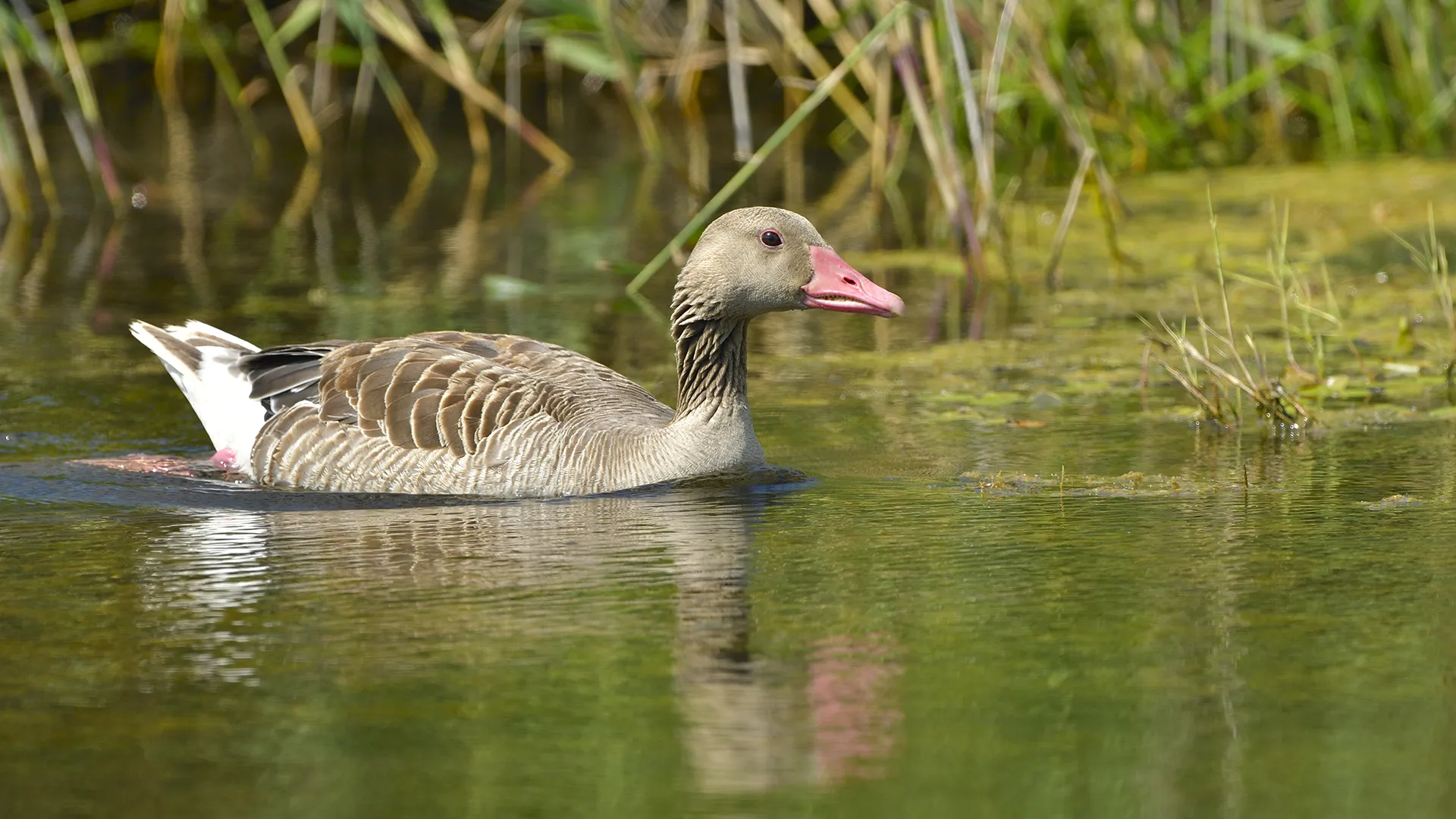
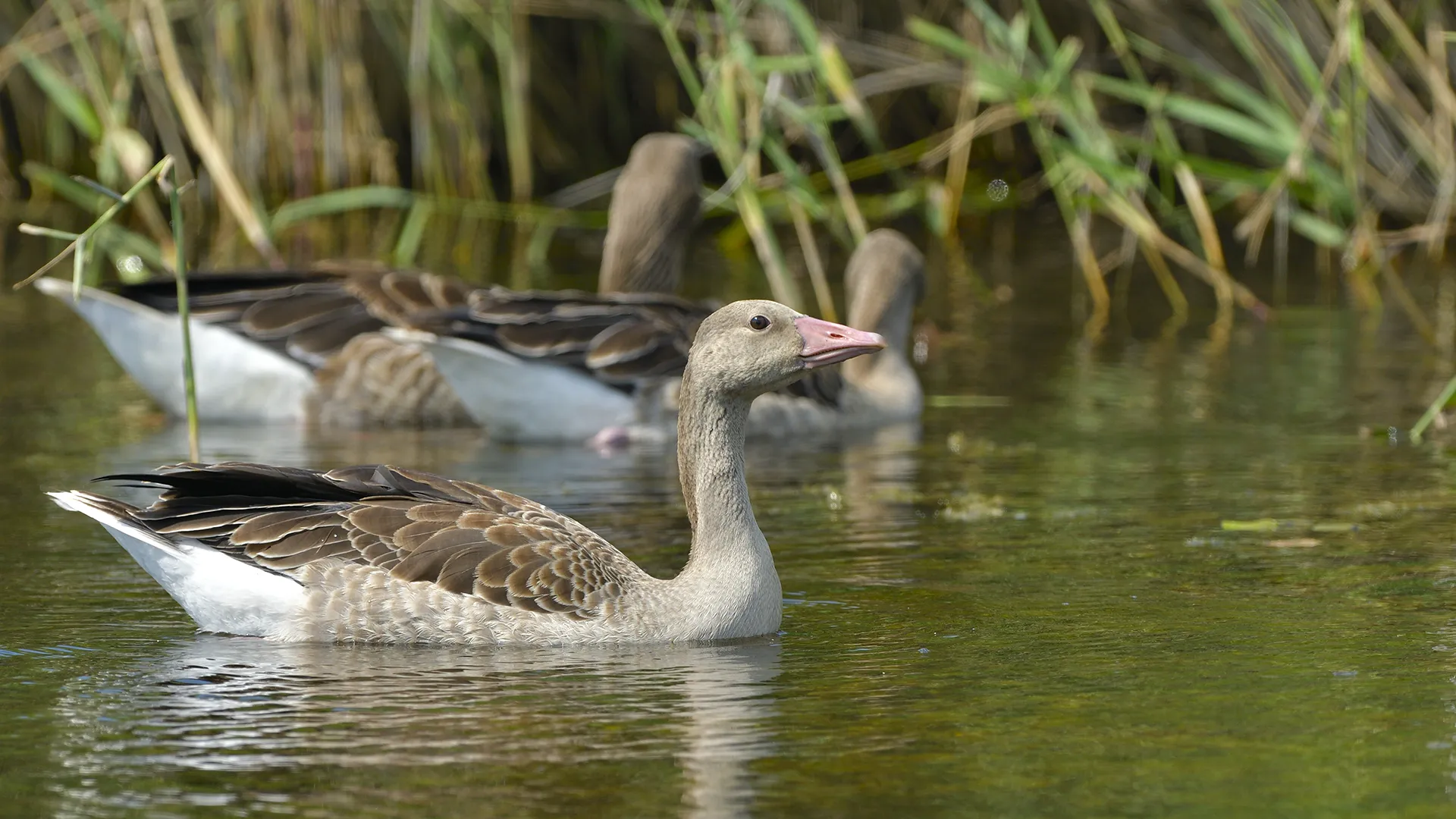
The birds of the Danube Delta belong to the eastern subspecies, Anser anser rubrirostris, which has a pink bill and paler plumage than the western birds.
Quick facts
Quick facts
- Scientific name Anser anser (Linnaeus, 1758); in Romania the eastern subspecies Anser anser rubrirostris Swinhoe, 1871
- Common name Greylag Goose; the eastern form is sometimes called Eastern Greylag Goose
- Family Anatidae (ducks, geese and swans)
- Order Anseriformes (waterfowl)
- Length 76–89 cm
- Wingspan 160 cm
- Weight 3–4 kg
- Diet plants: grasses, water plants, roots and shoots of reed and other marsh plants; in autumn and winter also grain and young winter cereals in the fields
- Habitat reed beds, floating reed islands and marshes of the Danube Delta; in winter also lagoons and farmland around them
- Breeding one brood a year; usually 5–7 eggs, incubated by the female for about 4 weeks; the young fly at about 7–8 weeks
- Conservation status Least Concern (global IUCN Red List); a game species in Romania
When to see it in the Danube Delta and Dobrogea
- JanWinter flocks
- FebWinter flocks
- MarPairs, nesting begins
- AprNesting
- MayFamilies with goslings
- JunFamilies, moult
- JulMoult
- AugFlocks gather
- SepFlocks
- OctMigrants arrive
- NovWinter flocks
- DecWinter flocks
- Status here
- Present all year: breeds in the Danube Delta, with larger flocks in autumn and winter.
- IUCN Red List
- Least Concern
- Our checklist
- No. 11 of 385 · see the full checklist
How to recognize it
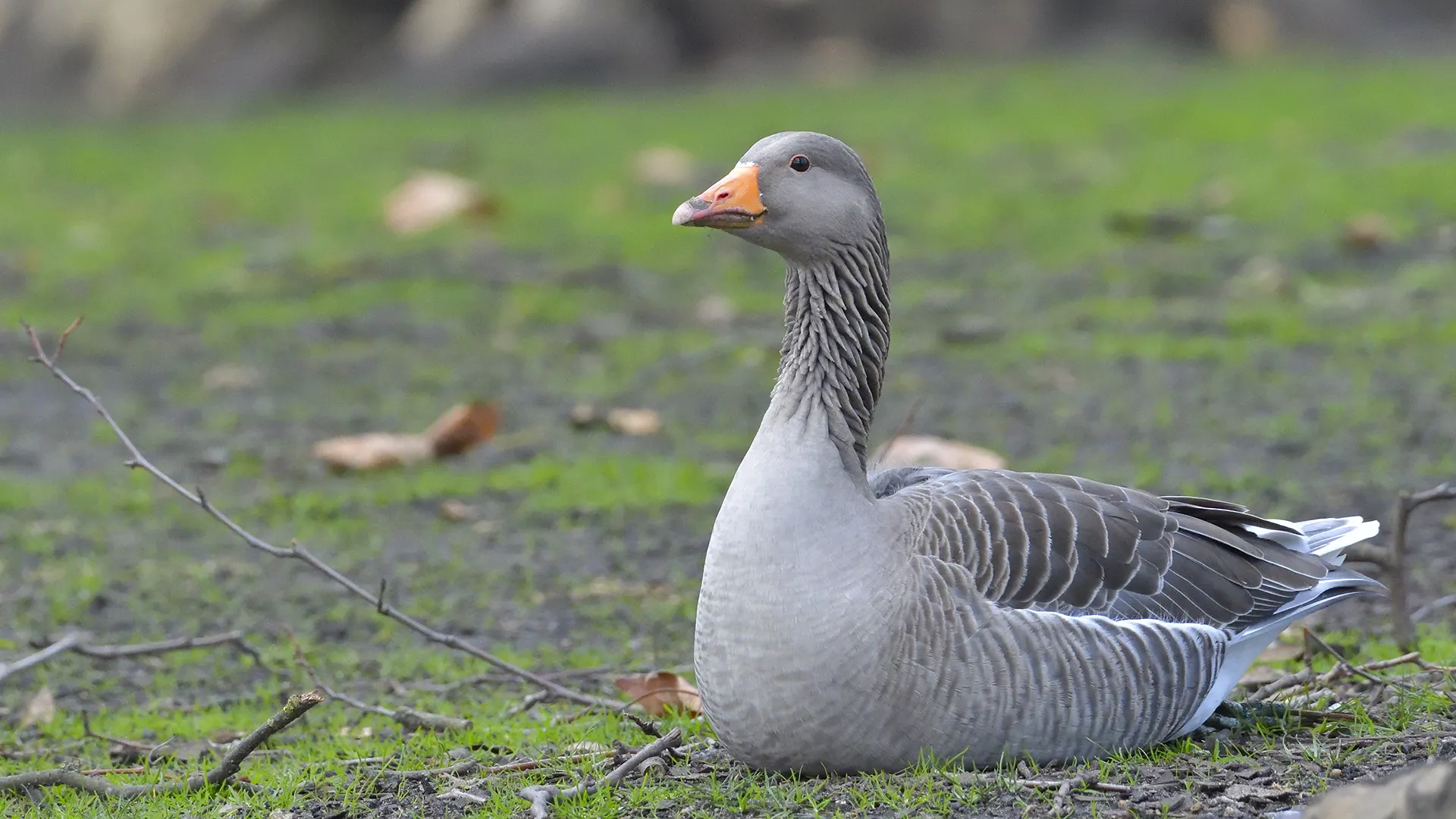
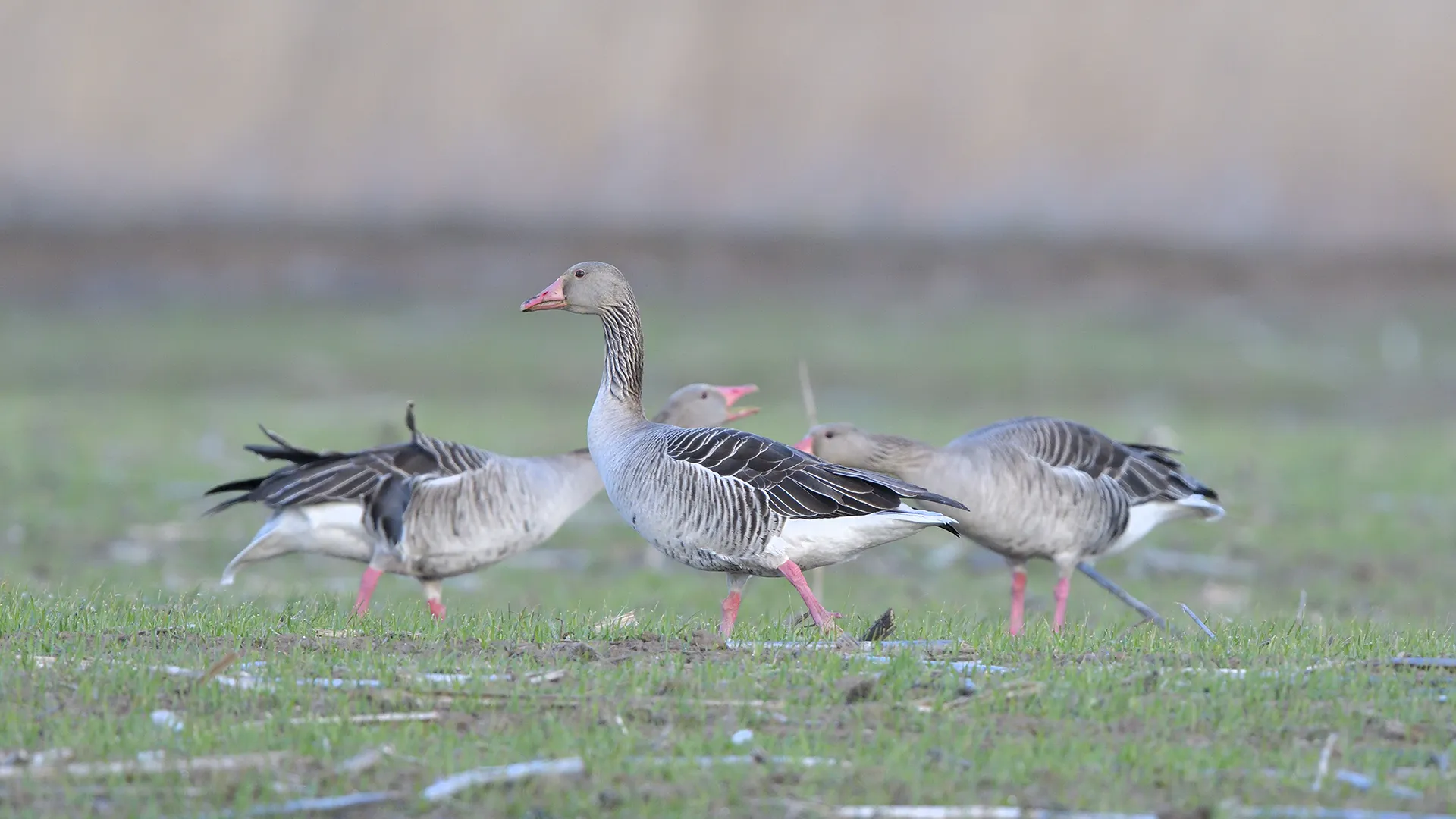
The Greylag Goose is a big, heavy goose with a thick neck and a large head. The plumage is gray-brown, with pale edges to the feathers that give the back and flanks a barred look. The belly is paler, sometimes with a few dark spots, and the undertail is white. The legs are pink. Birds of the eastern subspecies found in the Danube Delta have a pink bill and are slightly larger and paler than western birds, which have an orange bill.
In flight, the pale gray front of the wing contrasts with the darker flight feathers, a good clue even at a distance. The call is a loud, deep cackle, very similar to the farmyard goose.
In winter it mixes with Greater White-fronted Geese, which are smaller and darker, with a white blaze at the base of the bill and black bars on the belly in adults. The rare Taiga and Tundra Bean Geese are darker, with a dark brown head and neck and an orange and black bill.
The wild ancestor of the farmyard goose
Most domestic geese in Europe descend from the Greylag Goose, which was domesticated thousands of years ago. The resemblance is still clear in the voice, the shape and the behavior. In the Danube Delta, where village geese often swim on the channels next to wild birds, the difference is in the details: wild Greylags are slimmer, more alert and always fly off long before a boat comes close.
Nesting in the Danube Delta
Greylag Geese pair for life. Pairs settle on their nesting areas at the end of winter, and in the Danube Delta the eggs are laid from the second half of March and in April. The nest is a mound of reed and other plants, built on dry ground among the reeds, on floating reed islands or on small islands where foxes cannot easily reach.
The female lays usually five to seven eggs and incubates them for about four weeks, while the male stands guard nearby. The goslings feed themselves from the first day and follow their parents along the edges of the reed beds. In early summer the adults molt all their flight feathers at once and cannot fly for about a month. During this time they hide in dense reed beds and are very hard to see. The young fly at about seven to eight weeks, and families stay together through the autumn and winter.
Where and when to see it
Our checklist marks the Greylag Goose as abundant in every month. In spring and summer look for pairs and families on quiet lakes and channels with wide reed beds. From late summer, flocks gather on the larger lakes, and in autumn and winter they are joined by birds from farther north and east. In winter Greylag Geese feed in the fields around the Danube Delta and the lagoons, and they roost on open water.
Romanian estimates give a breeding population of about 3,200–6,800 pairs, most of them in the Danube Delta. A 2020 estimate for the wintering population in Romania was 4,600–12,500 birds. The midwinter census of January 2026 counted 12,133 Greylag Geese, compared with 14,313 in January 2025.
Interesting facts
- The goose that followed Konrad Lorenz. Greylag goslings were the subjects of Konrad Lorenz’s famous studies of imprinting. Goslings hatched in an incubator took the scientist for their parent and followed him everywhere. This work helped earn him a Nobel Prize in 1973.
- The geese that saved Rome. According to the Roman story, the sacred geese kept on the Capitoline Hill raised the alarm when the Gauls tried a night attack in 390 BC. They were domestic geese, descended from the Greylag.
- Partners for life, mostly. Most pairs stay together for life, but studies show that about 5–8% of pairs separate and find new partners.
- Family lessons. The young stay with their parents through their first autumn and winter. They learn the feeding places, roosts and migration routes from the adults, and the family only splits up when the parents start nesting again the next spring.
Status and conservation
The Greylag Goose is widespread and increasing in much of Europe and is listed as Least Concern on the global IUCN Red List. In Romania it is a game species, hunted legally in autumn and winter outside strictly protected areas. Its main needs in the Danube Delta are large, quiet reed beds for nesting and molting. Reed burning, disturbance in spring and early summer and fast boats in the channels are the main local pressures.
Seeing it on a nature tour
On our multi-day nature tours in the Danube Delta, Greylag Geese are part of almost every boat trip. In May and June, families with small goslings swim along the edges of the reed beds, and from late summer large flocks fly over the lakes in the evening, calling loudly as they come in to roost.
See it with us
Our birding guides are biologists and ornithologists who are on the water every day of the year. Small groups, open boats, the best hours of the day.
Keep reading
Keep reading
More from the blog

3 min read
Rosy Starling (Pastor roseus)
The Rosy Starling, a pink and black nomad of the Asian steppes that invades Dobrogea in some years: identification, diet, colonies and where to...
6 min read
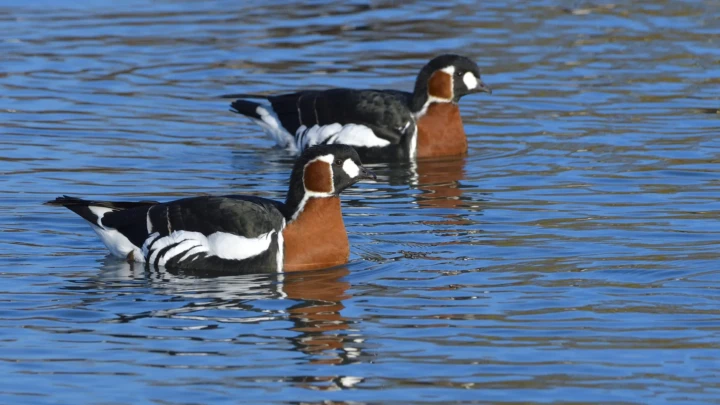
Red-breasted Goose (Branta ruficollis)
Most of the world population spends the winter on the western shore of the Black Sea, and about a third of it in Dobrogea....
5 min read
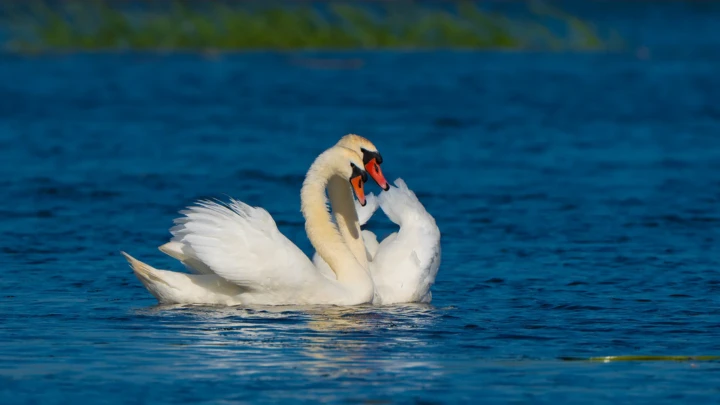
Mute Swan (Cygnus olor)
Meet the Mute Swan, a truly wild, year-round resident of the Danube Delta: how to recognize it, nesting in the reeds, when to see...