

No. 2 on our checklistMute Swan (Cygnus olor)
Meet the Mute Swan, a truly wild, year-round resident of the Danube Delta: how to recognize it, nesting in the reeds, when to see it, numbers and conservation.
The Mute Swan (Cygnus olor) is the large white swan with an orange bill that you see all year in the Danube Delta. In Western Europe many swans live half-tame on park lakes, but here they are truly wild birds, nesting deep in the reed beds and gathering in winter on the lakes and lagoons that stay free of ice.
It is one of the heaviest flying birds in Europe and one of the easiest to recognize, and most of Romania’s breeding swans nest in the Danube Delta and around the lagoons to the south.
Quick facts
Quick facts
- Scientific name Cygnus olor (J. F. Gmelin, 1789)
- Common name Mute Swan
- Family Anatidae (ducks, geese and swans)
- Order Anseriformes (waterfowl)
- Length 150 cm
- Wingspan 220 cm
- Weight 9–11.5 kg
- Diet mainly submerged water plants, reached by dipping the head and neck or upending; also some small invertebrates
- Habitat lakes, slow channels and reed beds of the Danube Delta, and the lagoons of the Razim-Sinoie complex
- Breeding one brood a year; usually 4–7 eggs, incubated for about 5–6 weeks; the young fly at about 4–5 months
- Conservation status Least Concern (global IUCN Red List)
When to see it in the Danube Delta and Dobrogea
- JanWinter flocks
- FebWinter flocks
- MarPairs on territory
- AprNesting
- MayNesting, first cygnets
- JunFamilies
- JulFamilies
- AugFamilies
- SepYoung birds
- OctFlocks gather
- NovWinter flocks
- DecWinter flocks
- Status here
- Resident and very common, present in every month; numbers in winter depend on ice and on birds arriving from the north.
- IUCN Red List
- Least Concern
- Our checklist
- No. 2 of 385 · see the full checklist
How to recognize it
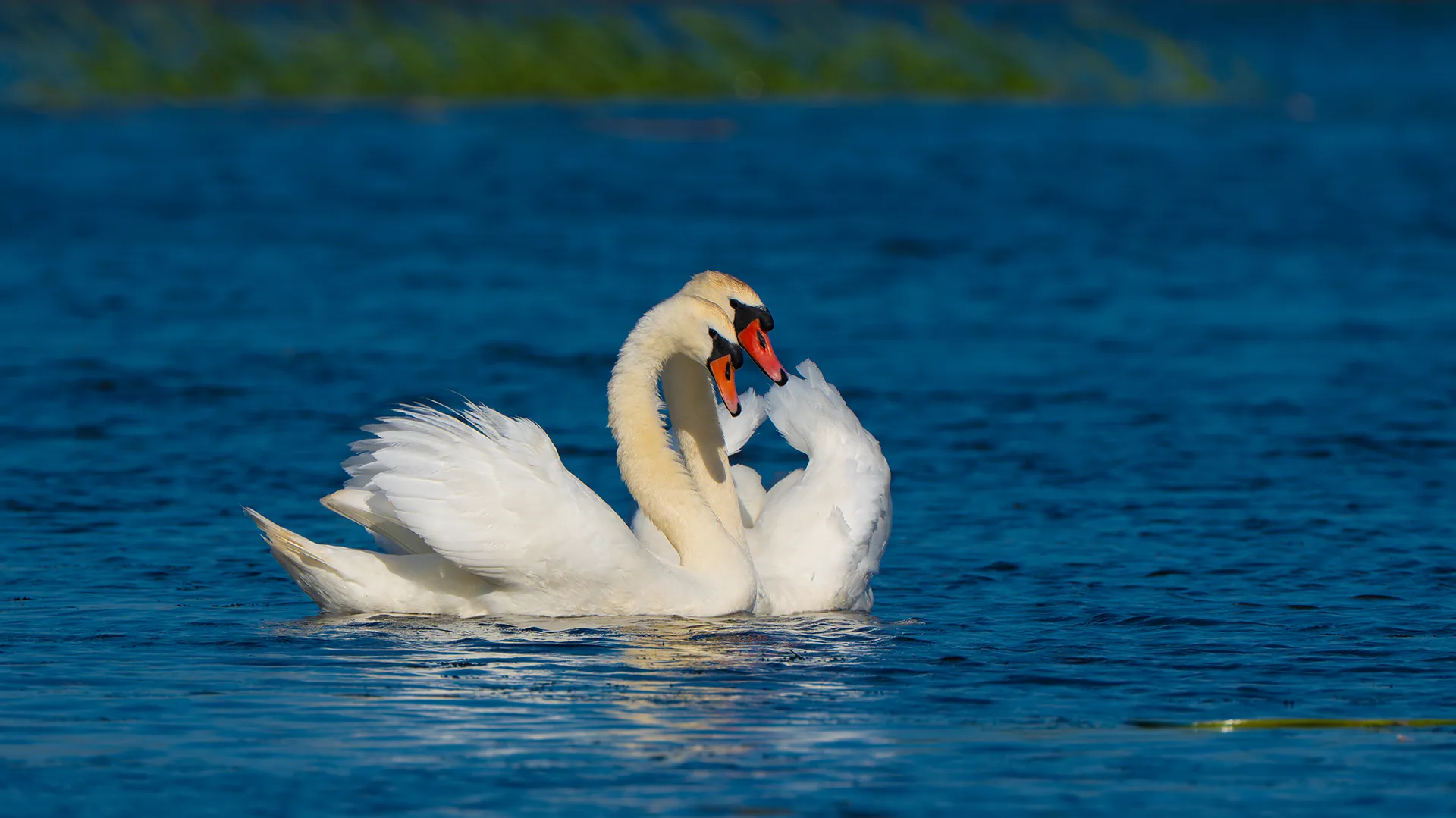
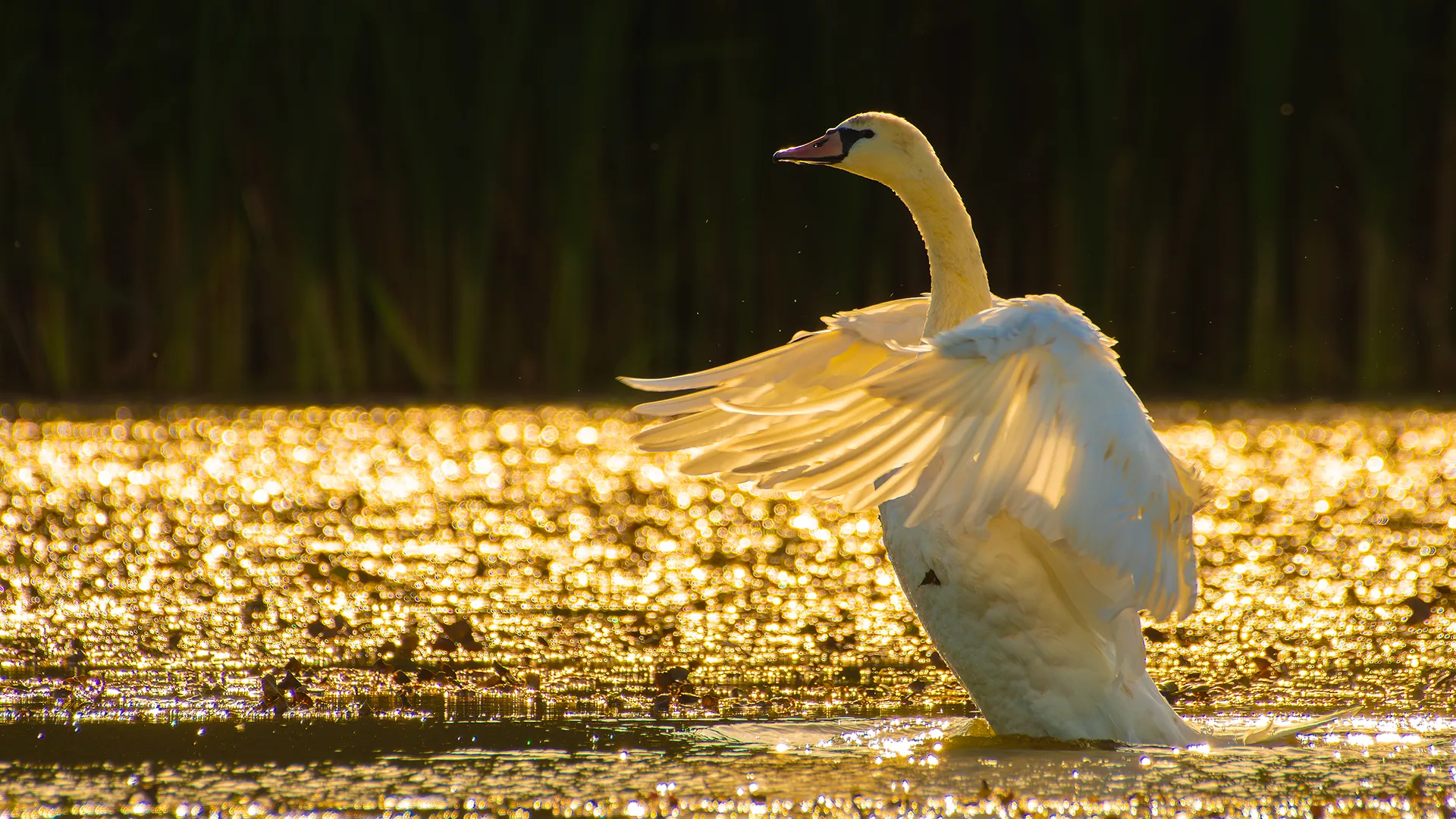
Adults are entirely white, with a long neck often held in a graceful S-curve. The bill is orange-red with a black base and a black knob on the forehead, larger in males. When it swims, the Mute Swan often holds its wings slightly raised over the back, like sails, especially when a male is defending his territory.
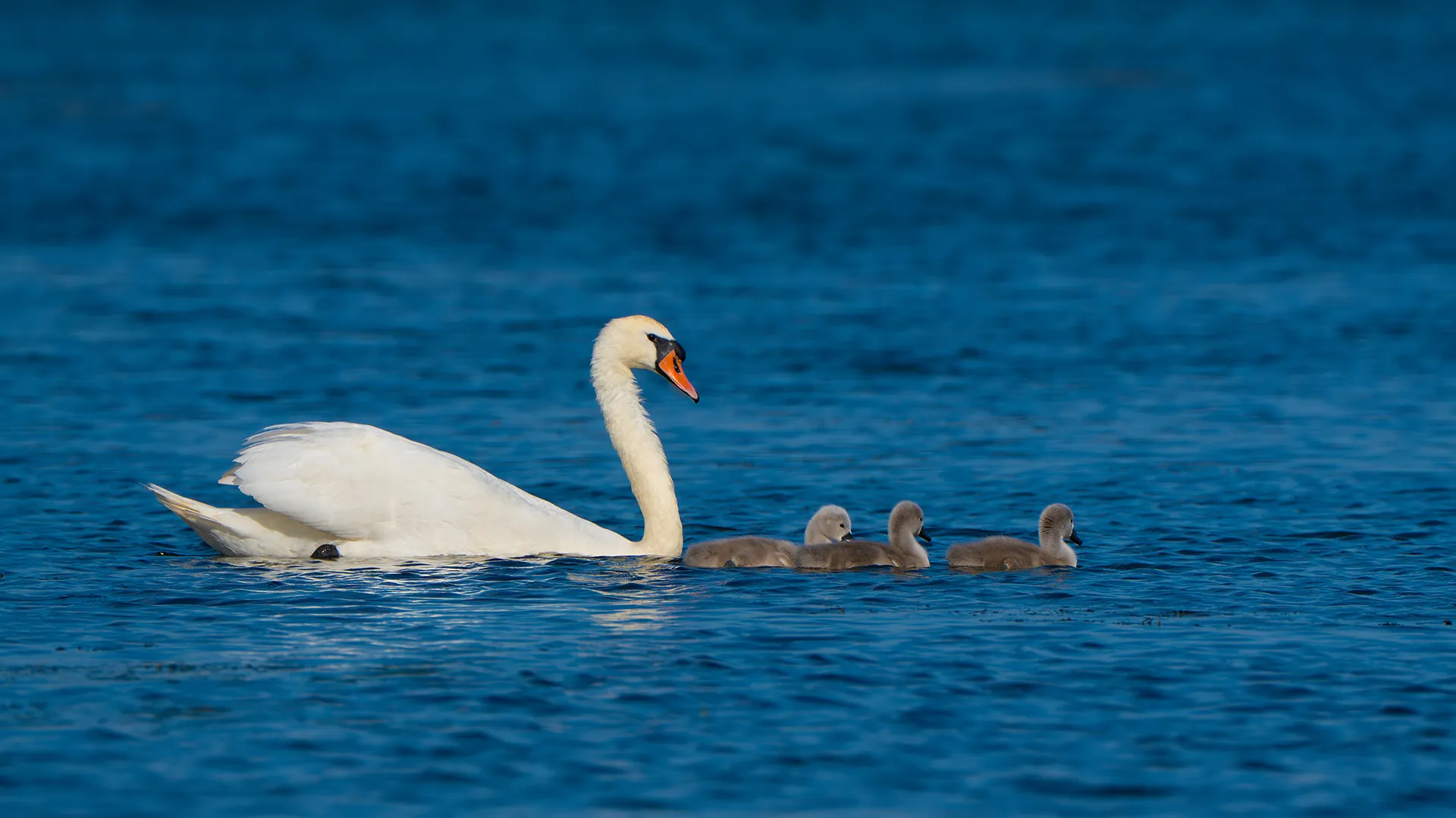
Young birds are grayish brown, with a grayish pink bill and no knob. They turn white gradually during their first and second years. A few cygnets are white from the start; this pale form is known as the “Polish” swan.
In winter two other swans may appear in the Danube Delta and Dobrogea: the Whooper Swan and the much rarer Tundra Swan. Both have black and yellow bills, with no knob, and keep the neck straighter. In flight the Mute Swan is also easy to identify by sound: its wings make a loud, rhythmic, throbbing hum, audible from far away, while the other two swans are quieter in flight but call often.
Not as silent as its name
The name “mute” is a little unfair. Mute Swans are quieter than Whooper and Tundra Swans, but they hiss loudly when they feel threatened, snort and make soft grunting calls to each other. The loudest sound they make is the one of their wings.
Nesting in the reeds
Pairs usually stay together for many years. In early spring they settle on a territory in the reed beds or on the edge of a lake and build a huge nest mound of reed and other plants, often more than a meter across. The female lays usually four to seven eggs and does most of the incubation, which lasts about five to six weeks, while the male guards the nest and drives away other swans and intruders.
The cygnets leave the nest soon after hatching and follow their parents on the water. In May and June families with small gray cygnets are a common sight on the channels. The young take about four to five months to learn to fly, and they often stay with their parents into the autumn.
Mute Swans feed mainly on submerged water plants. They reach them by dipping the head and long neck under water or by upending, with the tail pointing to the sky, which lets them feed deeper than ducks.
Where and when to see it
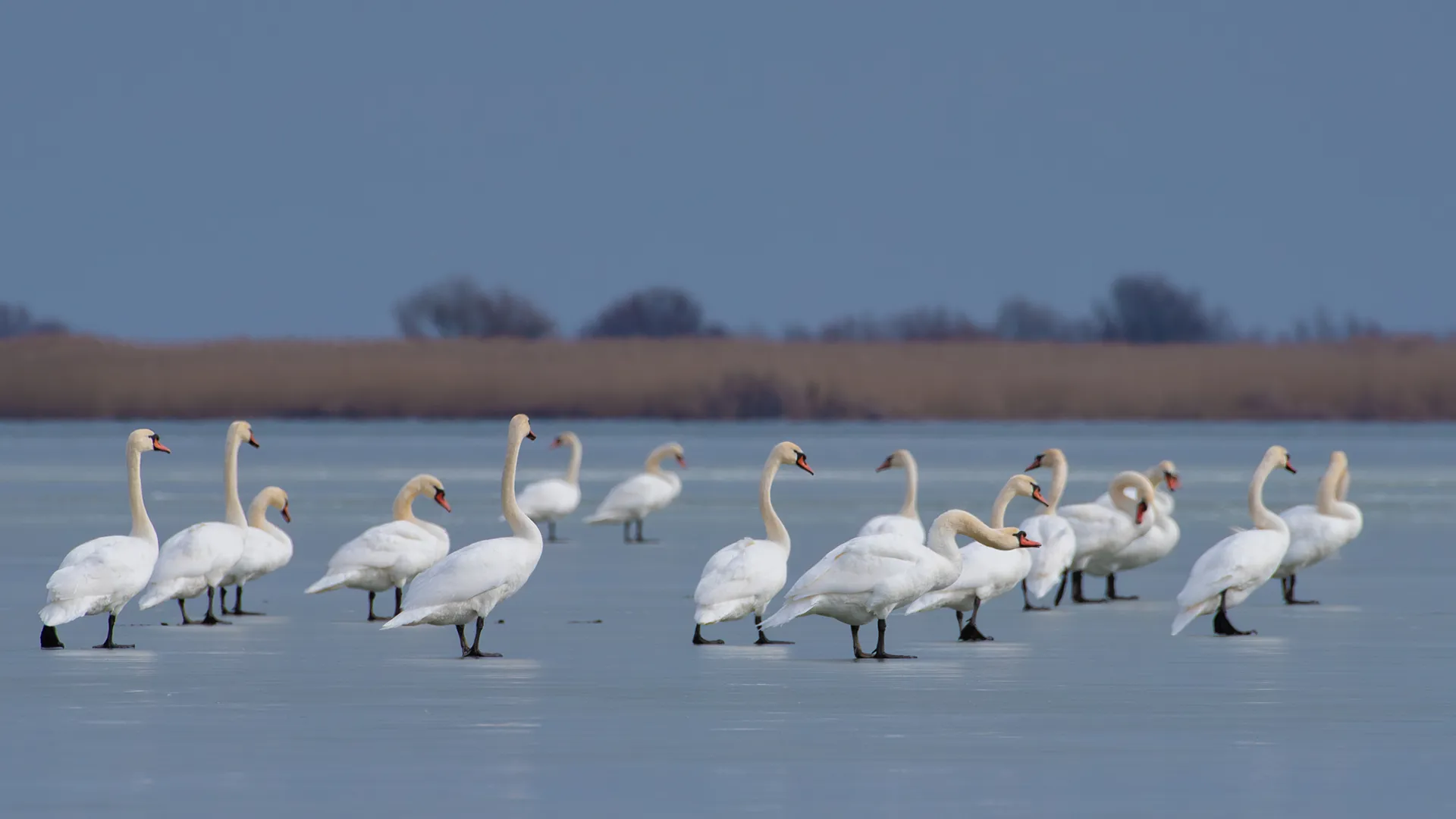
Our checklist marks the Mute Swan as abundant in every month. In the breeding season pairs are spread across the lakes and channels of the Danube Delta and the lagoons of the Razim-Sinoie complex. From autumn, swans gather in larger flocks on open water. When the lakes freeze, many move to unfrozen water along the Danube branches, the lagoons and the Black Sea coast, or farther south.
Romania’s report under the EU Birds Directive for 2013–2018 estimated 4,000–6,000 breeding pairs nationally, increasing, and Romanian sources agree that most of them nest in the Danube Delta. The midwinter waterbird census of January 2026 counted 13,086 Mute Swans across the country, compared with 21,449 in January 2025. These numbers vary a lot from year to year, depending on the weather and the area covered.
Interesting facts
- One of the heaviest flying birds. Adults weigh 9–11.5 kg, and males are heavier than females. That makes the Mute Swan one of the heaviest birds in the world that can still fly. It needs a long run across the water to take off.
- Wings you can hear from far away. In flight the wings make a loud, rhythmic throbbing sound, typical of this species. It carries a long way over the water, and you often hear a flying Mute Swan before you see it.
- A ride on a parent’s back. Tired young cygnets sometimes climb onto a parent’s back and are carried across the water.
- The “Royal Bird”. In Britain, unmarked Mute Swans on open water belong to the Crown by an old right. Every summer, during the traditional “Swan Upping” on the River Thames, the swans and their cygnets are counted and checked.
Status and conservation
The Mute Swan is widespread across Europe and Asia and is listed as Least Concern on the global IUCN Red List. In the Danube Delta its main needs are quiet reed beds for nesting and clean, shallow water rich in water plants. Disturbance near nests, fast boats in the channels and the loss of submerged vegetation in murky, polluted water are the main local pressures.
When you meet a swan family, keep your distance. A male with cygnets can be very defensive, and the stress is unnecessary for the birds.
Photographing swans on our tours
On our multi-day photo tours in the Danube Delta, Mute Swans are among the most rewarding subjects: families with cygnets in late spring, birds taking off across the water with their wings beating loudly, and white swans against frozen reeds in winter. Our boats move slowly, so we can approach without pushing the birds away.
See it with us
Our birding guides are biologists and ornithologists who are on the water every day of the year. Small groups, open boats, the best hours of the day.
Keep reading
Keep reading
More from the blog
3 min read
Northern Pintail (Anas acuta)
The Northern Pintail, perhaps the most elegant duck in Europe: identification, diet, breeding and when to see it on passage in the Danube Delta.
4 min read
Red-footed Falcon (Falco vespertinus)
A small, sociable falcon that nests in old rook nests and gathers in big roosts before migrating to southern Africa: the Red-footed Falcon in...

3 min read
Rosy Starling (Pastor roseus)
The Rosy Starling, a pink and black nomad of the Asian steppes that invades Dobrogea in some years: identification, diet, colonies and where to...