

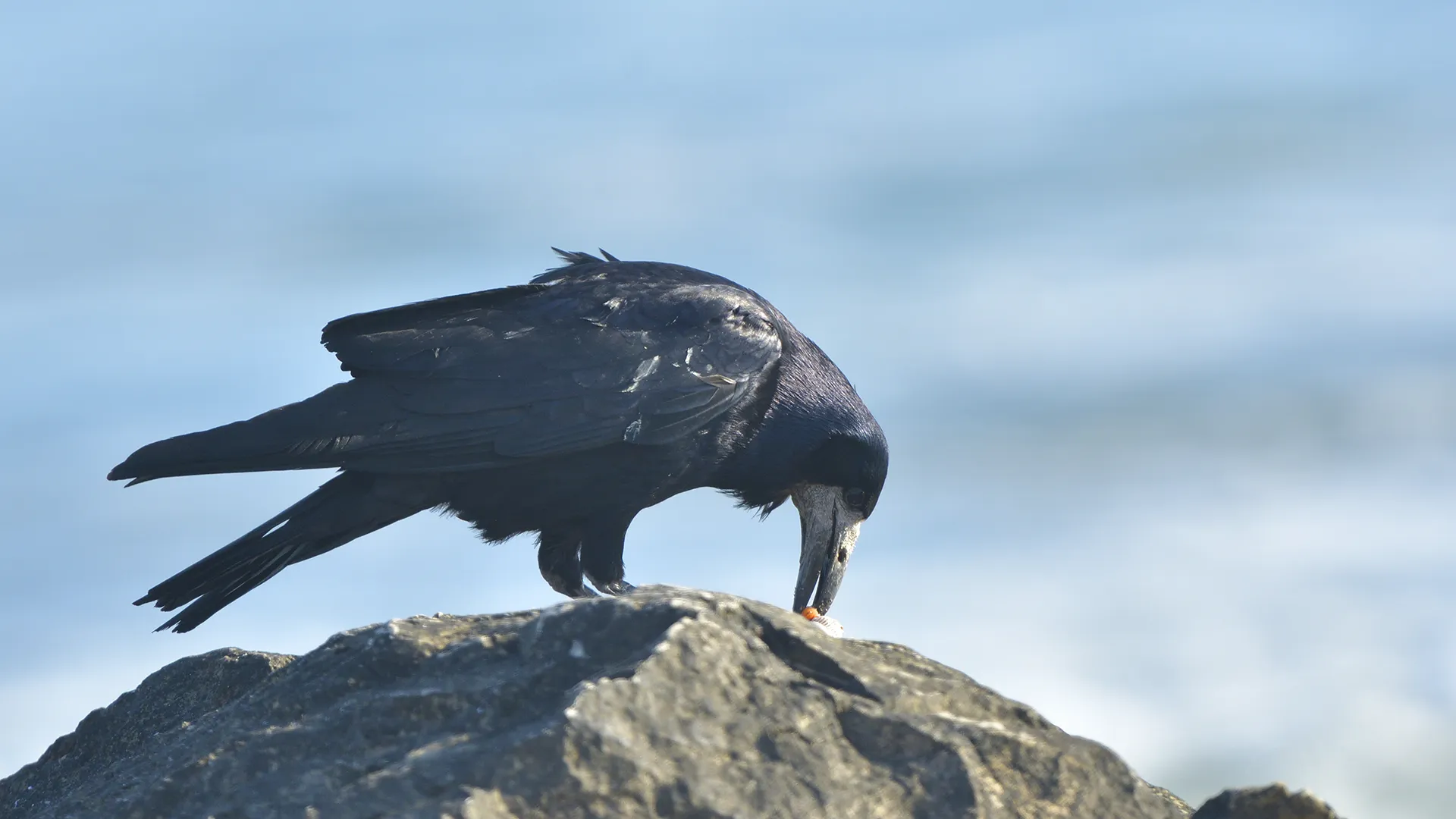
No. 240 on our checklistRook (Corvus frugilegus)
A black crow with a bare grey face, nesting in noisy colonies in tall trees: the Rook of the Danube Delta and Dobrogea, a clever bird whose old nests are used by Red-footed Falcons.
The Rook (Corvus frugilegus) is a large, black crow that nests in colonies, called rookeries, in tall trees. In the Danube Delta and Dobrogea it lives all year, feeding in flocks on fields and pastures and nesting in tree belts, groves and villages.
It is also a key species for other birds: in Romania the Red-footed Falcon nests mainly in old Rook nests.
Quick facts
Quick facts
- Scientific name Corvus frugilegus Linnaeus, 1758
- Common name Rook
- Family Corvidae (crows, jays and magpies)
- Order Passeriformes
- Length about 47 cm
- Wingspan about 81–94 cm
- Weight about 450 g (adults; males heavier)
- Diet omnivorous: soil invertebrates, insects, seeds and grain, fruit
- Habitat farmland and pastures with tree belts, groves, parks and villages
- Breeding in colonies; usually 3–4 eggs, incubated by the female for about 16 days; young leave the nest at 32–34 days
- Conservation status Least Concern (global IUCN Red List); Vulnerable on the European Red List of Birds (2021); Least Concern on the Romanian Red List (2022)
When to see it in the Danube Delta and Dobrogea
- JanFlocks, communal roosts
- FebRookeries reoccupied
- MarNest building, egg-laying
- AprIncubation, chicks
- MayYoung fledge
- JunFamily flocks
- JulFlocks on fields
- AugFlocks on fields
- SepPresent all year
- OctFlocks, communal roosts
- NovFlocks, communal roosts
- DecFlocks, communal roosts
- Status here
- Resident, present all year in farmland, tree belts and villages.
- IUCN Red List
- Least Concern
- Our checklist
- No. 240 of 385 · see the full checklist
How to recognize it
The Rook is about the size of a Hooded Crow but all black, with a glossy plumage. Adults are best told by the bare, greyish-white skin at the base of the bill, which makes the bill look long and pointed, and by the peaked, cone-shaped head. Young birds lack the bare face and are harder to identify.
Life in the rookery
Rooks nest close together, with nests often only a metre or two apart, high in tall trees. A rookery can be used for many years, and in Britain some have been occupied at the same site for over 100 years. In Bulgaria, the national atlas found that rooks breed mainly in groves of black locust, poplar plantations, parks and gardens, inside or close to towns and villages.
Rooks feed on the ground, probing the soil with their bills for insects and other invertebrates, and also take seeds and fruit. A study of pellets from rook colonies in Romania and Poland found seeds in 49% of the 188 pellets, mostly cherry stones, and cereal remains in 70% of the pellets from a farmland colony in Romania. Because they eat fruit and carry the seeds, rooks can help spread plants.
Rooks and Red-footed Falcons
The Red-footed Falcon does not build its own nest. In Romania it uses mainly old Rook nests, taking them over after the rooks have finished breeding. In the 1990s, rook numbers in eastern Hungary and western Romania fell by about 90% because of agricultural intensification, poisoning and tree removal, and the falcons declined with them. A rookery is therefore important not only for the Rooks.
Interesting facts
- Hooks from wire. In a 2009 study at the University of Cambridge, four captive rooks spontaneously bent straight wire into hooks to lift a small bucket of food, although rooks are not known to use tools in the wild.
- The right stone for the job. The same rooks chose small stones when the tube they had to drop them into was narrow, and larger stones when it was wide.
- A gardener in black. In the Romanian and Polish study, cherry stones were the most frequent seeds in rook pellets at all four colonies.
- Up to almost 23 years. The oldest ringed Rook in Britain lived 22 years and 11 months.
Status and conservation
The Rook is listed as Least Concern on the global IUCN Red List, but as Vulnerable on the European Red List of Birds (2021) because of strong declines, mainly in western Europe. In Romania it is Least Concern on the Romanian Red List (2022), with 150,000–200,000 breeding pairs and an uncertain trend. The loss of rookeries also affects the Red-footed Falcon, which depends on their old nests.
See it on our tours
On our multi-day birdwatching tours in the Danube Delta and Dobrogea we often pass rookeries in the tree belts of Dobrogea. In late spring and summer, check them for Red-footed Falcons using the old nests.
See it with us
Our birding guides are biologists and ornithologists who are on the water every day of the year. Small groups, open boats, the best hours of the day.
Keep reading
Keep reading
More from the blog

4 min read
White-winged Tern (Chlidonias leucopterus)
Jet black body and white wings in spring: the most striking of the marsh terns over the lakes of the Danube Delta.
3 min read
Little Egret (Egretta garzetta)
The Little Egret, the snow white heron with yellow feet: identification, its active hunting, the plume trade that nearly wiped it out and where...
3 min read
Northern Pintail (Anas acuta)
The Northern Pintail, perhaps the most elegant duck in Europe: identification, diet, breeding and when to see it on passage in the Danube Delta.