

No. 242 on our checklistHooded Crow (Corvus cornix)
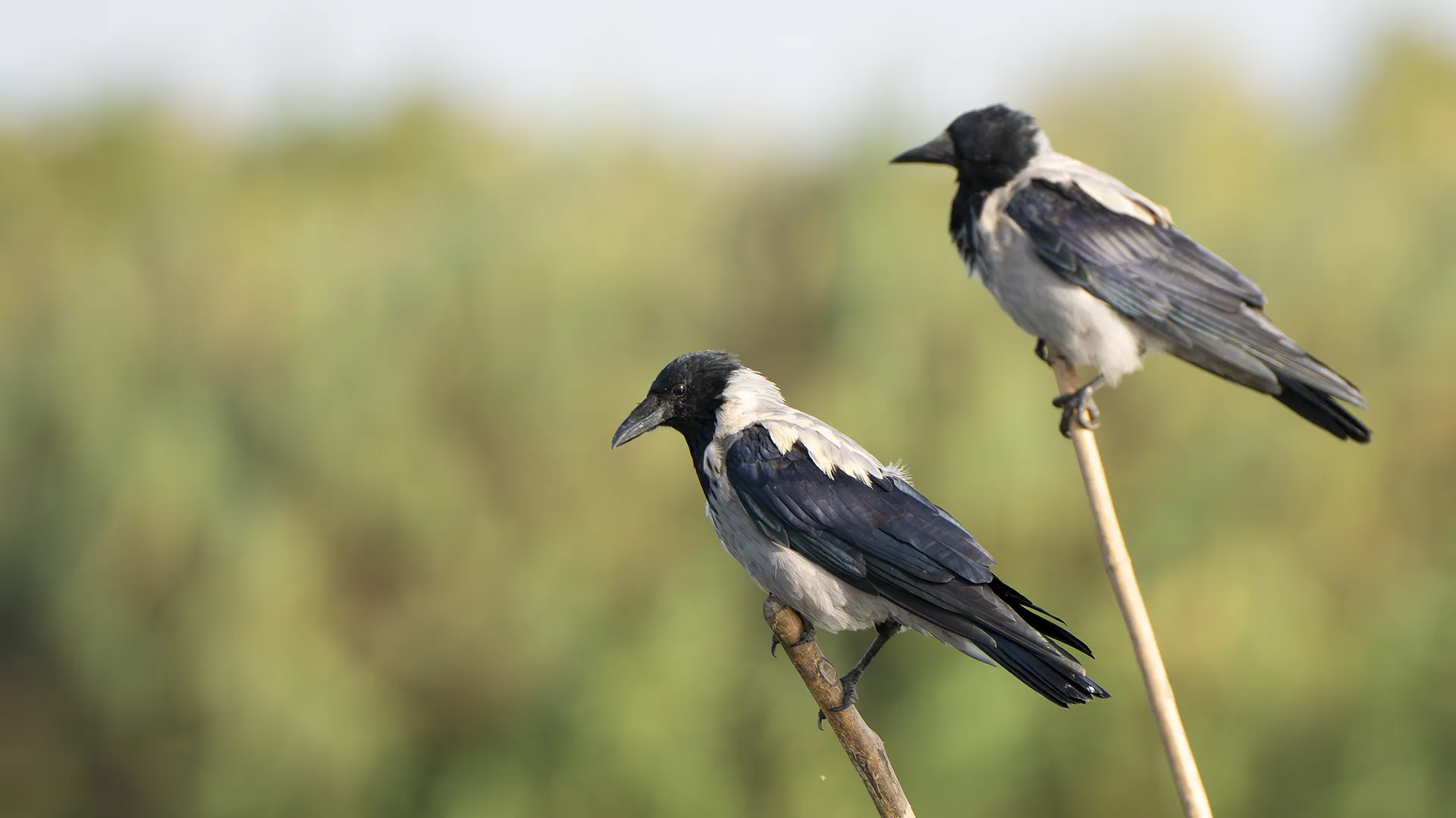
Grey body, black hood and wings: the Hooded Crow is the common crow of the Danube Delta, a clever omnivore whose old nests have been used by Saker Falcons in Dobrogea.
The Hooded Crow (Corvus cornix), also treated as Corvus corone cornix, is the common crow of the Danube Delta and Dobrogea. It lives all year in almost every habitat, from reedbeds and willow forests to villages, farmland and the coast.
Its grey and black plumage makes it easy to recognize, and its old nests are an important resource for other birds.
Quick facts
Quick facts
- Scientific name Corvus cornix Linnaeus, 1758; also treated as a subspecies of the Carrion Crow, Corvus corone cornix
- Common name Hooded Crow
- Family Corvidae (crows, jays and magpies)
- Order Passeriformes
- Weight about 505 g (BTO); 300–530 g in adults studied in Hungary
- Diet omnivorous: insects, molluscs, fish, small vertebrates, eggs and chicks, plants, carrion and scraps
- Habitat almost all open and semi-open habitats with trees: riverine forests, reedbed edges, farmland, villages and towns, the coast
- Breeding one brood a year; usually 3–6 eggs, incubated by the female for 18–19 days; young leave the nest at 28–30 days
- Conservation status Least Concern (global IUCN Red List); Least Concern on the Romanian Red List (2022), assessed together with the Carrion Crow
When to see it in the Danube Delta and Dobrogea
- JanPairs on territory
- FebPairs on territory
- MarNest building, egg-laying
- AprIncubation, chicks
- MayChicks in the nest
- JunYoung fledge
- JulFamily groups
- AugFamily groups
- SepPresent all year
- OctPresent all year
- NovFlocks, communal roosts
- DecFlocks, communal roosts
- Status here
- Resident, present all year in almost all habitats.
- IUCN Red List
- Least Concern
- Our checklist
- No. 242 of 385 · see the full checklist
How to recognize it
The Hooded Crow is a large crow with a two-tone plumage: the head, throat, wings and tail are black, while the back, belly and sides are ash grey. The bill and legs are black. It is about the size of a Rook, but no other crow in the region has a grey body. Birds in Romania and the southern Balkans belong mainly to the subspecies sharpii, which is paler and slightly smaller than the birds of northern Europe.
Grey crow, black crow
In western Europe the Hooded Crow is replaced by the all-black Carrion Crow. Where the two meet, along a narrow zone that runs through Central Europe, along the Elbe and the Alps, they interbreed. A 2014 study published in Science found that their genomes are almost identical: of 82 fixed differences found, 81 lay in one small region of the genome, linked to genes for plumage colour and vision. Crows seem to choose partners that look like themselves, and this is what keeps the two forms apart. For this reason some authorities treat them as two species, while others treat them as one.
Opportunist and nest builder
Hooded Crows eat almost anything, and they are often blamed for taking eggs and chicks. A study of the food brought to nestlings in a wetland national park in western Poland found that fish, plants and insects made up most of the diet, while birds and eggs were only a supplement, about 10% of the dry mass.
The large stick nest is built in trees, bushes or on electricity pylons. Old crow nests are later used by birds that do not build their own. In Dobrogea, all four Saker Falcon breeding attempts known in 2012 were in old Hooded Crow nests, before artificial nests were installed on pylons.
Interesting facts
- One small genomic island. In the 2014 study, 81 of the 82 fixed genetic differences between Hooded and Carrion Crows were packed into a single small region of the genome.
- A home for falcons. In Dobrogea, Saker Falcons nested in old Hooded Crow nests until artificial nests on pylons replaced them.
- Less of a nest robber than thought. In the Polish wetland study, eggs and birds made up only about a tenth of the food given to nestlings.
- A recent species in Britain. The British Ornithologists’ Union recognized the Hooded Crow as a species separate from the Carrion Crow in 2002.
Status and conservation
The Hooded Crow is listed as Least Concern on the global IUCN Red List. The Romanian Red List (2022) assesses it together with the Carrion Crow, under Corvus corone, as Least Concern, with 208,334–331,974 breeding pairs and an uncertain trend.
See it on our tours
On our multi-day photo tours in the Danube Delta and Dobrogea, Hooded Crows are everywhere, and their grey and black plumage makes a strong graphic subject against water and reeds. Watch for them chasing larger birds of prey for dramatic action shots.
See it with us
Our birding guides are biologists and ornithologists who are on the water every day of the year. Small groups, open boats, the best hours of the day.
Keep reading
Keep reading
More from the blog
3 min read
Whooper Swan (Cygnus cygnus)
The Whooper Swan, the trumpeting winter swan of the Danube Delta: how to tell it from Mute and Bewick’s Swans, its call, migration and...
2 min read
Desert Wheatear (Oenanthe deserti)
The Desert Wheatear, a rare vagrant from the deserts and steppes of Asia to the dunes of Dobrogea: how to identify it by its...

4 min read
Black-necked Grebe (Podiceps nigricollis)
Golden fans behind the eyes and red eyes: in spring, one of the most elegant water birds of the Danube Delta lakes.