

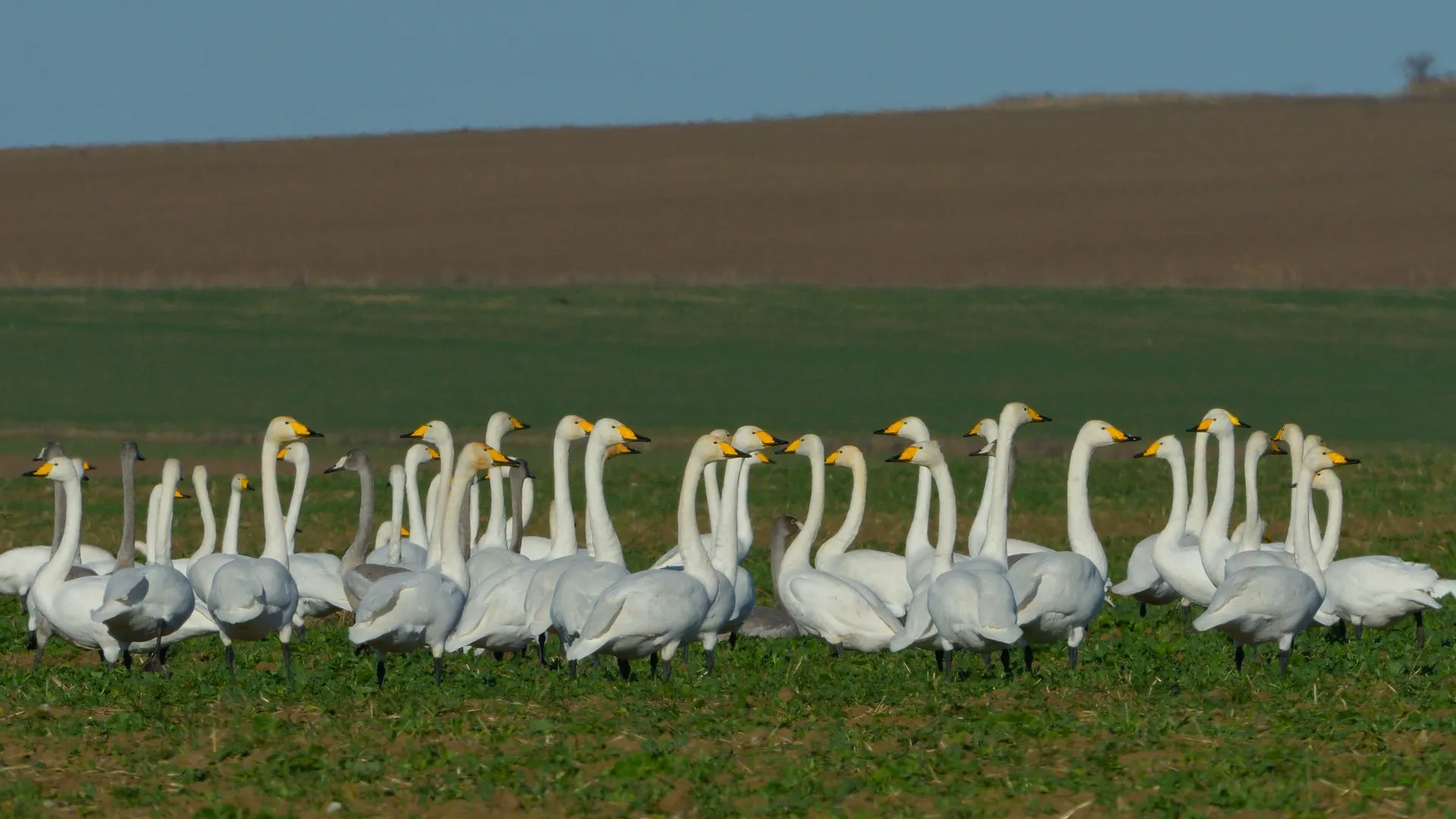
No. 4 on our checklistWhooper Swan (Cygnus cygnus)
The Whooper Swan, the trumpeting winter swan of the Danube Delta: how to tell it from Mute and Bewick’s Swans, its call, migration and where to see it.
In winter, on the open lakes of the Danube Delta, swans with straight necks and yellow and black bills appear among the Mute Swans, calling like trumpets. These are Whooper Swans, arrived from the taiga and tundra of the north. A flock rising from the ice, calling, is one of the unforgettable moments of winter.
Quick facts
- Scientific name Cygnus cygnus
- Family Anatidae (ducks, geese and swans)
- Length 150 cm
- Wingspan 230 cm
- Weight 9.3 kg
- Breeds in northern Europe and Asia
- In Romania in winter, November to March
When to see it in the Danube Delta and Dobrogea
- JanModerate
- FebModerate
- MarModerate
- AprAbsent
- MayAbsent
- JunAbsent
- JulAbsent
- AugAbsent
- SepAbsent
- OctAbsent
- NovModerate
- DecModerate
- Status here
- Winter visitor.
- IUCN Red List
- Least Concern
- Our checklist
- No. 4 of 385 · see the full checklist
Identification
It is as big as the Mute Swan, but holds its neck straight, not in an S, and does not raise its tail. The bill is black at the tip and yellow at the base, and the yellow forms a long, pointed wedge that extends past the nostril towards the tip. The profile of head and bill is long and straight, like a wedge. Juveniles are grey, with a pinkish bill, and stay with their parents through their first winter.
Bewick’s Swan has the same white, yellow and black pattern, but is clearly smaller, with a shorter neck, and the yellow on its bill is a small, rounded patch that does not reach the nostril.
Voice and diet
The Whooper Swan is very vocal. Its loud, trumpeting call carries far, especially when a flock takes off or families reunite. It feeds on aquatic plants, which it pulls from the bottom with its long neck, and in winter often grazes on fields: winter wheat, rapeseed and leftover potatoes or maize.
Migration
It breeds in northern Scandinavia, Iceland and the taiga and tundra of Russia, on remote lakes. Pairs stay together for life, and families migrate and winter together. They arrive here in November and December and leave in February and March. In harsh winters, when the northern lakes freeze completely, more of them reach us.
Where and when to see it
In winter you see it on the large, open lakes of the Danube Delta and the lagoons of Dobrogea, often in family groups, sometimes among Mute Swans. You can look for it on our private winter day trip, and read more about winter in the Danube Delta.
Interesting facts
- Finland’s national bird. The Whooper Swan is the symbol of Finland and appears on the Finnish one euro coin.
- Families that travel together. The young learn the migration route by flying with their parents, and the family stays together until spring.
- A species that came back. In the 20th century the Whooper Swan had almost disappeared from Finland; protection brought it back, and today thousands of pairs breed there.
Status and threats
The Whooper Swan is listed as Least Concern (LC) by the IUCN and is strictly protected in the European Union. The threats are power lines, lead shot swallowed from the mud and disturbance on the lakes where it winters.
See it with us
Our birding guides are biologists and ornithologists who are on the water every day of the year. Small groups, open boats, the best hours of the day.
Keep reading
Keep reading
More from the blog
3 min read
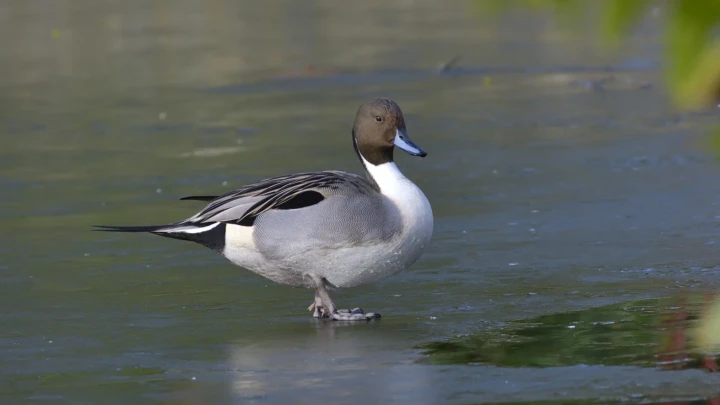
Northern Pintail (Anas acuta)
The Northern Pintail, perhaps the most elegant duck in Europe: identification, diet, breeding and when to see it on passage in the Danube Delta.
3 min read
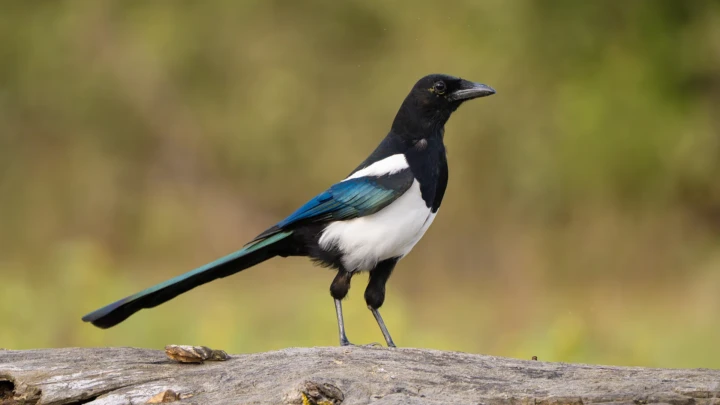
Eurasian Magpie (Pica pica)
Black and white with a long, glossy tail and one of the brightest minds among birds: the Eurasian Magpie, a familiar resident of the...
4 min read
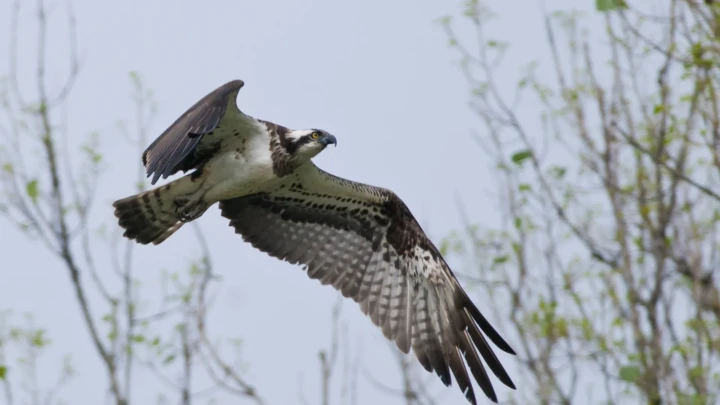
Osprey (Pandion haliaetus)
A fish-hunting raptor that dives feet-first into the water: when to see the Osprey on migration in the Danube Delta and Dobrogea, and why...