

No. 41 on our checklistCommon Pheasant (Phasianus colchicus)
How an introduced game bird lives in the Danube Delta and Dobrogea: Common Pheasant identification, harems, mate choice by spur length, history and status.
The Common Pheasant (Phasianus colchicus) is the long-tailed game bird whose loud, crowing call and whirring wings are heard all year in the fields, forest edges and reed margins of the Danube Delta and Dobrogea.
It is not a native Romanian bird. Pheasants were introduced for hunting, and today they live wild across the lowlands of the country, including the sandy ridges and villages of the Danube Delta.
Quick facts
Quick facts
- Scientific name Phasianus colchicus Linnaeus, 1758
- Common name Common Pheasant; also Ring-necked Pheasant
- Family Phasianidae (pheasants, partridges and allies)
- Order Galliformes (gamebirds)
- Length 70–88 cm, including the long tail
- Wingspan 80 cm
- Weight 980 g–1.4 kg
- Diet omnivorous: seeds, grain, fruits, buds and leaves, as well as insects and other small animals
- Habitat farmland with hedges and field margins, forest edges, scrub, reed margins and village outskirts
- Breeding one brood a year; usually 10–14 eggs, incubated by the female for 23–28 days; the chicks can flutter at about 12 days
- Conservation status Least Concern (global IUCN Red List); an introduced game species in Romania
When to see it in the Danube Delta and Dobrogea
- JanWinter groups
- FebWinter groups
- MarMales crow, territories
- AprHarems, nesting
- MayNesting
- JunFemales with chicks
- JulFamilies
- AugFamilies
- SepYoung independent
- OctAutumn groups
- NovWinter groups
- DecWinter groups
- Status here
- Resident all year: an introduced species, common in the farmland and on the sandy ridges of the Danube Delta and Dobrogea.
- IUCN Red List
- Least Concern
- Our checklist
- No. 41 of 385 · see the full checklist
How to recognize it
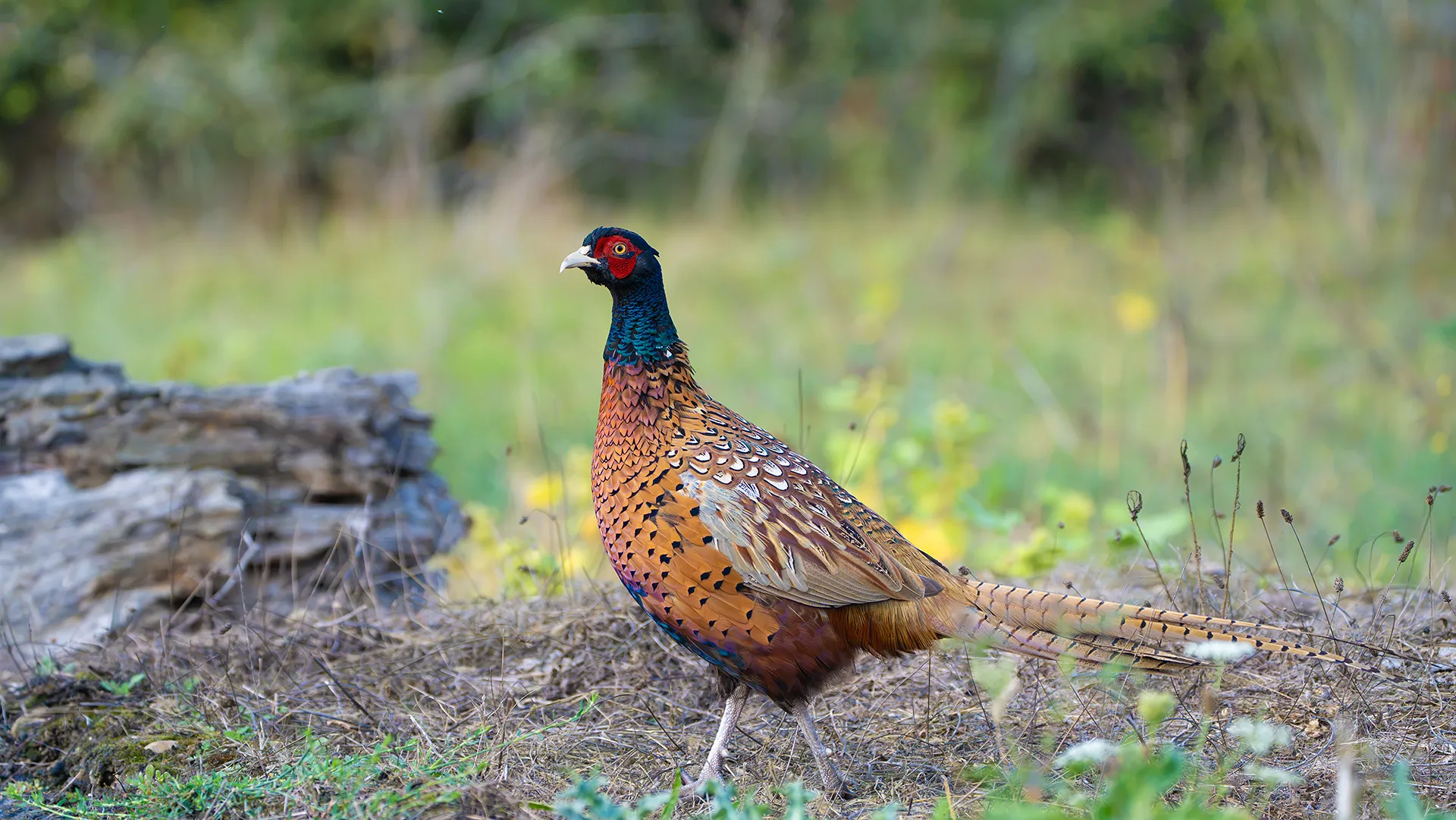
The male is unmistakable: a glossy, dark green head, bright red facial wattles, short ear tufts, copper and golden body plumage with dark markings, and a very long, barred tail. Many males also have a white ring around the neck. The female is smaller, sandy brown with dark spots and scales, and has a shorter, but still long, pointed tail.
The pheasants living in Romania are a mixture of forms that were brought from different parts of the species’ range. Some males have a complete white collar, others have none, and many birds are intermediate.
In spring the male gives a loud, hoarse double crow, “kor-kok”, usually followed by a burst of wing-whirring. When flushed, both sexes burst up from cover with loud wingbeats and alarm calls.
An introduced bird
The species is native to Asia, from Georgia to eastern China, with an isolated native population in eastern Greece. In Europe it was probably introduced from Roman times, and introductions became widespread in the Middle Ages, especially on the hunting estates of the nobility. In Romania it was introduced for hunting and is now present across the lowlands and hills of the country. For 2013–2018, Romania reported about 346,000–370,000 breeding pairs to the European Union, with an increasing trend.
Across Europe, pheasant numbers are strongly influenced by the release of farm-reared birds by hunters. In Britain alone, about 47 million pheasants were released in 2016.
Life in the Danube Delta and Dobrogea
In the Danube Delta pheasants live on the higher ground: the sandy ridges with their oak forests and scrub, the edges of fields and pastures, and the outskirts of villages. In Dobrogea they are common in farmland with hedges, field margins and patches of woodland. They feed on the ground, scratching for seeds, grain, buds and insects, and they roost at night in trees or dense cover.
Breeding: harems and mate choice
In early spring the males defend territories and gather small groups of females, known as harems. The nest is a simple scrape on the ground, lined with plants and hidden in tall vegetation. The female incubates alone and raises the chicks without help from the male. The chicks leave the nest soon after hatching and feed themselves.
Interesting facts
- The bird of the river Phasis. The name comes from Phasis, the ancient Greek name of the Rioni River in western Georgia, and colchicus refers to Colchis, the ancient land on the eastern shore of the Black Sea, where Europeans first knew the bird.
- Females choose the males with the longest spurs. A field experiment in Sweden, published in Nature in 1989, showed that female pheasants prefer males with longer spurs, and that this choice was linked to better breeding success. Spur length reflects the male’s age, size and survival chances.
- Bodyguards, not just mates. Studies of the harem system in Britain showed that a female guarded by a territorial male spent three times as much time feeding, one fifth as much time running and one tenth as much time alert as an unguarded female.
- Flying at less than two weeks old. Pheasant chicks can flutter short distances at only 11–13 days old, long before they are fully grown.
- A neighbor with a cost. In Britain, parasites carried by farm-reared pheasants may have contributed to the decline of the native Grey Partridge, although studies disagree on how large the effect is.
Status and conservation
The Common Pheasant is listed as Least Concern on the global IUCN Red List. In its native range in Asia, some populations are threatened by overhunting, habitat loss and the release of birds from other subspecies. In Romania it is an introduced game species, hunted from 1 October to 28 February and maintained in many hunting grounds by regular releases.
See it on our tours
On our multi-day nature tours in the Danube Delta, we often meet pheasants on the sandy ridges and along the field edges near the villages. Early in the morning, the crowing males are one of the typical sounds of the Danube Delta in spring.
See it with us
Our birding guides are biologists and ornithologists who are on the water every day of the year. Small groups, open boats, the best hours of the day.
Keep reading
Keep reading
More from the blog
4 min read
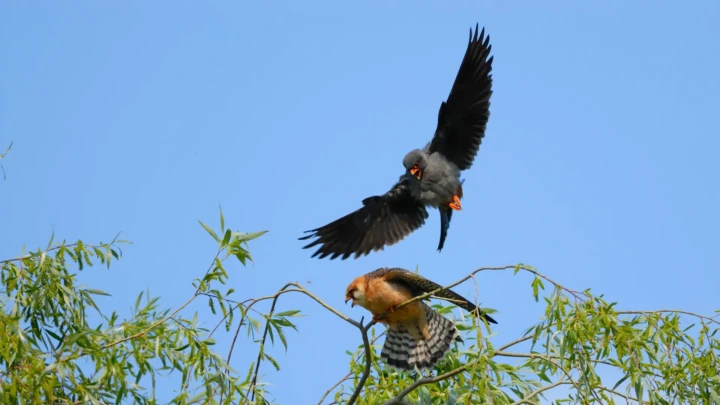
Red-footed Falcon (Falco vespertinus)
A small, sociable falcon that nests in old rook nests and gathers in big roosts before migrating to southern Africa: the Red-footed Falcon in...

5 min read
Little Grebe (Tachybaptus ruficollis)
The smallest grebe in Europe: a round little diver that comes to the Danube Delta in numbers for the winter.
4 min read
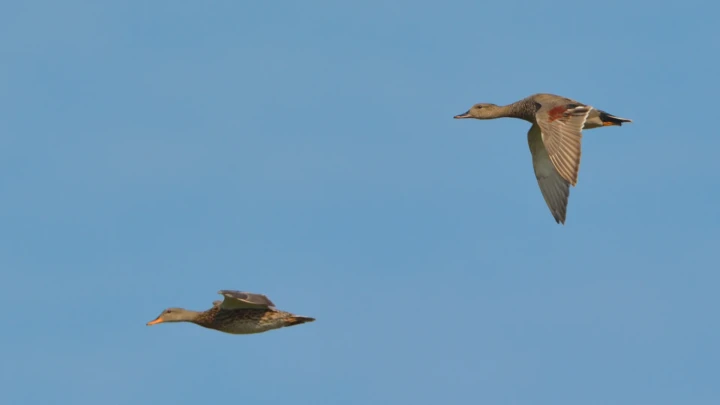
Gadwall (Mareca strepera)
Meet the Gadwall, a plant-eating dabbling duck that steals food from coots: identification, breeding in the Danube Delta, autumn migration and status.