

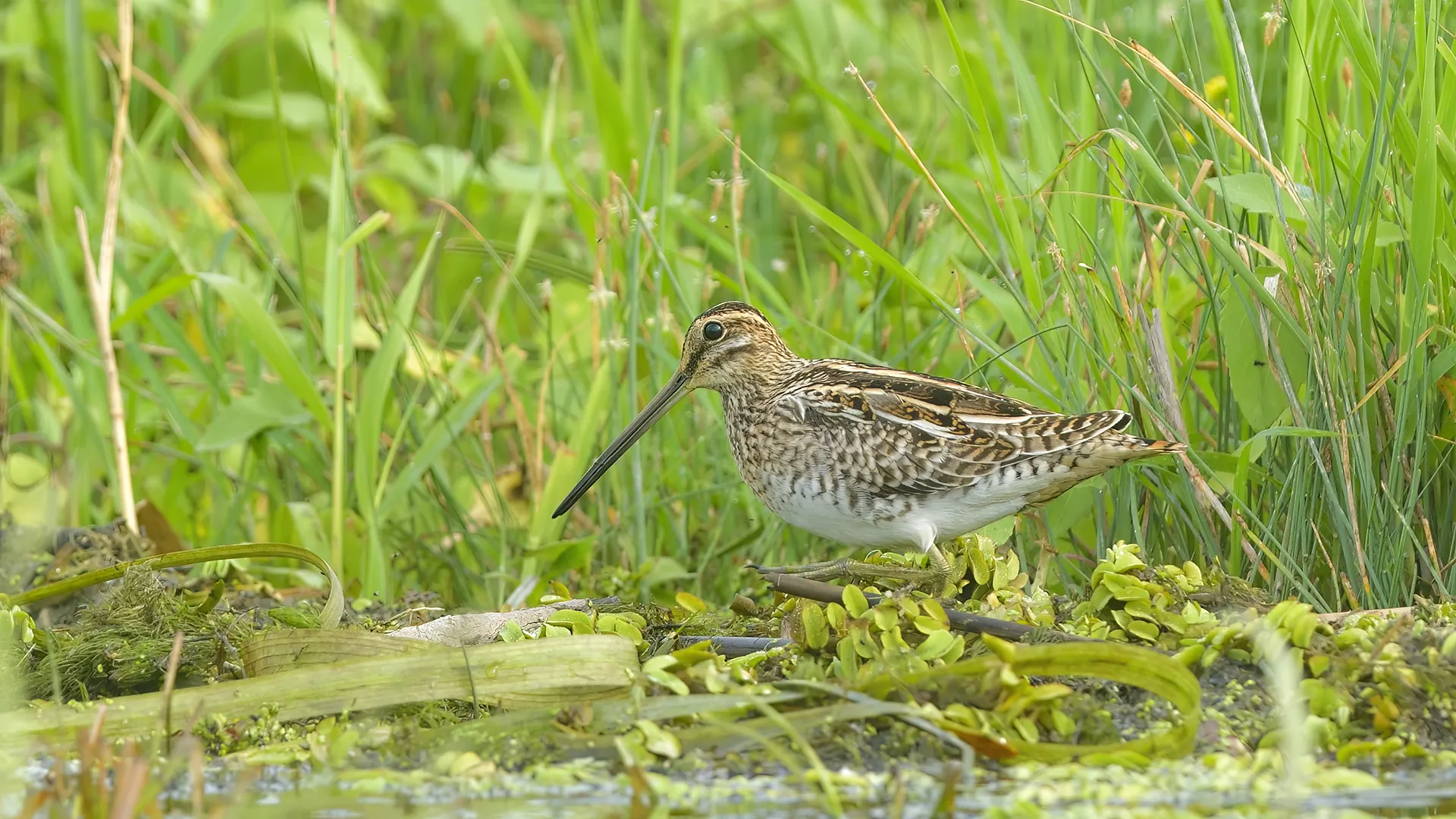
No. 94 on our checklistCommon Snipe (Gallinago gallinago)
Buff stripes and a long, straight bill help identify this well-camouflaged wader on passage through the Danube Delta.
The Common Snipe (Gallinago gallinago) is a wader with a long, straight bill and buff stripes on its mottled brown back. The Danube Delta and Dobrogea checklist records it on spring and autumn passage and very rarely in winter.
Linnaeus originally described it as Scolopax gallinago in 1758.
Quick facts
Quick facts
- Scientific name Gallinago gallinago (Linnaeus, 1758)
- Common name Common Snipe
- Family Scolopacidae
- Order Charadriiformes
- Weight about 108 g
- Habitat marshes and other wetlands with damp ground and low cover
- Breeding usually 4 eggs; the female incubates for 18–20 days; young typically fledge at 19–20 days
- Conservation status Least Concern globally; Romania (2022): Vulnerable as a breeding bird
When to see it in the Danube Delta and Dobrogea
- JanVery rare
- FebVery rare
- MarPresent
- AprPresent
- MayNot normally recorded
- JunNot normally recorded
- JulNot normally recorded
- AugNot normally recorded
- SepPresent
- OctPresent
- NovVery rare
- DecVery rare
- Status here
- Passage migrant and very rare winter visitor. More regular in March–April and September–October.
- IUCN Red List
- Least Concern
- Our checklist
- No. 94 of 385 · see the full checklist
How to recognize it
The bill is long and straight, the legs short, and the upperparts mottled brown with pale longitudinal stripes. A snipe that takes off can change direction sharply, but identification does not have to depend on a flight view. Scan muddy gaps and low vegetation slowly for the striped back and the long bill.
Passage and winter in the Danube Delta
March and April, then September and October, are the more regular months in the local checklist. The species is marked very rare from November through February, not absent. Romania has a small assessed breeding population, but the regional checklist does not identify Common Snipe as a local breeder.
Interesting facts
- The pale stripes run along the back. They break up the bird’s outline against vegetation and wet ground.
- The bill is very long for its size. It stands out even when the patterned body is hard to see.
- Take-off can be erratic. A snipe may change direction abruptly once airborne.
- Four eggs is the usual clutch. The female incubates, and the young hatch downy.
Status and conservation
The Common Snipe is Least Concern globally. Romania’s 2022 Red List classifies the breeding population as Vulnerable and reports 30–50 breeding pairs nationally, with an unknown short-term trend. That is not a breeding estimate for the Danube Delta.
See it on our tours
On our multi-day birdwatching tours in the Danube Delta and Dobrogea, scan damp margins during spring or autumn passage. Watch quietly from a distance rather than trying to flush a concealed bird.
See it with us
Our birding guides are biologists and ornithologists who are on the water every day of the year. Small groups, open boats, the best hours of the day.
Keep reading
Keep reading
More from the blog
5 min read
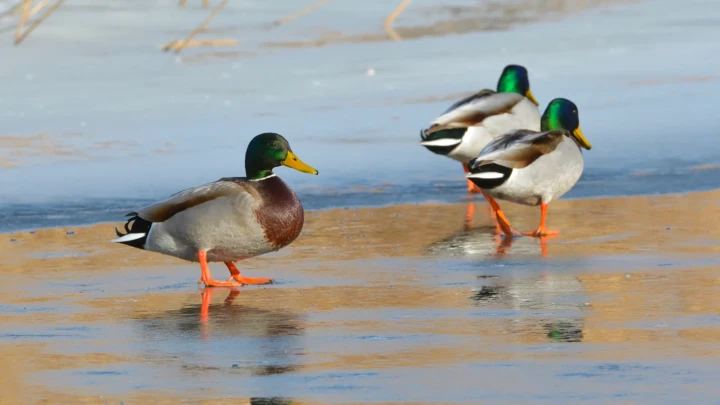
Mallard (Anas platyrhynchos)
The Mallard, the most common duck in the Danube Delta and the ancestor of farmyard ducks: identification, breeding, numbers, one-eyed sleep and changing bills.
5 min read
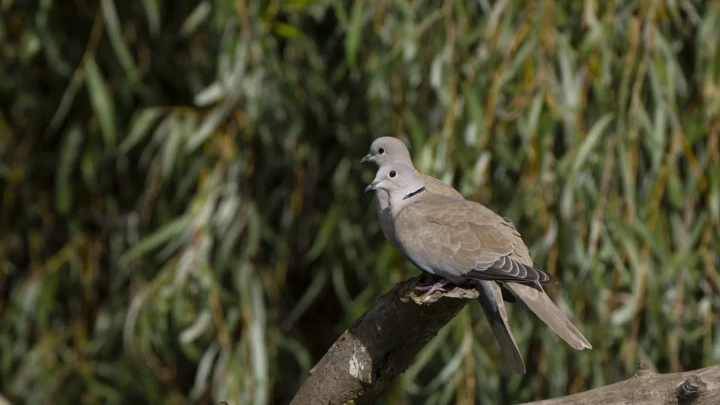
Eurasian Collared Dove (Streptopelia decaocto)
Unknown in most of Europe 200 years ago, the Eurasian Collared Dove now lives in every Danube Delta village: identification, spread, breeding and legend.
4 min read
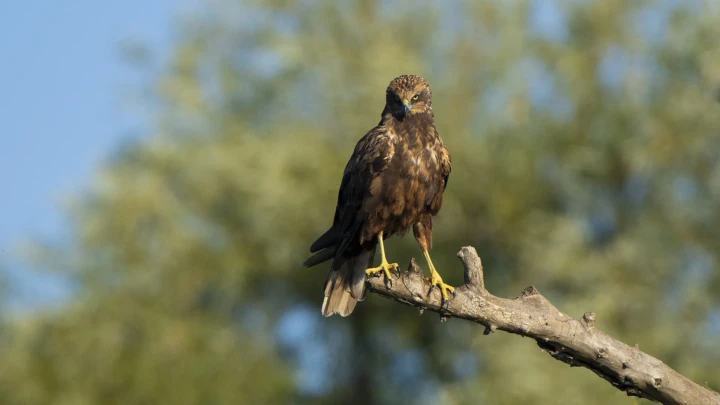
Western Marsh Harrier (Circus aeruginosus)
Gliding low over the reeds with wings raised in a shallow V: the Western Marsh Harrier is the most typical bird of prey of...