

No. 57 on our checklistCommon Wood Pigeon (Columba palumbus)
The Common Wood Pigeon, Europe's largest pigeon, in the forests and fields of the Danube Delta and Dobrogea: identification, breeding, migration and status.
The Common Wood Pigeon (Columba palumbus) is the largest pigeon in Europe. In the Danube Delta and Dobrogea it nests in the oak forests of the sandy ridges, in willow and poplar woods along the Danube branches and, more and more often, in parks and villages.
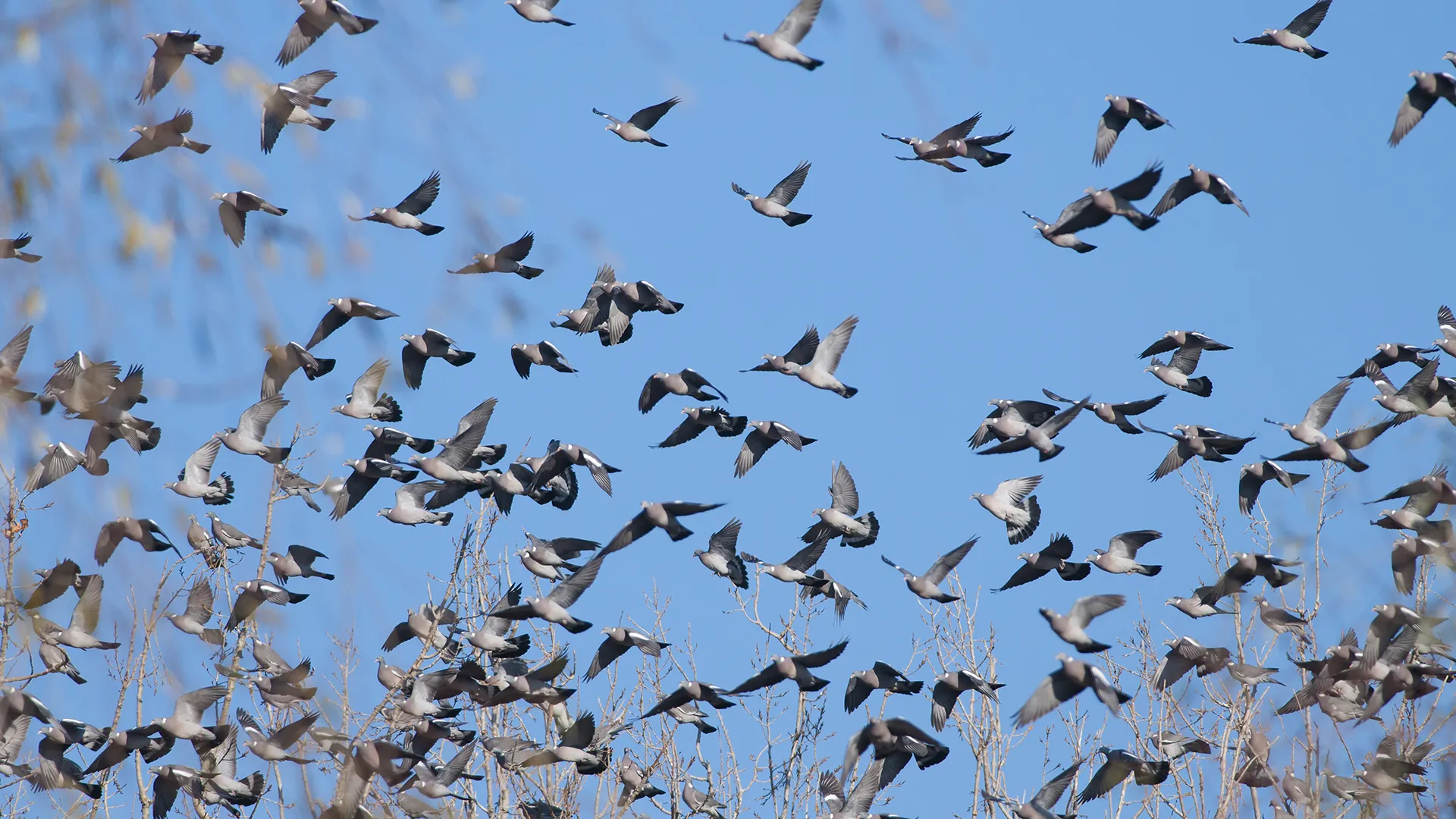
In autumn and winter its numbers grow, as flocks from the north and east arrive to feed on the fields and in the forests.
Quick facts
Quick facts
- Scientific name Columba palumbus Linnaeus, 1758
- Common name Common Wood Pigeon; also Woodpigeon
- Family Columbidae (pigeons and doves)
- Order Columbiformes (pigeons and doves)
- Length 40–42 cm
- Wingspan 78 cm
- Weight 450 g
- Diet plants: seeds, grain, acorns, beechnuts, berries, buds and green leaves, including crops such as rapeseed and cereals
- Habitat forests, woodland edges, riverine woods and tree belts next to farmland; also parks and gardens
- Breeding one or two broods a year; almost always 2 eggs, incubated by both parents for about 17 days; the young leave the nest at 33–34 days
- Conservation status Least Concern (global IUCN Red List); Least Concern on the Romanian Red List (2022); a game species in Romania
When to see it in the Danube Delta and Dobrogea
- JanWintering flocks
- FebWintering flocks
- MarSpring passage, display flights
- AprNesting
- MayNesting
- JunNesting
- JulYoung in the nest
- AugSecond broods
- SepFlocks gather
- OctAutumn passage
- NovAutumn flocks
- DecWintering flocks
- Status here
- Present all year: breeds in forests and woods; more numerous from October to March, with migrants and wintering birds.
- IUCN Red List
- Least Concern
- Our checklist
- No. 57 of 385 · see the full checklist
How to recognize it
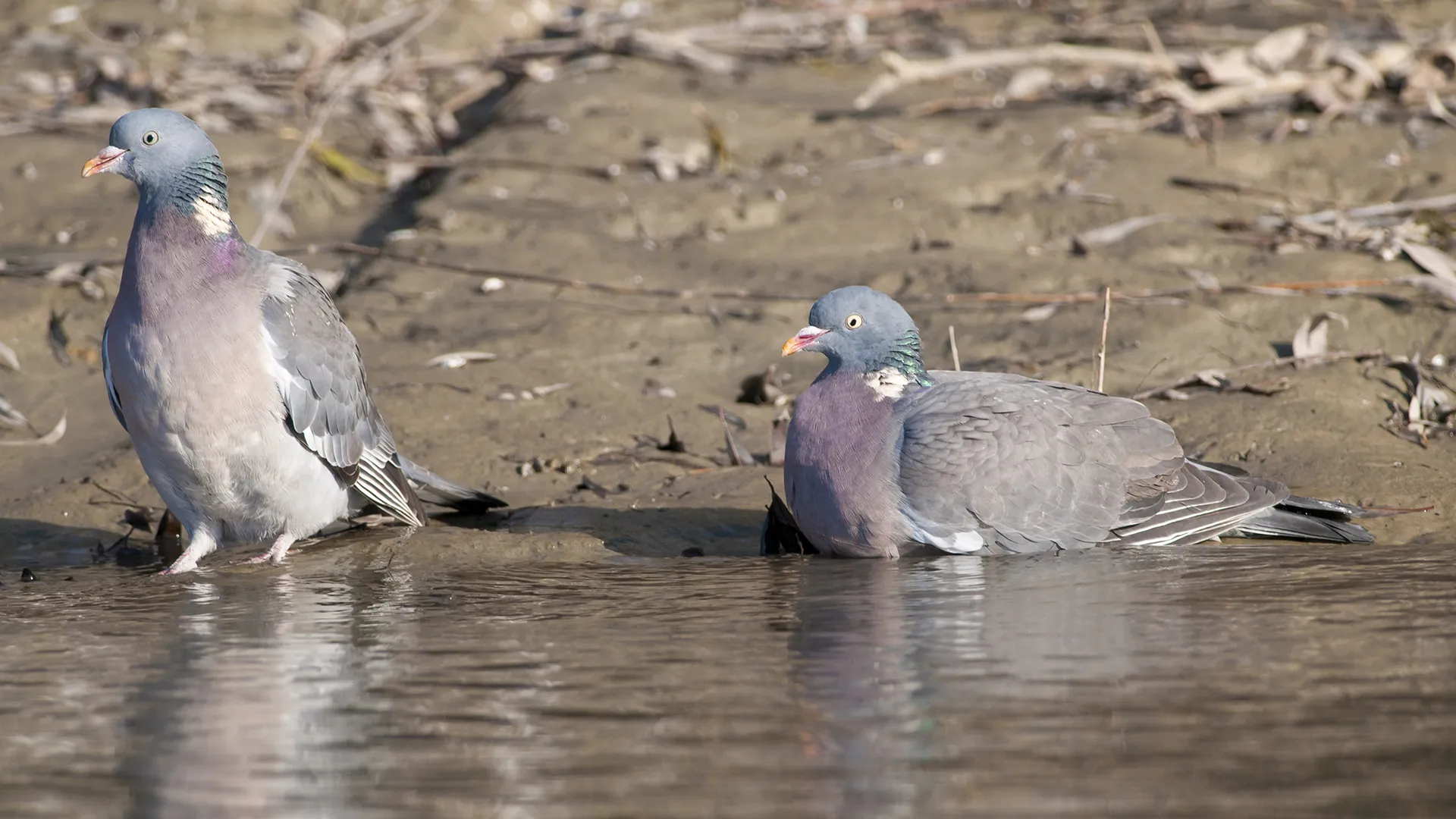
The Common Wood Pigeon is a large, heavy pigeon with a small head and a long tail. It is blue-gray, with a pinkish breast and a glossy green and purple patch on the side of the neck, with a bright white mark in the middle. In flight a broad white band across each wing is the best field mark, visible from far away. The tail has a dark band at the tip.
Juveniles lack the white neck patch and look duller. The smaller Stock Dove has no white on the wings or neck, and the Eurasian Collared Dove is much paler and slimmer, with a narrow black half-collar.
The song is a soft, husky, five-note cooing, repeated several times, with the stress on the second note. When a Wood Pigeon takes off in alarm, its wings make a loud clatter.
Life in the Danube Delta and Dobrogea
In the Danube Delta the Wood Pigeon breeds where there are tall trees: in the oak forests of Letea and Caraorman, in the willow and poplar woods along the branches of the Danube and in tree belts near villages. In Dobrogea it nests in forests and woodland patches and feeds on the surrounding farmland.
In Romania the species is widespread and increasing. National estimates based on the Common Bird Monitoring programme give about 288,000–390,000 pairs.
Across Europe the Wood Pigeon has also moved into towns. The first urban breeding was recorded in western and central Europe in the early 19th century, and the species has since colonized cities as far north-east as Lithuania, Belarus and Ukraine.
Breeding
The nest is a flimsy platform of twigs, often so thin that the eggs can be seen from below. It is placed in a tree or a tall bush. Both parents incubate and feed the young with “crop milk” at first, later adding seeds. The breeding season is long, and pairs can raise two broods.
In spring the males perform display flights over their territory. The bird climbs steeply, claps its wings, then glides down with the wings and tail spread, sometimes repeating the climb several times.
Migration and winter
Wood Pigeons from northern and eastern Europe are migratory, while many in the south of the range stay all year. In autumn large flocks move south and west. Farther west, several million Wood Pigeons from central Europe cross the western Pyrenees every autumn to winter in Spain and Portugal. In the Danube Delta and Dobrogea, flocks are most visible from October to March, often feeding on fields of rapeseed and winter cereals or on acorns in the forests.
Interesting facts
- Drinking like a straw. Most birds drink by scooping up water and tipping the head back. Pigeons keep the bill in the water and pump it in by suction, so they can drink quickly without lifting their heads.
- Applause in the air. During the display flight, the male can clap his wings up to nine times at the top of the climb, producing a sharp, whip-like crack on the downstroke.
- Millions over the mountains. Every autumn several million Wood Pigeons from central Europe fly over the western Pyrenees on their way to winter in Spain and Portugal.
- From forest bird to city bird. Once restricted to woodland and farmland, the Wood Pigeon is now a common breeding bird in many European capitals. Its spread into cities such as Madrid is now followed closely by researchers.
- Long-lived pigeon. The longevity record for a ringed Wood Pigeon in Britain is more than 17 years, although adults typically live about three years.
Status and conservation
The Common Wood Pigeon is listed as Least Concern on the global IUCN Red List and on the Romanian Red List (2022), with an increasing trend in Romania. It is a game species in Romania, hunted from 15 August.
See it on our tours
On our multi-day nature tours in the Danube Delta, we visit the old oak forests of Letea and Caraorman, where Wood Pigeons clatter out of the canopy and coo from the tall trees. In autumn and winter, flocks crossing the fields of Dobrogea are a common sight. Its smaller relative in the villages is the Eurasian Collared Dove.
See it with us
Our birding guides are biologists and ornithologists who are on the water every day of the year. Small groups, open boats, the best hours of the day.
Keep reading
Keep reading
More from the blog
3 min read
European Bee-eater (Merops apiaster)
The European Bee-eater, one of the most colourful birds in Europe: identification, how it disarms bees, colonies in sand banks and where to see...
4 min read
Western Jackdaw (Coloeus monedula)
The smallest crow of the Danube Delta, with a grey nape and pale silver eyes: the Western Jackdaw, a sociable bird of villages, old...

2 min read
Black-tailed Godwit (Limosa limosa)
A long-billed wader with a bold wing stripe. Black-tailed Godwit occurs on passage and is a very rare breeder in the Danube Delta region.