


No. 159 on our checklistDalmatian Pelican (Pelecanus crispus)
The Dalmatian Pelican, the largest pelican in the world: how to tell it from the Great White Pelican, fishing, breeding, migration and where to see it.
The largest pelican in the world and one of the heaviest flying birds. The Dalmatian Pelican needs peace, shallow water rich in fish and reed islands that people cannot reach. Wherever you see it, the Danube Delta is working as it should.
Quick facts
- Scientific name Pelecanus crispus Bruch, 1832. “Crispus” means curly, after the wavy feathers on the nape
- Family Pelecanidae, order Pelecaniformes
- Length 160-180 cm
- Wingspan 270-320 cm, a little more in large males
- Weight on average around 10 kg; large males exceed 13 kg
- In the Danube Delta present all year; breeds here, and some birds move south in winter
- Conservation status Near Threatened (NT) on the IUCN Red List; strictly protected in the European Union (Annex I of the Birds Directive)
When to see it in the Danube Delta and Dobrogea
- JanRare
- FebRare
- MarRare
- AprModerate
- MayModerate
- JunModerate
- JulModerate
- AugModerate
- SepModerate
- OctModerate
- NovRare
- DecRare
- Status here
- Summer breeder, all year. Common in the Danube Delta, partially migrant (approx. 400 nesting pairs).
- IUCN Red List
- Near Threatened
- Our checklist
- No. 159 of 385 · see the full checklist
Identification
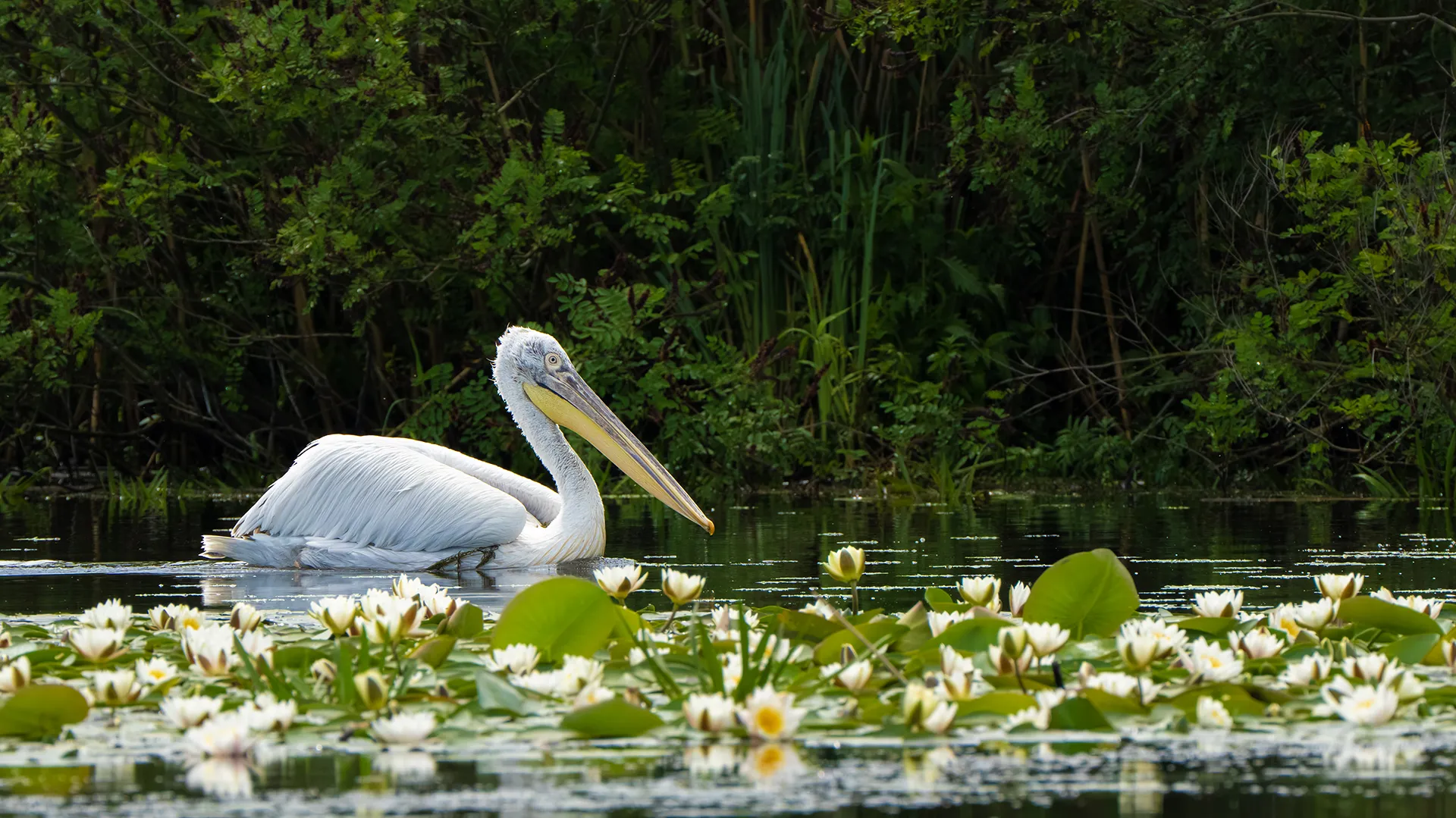
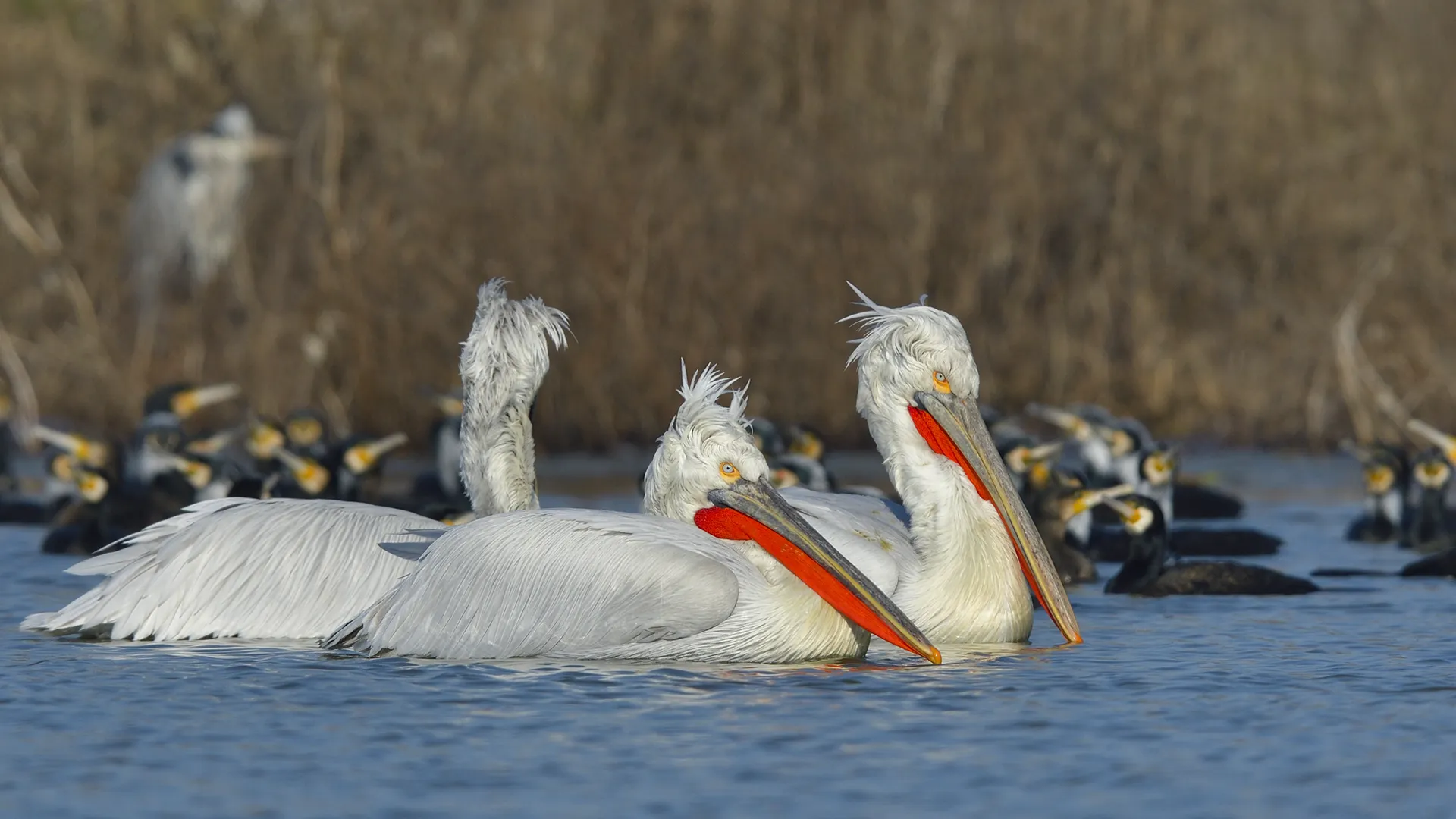
Seen up close, the Dalmatian Pelican looks more “tousled” and greyer than its relative, the Great White Pelican (Pelecanus onocrotalus). The adult’s plumage is silvery white with a greyish tinge, and on the nape it has a crest of long, curly feathers, which rises into a real mane in the breeding season. The iris is pale yellowish, surrounded by a ring of bare skin, and the legs are dark grey.
The most spectacular detail appears at the end of winter: the throat pouch, the skin sac under the bill, turns an intense orange red. It is the sign of breeding plumage, the time when pairs form. After the eggs are laid, the colour fades towards yellow.
Juveniles are greyish brown, with a grey pouch, and take three to four years to reach adult plumage.
Dalmatian and Great White Pelican: how to tell them apart
In the Danube Delta the two species often share the same lakes. Our guides show you the differences in the field:
- Colour: the adult Great White Pelican is white with a pinkish tinge; the Dalmatian Pelican is greyish, silvery white.
- Head: the Great White has a smooth head, yellowish pink skin around a dark eye; the Dalmatian has a curly crest and a pale eye.
- Forehead: in the Great White the forehead feathering comes down to a sharp point towards the bill; in the Dalmatian the feather line at the base of the bill is straight or slightly concave.
- Legs: pinkish orange in the Great White, grey in the Dalmatian.
- In flight, seen from below: the Great White shows a strong contrast, with black flight feathers and the rest of the wing white; in the Dalmatian the wing is greyish, with only the tips darker. This is the most reliable feature at a distance.
- Silhouette: the Dalmatian is larger and heavier, with broader wings.
Diet and fishing technique
The Dalmatian Pelican is a fish eater: it feeds almost exclusively on fish. It needs about 1.2-1.5 kg a day, and the fish it catches usually weigh from a few dozen grams to over a kilogram: Prussian carp, carp, perch, rudd, bream.
Unlike the Great White Pelican, which fishes in large, well coordinated groups, the Dalmatian usually hunts alone, in pairs or in small groups. It swims with its body high and, when it spots a fish, suddenly plunges its head and neck, using the pouch like a landing net: it fills it with water and fish, then presses it against its chest to squeeze out the water and swallows the prey. It cannot dive, so it depends on shallow water and fish close to the surface. In deeper water it sometimes forms a semicircle and drives fish towards the shore. It is also known for stealing fish from cormorants that surface next to it.
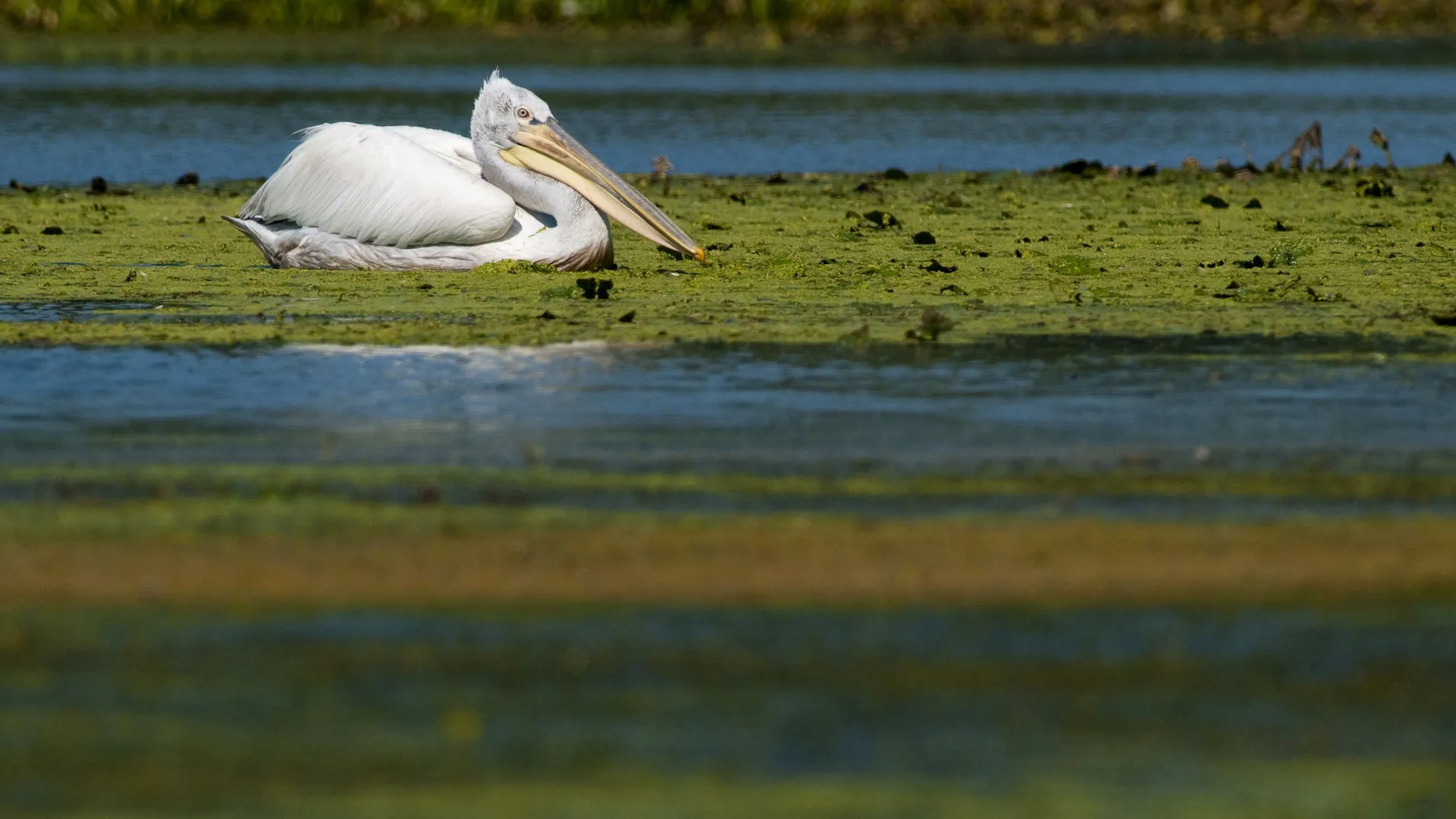
It fishes mostly early in the morning and in the evening. In the hot hours of the day it rests on sandbanks, floating islands or on the water, in quiet flocks.
Breeding and life cycle
The Dalmatian Pelican is the first of the large birds of the Danube Delta to start breeding: pairs settle from the end of winter, in February or March, about a month before the Great White Pelican. It nests on floating islands of reed and roots or on isolated islets, in smaller groups than the Great White Pelican and sometimes right next to it. It is very faithful to its traditional sites and returns to the same areas year after year.
The nest is a large heap of reeds, bulrushes and branches, which the pair builds up and repairs every season. The female usually lays two eggs (between one and six), incubated by the parents in turn for 30-34 days. The chicks hatch naked and helpless, are fed on half digested fish taken straight from the parents’ pouch, and fly at about 85 days. They become independent at around three and a half months and reach sexual maturity at three or four years.
During the breeding season the Dalmatian Pelican feeds close to the nest, usually less than a kilometre away. That is why peace around the colonies and fish nearby decide the success of the whole season.
Migration and wintering
The Danube Delta population is partly migratory. In mild winters, with unfrozen lakes, some birds stay here all year. When the lakes freeze, Dalmatian Pelicans move south, to Greece and Türkiye, where they find open water and fish. Their presence in the Danube Delta in winter therefore depends on the weather and on food.
In spring they return early, often while there is still ice on the lakes. They are the first large birds to announce the new season.
Where and when to see it in the Danube Delta
You see it on the large, open lakes and in shallow areas rich in fish, often among flocks of Great White Pelicans. In spring, from March to May, when the birds have orange red pouches and raised crests, is the finest time to watch it. In summer you see it resting on sandbanks and floating islands, and in autumn it gathers in flocks on lakes with plenty of fish.
We do not publish the places where it breeds and we do not approach them: the Dalmatian Pelican is one of the birds most sensitive to disturbance in the Danube Delta. On our day trips and holidays we watch it from a distance, with binoculars, and the guide explains everything you see.
Interesting facts
- One of the heaviest flying birds. At 10-13 kg and with a wingspan of over three metres in large males, the Dalmatian Pelican ranks alongside the Great Bustard among the heaviest flying birds.
- A long distance glider. Because it is so heavy, it rarely flaps. It climbs in circles on thermals rising from the ground, then glides for kilometres without effort, in lines or V formations.
- The largest colony in the world is on Lake Mikri Prespa, on the border between Greece and Albania, with more than a thousand pairs. The Danube Delta holds a few hundred pairs, one of the most important populations in Europe.
- The pelicans of Lake Kerkini. In winter many Dalmatian Pelicans from the Black Sea region and the Balkans gather in northern Greece. On Lake Kerkini fishermen have fed them for decades, and the birds have grown used to boats, so there you see them very close, in full breeding plumage. We run a Dalmatian Pelican photo tour on Lake Kerkini.
- A net, not a larder. The pouch holds several litres of water, more than fits in the bird’s stomach. It is a fishing tool, not a storage place: the fish is swallowed straight away.
- A design 30 million years old. Pelican fossils about 30 million years old already have the bill and pouch of today’s pelicans. Few birds have kept their shape so unchanged.
Status and threats
In the 20th century the Dalmatian Pelican disappeared from much of its European range, with the drainage of wetlands, their conversion to farmland and direct persecution, as it was seen as a competitor of fishermen. Strict protection, peace in the breeding areas and artificial nesting platforms have brought a recovery in recent decades, and in 2017 its global status was improved from “Vulnerable” to “Near Threatened”. The world population is estimated at 10,000-20,000 birds.
The biggest cause of adult mortality today is power lines: such large, heavy birds collide with cables or are electrocuted on pylons, especially along the routes between feeding lakes and resting sites. Added to this is disturbance during the breeding season: a bird flushed from its nest leaves the eggs and chicks exposed to the sun and to gulls.
In the Danube Delta today, the greatest threat to nature is fast boats. Their waves wash over nests on the edges of floating islands, and their noise flushes feeding or resting flocks off the water; every forced flight costs a lot of energy for a 10 kg bird. That is why our boats go slowly on the channels.
See it with us
Our birding guides are biologists and ornithologists who are on the water every day of the year. Small groups, open boats, the best hours of the day.
Keep reading
Keep reading
More from the blog

4 min read
Whiskered Tern (Chlidonias hybrida)
The tern of the water lilies: it nests on floating leaves and hunts low over the lakes of the Danube Delta all summer.

5 min read
Common Cuckoo (Cuculus canorus)
The Common Cuckoo in the Danube Delta: how to recognize it, how females trick reed warblers into raising their young, migration to Africa and...

5 min read
Ferruginous Duck (Aythya nyroca)
Meet the Ferruginous Duck, a white-eyed diving duck for which Romania is a European stronghold: identification, late nesting, moult, migration and conservation.