

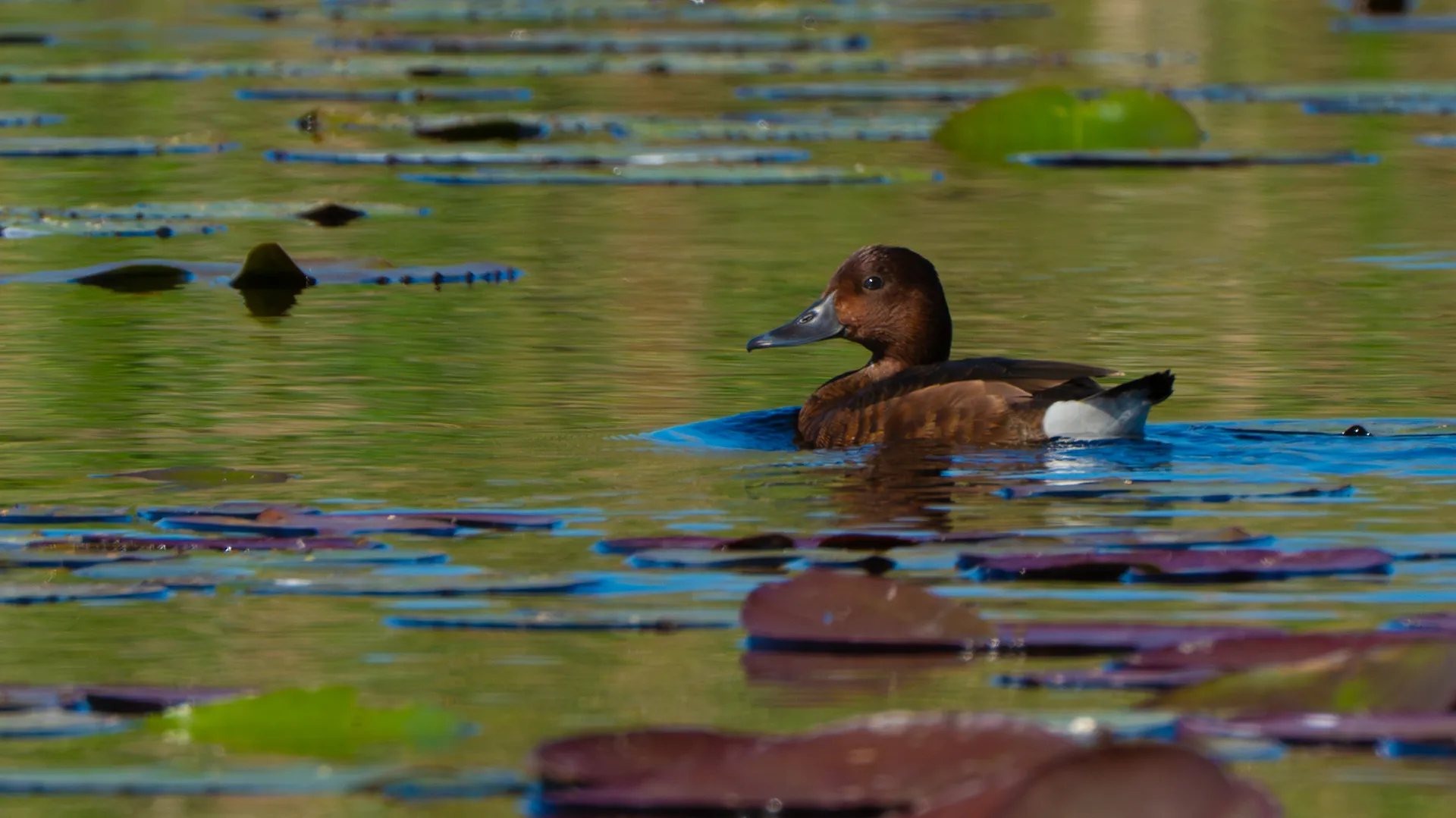
No. 29 on our checklistFerruginous Duck (Aythya nyroca)
Meet the Ferruginous Duck, a white-eyed diving duck for which Romania is a European stronghold: identification, late nesting, moult, migration and conservation.
The Ferruginous Duck (Aythya nyroca) is a small, dark chestnut diving duck with a bright white eye in the male. It is a bird of quiet, well-vegetated waters, and Romania, with the Danube Delta and its fishponds, holds one of the most important breeding populations in Europe.
It arrives in spring, nests late in the season and in late summer gathers on the lakes of the Danube Delta to moult, before leaving for the Mediterranean and Africa.
Quick facts
Quick facts
- Scientific name Aythya nyroca (Güldenstädt, 1770); originally described as Anas nyroca
- Common name Ferruginous Duck; also Ferruginous Pochard or White-eyed Pochard
- Family Anatidae (ducks, geese and swans)
- Order Anseriformes (waterfowl)
- Length about 38–42 cm
- Wingspan about 60–67 cm
- Diet omnivorous, but mostly plant material: seeds and parts of aquatic plants, also insects, snails and other small invertebrates
- Habitat shallow lakes, marshes and fishponds with dense reeds and rich underwater vegetation
- Breeding one brood a year; 7–10 eggs, incubated by the female for 25–28 days; the young fly at 55–60 days
- Conservation status Near Threatened (global IUCN Red List); Least Concern on the European Red List (2021); strictly protected in Romania
When to see it in the Danube Delta and Dobrogea
- JanAbsent (winters farther south)
- FebAbsent (winters farther south)
- MarFirst arrivals
- AprPairs on the lakes
- MayCourtship, nest sites
- JunNesting
- JulFemales with ducklings
- AugMoult gatherings
- SepPost-breeding flocks
- OctLast birds
- NovAbsent (winters farther south)
- DecAbsent (winters farther south)
- Status here
- Summer visitor and breeder, from March to October; most visible in August and September.
- IUCN Red List
- Near Threatened
- Our checklist
- No. 29 of 385 · see the full checklist
How to recognize it
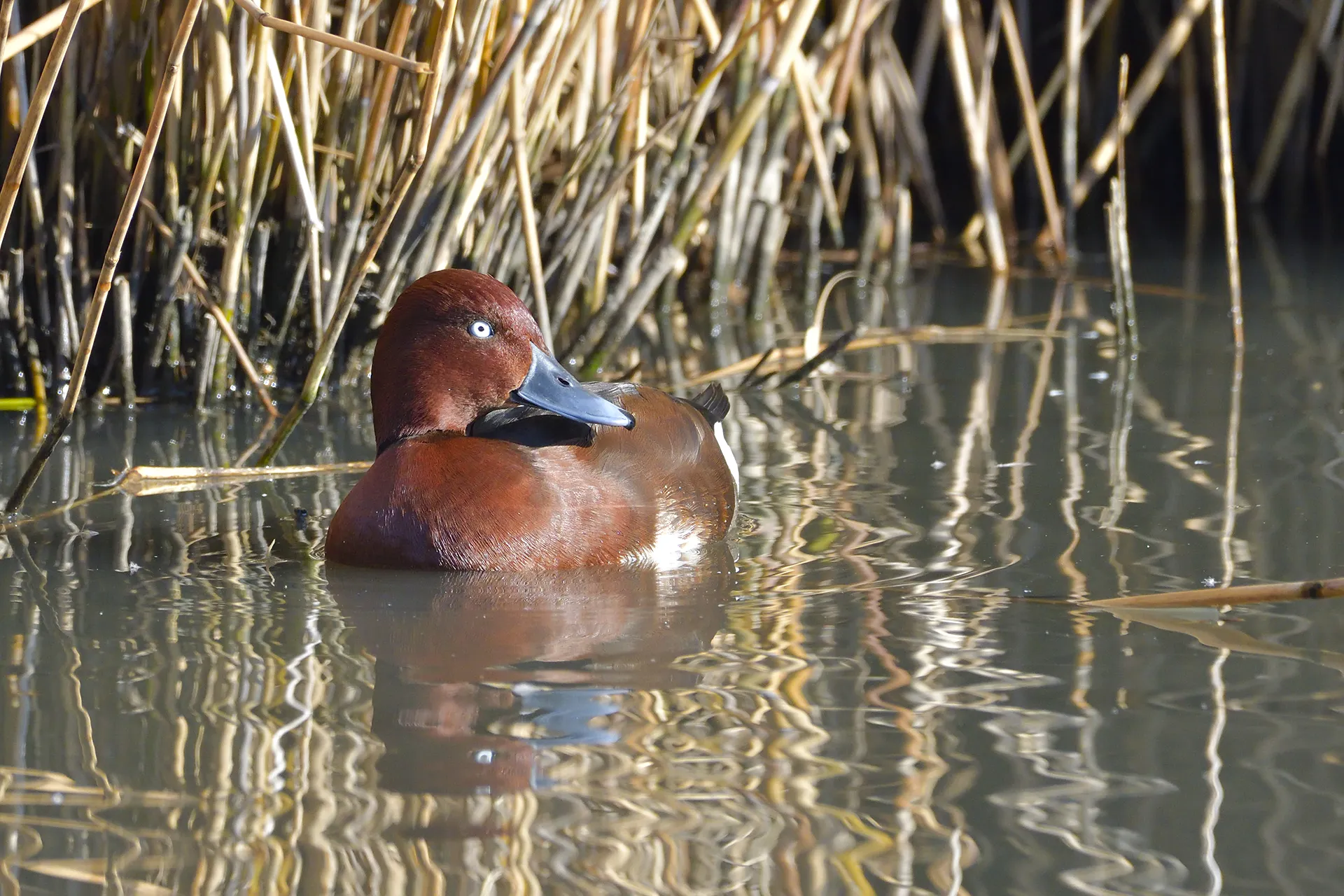
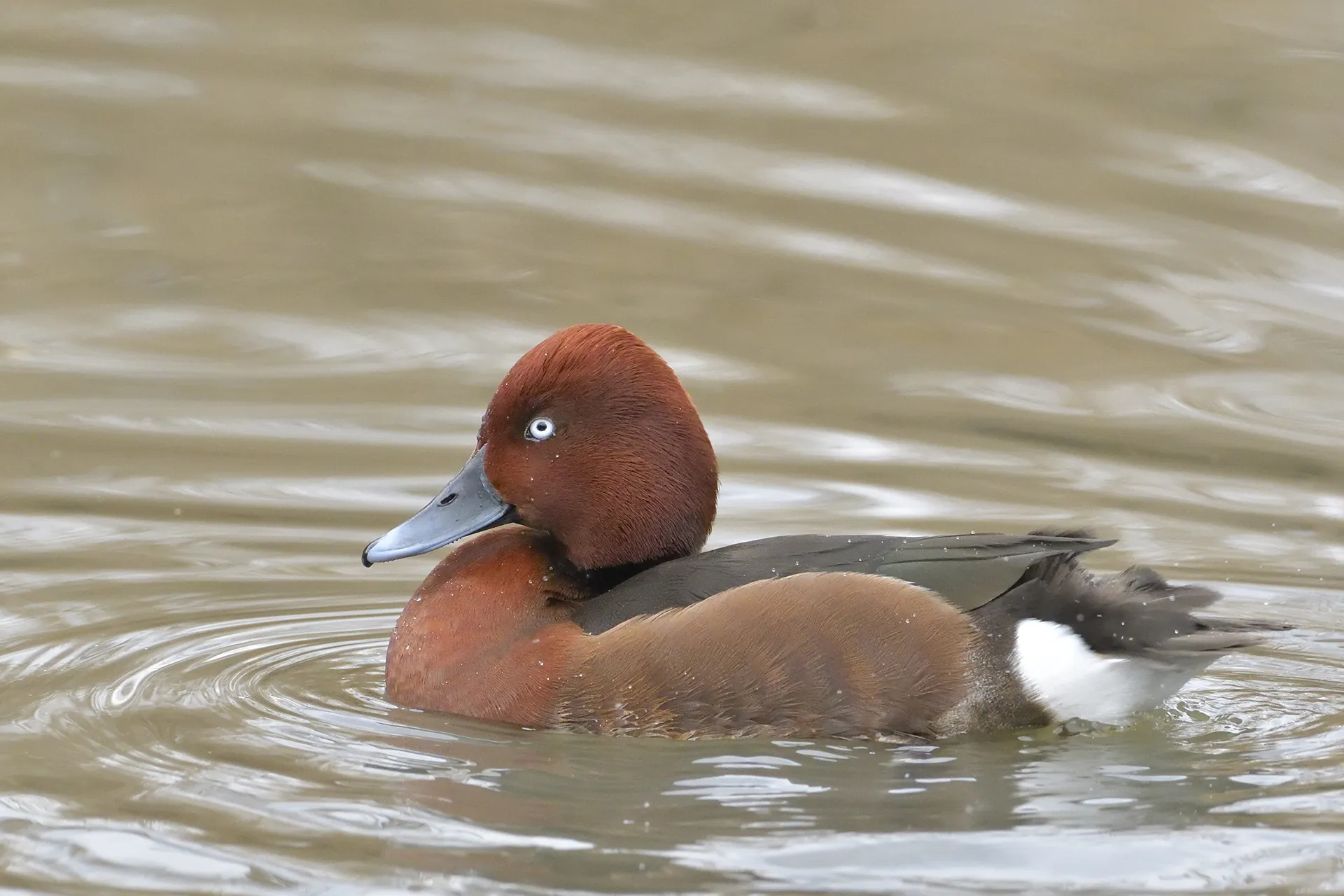
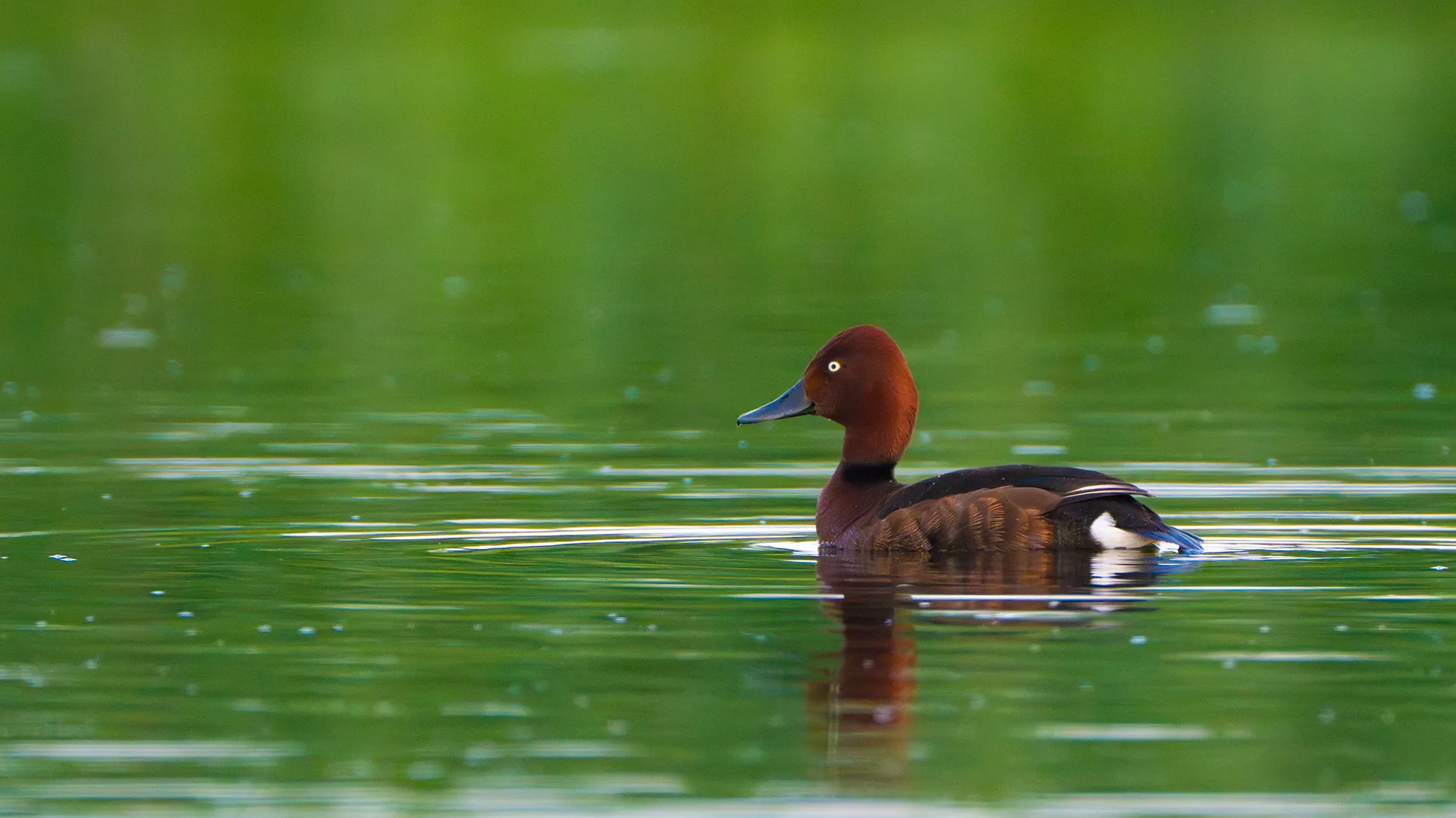
The Ferruginous Duck is smaller and slimmer than the Common Pochard, with a high, peaked crown. The drake is a deep, glossy chestnut, darker on the back, with a pure white patch under the tail and a striking white eye. The female is duller brown with a dark eye, but she shows the same white undertail.
In flight both sexes show a broad white wing bar that runs almost to the wing tip, and a white belly. On the water, look for the combination of a dark, rich brown bird, a white undertail and the neat, rounded head. Ferruginous Ducks occasionally hybridize with other diving ducks, especially Common Pochard, so a bird that looks “almost right” deserves a careful second look.
Where it lives in the Danube Delta
This is a duck of small and medium-sized lakes with clear water, rich underwater plants and a thick fringe of reeds. It prefers areas of shallow water close to dense vegetation, where it feeds by diving and by upending. In the Danube Delta it breeds on the quieter lakes and channels inside the reed beds. Outside the Danube Delta it also uses the extensive fishponds of Dobrogea and the Danube floodplain.
Fishponds matter a great deal. The international action plan for the species estimated that about 60% of Romania’s Ferruginous Ducks bred on fishponds, and more than half of the country’s fishponds had been abandoned after 1989. Abandoned ponds dry out and fill with scrub, while ponds that are farmed too intensively lose their vegetation. Both changes make them unsuitable for the ducks.
A late nester
Ferruginous Ducks form pairs for one season only. The nest is placed on the ground near the water, above the water in dense reeds or on floating rafts of vegetation. In southern Europe incubation begins from late May to late June. The female incubates alone for 25–28 days, and the ducklings need another 55–60 days before they can fly.
Because the species breeds so late, many broods are still not independent in August, when the duck hunting season opens in Romania and in most of Europe.
Moult and migration
After breeding, the ducks gather in flocks to moult. During the moult they lose their flight feathers and cannot fly for a few weeks. Large moulting flocks gather regularly in a few major wetlands of eastern Europe, including the Danube Delta. August and September are the best months to see the species here.
Departure begins in September and peaks in October. The birds winter mainly around the Mediterranean and in Africa south of the Sahara. Only a few dozen stay in Romania in winter.
Interesting facts
- A name meaning “diver”. The scientific name nyroca comes from the Russian word nyrok, “diving duck”, from a verb meaning “to dive”. The species was described in 1770 by Johann Anton Güldenstädt from birds of southern Russia.
- Romania holds over a third of Europe’s breeders. Romania reported 2,600–10,500 pairs for 2013–2015, about 37% of the European breeding population. Most of them breed in the Danube Delta and on the country’s fishponds.
- The white eye. Only the drake has the white iris that gives the species its old English name, White-eyed Pochard. The female’s eye is dark brown.
- Moulting together. After breeding, Ferruginous Ducks gather in large moulting flocks in a few major wetlands of eastern Europe, such as the Danube Delta, the Dniester Delta and the Volga Delta.
Status and conservation
Globally, the Ferruginous Duck is listed as Near Threatened on the IUCN Red List because of a suspected moderately rapid decline. On the European Red List (2021) it is assessed as Least Concern. It is listed in Annex I of the EU Birds Directive and is strictly protected in Romania.
The main threats are the loss and degradation of wetlands, drought, illegal shooting and confusion with legally hunted ducks, lead poisoning from spent shot, and drowning in fishing nets. Quiet lakes with rich vegetation, well-managed fishponds and careful hunters who know their diving ducks make a real difference.
See it on our tours
On our multi-day photo tours in the Danube Delta, we move slowly and quietly through the small channels and lakes where Ferruginous Ducks feed along the reed edges. In late summer, when the moulting flocks gather, the species is often easier to find and to photograph.
See it with us
Our birding guides are biologists and ornithologists who are on the water every day of the year. Small groups, open boats, the best hours of the day.
Keep reading
Keep reading
More from the blog

5 min read
Grey Partridge (Perdix perdix)
A plump farmland bird of the Dobrogea steppe that freezes in the grass and bursts into flight at your feet

2 min read
Water Rail (Rallus aquaticus)
A long red bill, barred flanks and a pig-like squeal. Water Rail is present year-round in the Danube Delta but often stays hidden in...
3 min read
Little Bustard (Tetrax tetrax)
The Little Bustard, a rare steppe bird that once bred in Dobrogea: identification, its leaping courtship display, diet and where it still appears in...