

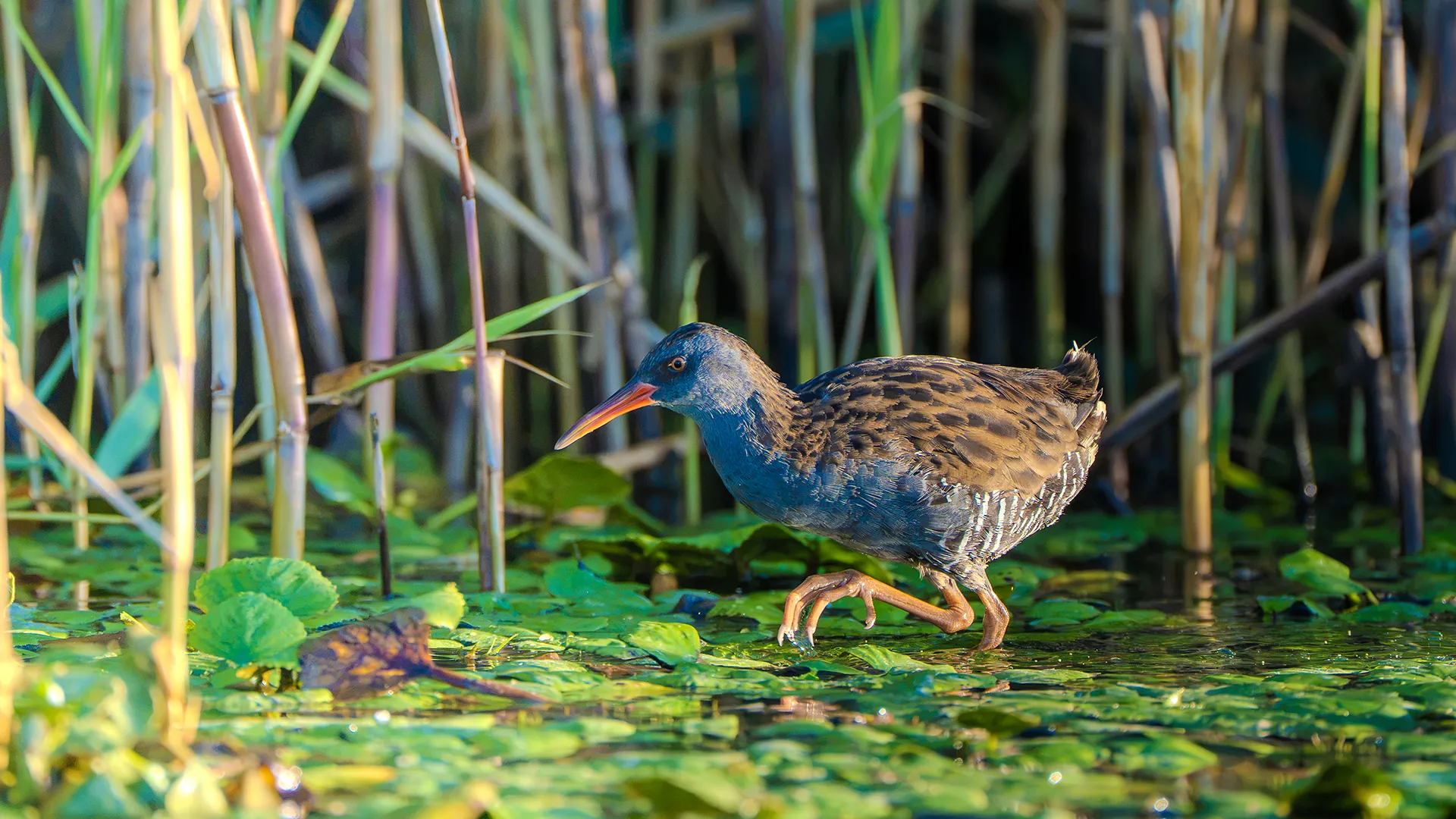
No. 62 on our checklistWater Rail (Rallus aquaticus)
A long red bill, barred flanks and a pig-like squeal. Water Rail is present year-round in the Danube Delta but often stays hidden in wetland vegetation.
The Water Rail (Rallus aquaticus) is a secretive wetland bird with a long red bill and black-and-white barred flanks. The Danube Delta and Dobrogea checklist records it all year and notes winter as the best time to look for it.
Quick facts
Quick facts
- Scientific name Rallus aquaticus Linnaeus, 1758
- Common name Water Rail
- Family Rallidae
- Order Gruiformes
- Weight about 127 g
- Diet insects, other small animals and plant material such as seeds and roots
- Habitat dense vegetation at wetland margins and on wet ground
- Breeding usually 6–11 eggs; incubation normally 19–22 days, mostly by the female; young typically fledge at 20–30 days
- Conservation status Least Concern globally; Least Concern as a breeding bird in Romania (2022)
When to see it in the Danube Delta and Dobrogea
- JanPresent
- FebPresent
- MarPresent
- AprPresent
- MayPresent
- JunPresent
- JulPresent
- AugPresent
- SepPresent
- OctPresent
- NovPresent
- DecPresent
- Status here
- Present all year; difficult to see, with winter noted as the best time locally.
- IUCN Red List
- Least Concern
- Our checklist
- No. 62 of 385 · see the full checklist
How to recognize it
The adult has a blue-grey face and breast, streaked brown upperparts and black-and-white bars along the sides. The long, slender red bill is useful in a brief view. A pig-like squeal from dense vegetation is often a much better indication that a Water Rail is nearby.
At the edge of cover
Water Rails use dense vegetation around wet ground and water. They pick up food on land and in the shallows, taking both animal and plant matter. Watch an opening in the vegetation from a distance rather than trying to follow a bird into cover.
Why winter can be worth trying
The checklist notes that the species is hard to see and gives winter as the best time locally. That is advice about finding the bird, not a claim that the local population peaks in winter.
Interesting facts
- Its squeal sounds pig-like. You may hear it from dense vegetation without seeing the bird.
- Its toes are long. They help spread the rail’s weight on soft wet ground.
- It eats both animals and plants. The diet includes such varied items as insects, seeds and roots.
- The original scientific name is unchanged. Linnaeus named the species Rallus aquaticus in 1758.
Status and conservation
The Water Rail is Least Concern globally and as a breeding bird in Romania’s 2022 Red List. The national estimate is 9,397–21,155 breeding pairs, with an unknown short-term trend.
See it on our tours
On our multi-day photo tours in the Danube Delta and Dobrogea, watch gaps in wetland vegetation quietly if the itinerary brings you near suitable habitat. The squealing call can be your first clue to a bird hidden from view.
See it with us
Our birding guides are biologists and ornithologists who are on the water every day of the year. Small groups, open boats, the best hours of the day.
Keep reading
Keep reading
More from the blog

5 min read
Pallas’s Gull (Ichthyaetus ichthyaetus)
The largest black headed gull in the world, nesting on the islands of the Danube Delta coast since 2009.

4 min read
Red-necked Grebe (Podiceps grisegena)
A brick red neck, pale grey cheeks and a dagger bill with a yellow base: a shy breeding grebe of the quiet lakes of...
4 min read
Eurasian Hobby (Falco subbuteo)
Fast enough to catch swallows and dragonflies in the air: the Eurasian Hobby, a summer falcon of the Danube Delta and Dobrogea, and its...