

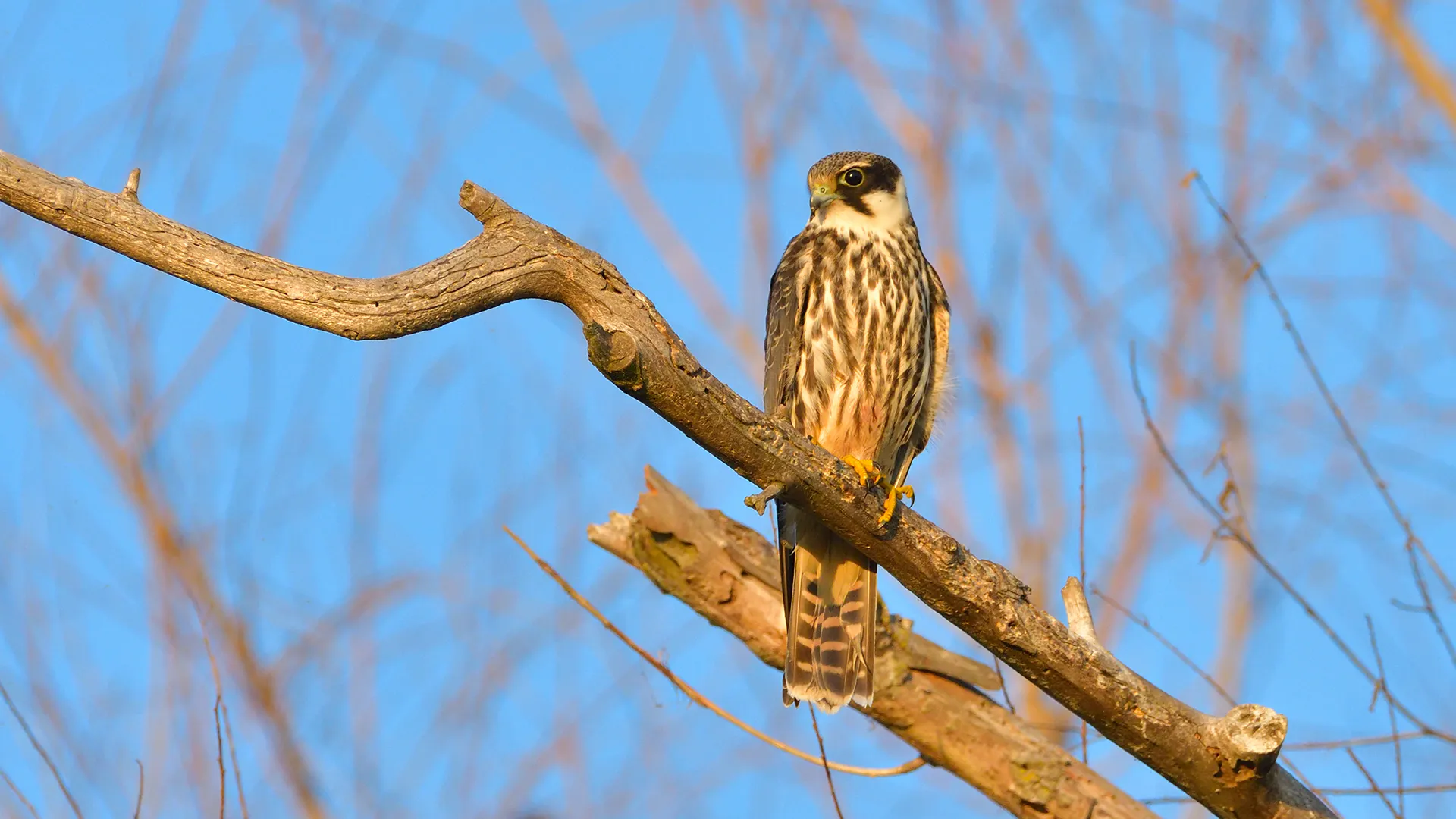
No. 226 on our checklistEurasian Hobby (Falco subbuteo)
Fast enough to catch swallows and dragonflies in the air: the Eurasian Hobby, a summer falcon of the Danube Delta and Dobrogea, and its long journey to southern Africa.
The Eurasian Hobby (Falco subbuteo) is a slim, fast falcon that catches almost all its prey in flight: dragonflies, beetles, swallows, martins and swifts. In the Danube Delta and Dobrogea it is a summer breeder, from April to September.
Wetlands rich in dragonflies, swallows and martins, like those of the Danube Delta, are typical hunting grounds.
Quick facts
Quick facts
- Scientific name Falco subbuteo Linnaeus, 1758
- Common name Eurasian Hobby
- Family Falconidae (falcons)
- Order Falconiformes
- Length about 28–36 cm
- Wingspan about 68–84 cm
- Weight about 130–340 g; about 210 g on average
- Diet flying insects, especially dragonflies, and small birds such as swallows, martins, swifts and larks; also bats
- Habitat open country with trees, river and lake edges, reedbeds and farmland
- Breeding one brood a year, in an old nest of a crow or another bird; usually 2–3 eggs, incubated for about 28 days; young fly at about 30–34 days
- Conservation status Least Concern (global IUCN Red List); Least Concern on the Romanian Red List (2022)
When to see it in the Danube Delta and Dobrogea
- JanIn Africa
- FebIn Africa
- MarIn Africa
- AprSpring arrival
- MayHunting over wetlands
- JunPairs at old crow nests
- JulIncubation, chicks
- AugYoung fledge
- SepAutumn passage
- OctLast migrants
- NovIn Africa
- DecIn Africa
- Status here
- Summer breeder and passage migrant, from April to September; winters in southern Africa.
- IUCN Red List
- Least Concern
- Our checklist
- No. 226 of 385 · see the full checklist
How to recognize it
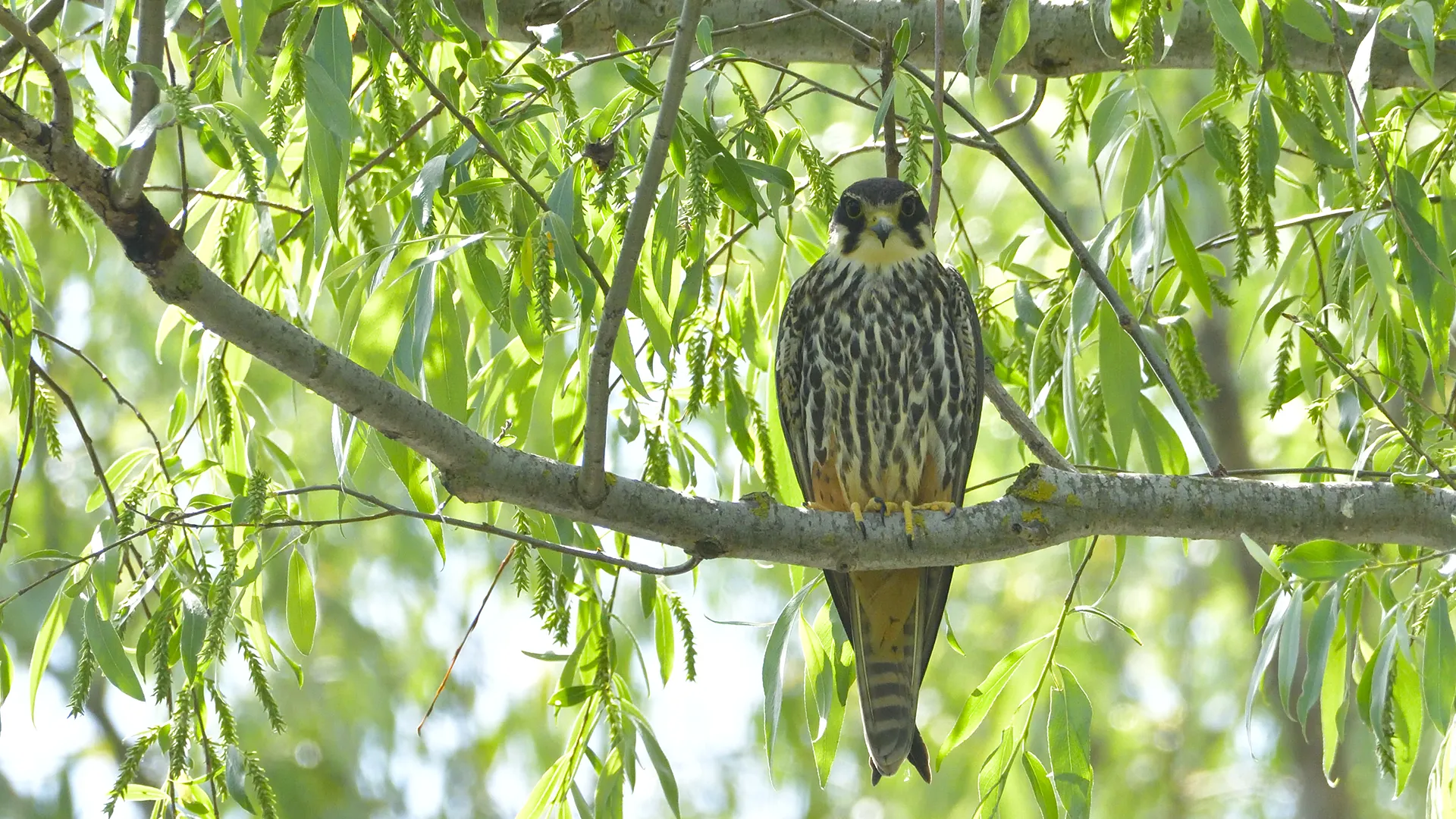
The Hobby has long, pointed, sickle-shaped wings and a relatively short tail, which in flight gives it the silhouette of a large swift. Adults are dark slate-gray above, with a black “moustache”, white cheeks and throat, heavily streaked underparts and rusty-red “trousers” and under-tail. Young birds lack the red and are browner above.
The Red-footed Falcon is smaller and males are uniformly dark gray, while the Peregrine Falcon is much larger and heavier, with barred, not streaked, underparts.
A hunter of the air
Hobbies hunt in fast, agile flight. Dragonflies and other large insects are caught with the feet and often eaten in the air, while birds are chased and taken after a fast dive or a sudden acceleration. They are most active at dawn and dusk, and they have been seen following cars, hunters or other raptors to catch small birds that they flush. Around Berlin, swallows, martins and swifts made up 55% of the birds taken by Hobbies.
The Hobby does not build a nest. It uses old nests of other birds, most often crows, high in a tall tree, and occasionally nests on electricity pylons. It breeds late: in a study in northern Italy, where it nested only in old Hooded Crow nests, the first egg was laid on average on 18 June. In Bulgaria it is also known to nest in rook colonies, together with Red-footed Falcons and Common Kestrels.
To Africa across the rainforest
Satellite tracking has shown the journeys of European Hobbies in detail. Four adults tracked from southern Sweden left in early September, crossed the Sahara and then converged on a narrow corridor across the equatorial rainforest of Central Africa, before reaching their winter range at about 10–18° south. The average journey was 9,223 km and lasted 61 days. A female from Germany, tracked through two full years, wintered mainly in Angola, and in spring 2010 flew 1,243 km in two days across Mali and Morocco.
Interesting facts
- Almost 15 years old. The oldest ringed Hobby in Britain lived 14 years and 10 months.
- Converging over the rainforest. The routes of the Swedish Hobbies came together to within 70 km of each other near the equator, probably because the birds avoid long flights over continuous rainforest.
- Flying at night too. The German female was recorded migrating over the Mediterranean near Gibraltar at 02:54 at night.
- A huge winter home. In Africa the same female used a winter range of more than 400,000 km² and travelled at least 9,000 km between her night roosts in a single winter.
Status and conservation
The Eurasian Hobby is listed as Least Concern on the global IUCN Red List, and most populations are considered stable. In Romania it is Least Concern on the Romanian Red List (2022), with 5,000–15,000 breeding pairs and an uncertain trend. Because it does not build its own nest, it depends on old crow nests in tall trees; in northern Italy, the felling of poplar plantations regularly forced pairs to move to new woodlots.
See it on our tours
On our multi-day Danube Delta discovery tours between May and August, watch the sky above the reeds and lakes at the end of the day: Hobbies catching dragonflies over the water are among the most impressive sights of the Danube Delta summer.
See it with us
Our birding guides are biologists and ornithologists who are on the water every day of the year. Small groups, open boats, the best hours of the day.
Keep reading
Keep reading
More from the blog

4 min read
Black-necked Grebe (Podiceps nigricollis)
Golden fans behind the eyes and red eyes: in spring, one of the most elegant water birds of the Danube Delta lakes.
2 min read
Northern Lapwing (Vanellus vanellus)
A long crest and broad rounded wings identify the Northern Lapwing, present all year in the Danube Delta and Dobrogea.
2 min read
Desert Wheatear (Oenanthe deserti)
The Desert Wheatear, a rare vagrant from the deserts and steppes of Asia to the dunes of Dobrogea: how to identify it by its...