

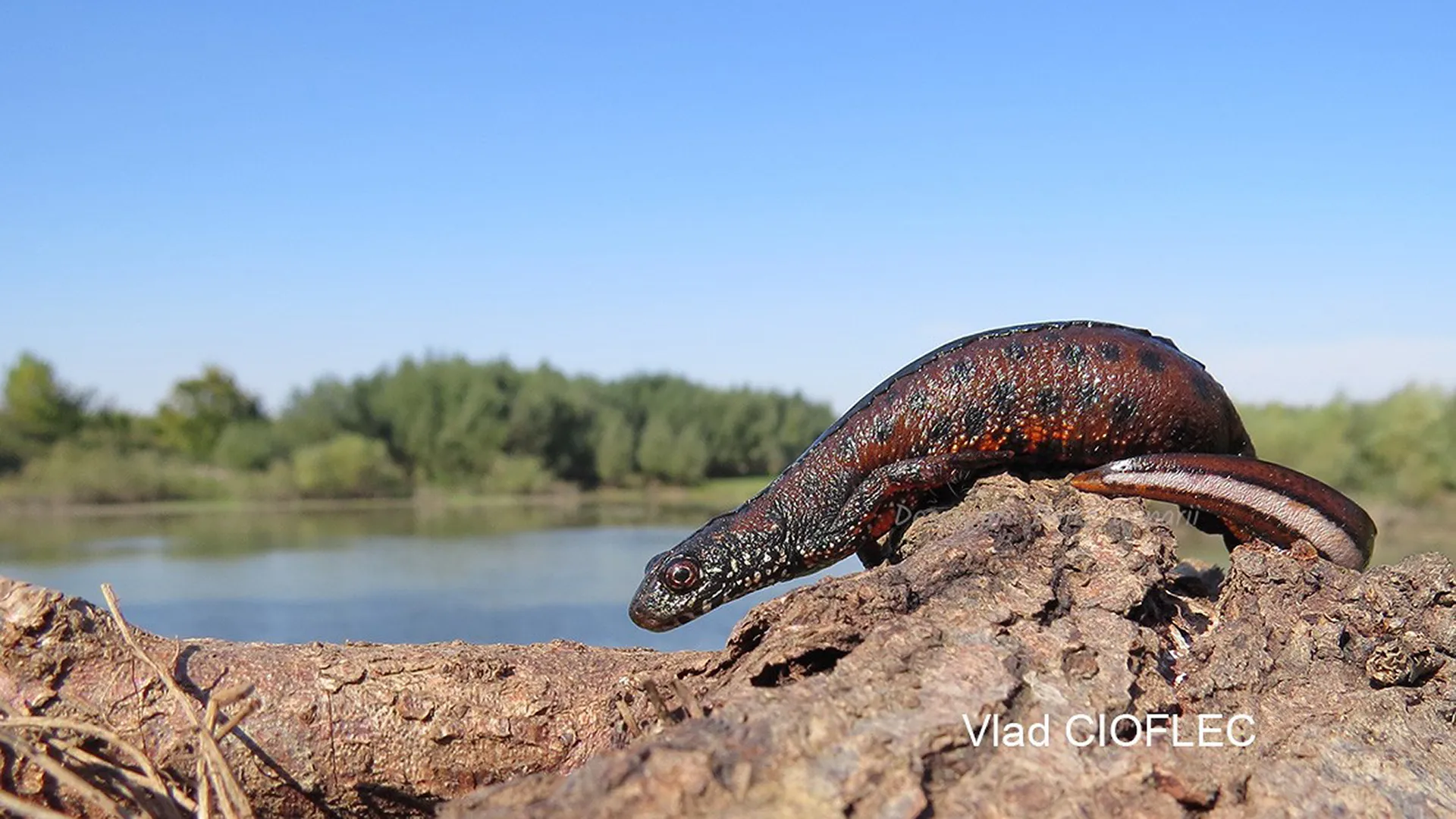
No. 2 on our checklistDanube Crested Newt (Triturus dobrogicus)
A newt that lives almost nowhere else but the Danube floodplains, with a spectacular breeding crest. Discover the Danube crested newt and where to find it in the delta's backwaters.
The Danube Crested Newt (Triturus dobrogicus) is a creature of the Danube floodplains: it lives almost nowhere else on Earth, and in our region it is at home in the delta’s quiet backwaters. It is the most aquatic of all European newts, spending half the year or more in the water, and in spring the males grow one of the most spectacular crests of any amphibian.
The species has a particular link to this region: it was described in 1903 by the Romanian naturalist Constantin Kiritzescu from specimens collected near Sulina and Tulcea, in the Danube Delta itself, and it still carries the Danube in both its English and its scientific name.
Quick facts
Quick facts
- Scientific name Triturus dobrogicus (Kiritzescu, 1903)
- Common name Danube Crested Newt
- Family Salamandridae (newts and salamanders)
- Order Caudata (tailed amphibians)
- Length usually 13 to 15 cm, exceptionally up to 17 cm
- Diet small aquatic invertebrates: insect larvae, crustaceans, worms and snails
- Habitat floodplain lakes, marshes, oxbows and quiet channels with rich vegetation
- Activity mostly aquatic; in water from March to October
- Breeding March to June; about 200 eggs laid one by one on aquatic plants
- Conservation status Near Threatened globally (IUCN); Least Concern on the EU Red List; protected under Annexes II and IV of the EU Habitats Directive
When to see it in the Danube Delta and Dobrogea
- JanVery rare
- FebVery rare
- MarRare
- AprAbundant
- MayAbundant
- JunModerate
- JulModerate
- AugModerate
- SepModerate
- OctRare
- NovVery rare
- DecVery rare
- Status here
- In water from March to October; hibernates on land in winter.
- IUCN Red List
- Near Threatened
- Our checklist
- No. 2 of 30 · see the full checklist
Description and identification
The Danube crested newt is the smallest of the European crested newts, usually 13 to 15 cm in total length, with females occasionally reaching 17 cm. The body is slender and elongated, with short legs, a build that reflects a life spent mostly in water. The back is dark brown to black, sprinkled with fine white dots; the belly is bright orange to red, marked with well defined black blotches.
In the breeding season the male transforms: a very high, jagged crest rises along the back and tail, and a white or bluish band runs along the lower edge of the tail. The display is one of the most striking among European amphibians and makes the breeding male almost impossible to confuse with anything else. Outside the season, and in females, the animals are more modest: dark newts with bright bellies, best recognised by the white stippling on the flanks.
A newt of the floodplain
Within the genus Triturus, this is the most water dependent species. Typical breeding sites are slow flowing river margins, oxbow lakes, flooded marshland, large ponds and channels with abundant underwater vegetation, and the Danube crested newt tolerates, or even favours, waters where fish are present. Adults stay in the water longer than any other crested newt, often more than six months a year.
The species is confined to the lowlands of the Danube river system, from Austria through Hungary and Serbia to the Danube Delta and Dobrogea, with a separate population along the Dnipro. In the delta it finds optimum conditions: a floodplain landscape of channels, marshes and lakes, where newts can move between water bodies with the floods. In late autumn the adults leave the water and winter on land, in rodent burrows, cracks in the earth or under logs and vegetation.
Diet
In the water, Danube crested newts feed on whatever small animals they can swallow: insect larvae, adult aquatic insects, small crustaceans, worms and snails, and occasionally frog eggs and tadpoles. On land, during the terrestrial phase, they hunt at night for worms, slugs and insects under the leaf litter. Prey is taken by a sudden lunge, and newts are themselves an important food for fish, birds and grass snakes in the delta’s food web.
Breeding
In March, as the water warms, the newts migrate to their breeding sites. The male performs an elaborate underwater courtship: he stands on his front legs in front of the female, displays his crest and tail band, and finally deposits a packet of sperm on the bottom, which the female picks up. Females lay about 100 to 200 eggs over two to three weeks, and each egg is wrapped individually into a folded leaf of an aquatic plant, a signature that reveals the newts’ presence in a pond.
The larvae develop in the water for two to four months, the longest larval period of any crested newt, and transform in July to early September. Young newts then leave the water and mature at two to three years of age. Some females skip a breeding season, a strategy that spreads the risk in an environment where a pond can dry or a flood can scatter a whole generation.
Conservation and threats
The Danube crested newt is listed as Near Threatened on the global IUCN Red List, the status our checklist follows, while the most recent European assessment, published in 2025, classes it as Least Concern at EU level, a change that reflects better knowledge rather than recovery. It is strictly protected under European law, in Annexes II and IV of the EU Habitats Directive and Appendix II of the Bern Convention. It has one of the narrowest distributions of any European amphibian, tied entirely to the Danube’s floodplains, and throughout most of its range its wetlands have been drained, regulated and cut off from the river.
The main threats are the loss of floodplain water bodies, river regulation, pollution and invasive species, and the species is declining across much of its range. The Danube Delta, where the floodplain still breathes with the river, is one of its strongholds, and protecting the delta’s network of marshes and channels protects this newt with them.
Where and when to see the Danube Crested Newt in the Danube Delta
Look for it in quiet, vegetated backwaters: oxbows and flooded marshes, small lakes and the edges of channels where aquatic plants grow dense, especially in the central Danube Delta around Mila 23 and the lakes of the Letea and Caraorman area. In April and May the breeding adults are concentrated in the shallows, and with polarised sunglasses and a slow approach you can watch the males displaying just below the surface.
A quiet rowing boat or an electric boat on a multi-day nature tour in the delta is the best way to search: drift along the reed line of a small lake in the morning, scan the open water near the vegetation, and be patient, these newts surface briefly for air and then vanish among the plants.
See it with us
Slow open boats, small groups and a guide who knows the places and the wildlife. From a few hours on the water to a week in the Danube Delta and Dobrogea.
Keep reading
Keep reading
More from the blog
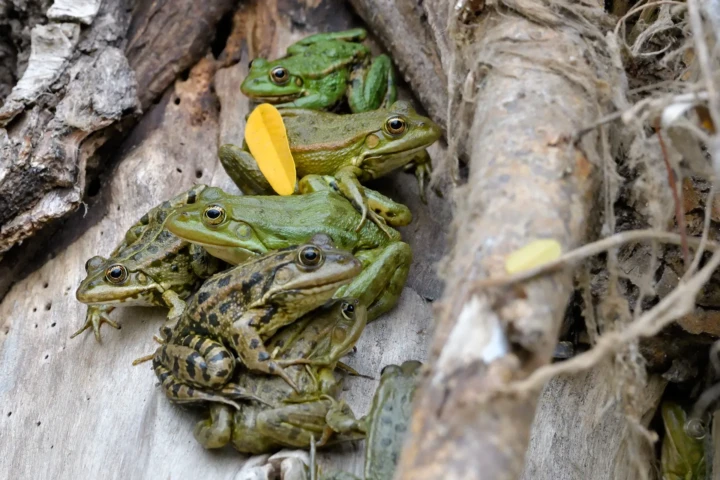
6 min read
Marsh Frog (Pelophylax ridibundus)
The largest frog in Europe and the laughing voice of the delta's channels. Discover the marsh frog, how to recognise it, and where to...
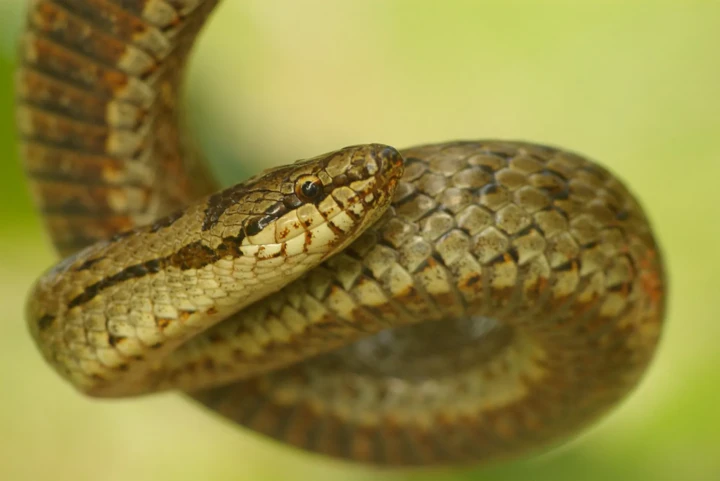
5 min read
Smooth Snake (Coronella austriaca)
Discover the Smooth Snake in the Danube Delta and Dobrogea: identification, live-bearing reproduction, dry refuges and responsible wildlife watching.
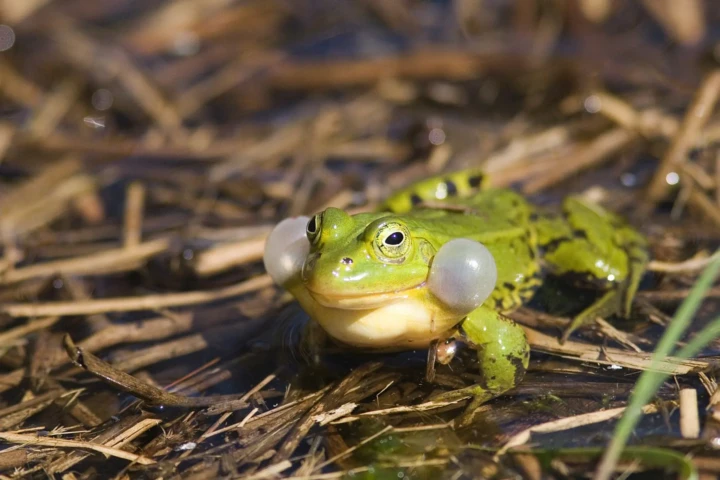
5 min read
Pool Frog (Pelophylax lessonae)
Meet the Pool Frog, the smallest and scarcest green frog of the Danube Delta: how to recognize it, where it lives and why it...