

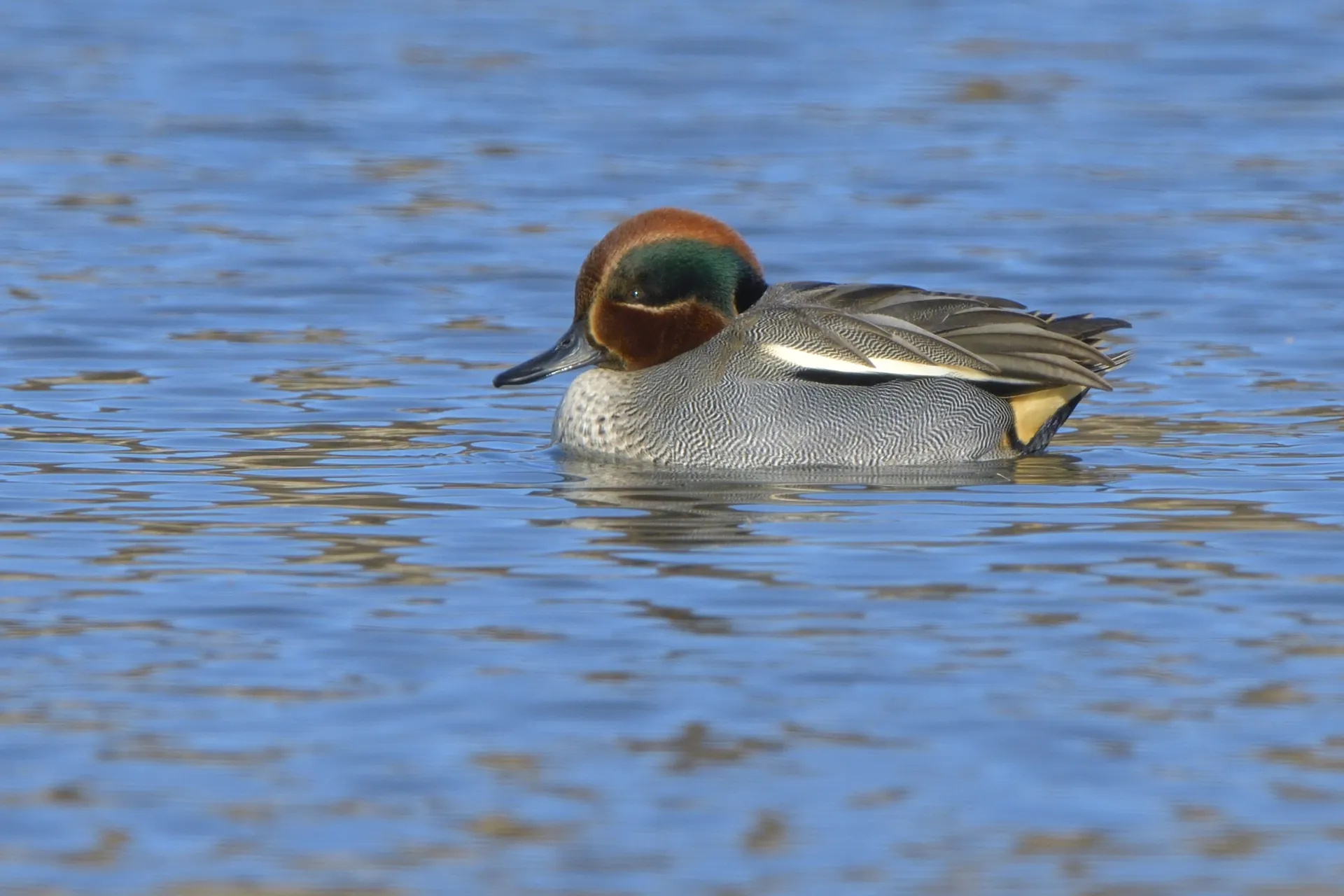
No. 39 on our checklistGreen-winged Teal (Anas crecca)
A small dabbling duck with a flash of green in the wing. Green-winged Teal, also called Eurasian Teal, occurs locally from September to April.
The Green-winged Teal (Anas crecca) on our checklist is the Eurasian Teal, a small dabbling duck. Both sexes show a green wing patch. In the Danube Delta and Dobrogea, look for it chiefly on passage and in winter.

Quick facts
Quick facts
- Scientific name Anas crecca Linnaeus, 1758
- Common name Green-winged Teal
- Family Anatidae
- Order Anseriformes
- Weight about 320 g
- Habitat freshwater and coastal wetlands
- Breeding usually 8–11 eggs; the female incubates for 21–23 days; young typically fly at 25–30 days
- Conservation status Least Concern globally; Romanian Red List (2022): breeding, passage and wintering populations not evaluated
When to see it in the Danube Delta and Dobrogea
- JanSeasonal records
- FebSeasonal records
- MarSeasonal records
- AprSeasonal records
- MayNot usually recorded
- JunNot usually recorded
- JulNot usually recorded
- AugNot usually recorded
- SepSeasonal records
- OctSeasonal records
- NovSeasonal records
- DecSeasonal records
- Status here
- Mainly a passage and winter visitor, recorded from September to April.
- IUCN Red List
- Least Concern
- Our checklist
- No. 39 of 385 · see the full checklist
How to recognize it
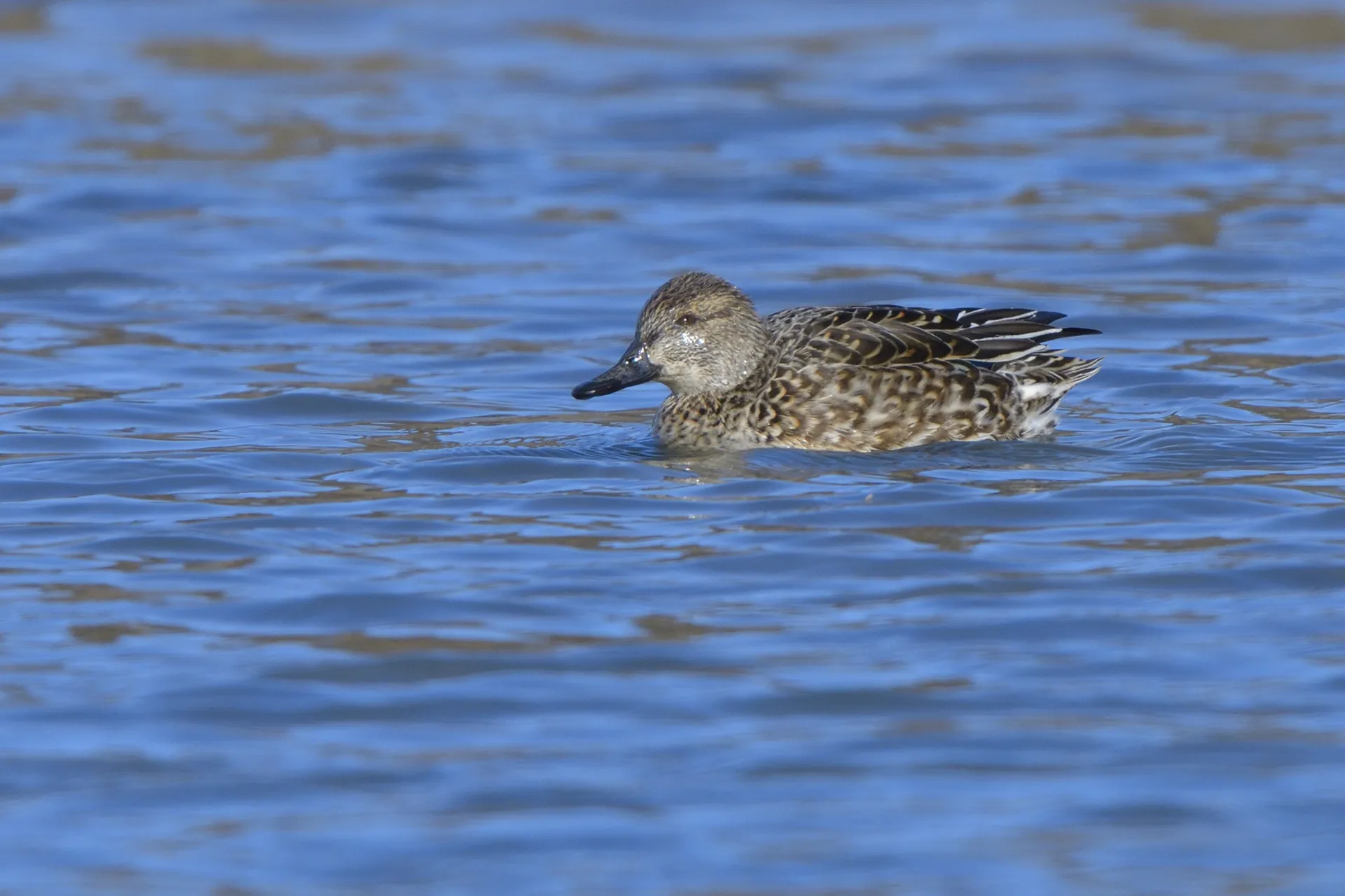
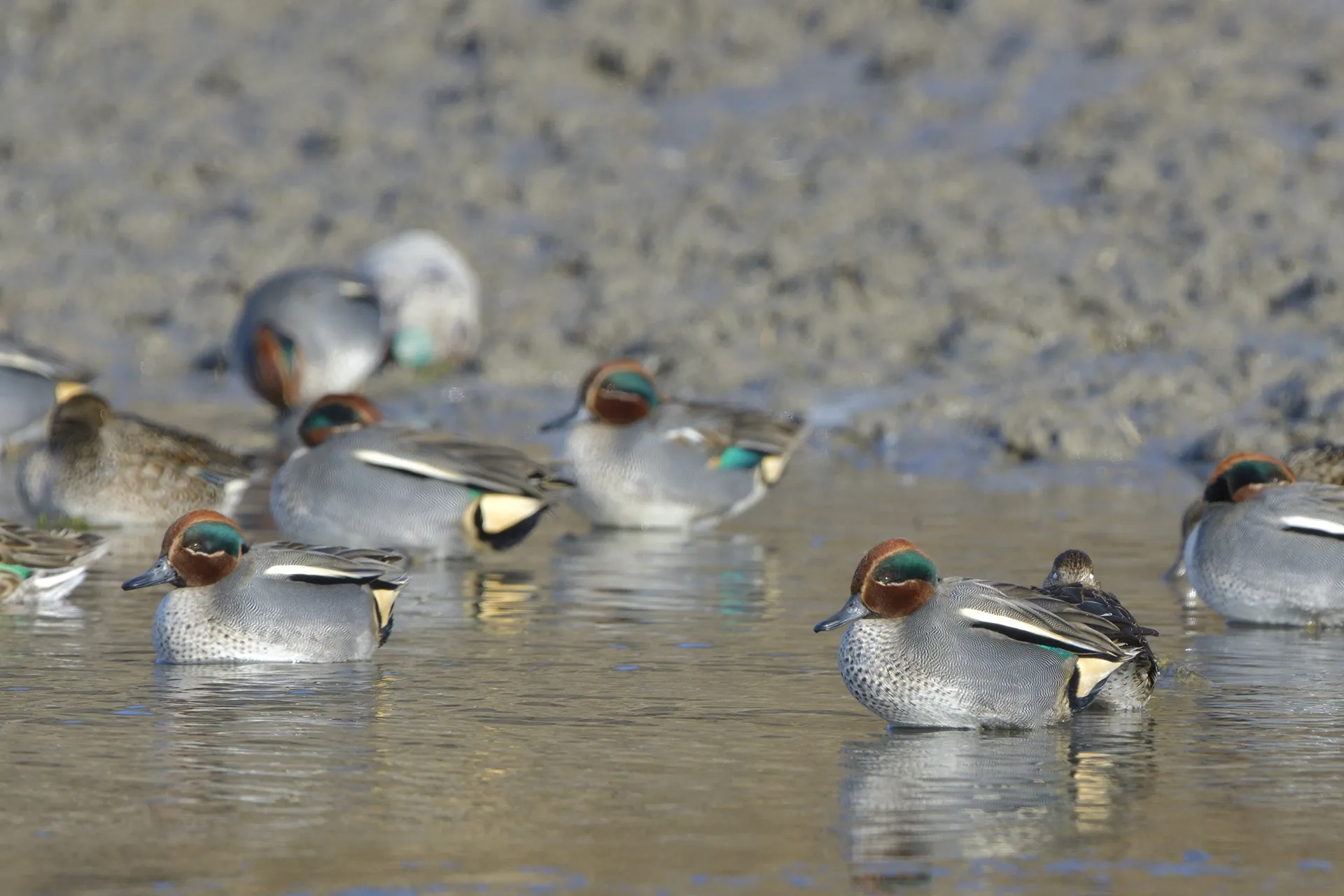
The breeding drake has a chestnut head with a broad green patch around the eye, edged by a fine pale line. A pale yellow triangle beside the tail is another useful clue. Females are patterned brown. Both sexes have a green wing patch, easier to see when the bird opens its wings.
Which teal does the name refer to?
Our checklist uses Green-winged Teal for the Eurasian bird, Anas crecca, also called Eurasian Teal or Common Teal. Names can differ between checklists, in part because some treatments group the Eurasian and American birds. Here the name refers only to the Eurasian bird.
Passage and winter in Romania
The Danube Delta and Dobrogea checklist records teal from September to April. Romania’s national assessment describes breeding as occasional and in small numbers. That national breeding record does not make the species a regular summer bird in the Danube Delta.
Interesting facts
- The green wing patch is not just a male feature. Females show it too, despite their much plainer head pattern.
- It weighs about a third of a kilogram. The British Trust for Ornithology’s average adult weight is 323 g.
- The scientific name has not changed from the original. Linnaeus named the species Anas crecca in 1758.
- Young teal develop quickly. The typical fledging period is 25–30 days.
Status and conservation
The Eurasian Teal is Least Concern globally. The 2022 Romanian Red List did not evaluate the national breeding, passage or wintering populations. The reported breeding estimate was 0–3 pairs, and the winter trend was uncertain.
See it on our tours
On our multi-day Danube Delta discovery tours, scan wetland margins during the September–April season. Watch for the drake’s chestnut-and-green head and the flash of green when a bird takes flight.
See it with us
Our birding guides are biologists and ornithologists who are on the water every day of the year. Small groups, open boats, the best hours of the day.
Keep reading
Keep reading
More from the blog

5 min read
Mute Swan (Cygnus olor)
Meet the Mute Swan, a truly wild, year-round resident of the Danube Delta: how to recognize it, nesting in the reeds, when to see...

4 min read
Bearded Reedling (Panurus biarmicus)
A small long tailed bird of the reed beds, heard as a ringing “ping” long before it is seen.

4 min read
Eurasian Blue Tit (Cyanistes caeruleus)
A tiny blue and yellow acrobat of willow forests, gardens and orchards: the Eurasian Blue Tit in the Danube Delta and Dobrogea, a bird...