

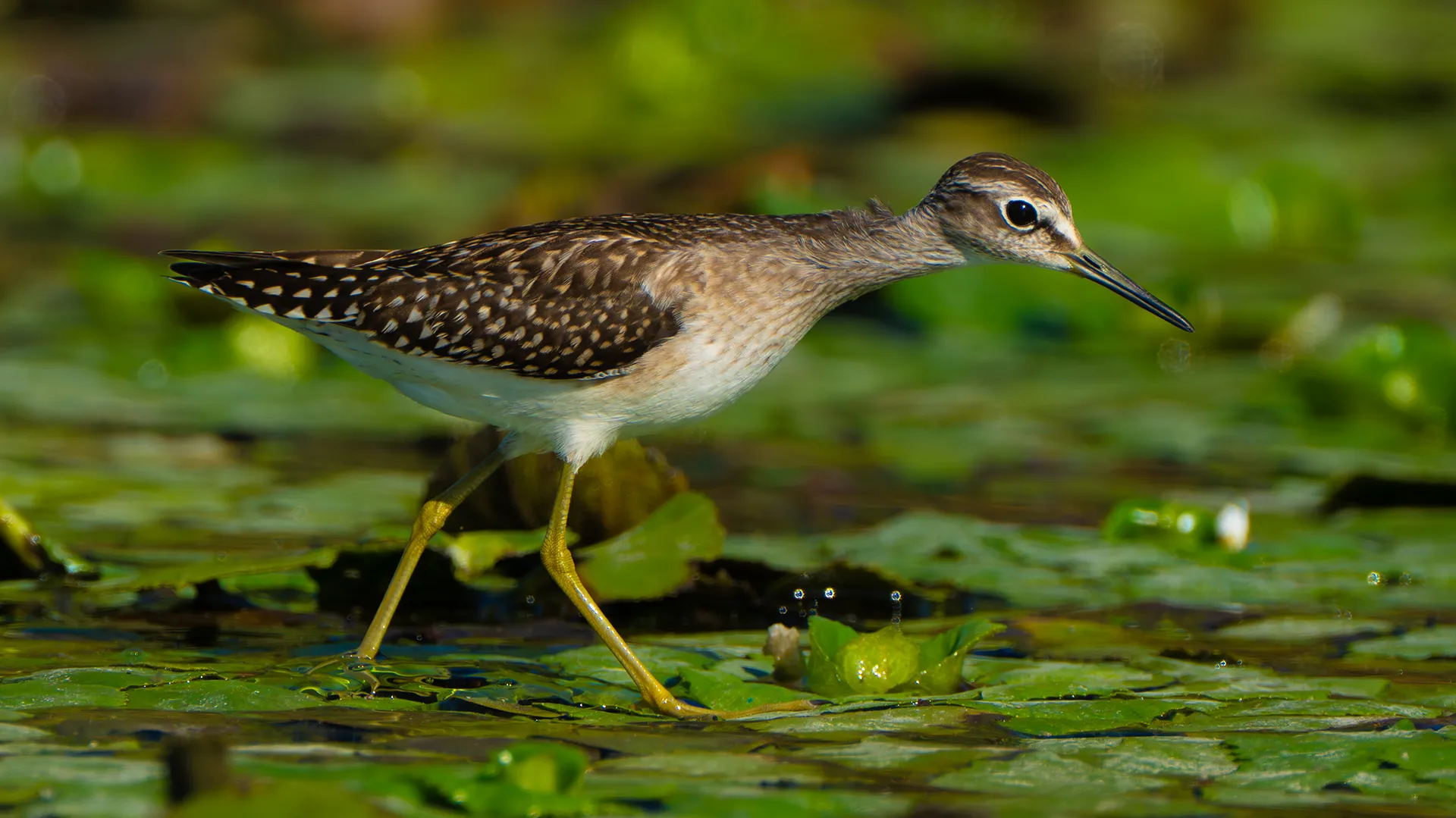
No. 101 on our checklistWood Sandpiper (Tringa glareola)
A slim, speckled wader from the northern bogs: how to identify the Wood Sandpiper on passage in the Danube Delta and Dobrogea, and when to look for it.
The Wood Sandpiper (Tringa glareola) is a slim, elegant wader that breeds in the bogs and marshes of the northern forests and winters mainly in Africa. In the Danube Delta and Dobrogea it is one of the most common waders on passage, feeding on flooded meadows, fishponds and the muddy edges of lakes and lagoons.
It passes through in spring, from late March to May, and again in a long autumn passage, from July to October.
Quick facts
Quick facts
- Scientific name Tringa glareola Linnaeus, 1758
- Common name Wood Sandpiper
- Family Scolopacidae (sandpipers, snipes and allies)
- Order Charadriiformes (waders, gulls and auks)
- Length 19–21 cm
- Wingspan 36–40 cm
- Weight 50–90 g
- Diet mainly aquatic insects and their larvae, beetles, flies, water bugs, spiders, small crustaceans, snails and worms
- Habitat on passage, shallow freshwater and brackish wetlands with emergent vegetation: flooded meadows, marshes, fishponds, lake margins and lagoon shores
- Breeding does not breed in Romania; nests in boreal bogs and wet tundra from Scandinavia to eastern Siberia; usually 4 eggs, incubated mainly by the female for 22–23 days
- Conservation status Least Concern (global IUCN Red List); passage population Not Evaluated on the Romanian Red List (2022) due to lack of trend data
When to see it in the Danube Delta and Dobrogea
- JanIn Africa
- FebIn Africa
- MarFirst spring migrants
- AprSpring passage
- MayLast spring migrants
- JunOn breeding grounds
- JulFirst adults return
- AugAutumn passage, adults
- SepAutumn passage, juveniles
- OctLast migrants
- NovIn Africa
- DecIn Africa
- Status here
- Passage migrant: spring passage from March to May and autumn passage from July to October; does not breed or winter here.
- IUCN Red List
- Least Concern
- Our checklist
- No. 101 of 385 · see the full checklist
How to recognize it
The Wood Sandpiper is a medium-sized wader with a straight, fairly short bill and long, yellowish legs. The upperparts are gray-brown and densely spotted with white, giving a speckled look, and there is a clear pale stripe over the eye. In flight it shows a square white rump, a finely barred tail and plain wings without a wing bar. The feet project beyond the tail tip.
The similar Green Sandpiper is darker and more contrasting, with blackish underwings and greenish legs. The Wood Sandpiper has pale underwings and a more delicate, upright look.
The call is the best clue: a high, excited “chiff-iff-iff”, given when the bird flushes, often in a nervous, zigzag flight.
On passage in the Danube Delta and Dobrogea
The Wood Sandpiper does not nest in Romania. Its breeding range lies farther north and east, in the boggy forests and wet tundra of Scandinavia, the Baltic countries, Russia and Siberia. Its winter quarters are mainly in Africa south of the Sahara.
The Romanian Red List (2022) gives a passage population of about 50,000–300,000 birds, based on Romania’s report under Article 12 of the EU Birds Directive. In the Danube Delta and Dobrogea, Wood Sandpipers often travel in small, loose groups. They prefer shallow fresh water with plenty of emergent vegetation, so flooded grasslands, drained fishponds, shallow marshes and the vegetated margins of lakes and lagoons attract the most birds.
They feed by walking steadily through shallow water and picking insects and other small invertebrates from the surface, the mud or the plants, sometimes sweeping the bill through the water.
A long journey in stages
Like other waders, Wood Sandpipers migrate in stages, stopping on wetlands to rest and refuel. A study of 65 years of ringing data from Ottenby, in south-east Sweden, showed that adults in autumn stayed on average 3.5 days and juveniles 5.2 days. Most birds from there follow the Mediterranean flyway, crossing central Europe towards northern Italy and southern France before continuing to Africa.
Adults leave the breeding grounds first, and the first returning birds appear in the Danube Delta and Dobrogea in July. Juveniles follow later, in August and September.
Breeding in the north
On its breeding grounds the male performs a switchback song flight high above the bog, then glides down with trilling calls. The nest is usually a shallow scrape on the ground, hidden in vegetation, but sometimes the species uses an old songbird nest in a tree, which is unusual for a wader. The chicks are downy and leave the nest soon after hatching, and fly at about four weeks.
Interesting facts
- A wader in a tree. The species name “Wood Sandpiper” fits better than it seems. Although it usually nests on the ground, it sometimes lays its eggs in the old tree nest of a thrush or another songbird.
- Light travelers. In the Swedish study, the fuel loads of Wood Sandpipers were relatively low compared with many other waders, which suggests a strategy of short flights between many wetlands rather than long non-stop flights.
- Adults fatten faster. At the same stopover, adults put on about 2.5 g per day, while juveniles gained only about 0.7 g per day, showing that experience matters for refueling.
- Different roads for the young. Recoveries of ringed birds showed that juveniles migrate in more southerly and more scattered directions than adults.
- Slow moult for uncertain wetlands. In southern Africa, Wood Sandpipers live on temporary inland wetlands that can dry up quickly. They replace their flight feathers more slowly than species wintering on the coast, probably so they can keep flying to find new wetlands.
Status and conservation
The Wood Sandpiper is listed as Least Concern on the global IUCN Red List. On the Romanian Red List (2022), the passage population remains Not Evaluated, because there are no trend data for migrating populations. It depends on a chain of good stopover wetlands along its route, so the drainage of small marshes and flooded meadows, the loss of shallow water in fishponds and disturbance can all reduce the places where it can rest and feed.
See it on our tours
On our multi-day photo tours in the Danube Delta and Dobrogea, spring and late summer bring Wood Sandpipers to the shallow marshes and lagoon edges, where they can be photographed feeding in good light, often alongside other waders.
See it with us
Our birding guides are biologists and ornithologists who are on the water every day of the year. Small groups, open boats, the best hours of the day.
Keep reading
Keep reading
More from the blog

3 min read
Spanish Sparrow (Passer hispaniolensis)
A sparrow with a chestnut cap and a black spotted chest that often builds its nest inside a stork’s nest.

4 min read
White-winged Tern (Chlidonias leucopterus)
Jet black body and white wings in spring: the most striking of the marsh terns over the lakes of the Danube Delta.

3 min read
Rosy Starling (Pastor roseus)
The Rosy Starling, a pink and black nomad of the Asian steppes that invades Dobrogea in some years: identification, diet, colonies and where to...