

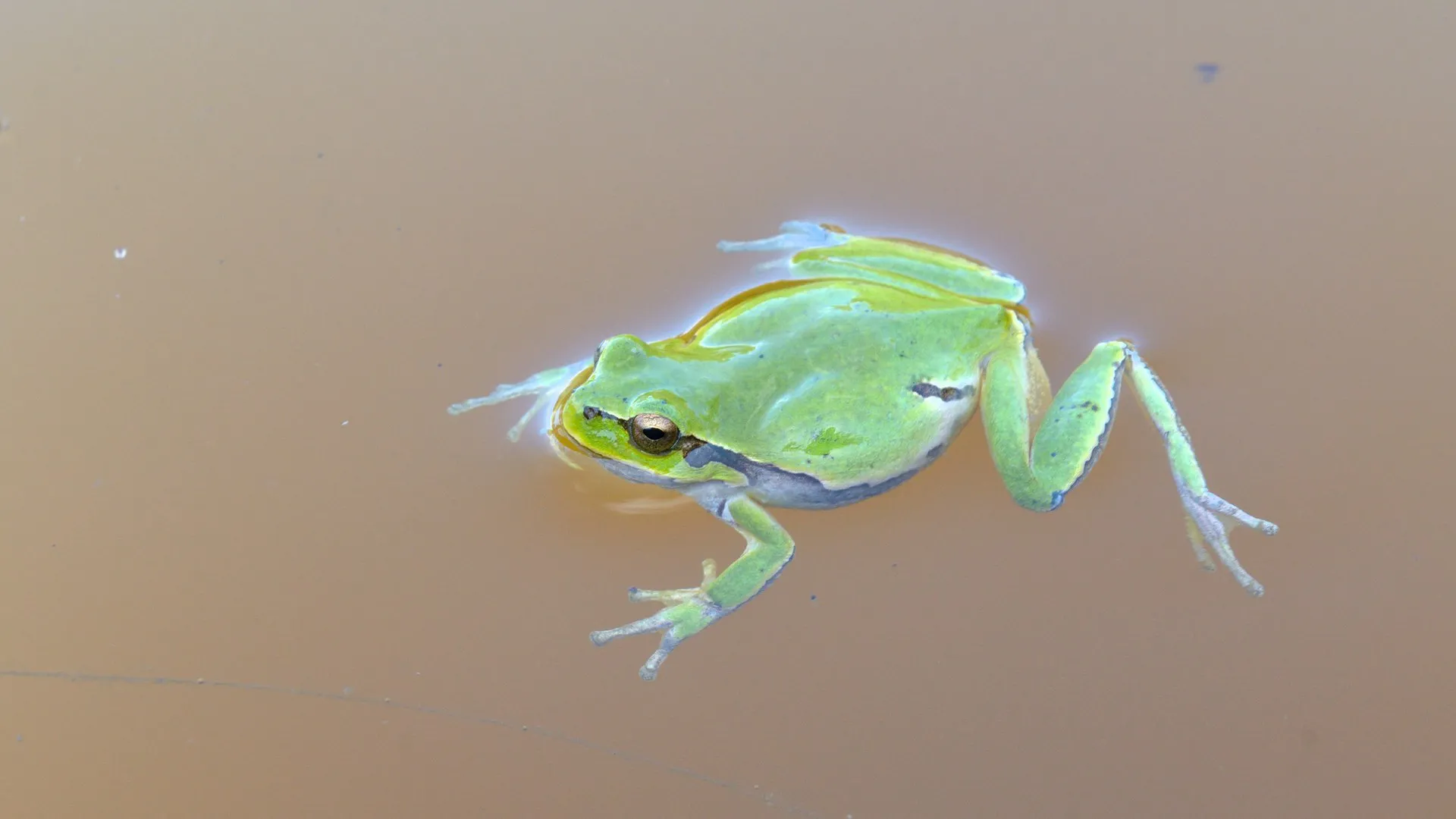
No. 8 on our checklistEastern Tree Frog (Hyla orientalis)
The Eastern Tree Frog is a small amphibian with a surprisingly powerful voice. Discover its remarkable climbing abilities, changing colours, spring breeding calls and the special connection between its scientific history and Tulcea.
The Eastern Tree Frog (Hyla orientalis) is one of the smallest and most distinctive amphibians of the Danube Delta and Dobrogea. With its bright green skin, remarkable climbing abilities and surprisingly loud breeding calls, this little frog is often heard long before it is seen.
Although closely related to the European Tree Frog (Hyla arborea), the Eastern Tree Frog is recognised as a separate species. Interestingly, Tulcea is one of the localities mentioned in its original scientific description, giving this amphibian a special connection to the region.
Quick facts
Quick facts
- Scientific name Hyla orientalis Bedriaga, 1890
- Common name Eastern Tree Frog
- Family Hylidae
- Order Anura
- Length usually up to approximately 5 cm
- Diet insects and other small invertebrates
- Habitat wetlands, reed beds, shrubs, woodland edges and other vegetated habitats
- Activity mainly nocturnal and crepuscular
- Breeding spring to early summer, depending on local conditions
When to see it in the Danube Delta and Dobrogea
- JanVery rare
- FebVery rare
- MarRare
- AprAbundant
- MayAbundant
- JunAbundant
- JulModerate
- AugModerate
- SepModerate
- OctRare
- NovVery rare
- DecVery rare
- Status here
- Active from spring to autumn; hibernates in winter.
- IUCN Red List
- Least Concern
- Our checklist
- No. 8 of 30 · see the full checklist
Description and identification
The Eastern Tree Frog is a small, slender amphibian, usually bright green above, with a pale underside. A dark stripe extends from the nostril through the eye and along the side of the body, helping distinguish its characteristic appearance.
Its toes end in rounded adhesive pads, allowing it to climb reeds, leaves, shrubs and even smooth vertical surfaces. Unlike most frogs associated with wetlands, it spends much of its active life above the ground, among vegetation.
Despite its familiar green appearance, the Eastern Tree Frog can change colour. Individuals may appear grey, brownish or olive, depending on environmental conditions and their physiological state. This is not the rapid, complex colour change of a chameleon, but it can make the same frog look surprisingly different from one observation to another.
Habitat and distribution
In the Danube Delta and Dobrogea, the Eastern Tree Frog inhabits wetlands and nearby areas with abundant vegetation. It can be found among reeds, shrubs, trees and other plants, often close to ponds, canals or shallow standing water.
The species is distributed across parts of eastern and southeastern Europe and extends into western Asia. In Romania, its distribution is associated with the broader range of eastern tree frog populations, historically included within Hyla arborea.
Outside the breeding period, individuals may spend considerable time away from open water, provided suitable vegetation and humid refuges are available.
Behaviour and the remarkable breeding call
For such a small animal, the Eastern Tree Frog produces an impressively powerful call. During the breeding season, males gather near suitable water bodies and call repeatedly, often forming choruses that can be heard from a considerable distance.
Each male has a single vocal sac beneath the throat, which inflates during calling and acts as a resonating chamber. The repeated calls help attract females and are among the most recognisable amphibian sounds of spring evenings in the Delta.
During the day, these frogs often remain motionless on leaves, reeds or branches. Their small size and colour make them difficult to locate, even when they are only a short distance away.
Reproduction and seasonal activity
The Eastern Tree Frog becomes more active as temperatures rise in spring. Breeding generally takes place during spring and may continue into early summer, depending on temperature, rainfall and water conditions.
Females lay eggs in small clusters attached to submerged vegetation. The developing larvae are aquatic, feeding and growing until metamorphosis transforms them into young frogs capable of leaving the water.
During summer, adults may be encountered among vegetation, sometimes at a considerable height above the ground. As temperatures decline in autumn, activity gradually decreases, and the frogs seek sheltered places where they can survive the winter in a dormant state.
Diet
Eastern Tree Frogs feed mainly on insects and other small invertebrates. They capture prey using their quick movements and sticky tongue, often hunting among leaves and branches.
By consuming a variety of small arthropods, they form part of the complex food web connecting the aquatic and terrestrial habitats of the Danube Delta.
Conservation and threats
Like many amphibians, the Eastern Tree Frog depends on the availability of suitable breeding waters and healthy surrounding vegetation. The drainage of wetlands, loss of small ponds, habitat fragmentation and pollution can negatively affect local populations.
The preservation of shallow breeding habitats, reed beds, shrubs and natural vegetation corridors is important for the long-term survival of the species.
An interesting scientific connection to Tulcea
The Eastern Tree Frog has a particularly interesting taxonomic history. For many years, it was generally treated as part of the European Tree Frog, Hyla arborea. Molecular research later supported its recognition as a distinct species, Hyla orientalis.
In the original description published by Bedriaga in 1890, Tulcea, Romania, was mentioned alongside Kharkov, Ukraine, among the localities associated with the taxon. This makes Tulcea part of the scientific history of a frog now recognised across a much wider geographical range.
Where and when to see the Eastern Tree Frog in the Danube Delta
Spring is an excellent time to discover the Eastern Tree Frog, particularly during the breeding period, when males call from vegetation near shallow water. Warm evenings can reveal their presence through sound even when the frogs remain hidden.
During summer, they can still be found among reeds, shrubs and trees, although locating a silent individual requires patience and careful observation. Occasionally, tree frogs may also be discovered near outdoor lights, where insects gather during the night.
For nature enthusiasts visiting the Danube Delta, this small amphibian is a reminder that some of the most interesting wildlife encounters involve listening carefully and examining the vegetation around us, rather than searching only for larger animals.
See it with us
Slow open boats, small groups and a guide who knows the places and the wildlife. From a few hours on the water to a week in the Danube Delta and Dobrogea.
Keep reading
Keep reading
More from the blog
4 min read
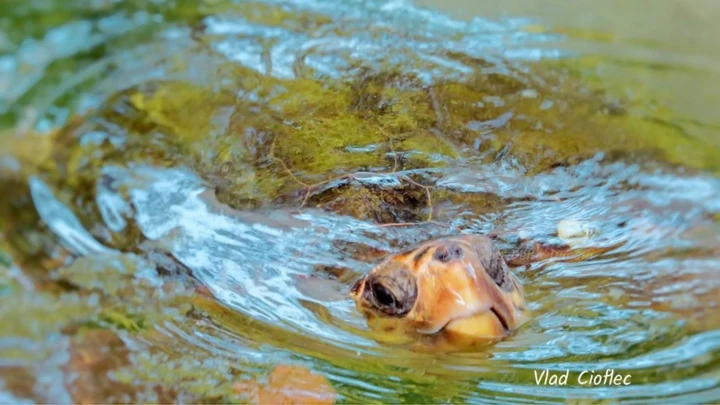
Loggerhead Sea Turtle (Caretta caretta) in the Black Sea
The Loggerhead Sea Turtle reaches the Black Sea only by chance. How to identify it, the only two records from Romania, both on Danube...
4 min read
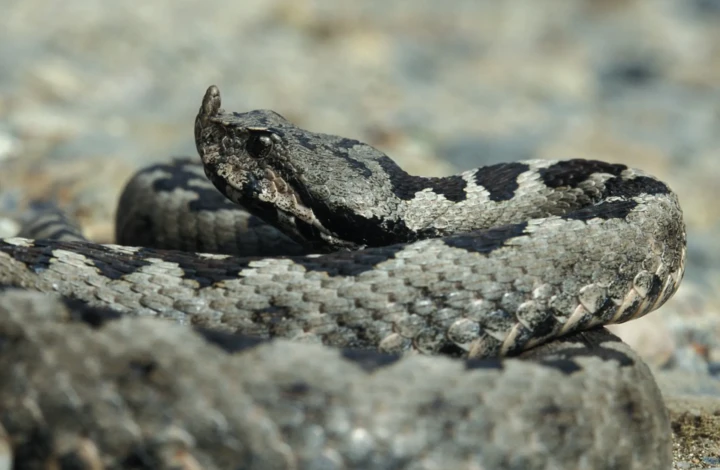
Nose-horned Viper (Vipera ammodytes) in Dobrogea
Meet the Nose-horned Viper, the largest viper and most venomous snake in Romania, on the rocky hills of Dobrogea: identification, where it lives, behavior,...
4 min read
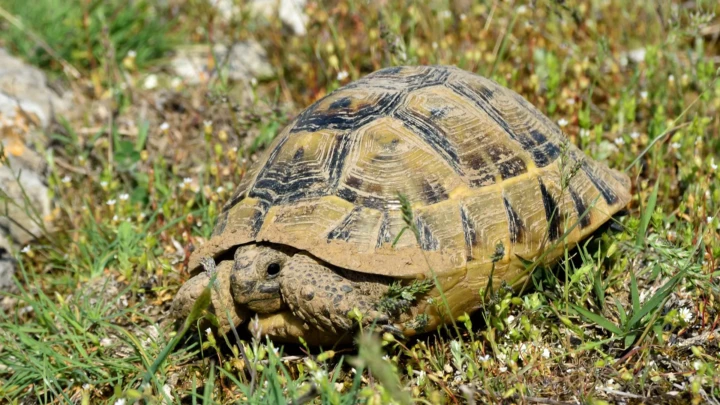
Spur-thighed Tortoise (Testudo graeca)
The Spur-thighed Tortoise is the only native land tortoise of eastern Romania, living in the dry grasslands, hills and scrublands of Dobrogea. Discover how...