

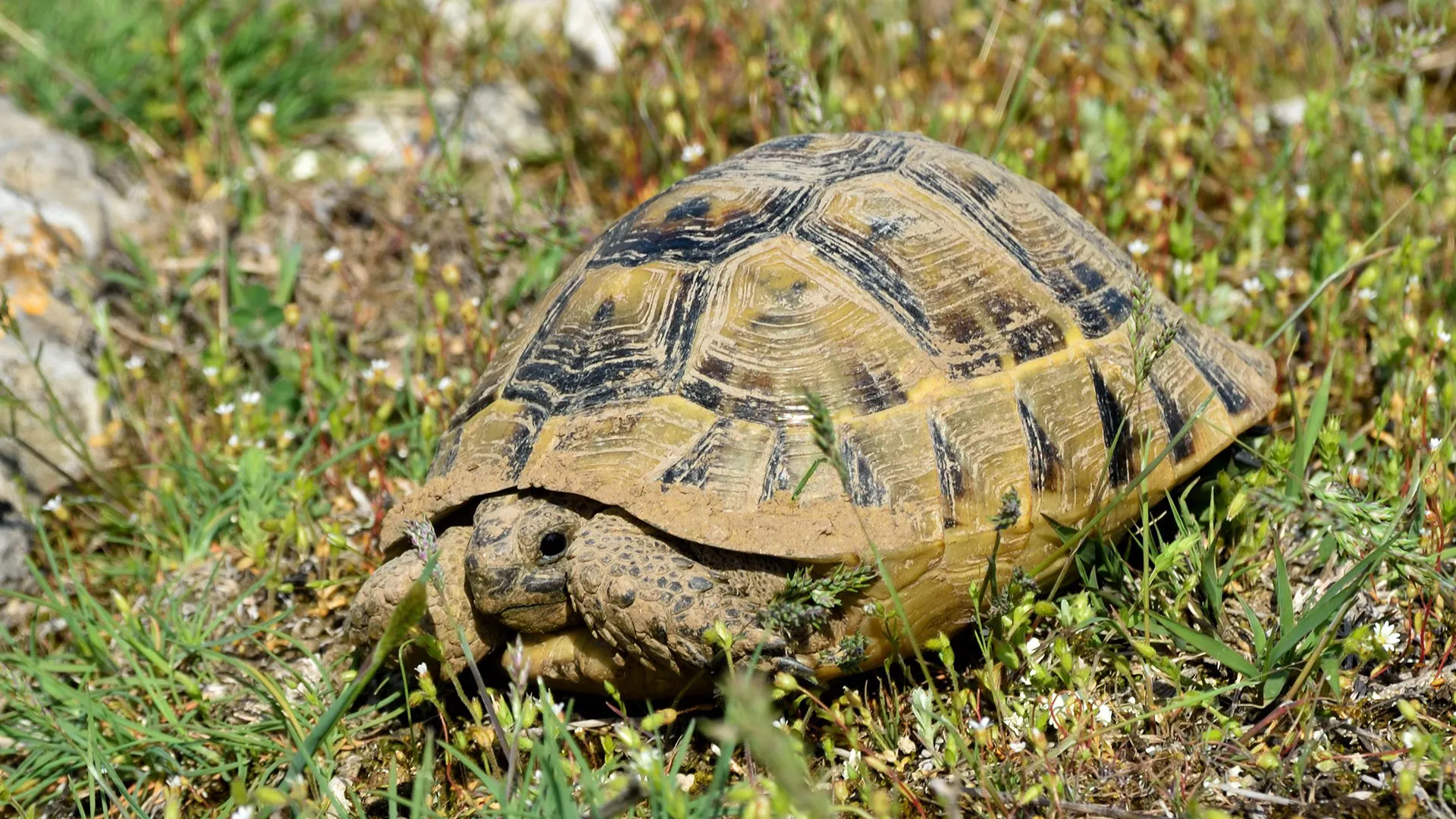
No. 14 on our checklistSpur-thighed Tortoise (Testudo graeca)
The Spur-thighed Tortoise is the only native land tortoise of eastern Romania, living in the dry grasslands, hills and scrublands of Dobrogea. Discover how to identify it, where it lives, its seasonal behaviour and why protecting these long-lived reptiles matters.
The Spur-thighed Tortoise (Testudo graeca) is the only native land tortoise found in eastern Romania. In our country, it occurs in Dobrogea, where its populations are among the northernmost in the species’ distribution. This long-lived reptile can survive for more than 50 years and feeds almost entirely on plants.
Quick facts
Quick facts
- Scientific name Testudo graeca Linnaeus, 1758; Dobrogea populations are traditionally assigned to Testudo graeca ibera Pallas, 1814
- Common name Spur-thighed Tortoise (Greek Tortoise)
- Family Testudinidae
- Order Testudines
- Shell length Usually 15–25 cm; females are generally larger than males
- Diet Mainly herbaceous plants, flowers and fruits; occasionally animal material
- Seasonal activity Generally April to October, depending on weather conditions
- Conservation status Vulnerable (VU), IUCN Red List; protected under Annexes II and IV of the EU Habitats Directive
When to see it in the Danube Delta and Dobrogea
- JanVery rare
- FebVery rare
- MarVery rare
- AprModerate
- MayModerate
- JunModerate
- JulModerate
- AugModerate
- SepModerate
- OctRare
- NovVery rare
- DecVery rare
- Status here
- Active from April to October in Dobrogea; hibernates in winter.
- IUCN Red List
- Vulnerable
- Our checklist
- No. 14 of 30 · see the full checklist
Identification
The Spur-thighed Tortoise has a high, domed shell, varying from yellowish brown to olive brown, usually with dark markings on each scute. Its strong legs are covered with protective scales and are adapted to walking across dry, uneven terrain.
Two characteristics help distinguish it from Hermann’s Tortoise (Testudo hermanni), which occurs in southwestern Romania. The supracaudal scute, positioned above the tail, is usually undivided, and each hind thigh bears a prominent conical horny tubercle, or spur. Unlike Hermann’s Tortoise, its tail does not end in a distinct horny tip.
Seasonal activity and reproduction
In Dobrogea, Spur-thighed Tortoises generally emerge from winter dormancy in late March or April, as the soil warms. Spring is also an important period for courtship. Males pursue females, sometimes pushing them with their shells or biting their legs before mating.
During May and June, females search for sunny places with suitable soil, where they dig nests using their hind legs. A clutch commonly contains between two and eight eggs, although numbers vary.
Incubation lasts through the warm months, with hatchlings generally emerging in late summer or early autumn. As in many tortoises, incubation temperature influences the sex of the young, with warmer temperatures tending to produce more females.
During the hottest summer days, activity is often concentrated in the cooler morning and evening hours. Tortoises seek shade beneath shrubs or among vegetation to avoid overheating. As temperatures decline in autumn, they prepare for winter dormancy, sheltering in the ground or other protected places.
Habitat and distribution in Dobrogea
The Spur-thighed Tortoise inhabits dry grasslands, scrublands, rocky slopes, woodland edges and open areas with scattered trees. In Dobrogea, it is particularly associated with steppe and forest-steppe landscapes, where sunny feeding areas alternate with shrubs and other protective vegetation.
It occurs in the Măcin Mountains, the Babadag Plateau, southern Dobrogea, including the Hagieni area, and suitable habitats around the Razim–Sinoie lagoon complex.
The species has also been reported from Letea and sandy ridges near Sfântu Gheorghe, within the wider Danube Delta region. However, its distribution there requires careful interpretation, and these records should not be taken as evidence of widespread, established populations throughout the Delta’s wetlands.
Diet
The Spur-thighed Tortoise is predominantly herbivorous. A field study conducted by Alexandru and Oana Iftime in Dobrogea found that plant material accounted for more than 95% of the observed diet, with 25 plant species recorded as food.
It feeds on grasses, leaves, flowers and fruits, depending on seasonal availability. Occasional consumption of animal material, including carrion, has also been documented. Researchers have even observed individuals ingesting calcareous soil, a behaviour known as geophagy.
Its feeding habits are closely connected to the diversity of natural vegetation, making the preservation of steppe grasslands and scrubland habitats particularly important.
Conservation and threats
The Spur-thighed Tortoise is a protected species whose populations in Dobrogea have been affected by habitat loss and fragmentation. The conversion of natural grasslands into agricultural land, development, vegetation fires and intensive grazing can reduce the availability of suitable habitats.
Another serious threat is the collection of wild tortoises for private gardens or illegal trade. Because these animals mature slowly, often requiring many years before they reproduce, removing even a few adults can have long-term consequences for a local population.
Road traffic also presents a danger, especially during periods when tortoises move between feeding areas, shelters and nesting sites.
What to do if you encounter a tortoise
If you find a Spur-thighed Tortoise in the wild, the best thing to do is leave it undisturbed. Do not take it home or move it to another habitat, even if the new location appears safer or more suitable.
If a tortoise is crossing a road and you can help without putting yourself or others at risk, move it a short distance to the side it was heading towards. Hold it gently with both hands by the sides of its shell, keeping it upright.
These tortoises belong in their natural habitats. Observing them without handling or disturbing them is the best way to appreciate one of Dobrogea’s most distinctive reptiles.
See it with us
Slow open boats, small groups and a guide who knows the places and the wildlife. From a few hours on the water to a week in the Danube Delta and Dobrogea.
Keep reading
Keep reading
More from the blog
5 min read
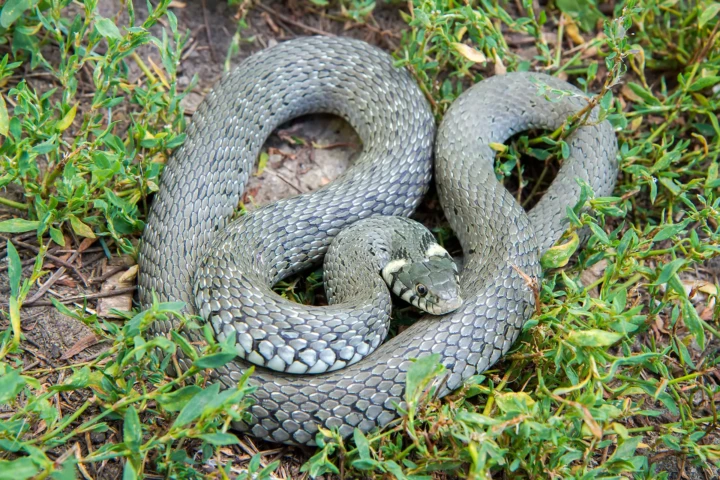
Grass Snake (Natrix natrix)
The harmless snake with the yellow collar, the delta's most often seen serpent and a famous actor that plays dead. Discover the grass snake...
5 min read
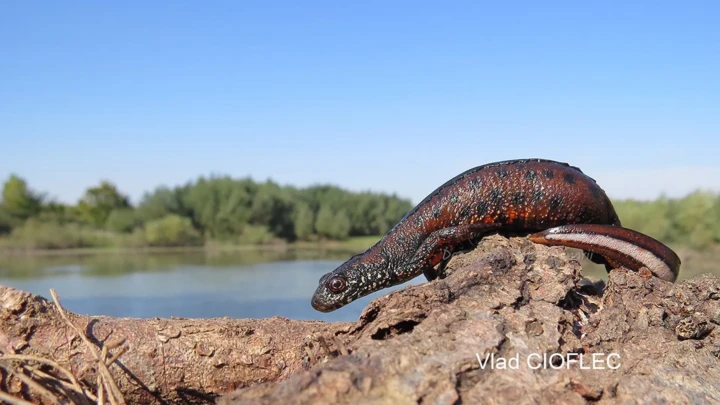
Danube Crested Newt (Triturus dobrogicus)
A newt that lives almost nowhere else but the Danube floodplains, with a spectacular breeding crest. Discover the Danube crested newt and where to...
5 min read
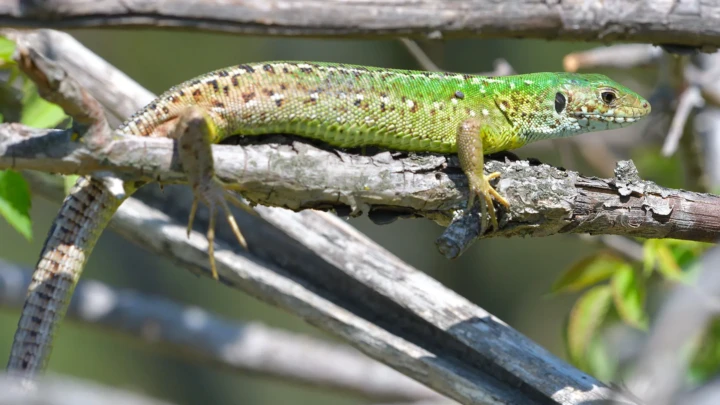
European Green Lizard (Lacerta viridis)
A bright green lizard up to 40 cm long, basking on the bushes of Dobrogea's hills. Discover the European green lizard and where to...