

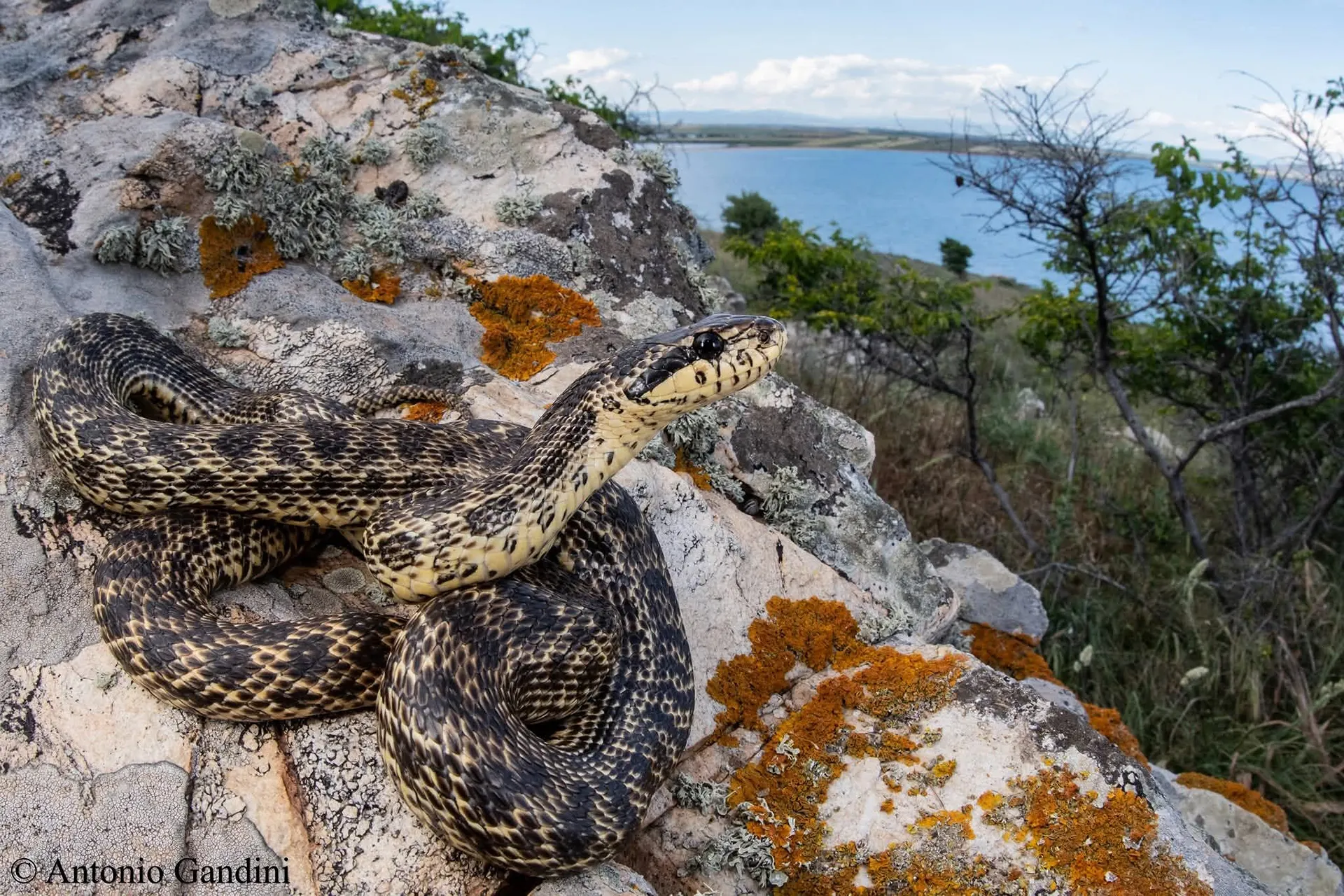
No. 25 on our checklistBlotched Snake (Elaphe sauromates)
Meet the elusive Blotched Snake of Dobrogea: identification, older scientific names, habitat and conservation, without promises of easy sightings.
The Blotched Snake (Elaphe sauromates) is a substantial, nonvenomous snake whose dark markings break up a yellowish or brownish body among grasses and scrub. Its size makes it memorable, but size does not make it easy to find: Romanian research describes it as an exceptionally elusive species.
For visitors exploring the Danube Delta and Dobrogea, it belongs to the wider terrestrial wildlife story, not to a list of animals that can reasonably be promised on a boat trip.
Quick facts
Quick facts
- Scientific name Elaphe sauromates (Pallas, 1811), following The Reptile Database
- Common name Blotched Snake
- Family Colubridae (typical snakes)
- Order Squamata (scaled reptiles)
- Length commonly around 120–140 cm in the Romanian monitoring guide; large adults can exceed 2 m
- Diet birds, eggs and small mammals, with other vertebrate prey also recorded
- Habitat open grassy habitats, scrub and structurally varied edges with shelter
- Activity observed and surveyed by day; encounters are difficult to predict
- Breeding egg-laying; spring mating and summer reproduction documented in southeastern Europe
- Conservation status Least Concern globally (2017 IUCN assessment); Critically Endangered in Romania’s 2005 Red Book
When to see it in the Danube Delta and Dobrogea
- JanWinter rest
- FebWinter rest
- MarWeather-led
- AprWeather-led
- MaySurvey window
- JunSurvey window
- JulSurvey window
- AugSurvey window
- SepSurvey window
- OctWeather-led
- NovWinter rest
- DecWinter rest
- Status here
- May–September is the Romanian guide’s monitoring window, not the full limit of possible activity. No abundance estimate.
- IUCN Red List
- Least Concern globally (2017); Critically Endangered in Romania’s 2005 Red Book
- Our checklist
- No. 25 of 30 · see the full checklist
Description and identification
Adults have a muscular body marked with large dark blotches along the back and smaller markings on the sides. The background can be yellowish, brownish or grayish, and the head carries a dark stripe behind the eye. The pupils are round and the dorsal scales are keeled, meaning that each bears a raised longitudinal ridge.
The Romanian monitoring guide gives a usual length of about 120–140 cm and notes that large individuals can exceed two meters. Those exceptional lengths should not define expectations for every encounter. A partly concealed animal can also be difficult to judge accurately without a scale reference.
Older literature often uses Elaphe quatuorlineata sauromates, treating it as a subspecies of the Four-lined Snake. Current taxonomy recognizes Elaphe sauromates separately. Recognizing the older combination is useful when reading historical distribution records and legal documents.
Why a large snake can remain unseen
Its pattern works particularly well in vegetation, where dark marks and pale areas interrupt the outline of the body. A snake lying still among stems can be much less conspicuous than its field-guide photograph suggests. Searching harder does not justify trampling cover or dismantling refuges.
A Romanian morphological study published in 2016 examined nine adults captured during fieldwork in continental Dobrogea between 2011 and 2014. That is a research sample, not a population estimate. The study is valuable precisely because direct observations have been difficult to accumulate.
The distinction matters for tourism: a documented regional species is not automatically a likely sighting. An honest account must leave room for walks through suitable habitat without an encounter, rather than turning scientific distribution records into a wildlife guarantee.
Habitat in Dobrogea
Romanian research and monitoring guidance describe open habitats with grass, scattered shrubs and other cover, including structurally varied edges. Refuges may include stone piles, walls and dense vegetation. Some occupied settings are relatively moist, so it would be misleading to describe the species as restricted to bare, arid rock.
Dobrogea is central to its documented Romanian distribution, although records elsewhere in the country are also known. The 2016 study explicitly excluded the Danube Delta from its fieldwork. Its findings therefore support an account of continental Dobrogea, not a claim about the frequency of snakes within the wetland.
Food and behavior
Birds, their eggs and small mammals occur in the documented diet, with other vertebrates also recorded. Research elsewhere in southeastern Europe shows that birds and eggs can be particularly important. Exact percentages from one population should not be assumed to apply to Dobrogea.
The snake is nonvenomous and uses constriction to subdue suitable prey. Its ecological role is that of a predator within the grassland and scrub food web, not a danger that justifies killing it. As with any wild snake, attempting to seize or corner it can provoke defensive behavior.
For an observer, the useful approach is to keep a respectful distance and leave the animal’s escape route clear. A photograph showing the body pattern and head may help identification, but no identification exercise requires catching or repositioning the animal.
Reproduction and seasonal activity
This is an egg-laying species. A 2024 study from Greek Thrace describes spring mating and summer egg-laying, with young expected later in summer. Some reproductive information came from breeding observations rather than animals followed entirely in the wild, so it should not be presented as a precise Romanian schedule.
The Romanian monitoring guide recommends May to September for its species-specific survey program. The calendar above marks that documented monitoring window and allows for weather-dependent activity outside it. A survey window is neither a full biological limit nor evidence that the species is abundant during those months.
This distinction also avoids false precision in planning a visit. Warm conditions and suitable habitat are relevant, but a monthly table cannot predict when an elusive individual will emerge from cover.
Conservation: different geographic scales
The global IUCN assessment published in 2017 lists the species as Least Concern. Romania’s 2005 Red Book classified it as Critically Endangered nationally, a designation cited in Romanian scientific literature. These assessments concern different geographic scales and dates; neither should be substituted for the other.
The species is covered by Annexes II and IV of the EU Habitats Directive, including listings under its older taxonomic combination. Protection involves both habitat conservation and strict species protection. Destroying refuges or killing a snake because of its appearance defeats both aims.
For visitors, restraint is especially important with a difficult-to-detect species. Do not move animals, pull apart stone piles or publicize precise refuge locations. A regional sighting record is useful, but the animal’s safety and habitat should come before the desire to produce a close photograph.
A possible encounter, not a promised highlight
During multi-day birdwatching programs that include Dobrogea as well as the Danube Delta, we also watch for other wildlife where habitats overlap. A Blotched Snake would be an exceptional addition to a walk, not something to build an expectation around. The same quiet attention that helps with birds can make an incidental reptile encounter possible without disturbing the ground cover.
See it with us
Slow open boats, small groups and a guide who knows the places and the wildlife. From a few hours on the water to a week in the Danube Delta and Dobrogea.
Keep reading
Keep reading
More from the blog
6 min read
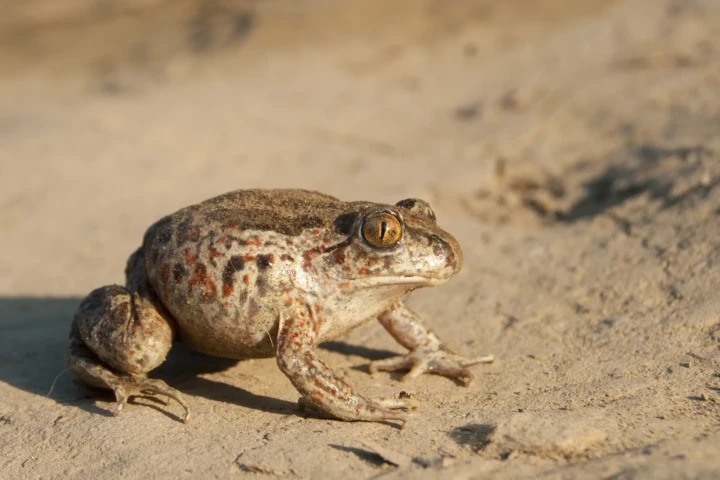
Common Spadefoot (Pelobates fuscus)
Meet the Common Spadefoot of the Danube Delta: a burrowing night toad of sandy ridges, with giant tadpoles and a short spring breeding season.

3 min read
Reptile and Amphibian List of the Danube Delta and Dobrogea
30 reptiles and amphibians of the Danube Delta and Dobrogea, from fire-bellied toads and pond turtles to the meadow viper, with names in five...
5 min read
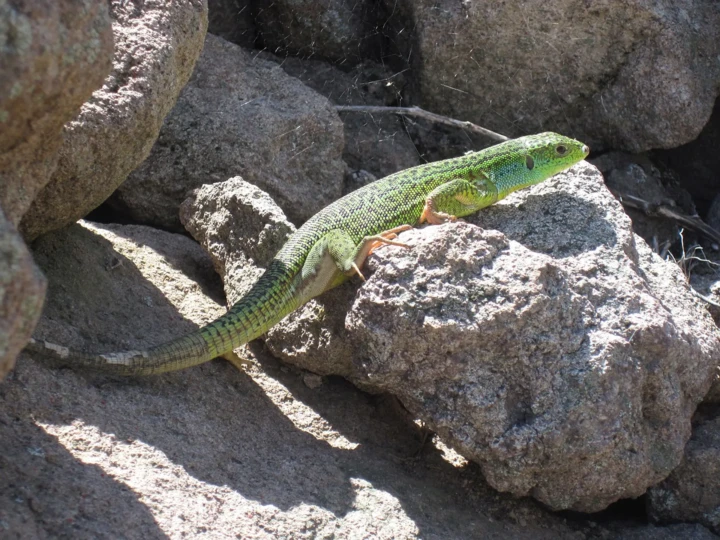
Balkan Green Lizard (Lacerta trilineata) in Dobrogea
Meet the Balkan Green Lizard, the largest lizard in Romania, found only in Dobrogea near the Danube Delta: identification, where it lives, behavior, taxonomy...