

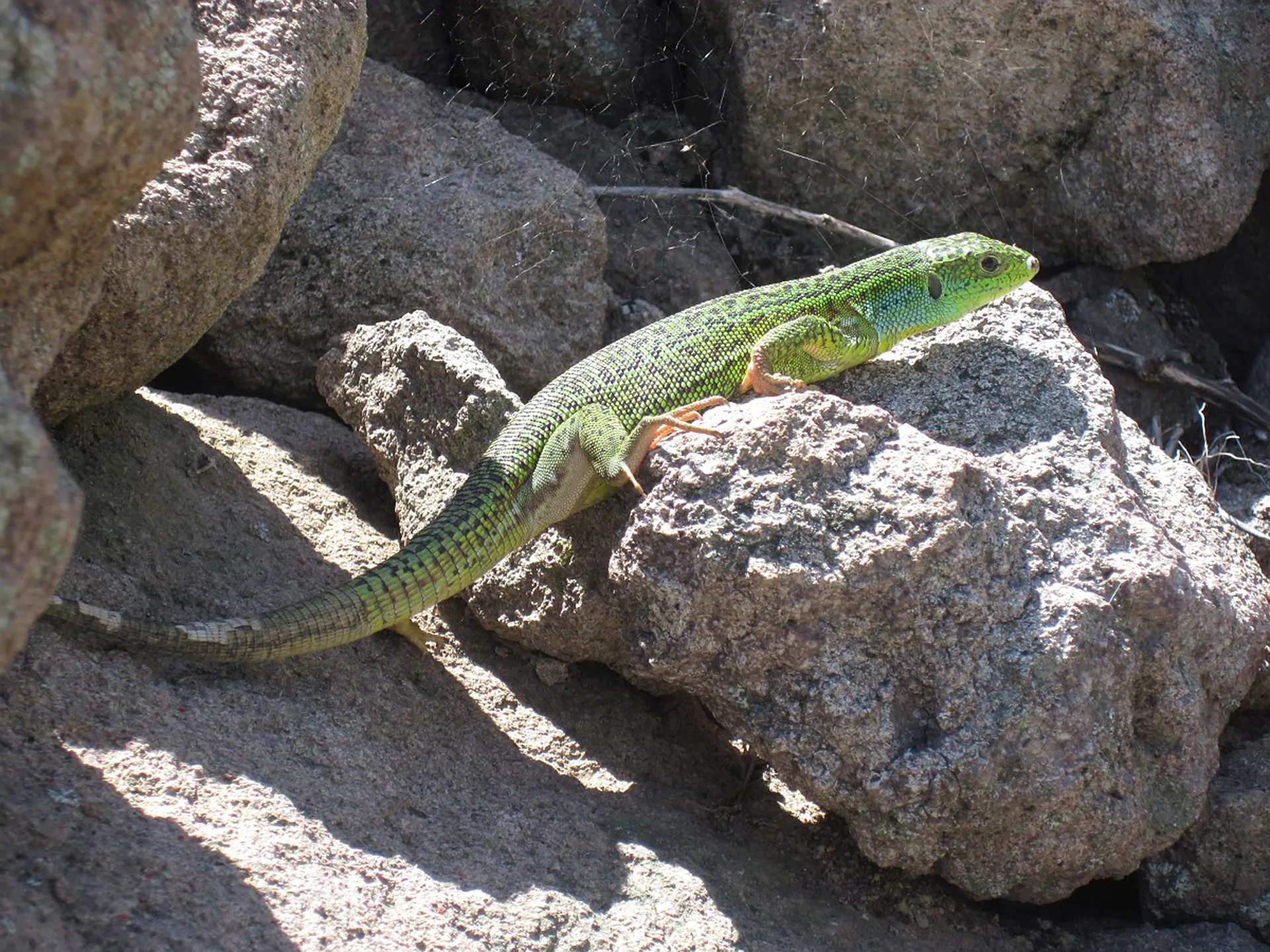
No. 20 on our checklistBalkan Green Lizard (Lacerta trilineata) in Dobrogea
Meet the Balkan Green Lizard, the largest lizard in Romania, found only in Dobrogea near the Danube Delta: identification, where it lives, behavior, taxonomy and conservation.
The Balkan Green Lizard (Lacerta trilineata) is the largest lizard in Romania, sometimes reaching more than 40 cm. In the country it lives only in Dobrogea, where a local form was described as Lacerta trilineata dobrogica.
Its striped young and bright green adults can be found on forest edges and bushy slopes of the Dobrogean hills, right next to the Danube Delta.
Quick facts
Quick facts
- Scientific name Lacerta trilineata Bedriaga, 1886; Romanian populations belong to Lacerta trilineata dobrogica Fuhn & Mertens, 1959
- Common name Balkan Green Lizard
- Family Lacertidae (wall lizards and relatives)
- Order Squamata (lizards and snakes)
- Length over 35 cm including the tail, exceptionally more than 40 cm; hatchlings about 8 cm
- Diet mainly large insects and other invertebrates; large adults can also take small vertebrates
- Habitat forest edges, plantations, bushy valleys and rocky slopes of the Dobrogean plateau
- Activity by day, from spring to autumn; basks near bushes and escapes into dense cover
- Breeding lays eggs in late spring or early summer; hatchlings appear in late summer
- Conservation status Least Concern (global IUCN Red List); EU Habitats Directive Annex IV
When to see it in the Danube Delta and Dobrogea
- JanWinter rest
- FebWinter rest
- MarWinter rest
- AprEmerging
- MayMating season
- JunEgg-laying
- JulActive
- AugHatchlings
- SepActive
- OctLast activity
- NovWinter rest
- DecWinter rest
- Status here
- Local on the Dobrogean mainland, including the hills on the southern edge of the Danube Delta. Indicative seasonal pattern only.
- IUCN Red List
- Least Concern
- Our checklist
- No. 20 of 30 · see the full checklist
Description and identification
This is a big, powerful lizard with a large head. Adults usually exceed 35 cm, and exceptional individuals pass 40 cm, most of it tail. Adult males are yellowish green, with a small black spot on each dorsal scale, a yellow belly and light blue on the sides of the neck. Unlike the European Green Lizard, the male’s throat is never blue.
Females are greenish and often keep three pale stripes along the back, which give the species its scientific name, trilineata. Juveniles look completely different: they are brown with five pale stripes along the body. Hatchlings measure about 8 cm.
The European Green Lizard, Lacerta viridis, also lives in Dobrogea and is the most likely source of confusion. It is smaller, and breeding males have a blue throat. Young Balkan Green Lizards, with five stripes, can be mistaken for other lizards, but their size and stripe pattern help.
Where it lives in Dobrogea
In Romania the species is found only in Dobrogea, on the continental plateau. Zsolt Török, who studied the distribution of green lizards on the mainland of northern Dobrogea between 1994 and 2008, recorded it on the forested edges of the Beștepe Hills and the Pricopan Ridge, in forestry plantations around Dunavăț and Tulcea, and in valleys close to forests, such as at the foot of Priopcea Hill.
Where there is no compact forest, it lives in rocky places, such as Piatra Roșie hill near Cerna, the railway cutting in Tulcea and the Sitorman quarry, along streams such as the Megina valley and in bushy dry valleys, for example at Cape Doloșman. Around Murighiol and Dunavăț, on the southern edge of the Danube Delta, Török found it only at the edges of, or inside, small plantations of ash, poplar and Black Locust surrounded by fields.
The monitoring guide for reptiles of community interest adds sites such as the Canaraua Fetii valley, the Hârșova area, Cernavodă, the Cheia and Gura Dobrogei reserves, the shores of Lake Nuntași and the Beștepe Hills.
Sharing the hills with the Green Lizard
On the Pricopan Ridge and the Beștepe Hills, both green lizard species occur. Török observed a clear separation: the Balkan Green Lizard lives mostly on the lower slopes, while the European Green Lizard is more frequent higher up. Where only the Balkan Green Lizard is present, it occurs from the base of the hill to the top. The smaller Balkan Wall Lizard lives in the same areas.
Daily life and breeding
Balkan Green Lizards bask close to bushes, stone piles or the edge of a wood and run into dense cover when disturbed. They are wary, and adults are often heard rustling away before they are seen. The diet consists mainly of large insects and other invertebrates, and large adults can also take small vertebrates. Females lay eggs in late spring or early summer, and the striped hatchlings appear in late summer.
Taxonomy and names
The Balkan Green Lizard was long treated as a single species with many subspecies. Recent revisions, followed by the 2025 European Red List, have split off some of the southern and island forms as separate species. The Dobrogean form, Lacerta trilineata dobrogica, described by Fuhn and Mertens in 1959, remains within Lacerta trilineata. In older literature you may also find it described as a variety of Lacerta viridis.
Conservation and responsible observation
The species is assessed as Least Concern globally and is not among the threatened reptiles in the 2025 European Red List. It is listed in Annex IV of the EU Habitats Directive, and in Romania it is protected under Annex 4A of Government Emergency Ordinance 57/2007. In Romania it is rare and local, and its populations depend on bushy forest edges, hedgerows and small woods in an increasingly agricultural landscape.
Keep a respectful distance, do not try to catch it, and avoid disturbing stone piles and bushes where it shelters.
Seeing it on a nature tour
On our multi-day nature tours in the Danube Delta and Dobrogea, the hills and forest edges around Tulcea, Beștepe and Murighiol are close to the Danube Delta and can be combined with a day on the water. Warm, sunny mornings in May and June give the best chance to see adult males at the edge of the bushes.
See it with us
Slow open boats, small groups and a guide who knows the places and the wildlife. From a few hours on the water to a week in the Danube Delta and Dobrogea.
Keep reading
Keep reading
More from the blog
5 min read
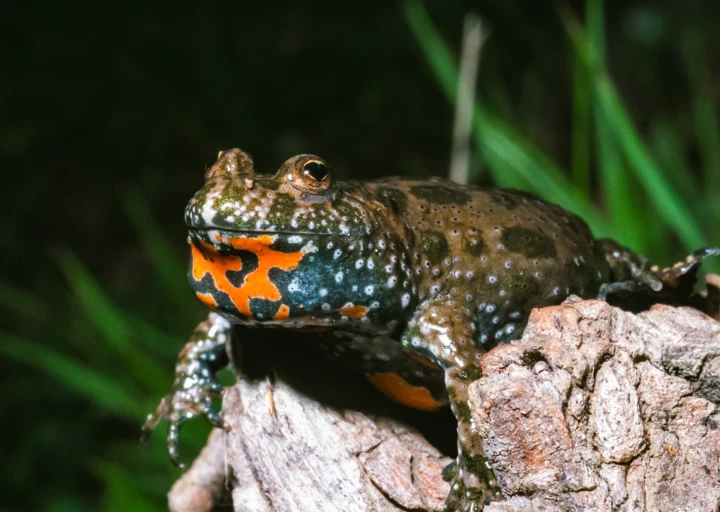
European Fire-bellied Toad (Bombina bombina)
A small, dark toad with a fire-coloured belly, hidden in the still waters of the Danube Delta. Discover its warning colours, its soft unk...
5 min read
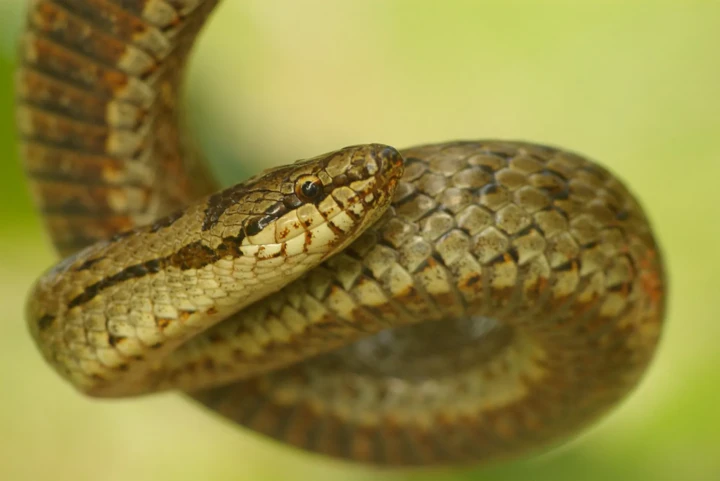
Smooth Snake (Coronella austriaca)
Discover the Smooth Snake in the Danube Delta and Dobrogea: identification, live-bearing reproduction, dry refuges and responsible wildlife watching.
5 min read
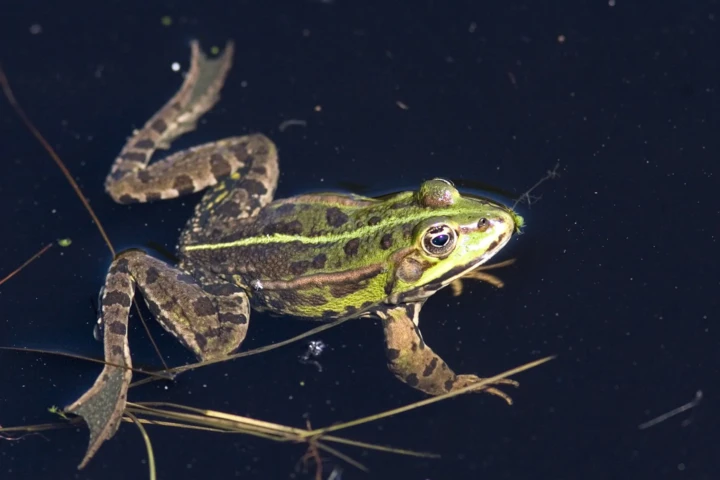
Edible Frog (Pelophylax kl. esculentus)
Meet the Edible Frog, a hybrid of the Marsh Frog and the Pool Frog that lives in the lakes of the Danube Delta and...