

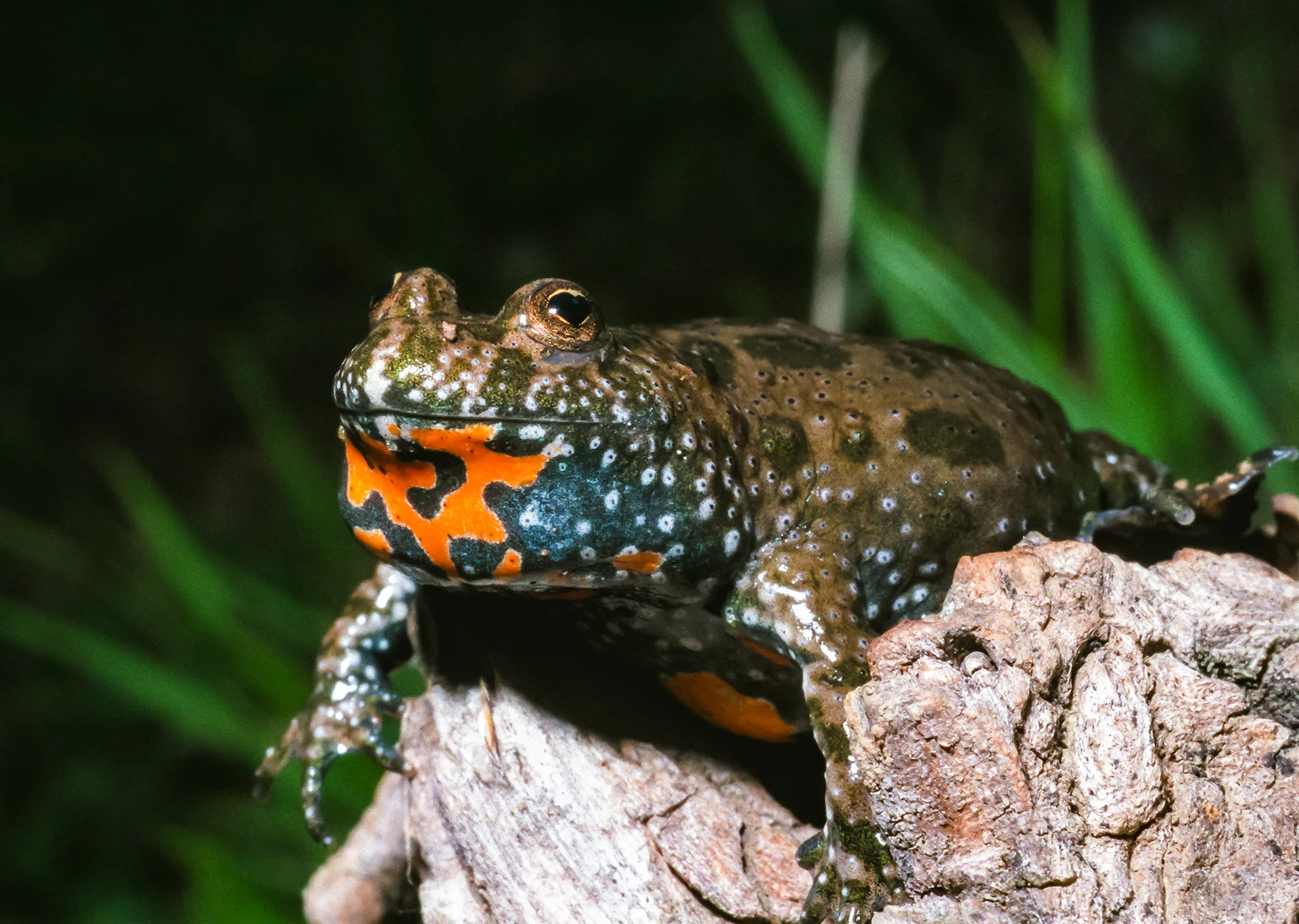
No. 3 on our checklistEuropean Fire-bellied Toad (Bombina bombina)
A small, dark toad with a fire-coloured belly, hidden in the still waters of the Danube Delta. Discover its warning colours, its soft unk breeding call, and where to look for it in spring.
The European Fire-bellied Toad (Bombina bombina) is a small, warty toad of the still waters of the Danube Delta. Its back is dark and modest, but its belly is a hidden warning: grey and black, blotched with bright orange red, and shown to any predator that picks the toad up. On warm evenings in late spring, its soft, hollow “unk… unk” call is one of the characteristic sounds of the Danube Delta’s quiet ponds.
Although easily overlooked, the fire-bellied toad is common in suitable habitats across the Danube Delta. In May and June the calling males give away ponds, marshes and flooded clearings that would otherwise pass unnoticed, and with patience the toads themselves can be watched floating among the vegetation.
Quick facts
Quick facts
- Scientific name Bombina bombina (Linnaeus, 1761)
- Common name European Fire-bellied Toad
- Family Bombinatoridae (fire-bellied toads)
- Order Anura (frogs and toads)
- Length usually 4 to 5 cm
- Diet small invertebrates: insects, spiders, worms and aquatic larvae
- Habitat shallow, sunlit, well vegetated still waters
- Activity by day and at dusk, especially in the breeding season
- Breeding May to July, sometimes later in the summer
- Conservation status Least Concern (IUCN); protected under Annexes II and IV of the EU Habitats Directive
When to see it in the Danube Delta and Dobrogea
- JanVery rare
- FebVery rare
- MarRare
- AprModerate
- MayAbundant
- JunAbundant
- JulModerate
- AugModerate
- SepRare
- OctRare
- NovVery rare
- DecVery rare
- Status here
- Active from March to October; hibernates in the mud at the bottom of ponds in winter.
- IUCN Red List
- Least Concern
- Our checklist
- No. 3 of 30 · see the full checklist
Description and identification
Adult fire-bellied toads usually measure 4 to 5 cm from snout to vent, with females slightly larger than males. The body is flattened and covered in small warts; the back is grey brown to olive with darker markings, camouflaging the toad against mud and vegetation. The belly is grey to black, marked with large orange red spots, the “fire” that gives the species its name.
The eyes are set high on the head, and the pupil is triangular to heart shaped, a detail that immediately separates the genus Bombina from other European frogs and toads. In the breeding season, males develop dark nuptial pads on the insides of their first and second fingers, which is the easiest way to tell the sexes apart. On land the toad walks slowly and deliberately; in water it is a capable swimmer that rarely leaves the surface vegetation.
The fire belly and the unkenreflex
When a fire-bellied toad is attacked, it does not only try to escape. It arches its back, twists its limbs upward and tips its head back, displaying the bright underside in a defensive posture known as the unkenreflex, the “toad reflex” of the German naturalists who first described it. The orange and black pattern works together with mild skin secretions that are distasteful to predators; the display is an honest advertisement that this small animal is a poor meal.
The secretion is harmless to humans, though it is wise to wash the hands after handling a toad and to keep them away from the eyes. A picked-up toad may also emit a short, squeaky distress call, one of the few sounds an amphibian makes outside its breeding season.
Habitat and diet
The fire-bellied toad is a lowland animal of warm, shallow, well vegetated waters: ponds, marshes, ditches, flooded channels and the quiet backwaters of river valleys. It prefers still water less than half a metre deep, rich in submerged plants where the eggs can be attached and the tadpoles can feed. In the Danube Delta it finds ideal conditions in the mosaic of small lakes, marshes and channels, and it readily colonises new flooded areas.
Adults feed on small invertebrates: beetles, flies, spiders, worms and the larvae of aquatic insects, caught at the water’s edge or picked from floating vegetation. The tadpoles graze on algae and detritus. Unlike many frogs, fire-bellied toads are active largely by day, especially in cool, cloudy weather.
Breeding
Breeding begins in late April or May, when the shallow waters warm. Males float at the surface and call with a soft, hollow “unk”, repeated at intervals of a few seconds. The call is produced while the toad breathes in, a peculiarity of the genus Bombina; almost all other frogs call while breathing out.
The female lays her eggs in small batches of ten to forty, attached to submerged plants just below the surface, and may deposit several hundred eggs over the season. Tadpoles hatch within about a week and develop for roughly a month before metamorphosing, usually in July and August, as tiny toads about one and a half centimetres long. In warm years the young may leave the water even earlier.
Conservation and threats
Globally the fire-bellied toad is listed as Least Concern by the IUCN, with a range that extends from Denmark and northern Germany eastwards to the Black Sea region. At European level it is strictly protected and included in Annexes II and IV of the EU Habitats Directive, and it is one of the species for which Natura 2000 sites are designated.
Its dependence on small, sunlit, fish free waters makes it sensitive to change: drainage of marshes, pollution, and the stocking of predatory fish in breeding ponds all eliminate local populations. In the Danube Delta, with its thousands of hectares of marsh and its dynamic floodplain, the species remains widespread and common.
Where and when to see the Fire-bellied Toad in the Danube Delta
Look for the fire-bellied toad in quiet, vegetated waters: marshes, flooded clearings and the edges of small lakes and channels, away from the main boating routes. The best season is May and June, when the males call by day and at dusk, and the soft “unk” carries far over the water. Approach slowly and scan the floating vegetation; a toad at rest floats with only its eyes and the top of its head above the surface, and many sightings come from small boats drifting along shallow channels.
On a day trip in the Danube Delta, ask your guide to stop for a few minutes by a quiet pond in the late afternoon: the chorus, made of many toads calling at once, is one of the sounds that visitors remember long after the trip.
See it with us
Slow open boats, small groups and a guide who knows the places and the wildlife. From a few hours on the water to a week in the Danube Delta and Dobrogea.
Keep reading
Keep reading
More from the blog
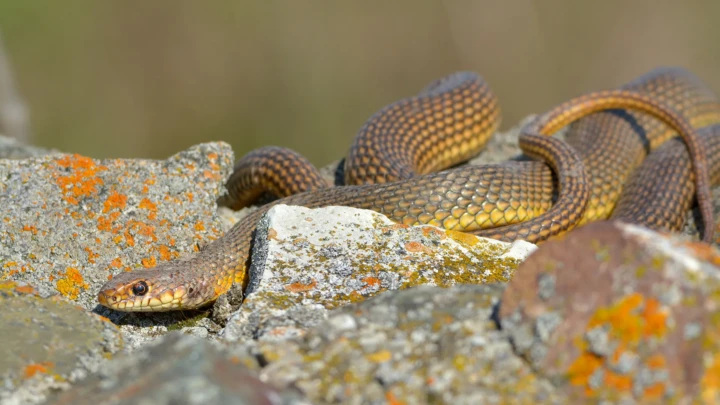
5 min read
Caspian Whipsnake (Dolichophis caspius)
Discover the Caspian Whipsnake of Dobrogea: a large, nonvenomous hunter of sunny slopes, with practical advice for watching it responsibly.
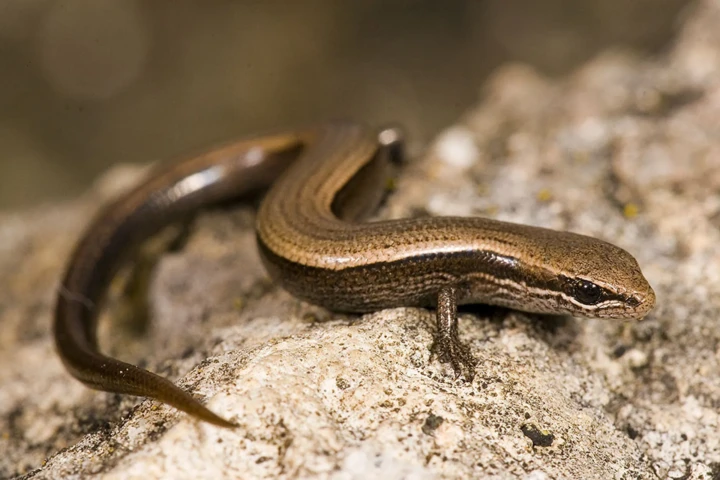
5 min read
European Snake-eyed Skink (Ablepharus kitaibelii)
Meet the European Snake-eyed Skink, the only skink in Romania: a tiny lizard that cannot blink, found in the oak woodland and dry slopes...
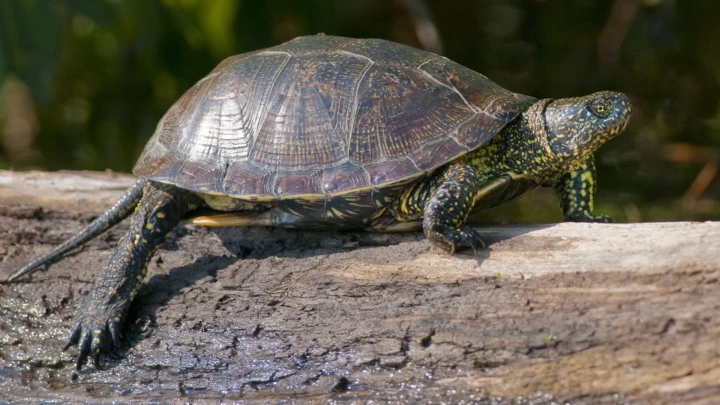
5 min read
European Pond Turtle (Emys orbicularis)
The European Pond Turtle is one of the most frequently encountered reptiles in the Danube Delta. Discover how to identify it, why it spends...