

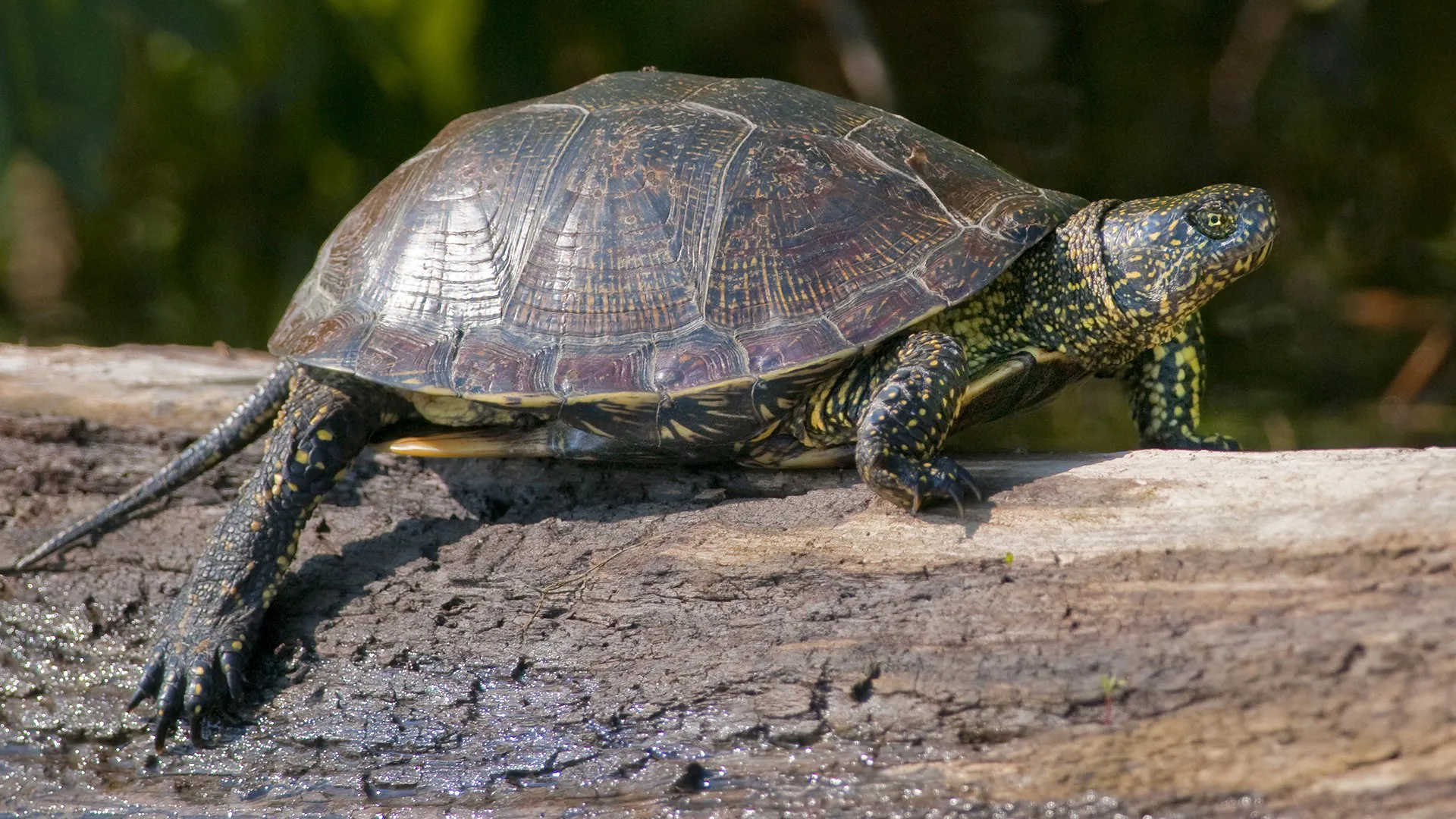
No. 13 on our checklistEuropean Pond Turtle (Emys orbicularis)
The European Pond Turtle is one of the most frequently encountered reptiles in the Danube Delta. Discover how to identify it, why it spends so much time basking in the sun, how it reproduces and what threatens its survival.
The European Pond Turtle (Emys orbicularis) is one of the most frequently encountered reptiles in the Danube Delta. On sunny spring days, ten or even twenty turtles may be basking together on a fallen tree trunk or a floating mat of vegetation along a channel. At the slightest movement of an approaching boat, they slip into the water, often before visitors have noticed them.
Quick facts
Quick facts
- Scientific name Emys orbicularis (Linnaeus, 1758)
- Common name European Pond Turtle
- Family Emydidae
- Order Testudines
- Shell length usually 12–20 cm, occasionally exceeding 25 cm
- Diet aquatic invertebrates, tadpoles, small fish, carrion and some plant material
- Activity generally March to October, depending on weather conditions
- Conservation status Near Threatened (NT), IUCN Red List; listed in Annexes II and IV of the EU Habitats Directive
When to see it in the Danube Delta and Dobrogea
- JanVery rare
- FebVery rare
- MarModerate
- AprAbundant
- MayAbundant
- JunAbundant
- JulAbundant
- AugAbundant
- SepAbundant
- OctModerate
- NovVery rare
- DecVery rare
- Status here
- Active from March to October; hibernates underwater in winter.
- IUCN Red List
- Near Threatened
- Our checklist
- No. 13 of 30 · see the full checklist
Identification
The European Pond Turtle has an oval, slightly domed shell, usually dark brown to almost black, decorated with fine yellow spots and radiating lines. Similar yellow markings are visible on the head, neck and limbs.
The underside of the shell, known as the plastron, is generally yellow with dark markings, sometimes becoming almost black in older individuals. It has a flexible connection that allows limited movement.
Males usually have a slightly concave plastron and a longer, thicker tail. Their eyes are often reddish, while females generally have yellowish eyes, although eye colour varies between individuals.
Diet and feeding behaviour
The European Pond Turtle is an opportunistic omnivore, feeding mainly on animal material, particularly when young. Its diet includes aquatic insect larvae, snails, crustaceans, worms, tadpoles and small fish. Adults may also consume aquatic vegetation.
It readily feeds on dead or weakened aquatic animals, contributing to the recycling of organic matter in wetland ecosystems. Food is swallowed underwater, where the turtle uses water movements to help transport it into the digestive tract.
Reproduction
Mating takes place in water, usually during spring. In May and June, females leave the water to search for sunny nesting sites with suitable soil, sometimes travelling several hundred metres from their usual aquatic habitat.
The female digs a flask-shaped nest, often in sandy ground, and typically lays between three and sixteen eggs before carefully covering them with soil.
As in many turtles, the temperature experienced by the developing embryos influences their sex. Hatchlings generally emerge towards the end of summer or in early autumn, although some remain in the nest throughout winter and emerge the following spring.
The European Pond Turtle in the Danube Delta
The Danube Delta provides extensive suitable habitat for the European Pond Turtle, with its network of lakes, canals, marshes and slow-moving freshwater. The species is widespread in the reserve and is considered relatively common in regional herpetological assessments.
Sandy ridges such as Letea and Caraorman, together with suitable elevated banks, provide potential nesting habitats. The combination of aquatic feeding areas and nearby dry, sun-exposed ground is particularly important for successful reproduction.
April and May are excellent months for observing pond turtles. They spend considerable time basking in the sun, often before the vegetation becomes dense enough to conceal them.
From a slow-moving boat, or with the engine switched off, it is possible to observe them resting on fallen branches and floating vegetation. Fast boats usually reveal little more than the ripples left behind as the turtles disappear underwater.
Seasonal activity and winter survival
European Pond Turtles generally become active in March or April, as water and air temperatures rise. During spring, basking helps them warm their bodies and become active after the colder months.
Activity continues through summer and gradually decreases during autumn. By October or November, depending on temperatures, most individuals enter a period of winter dormancy.
They usually overwinter underwater, often buried in soft bottom sediments. During this period, their metabolism slows dramatically, reducing oxygen requirements. They can absorb limited amounts of dissolved oxygen through specialised surfaces, including the skin and mucous membranes, allowing them to remain submerged for extended periods.
Conservation and threats
Although still relatively common in the Danube Delta, the European Pond Turtle faces several threats. Eggs and hatchlings are vulnerable to predators such as foxes, jackals, raccoon dogs and corvids. Nest predation can be particularly severe in some locations and years.
Adults may become trapped and drown in fishing nets because, like all turtles, they have lungs and must breathe air. Loss of nesting habitats and road mortality, particularly among females travelling to nesting sites, are additional concerns.
Released non-native turtles, especially the Pond Slider (Trachemys scripta), are another conservation concern. Competition for basking sites and other resources has been documented in some European habitats, although its severity varies between locations.
The European Pond Turtle is protected under European conservation legislation. Preserving healthy wetlands, suitable nesting areas and natural connections between aquatic and terrestrial habitats is essential for its long-term survival.
Interesting facts about the European Pond Turtle
- It can live for decades. Some individuals may exceed 40 years of age in the wild.
- Sunbathing is essential. Basking allows the turtle to raise its body temperature, supporting digestion, movement and other physiological processes.
- Nest temperature influences sex. Incubation temperature plays an important role in determining whether hatchlings develop as males or females.
- It survives winter underwater. Its greatly reduced metabolism allows it to remain submerged for long periods without breathing air.
Where and when to see the European Pond Turtle in the Danube Delta
The European Pond Turtle can be encountered throughout much of the Danube Delta wherever suitable freshwater habitats are available. Look for individuals basking on fallen tree trunks, exposed branches, floating vegetation and quiet banks.
Spring, particularly April and May, offers some of the best observation opportunities. Turtles may also be seen during summer and early autumn, although high temperatures and dense vegetation can make them less conspicuous.
Approaching slowly and keeping a respectful distance are the best ways to observe and photograph them. With patience, it is possible to watch these remarkable reptiles without causing them to retreat into the water.
See it with us
Slow open boats, small groups and a guide who knows the places and the wildlife. From a few hours on the water to a week in the Danube Delta and Dobrogea.
Keep reading
Keep reading
More from the blog
4 min read
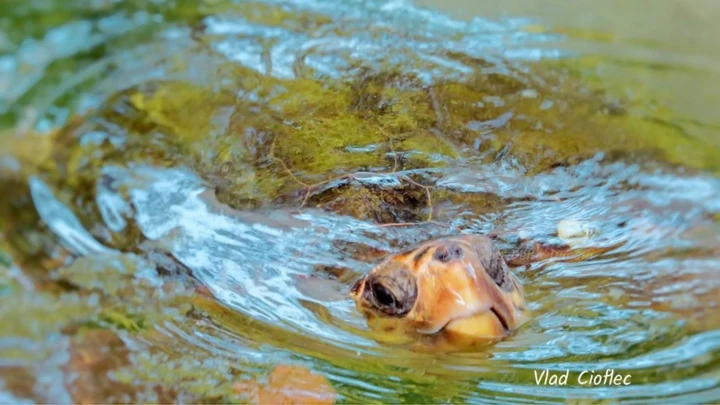
Loggerhead Sea Turtle (Caretta caretta) in the Black Sea
The Loggerhead Sea Turtle reaches the Black Sea only by chance. How to identify it, the only two records from Romania, both on Danube...
5 min read
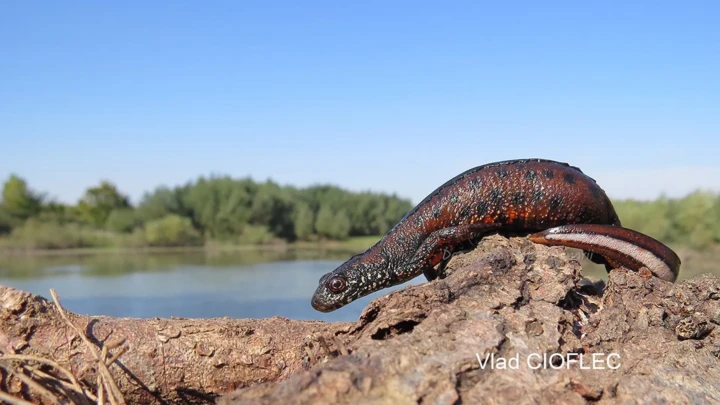
Danube Crested Newt (Triturus dobrogicus)
A newt that lives almost nowhere else but the Danube floodplains, with a spectacular breeding crest. Discover the Danube crested newt and where to...
5 min read
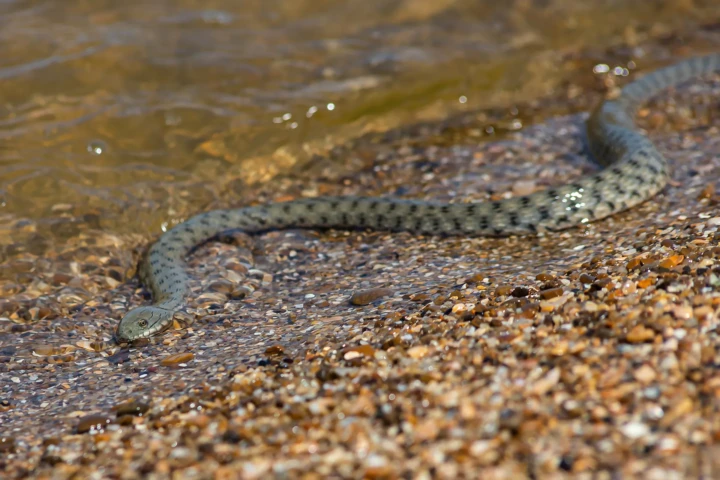
Dice Snake (Natrix tessellata)
A harmless fish-hunting snake that swims the channels of the Danube Delta. Discover how to recognise the dice snake, why it is often seen...