

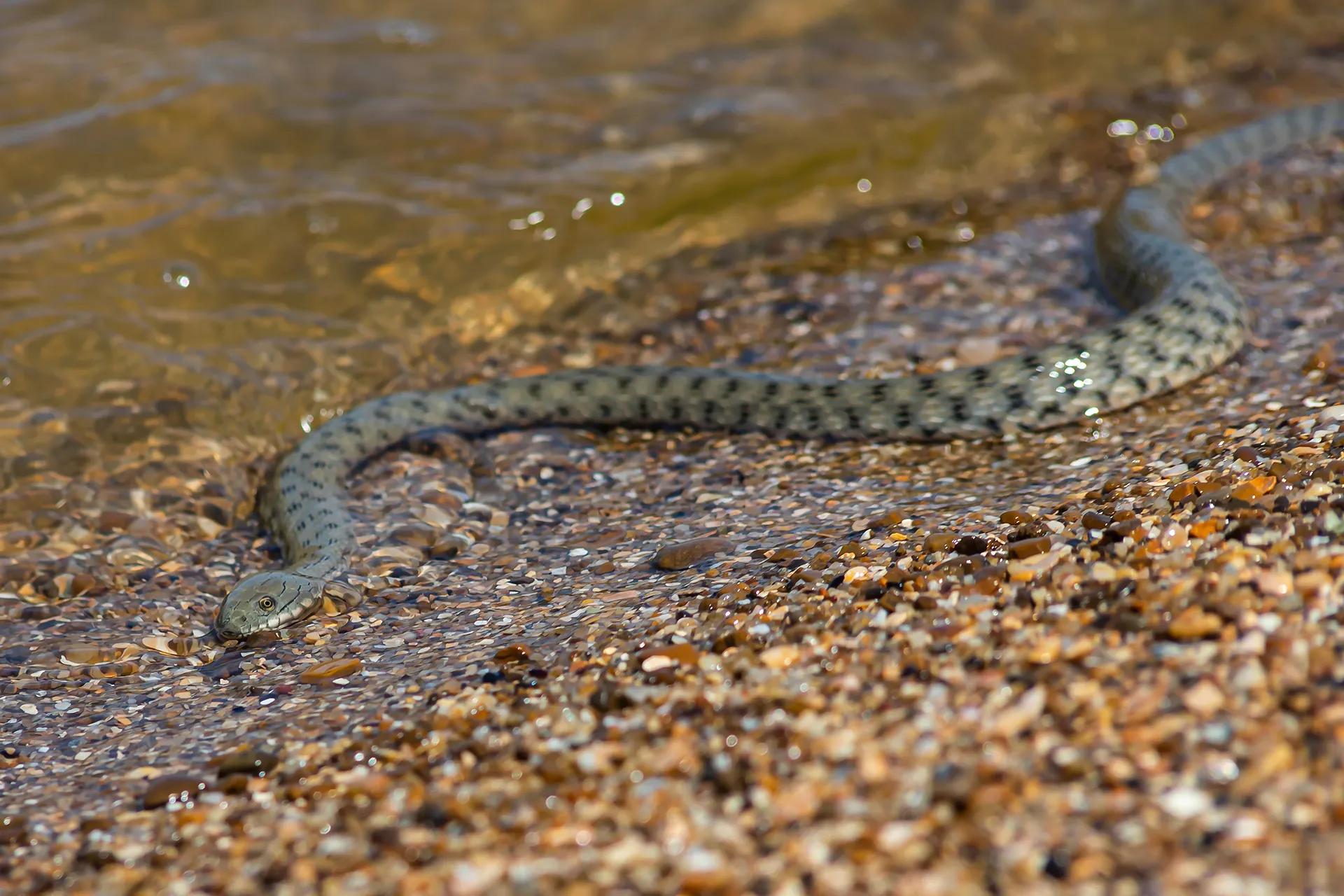
No. 28 on our checklistDice Snake (Natrix tessellata)
A harmless fish-hunting snake that swims the channels of the Danube Delta. Discover how to recognise the dice snake, why it is often seen from the boat, and where it hunts.
The Dice Snake (Natrix tessellata) is the water snake of the Danube Delta: a fast, graceful hunter of fish that spends much of its life swimming in channels and lakes. Visitors often see it crossing a channel in front of the boat, head held above the water, or basking on a bank in the morning sun, and wonder whether it is dangerous. It is not: the dice snake has no venom and no aggression towards people.
The name comes from the dark, dice like squares that pattern its skin. The scientific name, tessellata, is Latin for “tiled” and describes the neat checkerboard of dark marks on a grey, olive or brownish background, a pattern that camouflage breaks up the snake’s outline in the rippling water.
Quick facts
Quick facts
- Scientific name Natrix tessellata (Laurenti, 1768)
- Common name Dice Snake
- Family Natricidae (water snakes)
- Order Squamata (scaled reptiles)
- Length usually 70 cm to 1 m, exceptionally up to about 1.3 m
- Diet almost exclusively fish
- Habitat rivers, lakes, channels and other fish rich waters
- Activity mainly diurnal
- Breeding eggs laid in June and July; hatchlings emerge in late summer
- Conservation status Least Concern (IUCN); listed in Annex IV of the EU Habitats Directive and Annex II of the Bern Convention
When to see it in the Danube Delta and Dobrogea
- JanVery rare
- FebVery rare
- MarRare
- AprAbundant
- MayAbundant
- JunAbundant
- JulAbundant
- AugAbundant
- SepAbundant
- OctRare
- NovVery rare
- DecVery rare
- Status here
- Active from March to October; hibernates in winter.
- IUCN Red List
- Least Concern
- Our checklist
- No. 28 of 30 · see the full checklist
Description and identification
Adult dice snakes usually measure between 70 cm and 1 m, with females larger than males; exceptionally large females can reach about 1.3 m. The body is moderately stout, the head rounded and clearly wider than the neck, and the eyes and nostrils are placed high, the equipment of an animal that hunts at the water surface.
The back is grey, olive or brownish, with rows of dark, squarish blotches that give the species both its English and its scientific name. The belly is whitish to yellowish with black checks. Unlike its relative the grass snake, the dice snake usually shows no bright yellow collar at the neck, though juveniles can have a faint pale marking that fades with age. When handled, dice snakes rarely bite; they defend themselves with a foul smelling secretion and by emptying the bowels, which convinces most would-be predators, and most curious tourists, to put them down.
A specialist of fish
Fish make up almost the entire diet of an adult dice snake. In the Danube Delta this means mainly small, abundant species: gobies, bleak, roach and other small cyprinids. The snake hunts by sight, swimming underwater along the bottom or waiting motionless among vegetation, and usually swallows its prey out of the water. Studies of the species’ diet across Europe regularly find fish in more than 90 percent of stomachs, with amphibians taken only occasionally.
The species is strongly tied to fish rich waters and can reach remarkable densities where conditions are right. In the southern part of the Danube Delta, around Histria, one of the best studied populations forages even in the brackish waters of Lake Sinoe, where the snakes hunt in water that most freshwater species avoid.
Reproduction
Dice snakes mate in spring, soon after leaving the winter shelter. In June and July the females lay their eggs in warm, humid places that hold heat and moisture: rotting vegetation, compost and manure heaps, piles of decaying reed. A clutch counts roughly ten to twenty-five eggs, and the females of a population often use the same laying sites year after year. The hatchlings, about 15 to 20 cm long, emerge in late summer and start hunting small fish immediately; males mature in their second or third year, females a year or two later.
Conservation and threats
Globally the dice snake is listed as Least Concern by the IUCN, with a range that extends from central Europe through the Balkans and the Middle East to central Asia. It is protected by European law, in Annex II of the Bern Convention and Annex IV of the EU Habitats Directive, and national assessments in Romania have proposed a vulnerable status for the species, because its populations are tied to healthy waters and natural shores.
The main threats are the alteration of rivers and lake shores, water pollution, and persecution, as water snakes are still killed on sight by people who mistake them for vipers. In parts of Europe the invasive American mink has destroyed entire riparian populations. In the Danube Delta, with thousands of kilometres of natural channels and abundant fish, the dice snake remains one of the commonest and most often seen reptiles.
Where and when to see the Dice Snake in the Danube Delta
The dice snake is one of the reptiles visitors see most often from the boat. From April to September it swims openly across the channels and hunts along banks with vegetation, and on cool mornings it basks on fallen trunks, willow branches and the sunny edges of the channels. Watch the water ahead in narrow channels: a swimming snake, moving with the head raised and the body undulating underwater, is very often a dice snake. The shallow, fish rich channels around Mila 23, Sfântu Gheorghe and the lakes of the southern Danube Delta, including the Histria area, are all good places to look for it.
On a day trip or a multi-day tour in the delta you will almost certainly pass suitable habitat; if you see a snake in or near the water, enjoy it calmly, as there is no venomous water snake in the Danube Delta, and the dice snake is one of its most graceful swimmers.
See it with us
Slow open boats, small groups and a guide who knows the places and the wildlife. From a few hours on the water to a week in the Danube Delta and Dobrogea.
Keep reading
Keep reading
More from the blog
5 min read
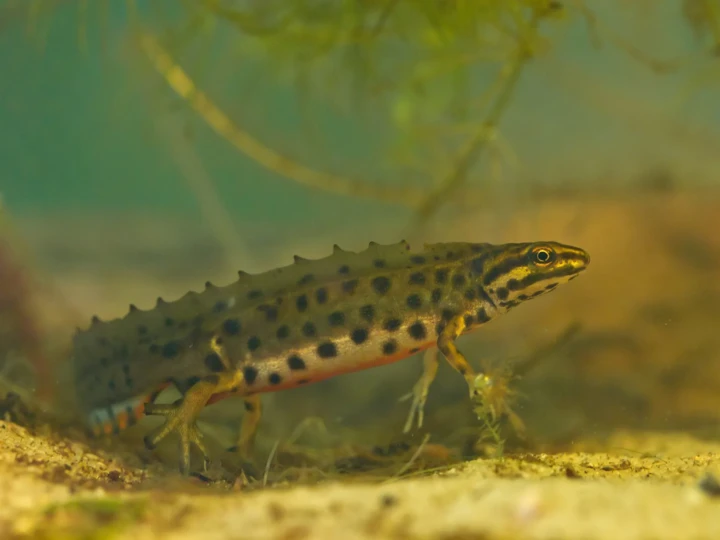
Smooth Newt (Lissotriton vulgaris)
Discover the Smooth Newt in the Danube Delta and Dobrogea: identification, leaf-wrapped eggs, seasonal habitats and responsible wildlife watching.
5 min read
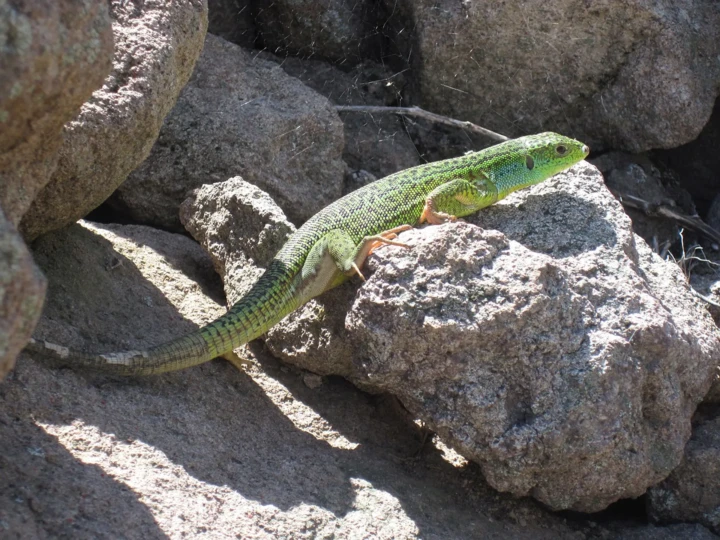
Balkan Green Lizard (Lacerta trilineata) in Dobrogea
Meet the Balkan Green Lizard, the largest lizard in Romania, found only in Dobrogea near the Danube Delta: identification, where it lives, behavior, taxonomy...
5 min read
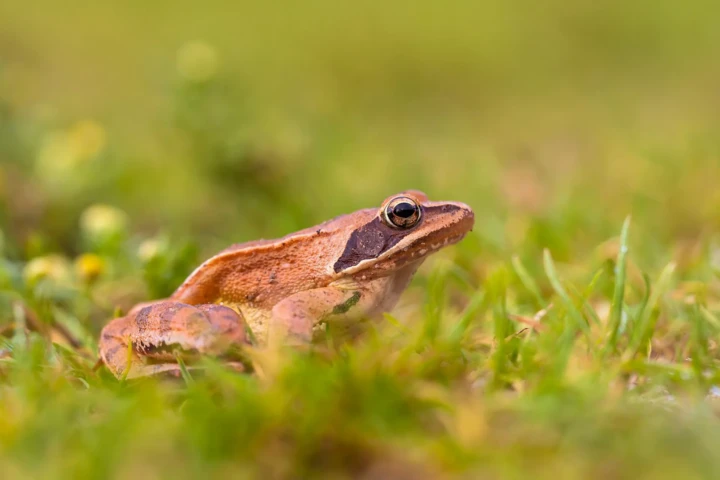
Agile Frog (Rana dalmatina)
Meet the Agile Frog of Dobrogea: long-legged woodland life, early spring breeding and responsible observation during a wider Danube Delta journey.