

No. 15 on our checklistEuropean Snake-eyed Skink (Ablepharus kitaibelii)
Meet the European Snake-eyed Skink, the only skink in Romania: a tiny lizard that cannot blink, found in the oak woodland and dry slopes of Dobrogea.
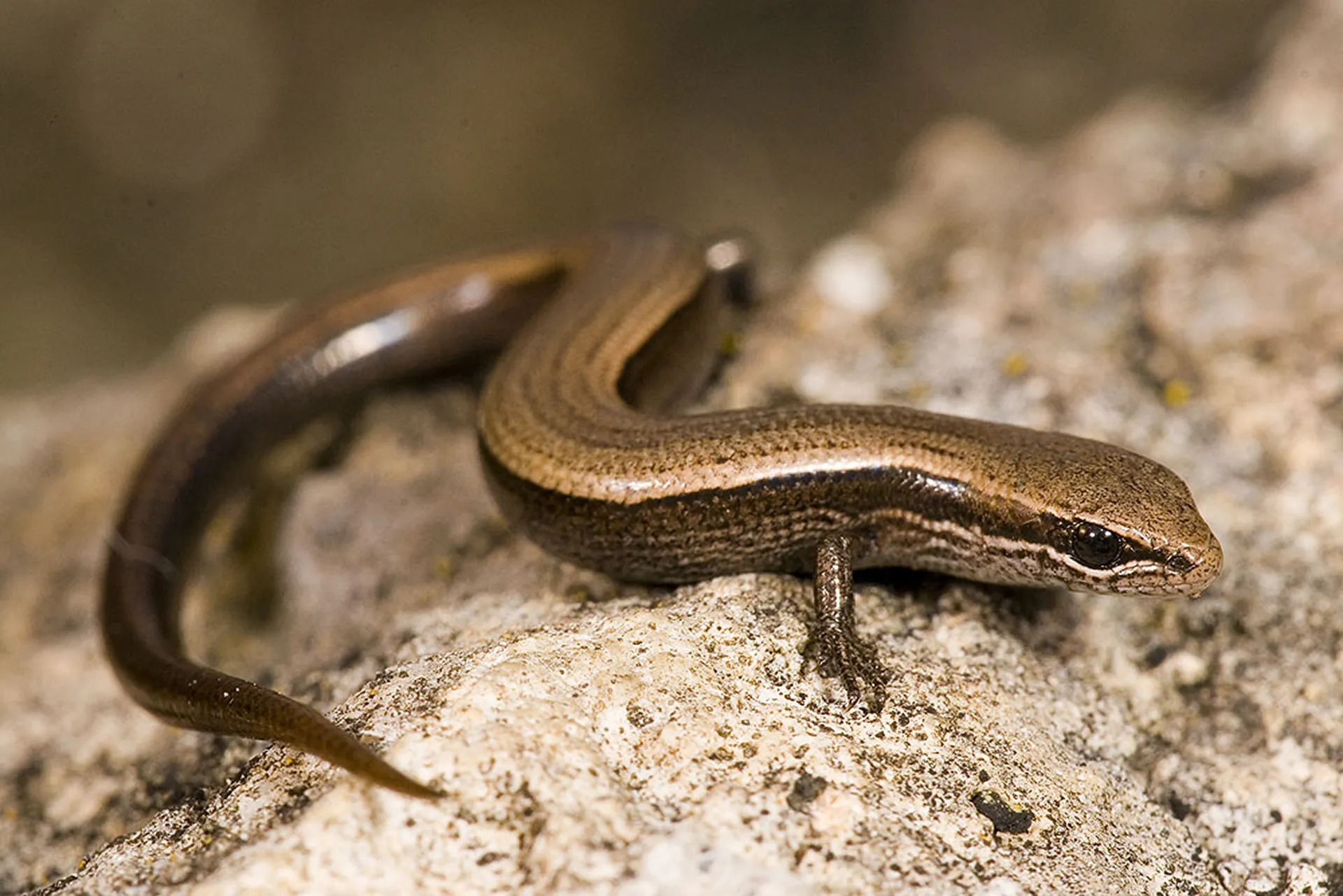
The European Snake-eyed Skink (Ablepharus kitaibelii) is the only skink in Romania and one of the smallest lizards in Europe. Its eyelids are fused into a transparent window, so, like a snake, it looks at the world without ever blinking.
It is a lizard of dry oak woodland and sunny grassland on the Dobrogea plateau, not of reedbeds and channels. The closest place to the Danube Delta where specialists monitor it is the Beștepe Hills, a low ridge on the edge of the Danube Delta that belongs to the Danube Delta Natura 2000 site.
Quick facts
Quick facts
- Scientific name Ablepharus kitaibelii (Bibron & Bory de Saint-Vincent, 1833)
- Common name European Snake-eyed Skink, also called European Copper Skink or Juniper Skink
- Family Scincidae (skinks)
- Order Squamata (lizards and snakes)
- Length up to about 13 cm including the tail
- Diet small invertebrates such as insects, spiders and small snails, hunted in leaf litter and among grass
- Habitat open oak woodland, woodland edges and grassy, south-facing slopes, usually close to leaf litter, stones or bushes
- Activity by day, mostly in the cooler hours after sunrise and before sunset; in hot summer weather it becomes active closer to dusk
- Breeding lays eggs; mating in spring, small clutches laid in early summer
- Conservation status Least Concern in Europe and EU27 (European Red List, 2009); Habitats Directive Annex IV; Endangered in the Romanian Red Data Book of Vertebrates (2005)
When to see it in the Danube Delta and Dobrogea
- JanWinter rest
- FebWinter rest
- MarWinter rest
- AprWeather-led
- MaySpring activity
- JunSpring activity
- JulEgg-laying
- AugHatchlings
- SepHatchlings
- OctWeather-led
- NovWinter rest
- DecWinter rest
- Status here
- Indicative seasonal pattern; activity depends on temperature and moisture. Romanian monitoring takes place from May to September. No abundance estimate.
- IUCN Red List
- Least Concern in Europe and EU27 (European Red List, 2009); not listed among threatened reptiles in the 2025 revision
- Our checklist
- No. 15 of 30 · see the full checklist
Description and identification
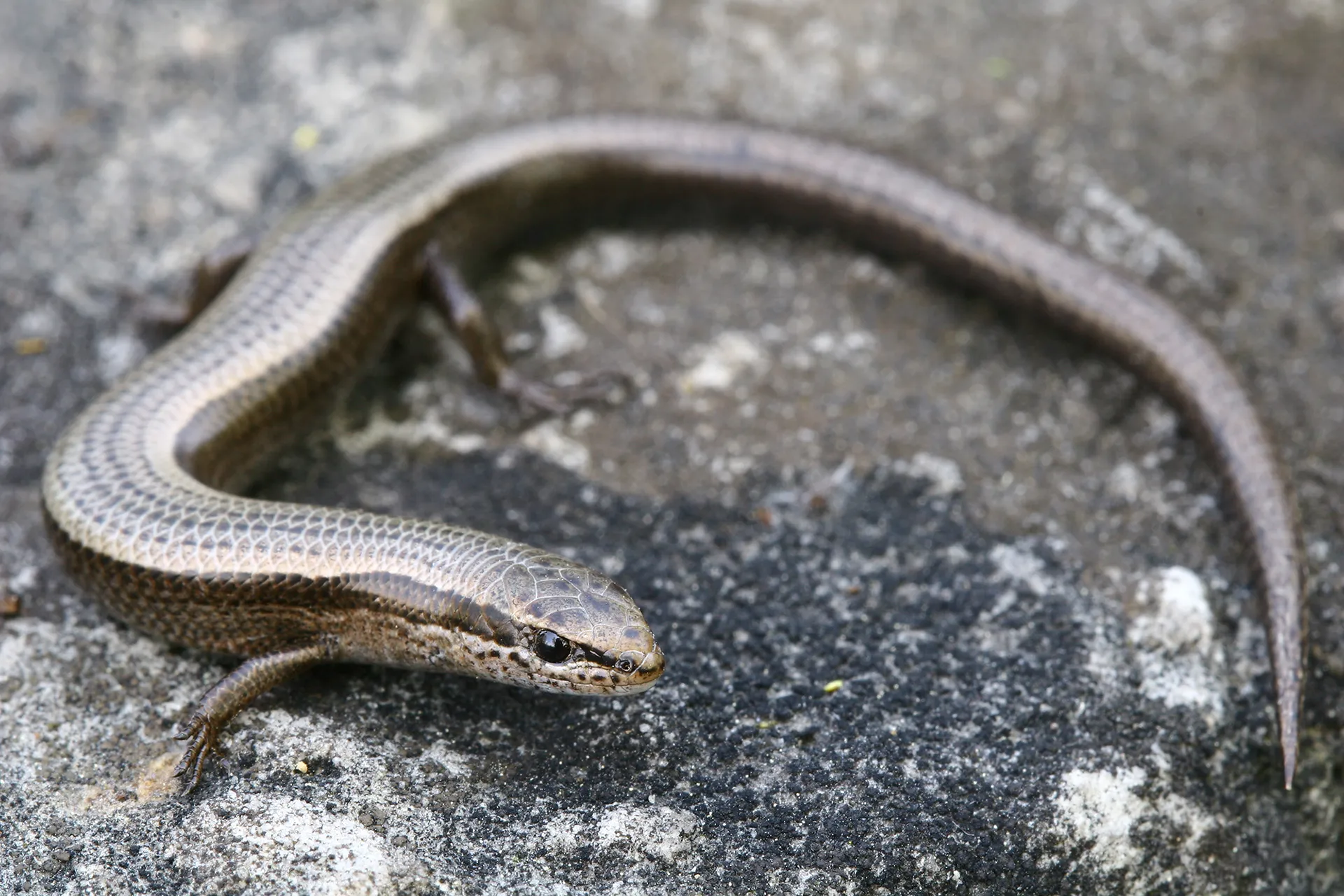
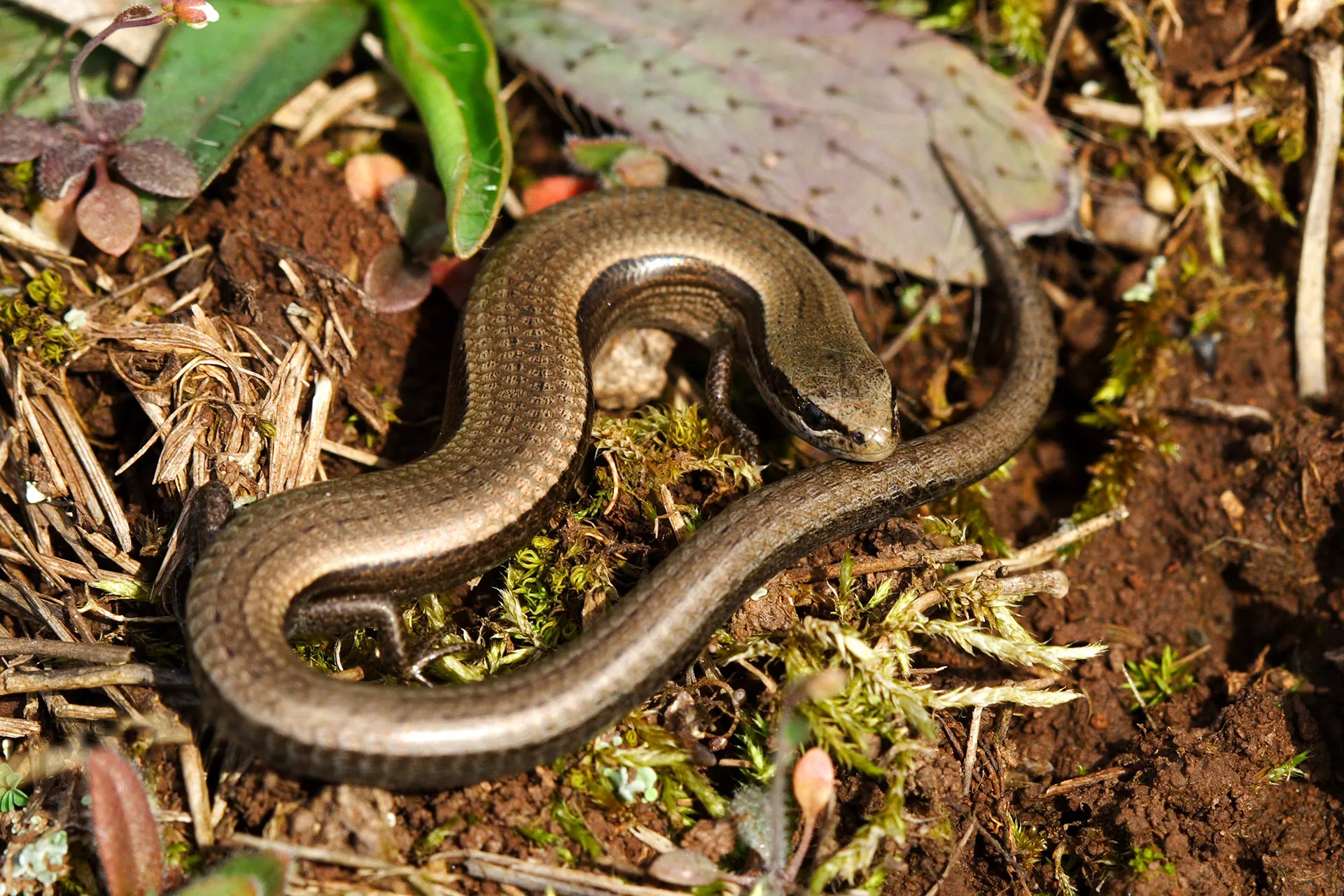
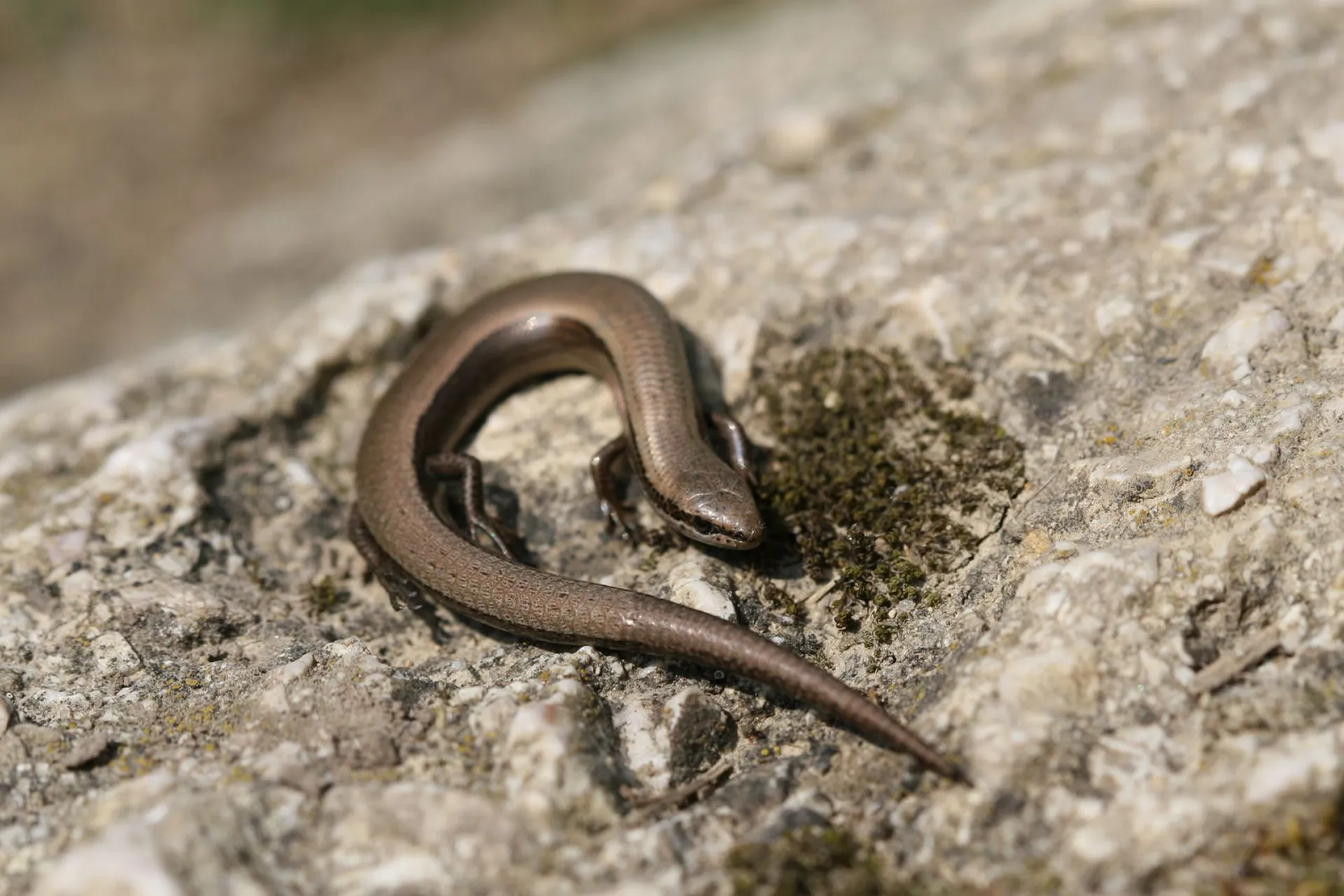
The Snake-eyed Skink is a slender, cylindrical lizard with a small, pointed head, no visible neck and very short legs. Its body is covered in smooth, glossy, overlapping scales arranged in neat rows, which give it a polished bronze or coppery shine. A darker band usually runs along each side of the body.
The feature that gives the species its name is the eye. The eyelids have grown together into a transparent cap, so the skink cannot close its eyes. The ear opening, by contrast, is visible. The tail is longer than the head and body together; it is thick at the base and narrows to a fine tip.
Females are generally larger than males, with a longer body and a shorter tail, while males have longer legs. At up to about 13 cm in total length, most of it tail, this is a very small reptile. In leaf litter it can easily be mistaken for a juvenile slow-worm or a small snake until the tiny legs are seen.
The Romanian population belongs to the subspecies Ablepharus kitaibelii stepaneki. Older Romanian works, including the classic 1961 reptile fauna by Fuhn and Vancea, referred to it as Ablepharus kitaibelii fitzingeri, and the EU Habitats Directive spells the name Ablepharus kitaibelli.
Where it lives in Dobrogea
In Romania the species lives only in the south of the country, up to about 200 m altitude, in sparse oak woodland and on grassland on gentle, south-facing slopes. In Dobrogea it is a species of the continental plateau. The Romanian national monitoring guide published in 2013 lists survey sites for it in the Măcin Mountains, the southern part of Babadag Forest, the Beștepe Hills, the Cheia reserve, Canaraua Fetii and Dumbrăveni Forest.
The Beștepe Hills are the meeting point of the two worlds: a dry ridge with steppe and woodland vegetation on one side and the wetlands of the Danube Delta on the other. The skink is not a species of the Danube Delta’s reedbeds, levees or sand dunes, so it should not be expected on boat trips through the channels.
A 2011 study comparing skinks from the Măcin and Babadag forests found that the Dobrogea populations were very similar to each other and did not show clear microhabitat preferences, probably because the woodland habitats there are fairly uniform.
A life in the leaf litter
This is a ground-dwelling lizard that hunts in the leaf litter, among grass and bushes and under stones. It moves with a quick, wriggling, almost snake-like motion and disappears into the litter at the slightest disturbance. Its prey consists of small invertebrates, including insects, spiders and small snails.
The skink usually has two peaks of activity, in the first hours after sunrise and the last hours before sunset. In the heat of summer it is often described as crepuscular, active around dusk.
The species lays eggs. In a population studied in Serbia, mating took place in April and May, eggs were laid from June to mid-August and hatchlings appeared from August into September, with a single clutch of 2 to 4 eggs per season. For Romania, Fuhn and Vancea reported clutches of 4 to 5 eggs.
Conservation and responsible observation
At European level the Snake-eyed Skink is not considered threatened. It was assessed as Least Concern in Europe and the EU27 in the first European Red List of reptiles, published in 2009, and it does not appear among the threatened species in the 2025 revision. The species is listed in Annex IV of the EU Habitats Directive, which requires strict protection, and in Romanian law it is protected under Annex 4A of Government Emergency Ordinance 57/2007.
In Romania, however, its range is small and fragmented, and the Romanian Red Data Book of Vertebrates (2005) lists it as Endangered. A 2024 Romanian study recommends stopping deforestation and the expansion of farmland and buildings, controlling intensive grazing and replacing Black Locust and pine plantations with oak to protect local populations.
Do not turn over stones or rake through leaf litter to look for skinks. The microhabitat is the animal’s shelter, and it is protected by law. The best chance of a sighting is to walk slowly along a sunny woodland edge on a mild spring morning and watch the ground. The calendar above shows seasonal activity, not how many skinks are present.
Looking for it on a photo tour
On our multi-day photo tours in the Danube Delta and Dobrogea, the dry hills and woodland edges of northern Dobrogea add a different set of subjects to the birds of the wetlands. A Snake-eyed Skink is always a lucky find. It takes patience, a low angle and a quiet approach, and the result is one of the most unusual small reptiles in Europe.
See it with us
Slow open boats, small groups and a guide who knows the places and the wildlife. From a few hours on the water to a week in the Danube Delta and Dobrogea.
Keep reading
Keep reading
More from the blog
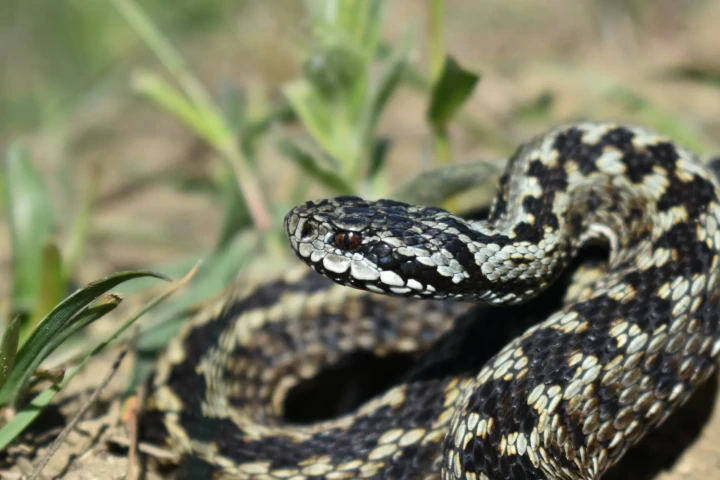
5 min read
Meadow Viper (Vipera ursinii) in the Danube Delta
Meet the Meadow Viper, a small, threatened viper that survives on a few sandy levees of the Danube Delta: identification, where it lives, names,...
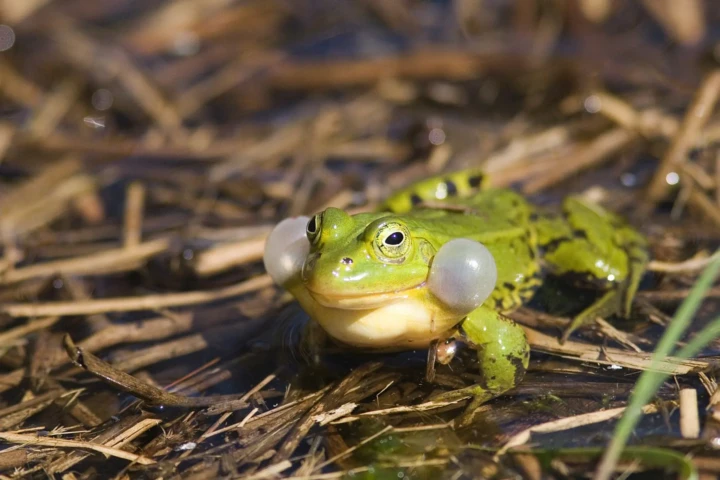
5 min read
Pool Frog (Pelophylax lessonae)
Meet the Pool Frog, the smallest and scarcest green frog of the Danube Delta: how to recognize it, where it lives and why it...
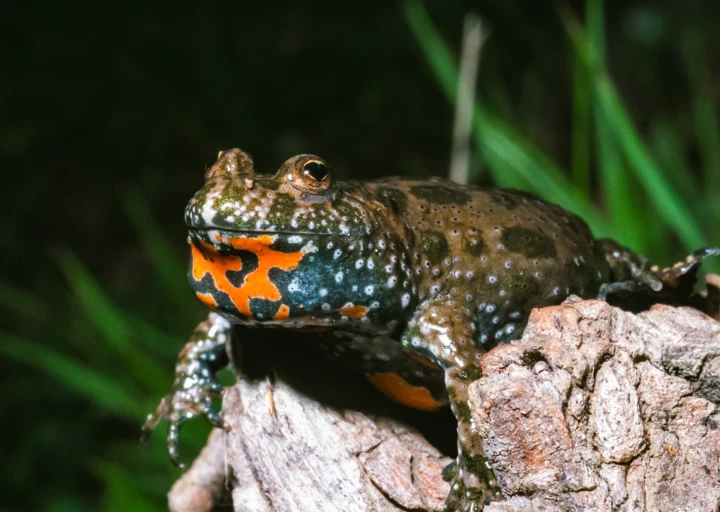
5 min read
European Fire-bellied Toad (Bombina bombina)
A small, dark toad with a fire-coloured belly, hidden in the still waters of the Danube Delta. Discover its warning colours, its soft unk...