

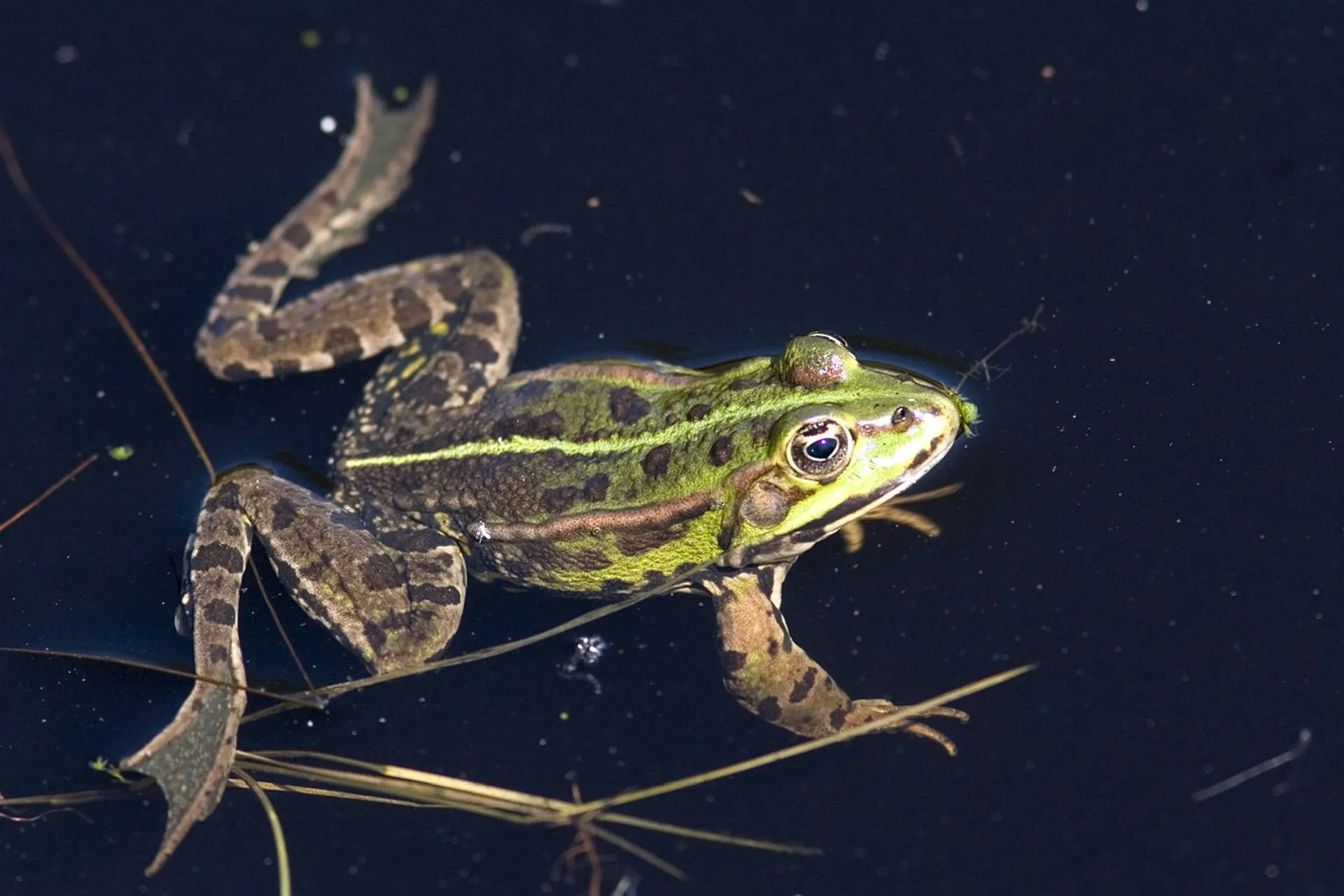
No. 11 on our checklistEdible Frog (Pelophylax kl. esculentus)
Meet the Edible Frog, a hybrid of the Marsh Frog and the Pool Frog that lives in the lakes of the Danube Delta and reproduces in a remarkable way.
The Edible Frog (Pelophylax kl. esculentus) is not a species in the usual sense. It is a hybrid between the Marsh Frog and the Pool Frog, and it survives by borrowing a parent species for reproduction, generation after generation.
In the lakes and channels of the Danube Delta, it lives alongside Marsh Frogs, and the two are not easy to tell apart.
Quick facts
Quick facts
- Scientific name Pelophylax kl. esculentus (Linnaeus, 1758)
- Common name Edible Frog
- Family Ranidae (true frogs)
- Order Anura (frogs and toads)
- Length relatively large; adults up to about 12 cm
- Diet invertebrates
- Habitat lakes and ponds, using the habitats of both parent species; usually avoids flowing water
- Activity in and near water during the warm season; hibernates in winter
- Breeding in the warm season, together with a parent species
- Conservation status not assessed separately on the European Red List published in 2025, as a hybrid form; Least Concern in the EU assessment cited by the Romanian monitoring guide; Habitats Directive Annex V
When to see it in the Danube Delta and Dobrogea
- JanWinter rest
- FebWinter rest
- MarWinter rest
- AprWeather-led
- MaySurvey window
- JunSurvey window
- JulSurvey window
- AugSurvey window
- SepSurvey window
- OctWeather-led
- NovWinter rest
- DecWinter rest
- Status here
- May–September is the Romanian monitoring guide’s survey window, not an exhaustive activity limit. No abundance estimate.
- IUCN Red List
- Not assessed separately in the European Red List published 2025 (hybrid form); Least Concern in 2009
- Our checklist
- No. 11 of 30 · see the full checklist
Description and identification
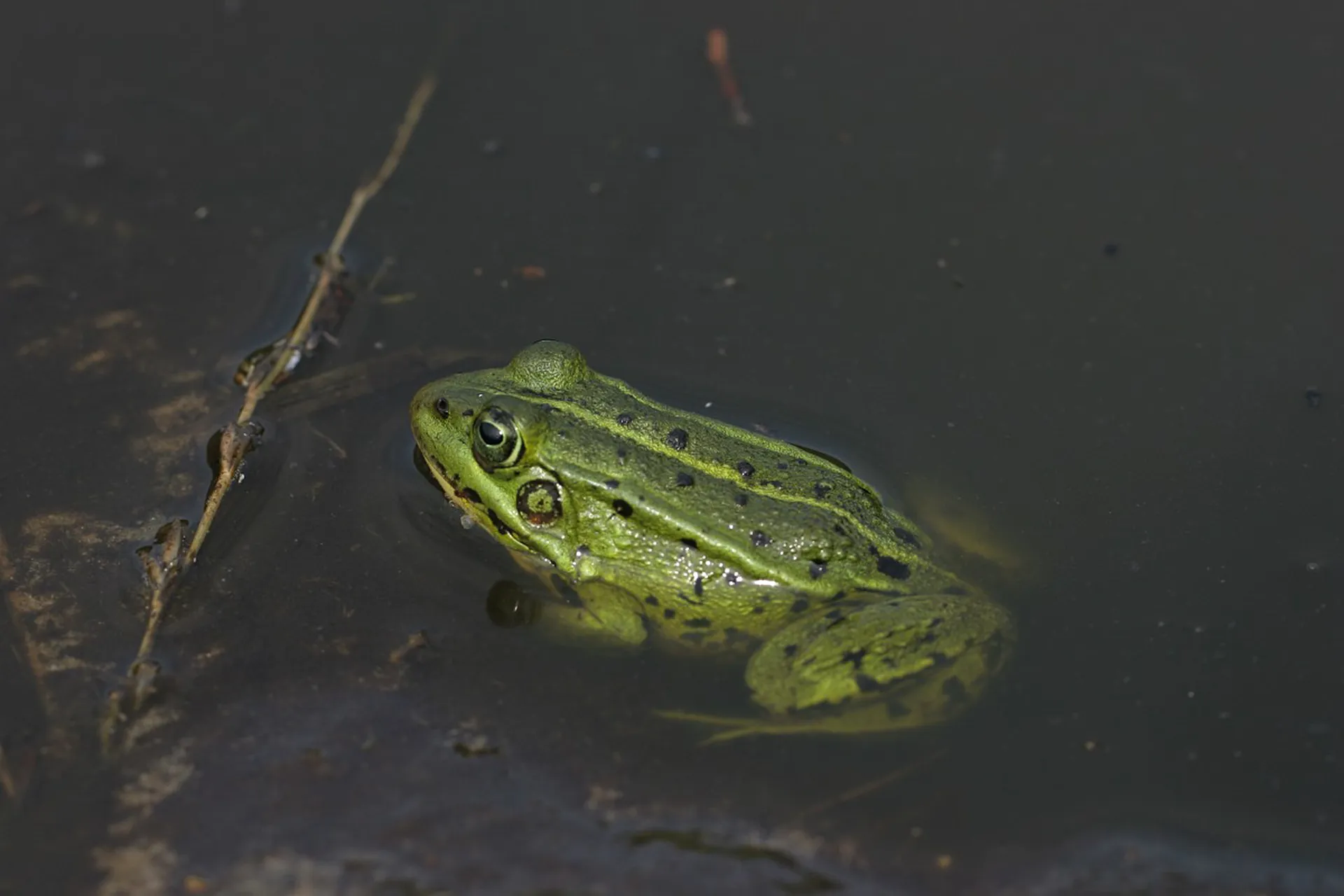
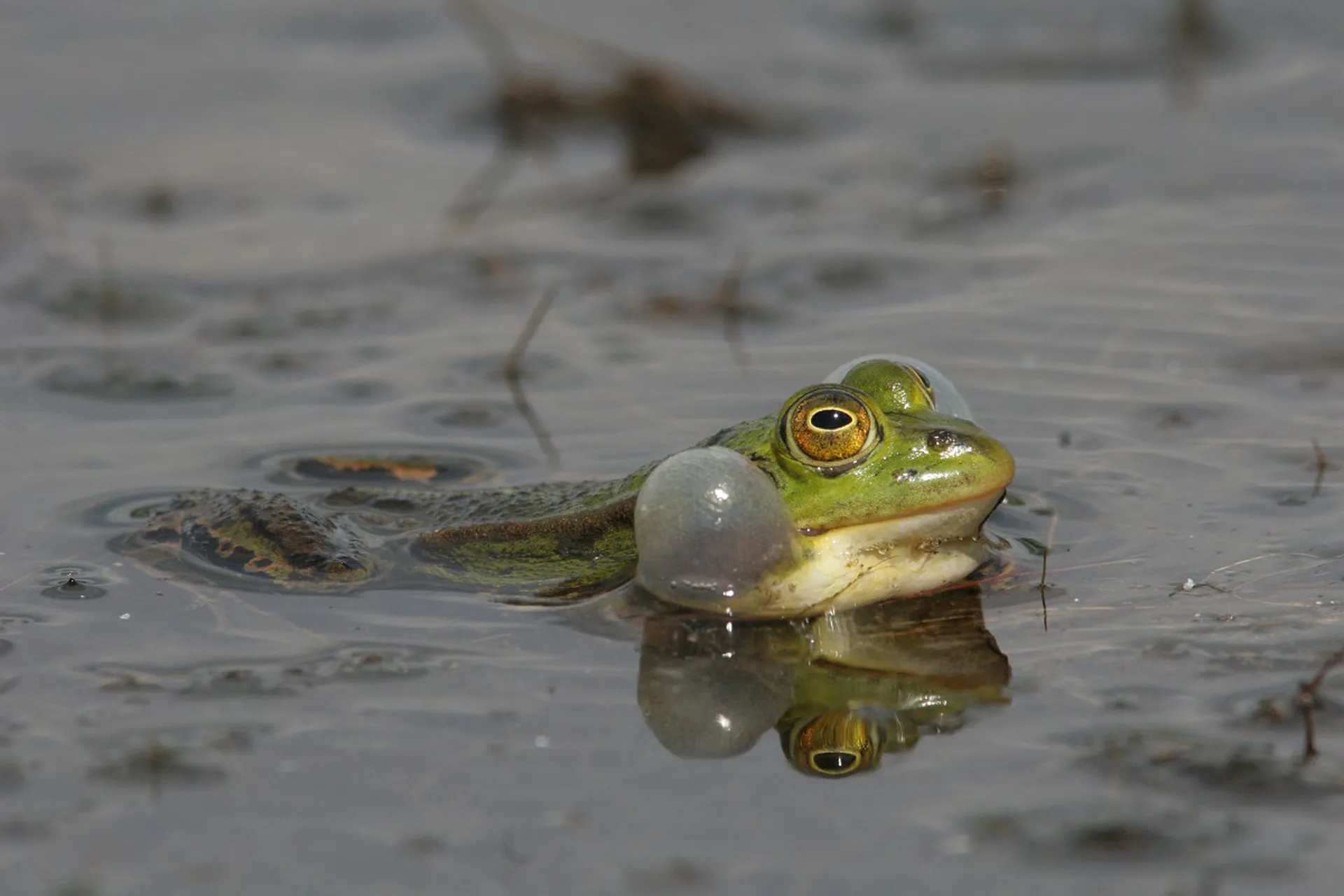
The Romanian monitoring guide describes the Edible Frog as a relatively large amphibian, with adults reaching up to 12 cm. The back is usually green, sometimes with brown spots, and generally has a paler stripe along the spine. The belly is whitish and evenly colored, without obvious spots. The thighs are marbled with white, and the males’ vocal sacs are gray.
The guide also gives the key detail on the foot: the inner metatarsal tubercle is prominent, compressed from the sides and almost crescent-shaped in profile. It is larger than in the Marsh Frog but smaller and less symmetrical than in the Pool Frog.
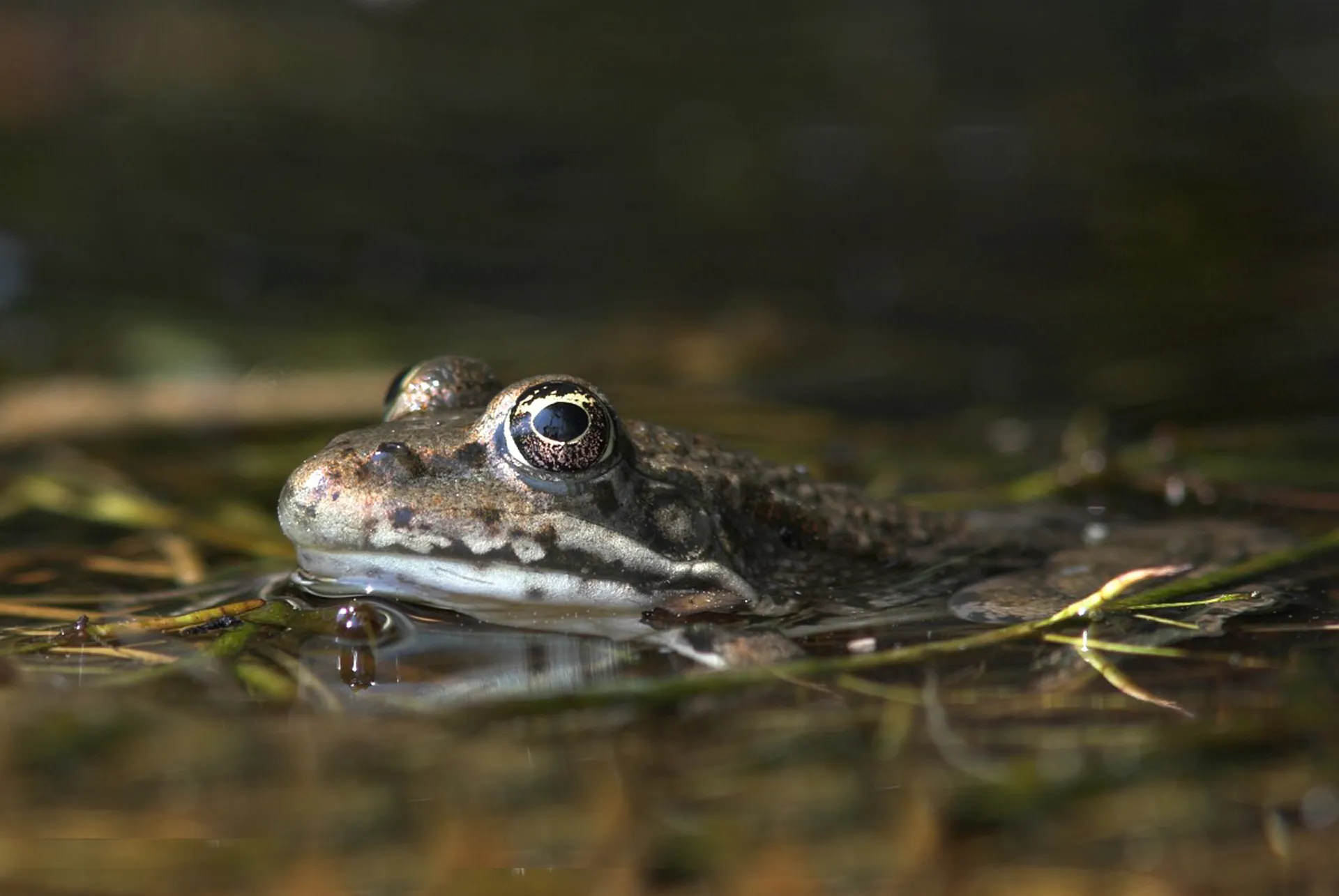
Because the Edible Frog is a hybrid, many of its features lie between those of its parents. Size, color and voice overlap with both, and specialists may need to examine a frog in the hand, or use genetic methods, to be sure. For visitors, a green frog in the Danube Delta is usually best recorded simply as a water frog.
Older publications use Rana esculenta. The name esculentus means edible, a reference to the frog legs eaten in parts of Europe.
How a hybrid keeps going
Normally, a hybrid passes on a mix of both parents’ genes. The Edible Frog does something different. During egg and sperm formation, it discards the genome of one parent and passes on the other unchanged. This reproductive system is called hybridogenesis, and the hybrid is described as a klepton, abbreviated “kl.” in its scientific name.
To produce the next generation of hybrids, an Edible Frog must mate with the parent species whose genome it has discarded. For this reason, it usually lives in mixed populations with the Marsh Frog or with the Pool Frog. A 2008 Romanian review summarizes the possible crosses: matings between two Edible Frogs, for example, can produce Marsh Frogs.
The same review notes that a male Marsh Frog and a female Pool Frog rarely pair in nature, because male water frogs prefer larger females and Marsh Frog males are almost always bigger than Pool Frog females.
Lakes of the Danube Delta
The Romanian monitoring guide reports the Edible Frog from all regions of Romania. It uses lakes and ponds and usually avoids flowing water. Its monitoring sites in the Danube Delta include the Caraorman and Crișan area, and the area of Canalul Tătaru, Grindul Sărăturile and Sfântu Gheorghe.
The guide adds a practical detail: in large lakes such as those of the Danube Delta, Edible and Marsh Frog populations are generally monitored from a boat rather than from the shore. Dense reed and floating vegetation make the banks hard to survey.
A 2009 record list for Dobrogea treated the Edible and Marsh Frogs together, because they are difficult to separate reliably by appearance. The authors described this pair as very common in Dobrogea, occupying almost all water bodies, and especially abundant in the Danube Delta. This describes both frogs together, not the Edible Frog alone.
Breeding season
Breeding takes place in the warm part of the year, when green frogs gather and call from the water. The guide’s monitoring schedule follows the season: adults and young from May to September, late-stage tadpoles in July and August, and recently metamorphosed young frogs in September.
The guide’s field sheets ask surveyors to count both frogs and egg masses, a reminder that each pond is used by both adults and the next generation.
Conservation and responsible observation
The Edible Frog was assessed as Least Concern on the European Red List in 2009. The 2025 update did not assess it separately, because it is a fixed hybridogenetic form between the Pool Frog and the Marsh Frog rather than a separate species. The Romanian monitoring guide gives its EU status as Least Concern.
It is listed in Annex V of the EU Habitats Directive and in Annex 5A of Romanian Government Emergency Ordinance 57/2007. Annex V covers species whose taking from the wild may be subject to management measures.
Do not catch frogs to identify them, and do not move frogs or tadpoles between waters. The calendar above shows seasonal activity, not how many frogs are present.
On a birdwatching boat trip
Our multi-day birdwatching tours spend long hours on the lakes and channels of the Danube Delta. While we look for birds, we also watch for other wildlife, including the green frogs basking on floating vegetation. From the boat, most will stay simply “water frogs”, and that is an honest identification for a group that challenges even specialists.
See it with us
Slow open boats, small groups and a guide who knows the places and the wildlife. From a few hours on the water to a week in the Danube Delta and Dobrogea.
Keep reading
Keep reading
More from the blog
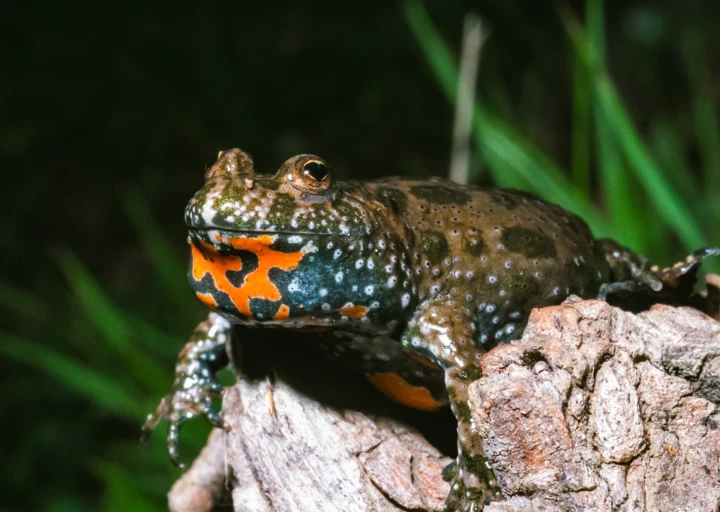
5 min read
European Fire-bellied Toad (Bombina bombina)
A small, dark toad with a fire-coloured belly, hidden in the still waters of the Danube Delta. Discover its warning colours, its soft unk...
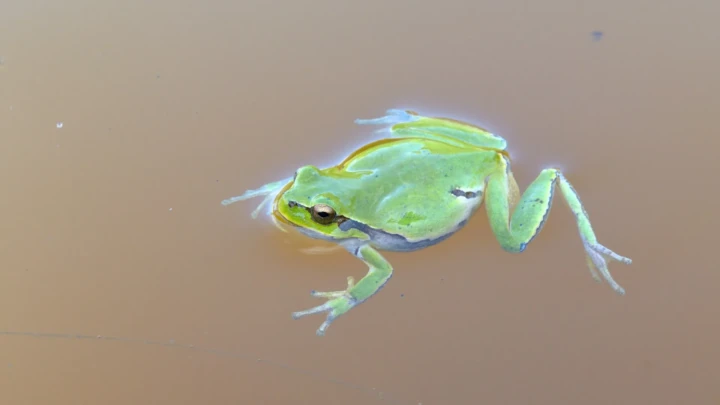
5 min read
Eastern Tree Frog (Hyla orientalis)
The Eastern Tree Frog is a small amphibian with a surprisingly powerful voice. Discover its remarkable climbing abilities, changing colours, spring breeding calls and...
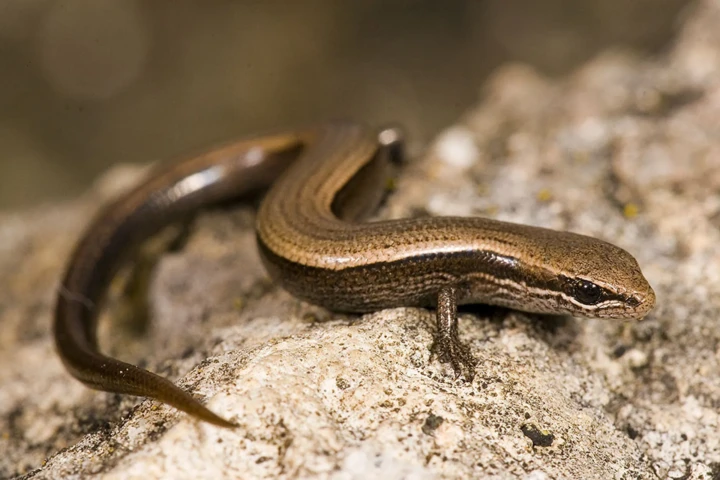
5 min read
European Snake-eyed Skink (Ablepharus kitaibelii)
Meet the European Snake-eyed Skink, the only skink in Romania: a tiny lizard that cannot blink, found in the oak woodland and dry slopes...